Archive for Hawking Radiation

Black Holes, Hawking Radiation (and AI…)

Posted in Artificial Intelligence, The Universe and Stuff with tags , , , , , on December 7, 2025 by telescoper

It seems to be a common misapprehension that the energy released by the supermassive black holes in, for example, active galactic nuclei is in the form of Hawking radiation. It isn’t. Hawking radiation is only significant for black holes of very low mass. The radiation produced around supermassive black holes is due to the extremely high density and temperate of matter falling into the black hole through an accretion disk not due to the evaporation of the black hole itself. Hawking radiation has never been experimentally detected.

Hawking showed that the a black hole will produce black-body radiation with a temperature, the Hawking Temperature, given by TH in a beautiful formula below that brings together constants relating to gravity, statistical mechanics, quantum theory and relativity:
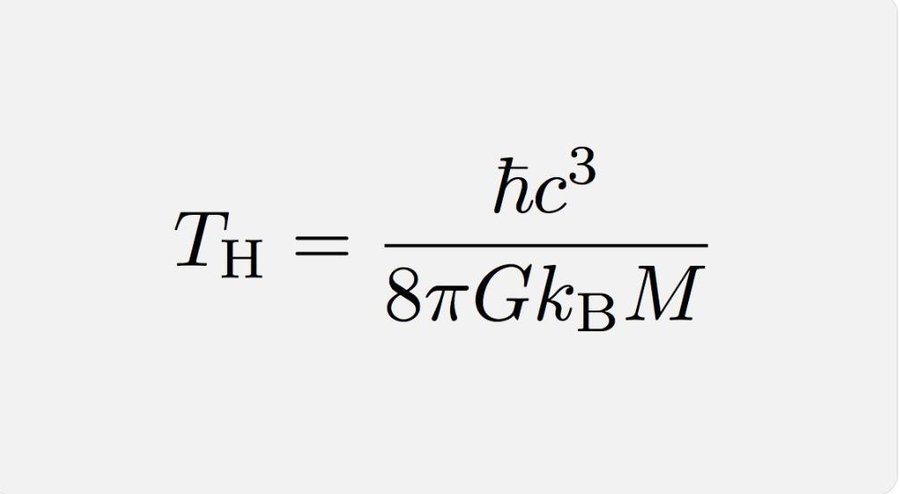
You can see that the Hawking Temperature is inversely proportional to the mass of the black hole M so is largest for very small black holes. In fact for a black hole with mass of order that of the Moon, the Hawking Temperature is just 3 Kelvin. Since the Universe is bathed in cosmic radiation with this temperature, such a black hole would not evaporate at all because it would absorb as much radiation as it emits by the Hawking mechanism as would any black hole of mass greater than this. The Hawking temperature for a supermassive black hole is many orders of magnitude lower than this, so Hawking radiation is completely irrelevant.

Notice that if a black hole does start to evaporate then its mass begins to decrease. Its Hawking temperature therefore increases so its mass decreases even more quickly. In the end the mass gets so low and the temperature so high that the black hole effectively explodes. Nobody really knows how to describe the final stage as it relies on physics we don’t understand.

Anyway, this all reminds that years ago I set an examination question that involved applying the Hawking formula above to calculate the lifetime of a black hole of mass M. It’s not too hard to show that it scales as M-3. Another part of the question asked: what is the mass of a black hole whose Hawking Temperature is room temperature (say 300 K), what would be the Schwarzschild radius of such a black hole, and what would be its lifetime?

I’ll leave it to my readers to plug the numbers into the Hawking formula above to derive the mass, etc. Please submit your answers through the comments box below. The first correct entry does not win a prize, not even a joke Peace Prize.

For a laugh I asked Google for the answer. Here is the AI summary:
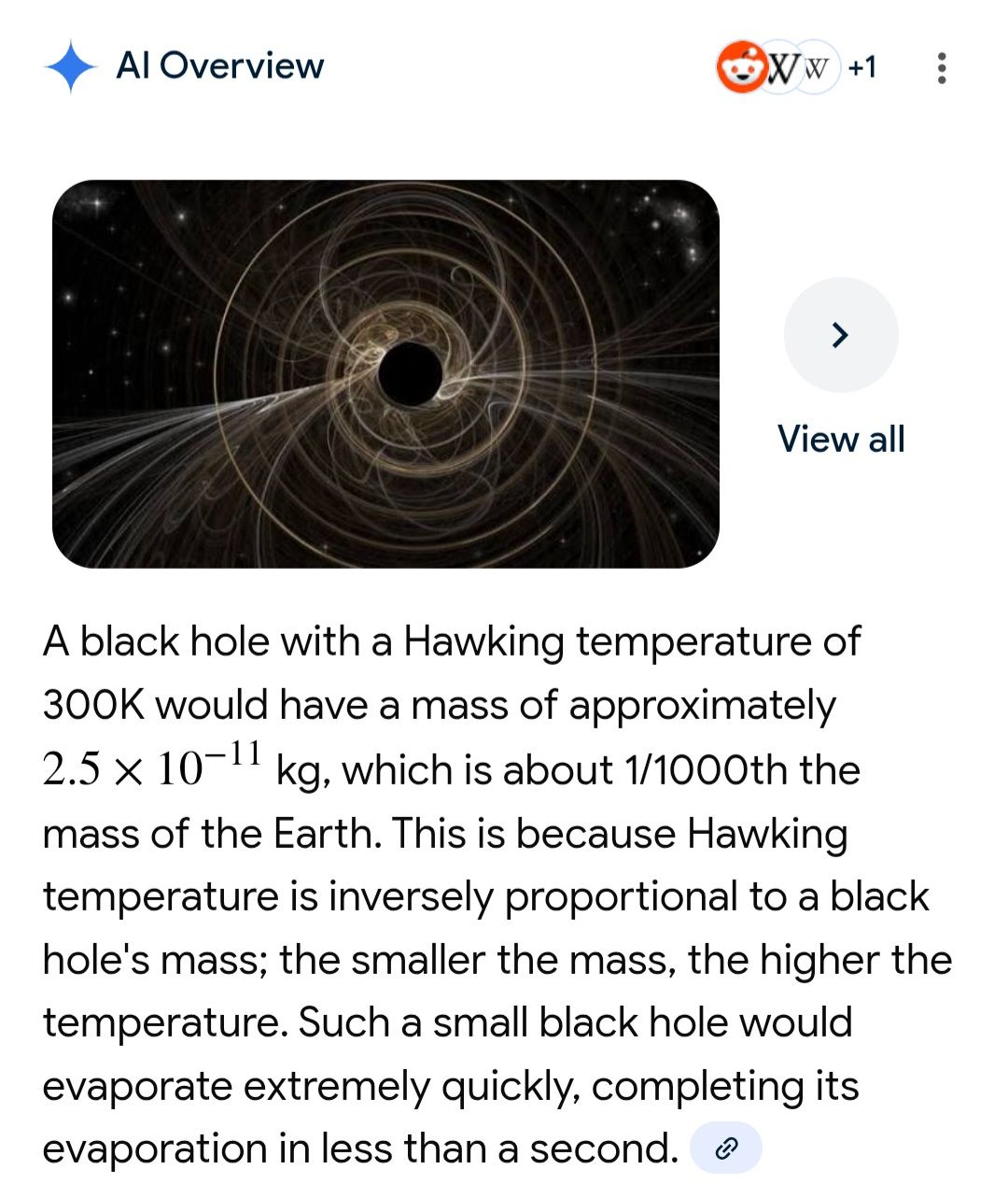
Bonus marks for pointing out everything that’s wrong in this summary.

Weekly Update at the Open Journal of Astrophysics – 22/03/2025

Posted in OJAp Papers, Open Access, The Universe and Stuff with tags , , , , , , , , , , , , on March 22, 2025 by telescoper

It’s Satuday morning once again, and time for another update of papers published at the Open Journal of Astrophysics. Since the last update we have published two papers, which brings the number in Volume 8 (2025) up to 29 and the total so far published by OJAp up to 264.

The papers we have published this week are connected by the theme of black holes and their role in galaxy formation, which is a very hot topic nowadays!

The first paper to report is “Hawking Radiation from non-evaporating primordial black holes cannot enable the formation of direct collapse black holes” by Jonathan Regan, Marios Kalomenopoulos and Kelly Kosmo O’Neil of the University of Nevada, USA. This paper, which is based on an undergraduate thesis, is a study of the irradiating effects of primordial black holes and a discussion of whether these might influence the subsequent formation of supermassive black holes. It is in the section marked Astrophysics of Galaxies, and was published on Tuesday  18th March.

The overlay is here:

and you can find the final accepted version on arXiv here.

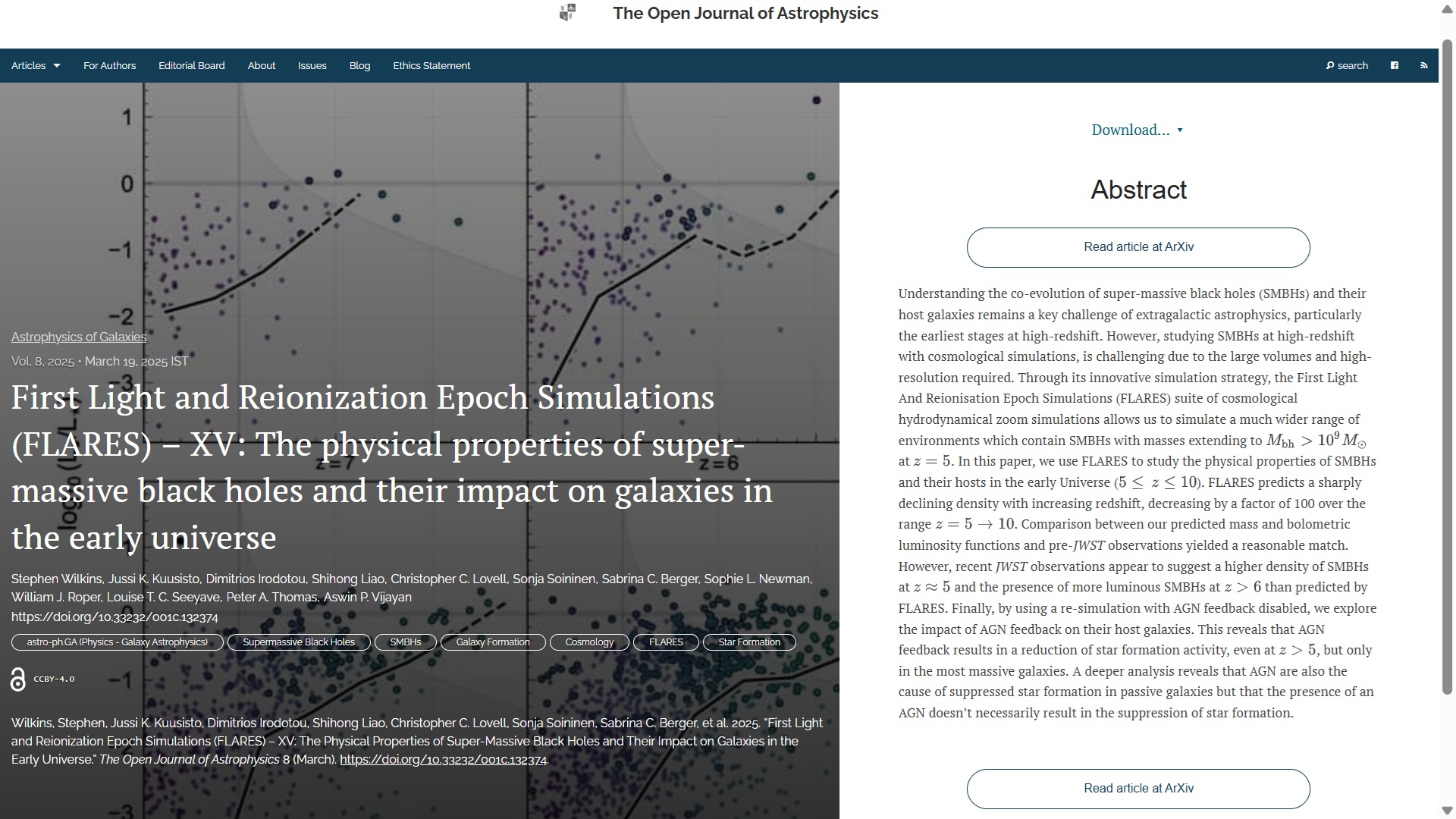
The second paper, which was published on Wednesday 19th March and is also in the folder Astrophysics of Galaxies, is “First Light and Reionization Epoch Simulations (FLARES) – XV: The physical properties of super-massive black holes and their impact on galaxies in the early universe” by Stephen Wilkins & Jussi K. Kuusisto (U. Sussex, UK), Dimitrios Irodotou (Institute of Cancer Research, UK), Shihong Liao (Beijing, China) Christopher C. Lovell (Portsmouth, UK), Sonja Soininen (Insitute of Cancer Research), Sabrina C. Berger (Melbourne, Australia), Sophie L. Newman (Portsmouth, UK), William J. Roper (Sussex), Louise T. C. Seeyave (Sussex), Peter A. Thomas (Sussex) and Aswin P. Vijayan Sussex). This paper uses cosmological hydrodynamical zoom simulations to study the formation of supermassive black holes and their impact on star formation in the early Universe.

Here is the overlay, which you can click on to make larger if you wish:


You can read the officially accepted version of this paper on arXiv here.

That’s all for this week. It’s been a bit frustrating for me as Managing Ediutor, because we have built up a backlog of several papers that were accepted for publication some time ago, but are still waiting for the authors to place the final version on arXiv. I hope these won’t take too long to appear, not least because I would like to clear my workflow on the Scholastica platform!

Black Hole Firewalls, etc.

Posted in Biographical, The Universe and Stuff with tags , , on September 2, 2013 by telescoper

Well, just back to the office after taking a restful weekend in Cardiff to recover from the trials and tribulations of the meeting of the Astronomy Grants Panel of the Science and Technology Facilities Council in Swindon last week. I’ve got a lot to catch up on, so I’ll just post this video which explains all about the issue of Black Hole Paywalls Fire Sales Firewalls about which there’s a not inconsiderable to-do and hoo-ha going on in the world of Physics. Pity they couldn’t put a firewall around Swindon, that’s all I can say…