Archive for IAU

Open Access Updates & Announcements

Posted in Open Access with tags , , , on August 3, 2024 by telescoper

When I wrote last week’s update on papers published at the Open Journal of Astrophysics, I was a little surprised that our publishing activity had not tailed off because of the summer vacations. Well, it has now because we haven’t publish any papers this week! Rather than not post an update at all, however, I thought I’d point out a few interesting things that have happened in the world of open access.

First. I draw your attention to an article in C&EN (Chemical & Engineering News) reflecting on the fact that the Gates Foundation (one of the largest research charities in the world) announced in March 2024 that, starting from Jan. 1, 2025, it would no longer cover publishing costs. I actually wrote about this decision here. The article is largely about the threat this poses to the Gold Open Access model, which in my opinion thoroughly deserves to be threatened. It does, however, talk briefly about Diamond Open Access which commercial publishers don’t like as it removes – or should do – their source of profits:

Another alternative model is diamond OA, in which all research papers and their associated peer-reviewed reports are published without fees for the author or the reader and are also freely available to read and reuse. 

It goes on to say:

Under diamond OA, publishers are no longer gatekeepers of research. Instead, they become service providers that handle manuscript submissions, typesetting, and copyediting. This is in contrast to the current publishing system, in which the publisher controls everything from the copyright to the production process.

I don’t really agree with even the limited role of “service providers” mentioned here, as much of what that role entails just involves a decent reviewing platform. Elsewhere the article says that moving to Diamond OA would entail a significant cost. That may be but, as I’ve said over and over again, the actual cost of online publishing is low compared to the level of profit extracted by commercial publishers. The cost to academia of moving to Diamond OA would be much less than not moving to Diamond OA.

The second item I’d like to draw your attention is called Choosing a publisher? It’s not all about the impact factor and is by Antigoni Messaritaki, a senior publisher at IOP Publishing,  When I saw the title I thought that it might be about the uselessness of Journal Impact Factors and a commitment by IOP Publishing to stop using them. Sadly it’s nothing of the sort. It tries to entice authors to look beyond journal impact factors when choosing a publisher, pushing Open Access as an important factor to consider. It admits that APCs are expensive, but never even mentions Diamond OA. It’s an entirely self-serving piece. I find the IOP’s stance on publishing, and the disingenuous way they try to excuse their own profiteering, unethical and unacceptable. That’s why I resigned my fellowship of the IOP.

Last, and by all means least, I should draw your attention that the 32nd General Assembly of the International Astronomical Union takes place next week in Cape Town. I’m not attending in person – I’ve done enough travelling this year! – but I have accepted an invitation to give a remote talk at a side event called Open Access Encounters on Wednesday 7th August:

Changes to the IAU Code of Conduct on Harassment

Posted in Harassment Bullying etc with tags , , on August 18, 2023 by telescoper

An email was sent on Wednesday from the President of the International Astronomical Union (IAU), Debra Elmegreen, to all members of that organization (which includes me). Part of that email has caused a considerable negative reaction among astronomers on social media, so I’m taking the liberty of posting the offending section here and commenting on it below.

This is what sparked the reaction:

The Executive Committee modified further details in the Code of Conduct. On p. 6 in the Harassment Policy, a link is given to UN definitions of harassment in different countries.

The most substantive change is on p. 7: “It is a form of harassment to physically or verbally abuse or discriminate against alleged offenders of IAU’s policies, or if such policies are found to have been breached, inflict (or pressure others to inflict) punishments besides those officially sanctioned. In addition, the physical or verbal abuse or discrimination of those who work or have worked with the alleged or sanctioned perpetrator, simply because of their scientific collaboration, is also a form of harassment and as such is covered by this policy.”

(I’ve added the link to the full code of conduct myself).

The first point to make is that the Code of Conduct here can and does apply only to specific IAU activities and meetings, which strictly limits its scope. It is mostly about behaviour during meetings, in fact. I also think much of the reaction to this change has resulted from reading that paragraph in isolation. It does make more sense when read in the context of the whole document. In particular, the paragraph alone says little about other victims of harassment but that is covered in the rest of the document, which runs to 13 pages.

Now to the amended text.

I think everyone agrees that physical or verbal abuse should never be condoned, but (a) that is covered by the Code of Conduct generally so there is no need to repeat it here, and (b) the addition of the word “discriminate” here is troublesome because it is so vague. The first sentence treats those against whom allegations have been made and those against allegations have been upheld in exactly the same way. I think that is fine for the “physically or verbally abuse” part, but extending it to “discriminate” is deeply problematic, depending on how one interprets the word. Is it now harassment for the organizers of a meeting to fail to invite to a meeting someone who has a track-record of sexual harassment? Or for a victim of harassment to refuse to work with a known harasser? Is it not up to individuals to decide with whom they want to work? Should anyone be immune from criticism of their choices?

One could take the view that anyone against whom serious allegations have been upheld should not be welcome at IAU meetings, and probably no longer be a member of the organization, so this situation should not arise within the scope of the Code of Conduct:

The IAU Executive Committee may decide on further disciplinary action for repeat or serious
offenders, such as being banned from participating in future IAU meetings or other IAU related
activities for a period of time, or even having the offender’s IAU membership revoked in
serious cases.

IUA Code of Conduct, p 10.

This of course depends on the interpretation of what “serious” means. Aren’t all examples of harassment to be taken seriously?

In any case I’m bound to say that if I were expelled from the IAU, it would have precisely zero effect on my life, career, or anything else.

The next clause is even worse: apparently it is harassment to “inflict (or pressure others to inflict) punishments besides those officially sanctioned.” Suppose then that a victim of harassment tries to take disciplinary action against the perpetrator through a mechanism outside the IAU (i.e. through the harasser’s employer). Is the victim then guilty of harassment? If a victim of harassment informs an early career researcher about their potential PI’s past behaviour, is that “pressure”?

The second sentence must have been introduced to protect those who may have experienced negative reactions as a result of working with a known harasser; an example testimony of such alleged “guilt by association” is given here; though see here for another view of the same event. Bearing in mind that early career researchers often have no choice with whom they work anyway, this change has some sense to it though one can hardly expect a decision to work with someone with a track-record of bad behaviour to pass without comment from people who have been victims of such behaviour.

My overall reaction to this change, giving the benefit of the doubt to its creators, is that it is badly worded and so muddled that it gives the impression of treating a history of harassment as a protected characteristic which cannot be the intention. I’d suggest getting someone with legal competence to rewrite this part of the changed policy. I’d also encourage other IAU members to write directly to the President if they feel strongly about this change.

P.S. On a procedural point, note that the preamble to the amendment quoted above states “The Executive Committee modified further details in the Code of Conduct.” Such a change is not within the scope of the Executive Committee as defined by the IAU Statutes. Statute 18:

The Officers of the Union are the President, the General Secretary, the President-Elect, and the Assistant General Secretary. The Officers decide short-term policy issues within the general policies of the Union as decided by the General Assembly and interpreted by the Executive Committee.

IAU Statute 18

So it is the job of the Executive Committee to interpret policies, not to create them. I think we need to know who changed what and for what purpose.

Update: An email in response to the criticism has been sent out by IAU President, Debra Elmegreen. It’s not very satisfactory, but at least it includes: “We… will consider suggestions for improved wording to the Code of Conduct to clarify possible misunderstandings”.

Another Update: Physics World has run a story on this (which links to this post).

The 2019 Gruber Prize for Cosmology: Nick Kaiser and Joe Silk

Posted in The Universe and Stuff with tags , , , , , , , on May 9, 2019 by telescoper

I’ve just heard that the Gruber Foundation has announced the winners of this year’s Gruber Prize for cosmology, namely Nick Kaiser and Joe Silk. Worthy winners the both of them! Congratulations!

Here’s some text taken from the press release:

The recipients of the 2019 prize are Nicholas Kaiser and Joseph Silk, both of whom have made seminal contributions to the theory of cosmological structure formation and to the creation of new probes of dark matter. Though they have worked mostly independently of each other, the two theorists’ results are complementary in these major areas, and have transformed modern cosmology — not once but twice.

The two recipients will share the $500,000 award, and each will be presented with a gold medal at a ceremony that will take place on 28 June at the CosmoGold conference at the Institut d’Astrophysique de Paris in France.

The physicists’ independent contributions to the theory of cosmological structure formation have been instrumental in building a more complete picture of how the early Universe evolved into the Universe as astronomers observe it today. In 1967 and 1968, Silk predicted that density fluctuations below a critical size in the Cosmic Microwave Background, the remnant radiation “echoing” the Big Bang, would have dissipated. This phenomenon, later verified by increasingly high precision measurements of the CMB, is now called “Silk Damping”.

In the meantime, ongoing observations of the large-scale structure of the Universe, which evolved from the larger CMB fluctuations, were subject to conflicting interpretations. In a series of papers beginning in 1984, Kaiser helped to resolve these debates by providing statistical tools that would allow astronomers to separate “noise” from data, reducing ambiguity in the observations.

Kaiser’s statistical methodology was also influential in dark matter research; the DEFW collaboration (Marc Davis, George Efstathiou, Carlos Frenk, and Simon D. M. White) utilised it to determine the distribution and velocity of dark matter in the Universe, and discovered its non-relativistic nature (moving at a velocity not approaching the speed of light). Furthermore, Kaiser devised an additional statistical methodology to detect dark matter distribution through weak lensing — an effect by which foreground matter distorts the light of background galaxies, providing a measure of the mass of both. Today weak lensing is among cosmology’s most prevalent tools.

Silk has also been impactful in dark matter research, having proposed in 1984 a method of investigating dark matter particles by exploring the possibilities of their self-annihilations into particles that we can identify (photons, positrons and antiprotons). This strategy continues to drive research worldwide.

Both Kaiser and Silk are currently affiliated with institutions in Paris, Kaiser as a professor at the École Normale Supérieure, and Silk as an emeritus professor and a research scientist at the Institut d’Astrophysique de Paris (in addition to a one-quarter appointment at The John Hopkins University). Among their numerous significant contributions to their field, their work on the CMB and dark matter has truly revolutionised our understanding of the Universe.

I haven’t worked directly with either Nick Kaiser or Joe Silk but both had an enormous influence on me, especially early on in my career. When I was doing my PhD, Nick was in Cambridge and Joe was in Berkeley. In fact I think Nick was the first person ever to ask me a question during a conference talk – which terrified the hell out of me because I didn’t know him except by scientific reputation and didn’t realize what a nice guy he is! Anyway his 1984 paper on cluster correlations was the direct motivation for my very first publication (in 1986).

I don’t suppose either will be reading this but heartiest congratulations to both, and if they follow my advice they won’t spend all the money in the same shop!

P.S. Both Nick and Joe are so distinguished that each has appeared in my Astronomy Lookalikes gallery (here and here).

Voting Matters

Posted in Maynooth, Politics, The Universe and Stuff with tags , , , , , on October 4, 2018 by telescoper

At last I have this afternoon free of teaching and other commitments, and having fortified myself with lunch in Pugin Hall, I’m preparing to make an attempt on the summit of the Open Journal of Astrophysics now that all the outstanding administrative obstacles have been cleared. Before shutting myself away to do up the loose ends, however, I thought I’d do a quick post about a couple of electoral matters.

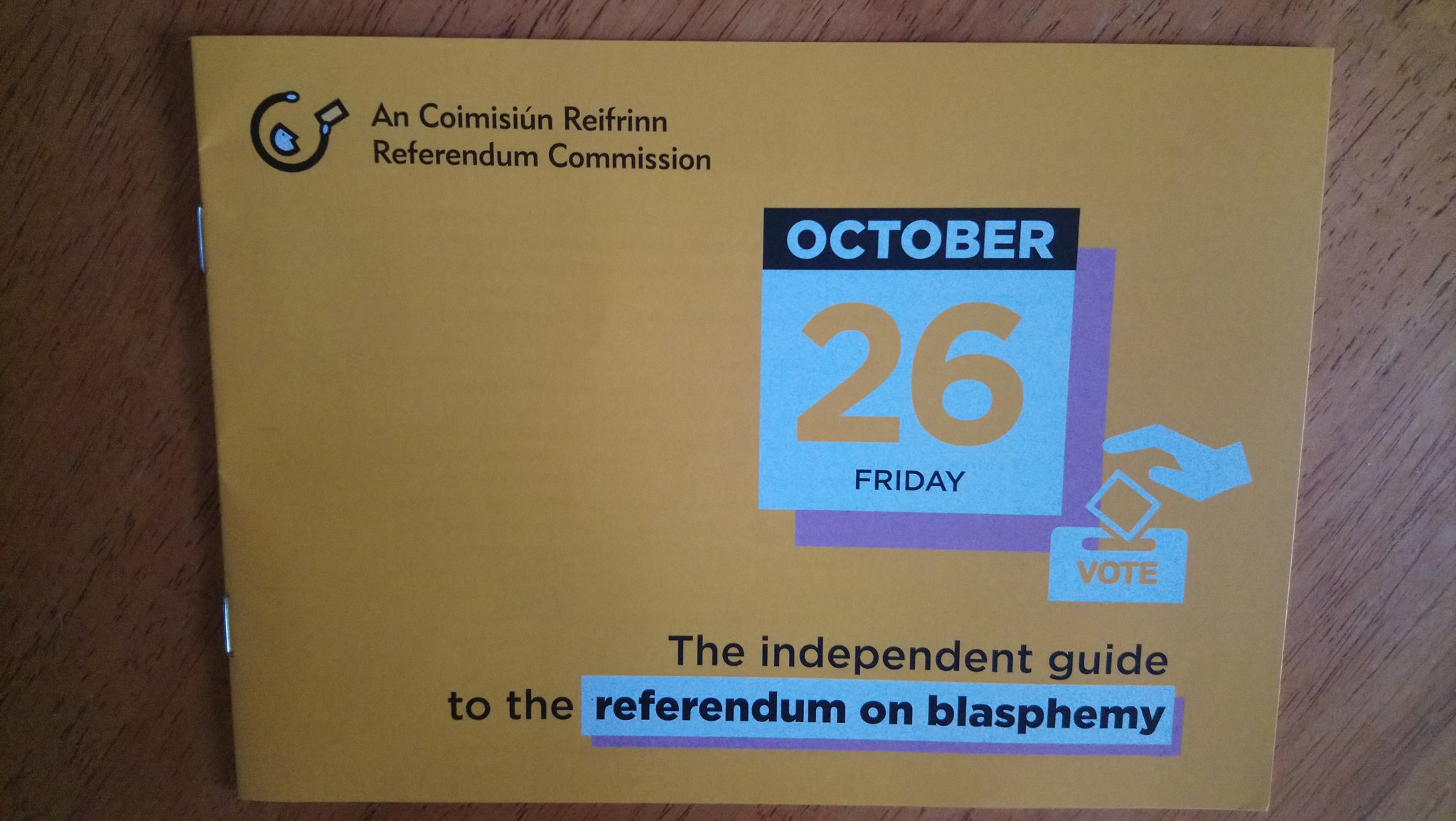
The first relates to this, which arrived at my Maynooth residence the other day:

This document reminded me that there is a referendum in Ireland on the same day as the Presidential election I mentioned at the weekend. The contents of the booklet can be found here. In brief,

At present, the Constitution says that publishing or saying something blasphemous is an offence punishable under law. Blasphemy is currently a criminal offence. The referendum will decide if the Constitution should continue to say that publishing or saying something blasphemous is a criminal offence. If the referendum is passed, the Oireachtas will be able to change the law so that blasphemy is no longer a criminal offence.

Having read the booklet thoroughly and thereby having understood all the issues, and the implications of the vote,  I have decided that I will vote in favour of making blasphemy compulsory.

The other matter being put to a vote is something I just found out about today when I got an email from the International Astronomical Union concerning an electronic vote on Resolution B4, that the Hubble Law be renamed the Hubble-Lemaître law. For background and historical references, see here. I don’t really have strong opinions on this resolution, nor do I see how it could be enforced if it is passed but, for the record, I voted in favour because I’m a fan of Georges Lemaître


Statistical Challenges in 21st Century Cosmology

Posted in The Universe and Stuff with tags , , on December 2, 2013 by telescoper

I received the following email about a forthcoming conference which is probably of interest to a (statistically) significant number of readers of this blog so I thought I’d share it here with an encouragement to attend:

–o–

IAUS306 – Statistical Challenges in 21st Century Cosmology

We are pleased to announce the IAU Symposium 306 on Statistical Challenges in 21st Century Cosmology, which will take place in Lisbon, Portugal from 26-29 May 2014, with a tutorial day on 25 May.  Apologies if you receive this more than once.

Full exploitation of the very large surveys of the Cosmic Microwave Background, Large-Scale Structure, weak gravitational lensing and future 21cm surveys will require use of the best statistical techniques to answer the major cosmological questions of the 21st century, such as the nature of Dark Energy and gravity.

Thus it is timely to emphasise the importance of inference in cosmology, and to promote dialogue between astronomers and statisticians. This has been recognized by the creation of the IAU Working Group in Astrostatistics and Astroinformatics in 2012.

IAU Symposium 306 will be devoted to problems of inference in cosmology, from data processing to methods and model selection, and will have an important element of cross-disciplinary involvement from the statistics communities.

Keynote speakers

• Cosmic Microwave Background :: Graca Rocha (USA / Portugal)

• Weak Gravitational Lensing :: Masahiro Takada (Japan)

• Combining probes :: Anais Rassat (Switzerland)

• Statistics of Fields :: Sabino Matarrese (Italy)

• Large-scale structure :: Licia Verde (Spain)

• Bayesian methods :: David van Dyk (UK)

• 21cm cosmology :: Mario Santos (South Africa / Portugal)

• Massive parameter estimation :: Ben Wandelt (France)

• Overwhelmingly large datasets :: Alex Szalay (USA)

• Errors and nonparametric estimation :: Aurore Delaigle (Australia)

You are invited to submit an abstract for a contributed talk or poster for the meeting, via the meeting website. The deadline for abstract submission is 21st March 2014. Full information on the scientific rationale, programme, proceedings, critical dates, and local arrangements will be on the symposium web site here.

Deadlines

13 January 2014 – Grant requests

21 March 2014 – Abstract submission

4 April 2014 – Notification of abstract acceptance

11 April 2014 – Close of registration

30 June 2014 – Manuscript submission