Archive for Igor Stravinsky

Adams, Rachmaninov & Stravinsky at the National Concert Hall

Posted in Music with tags , , , , , , , , , , on March 14, 2026 by telescoper

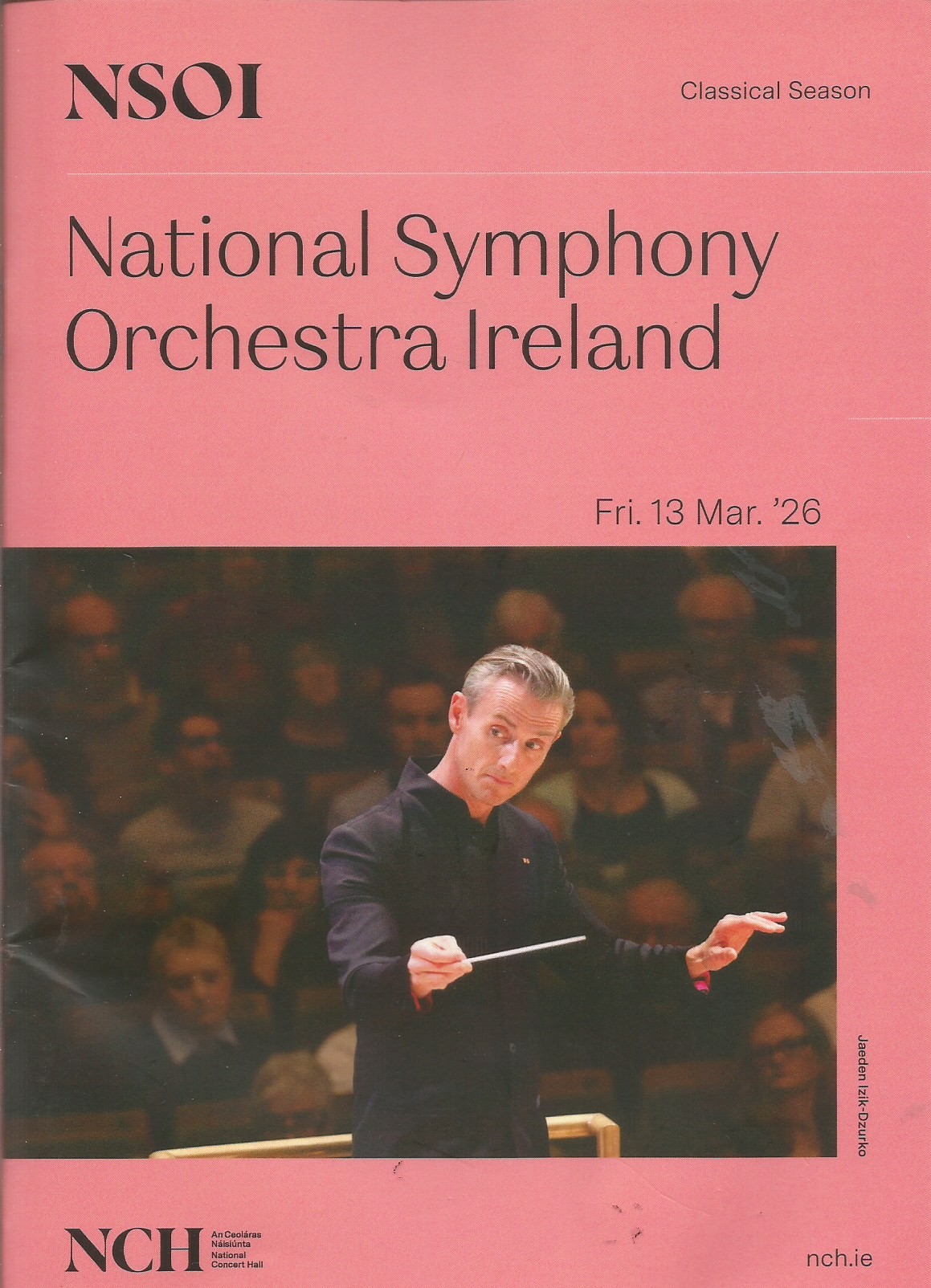
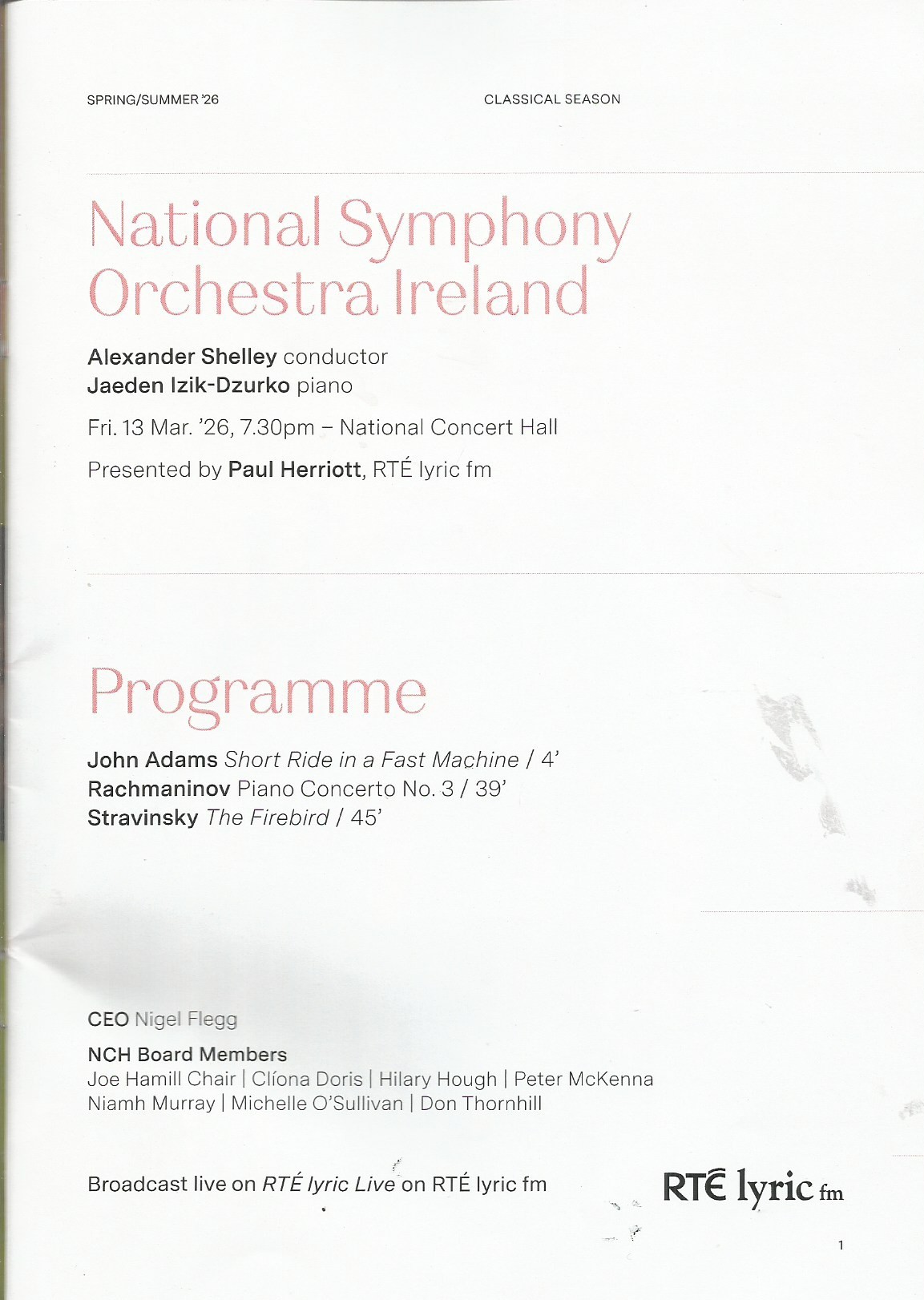
Yesterday evening found me once again at the National Concert Hall in Dublin for a programme of music played by National Symphony Orchestra Ireland, this time conducted by Principal Conductor Designate, Alexander Shelley, who takes over fully for the 2026/7 season. He took the opportunity afforded by the break between the first two numbers needed to bring the piano onstage, to introduce himself to the audience which made a pleasant change from having to watch in silence as all the chairs and desks were moved around.

The programme began with the exuvberant Short Ride in a Fast Machine by American composer John Adams which – believe it or not – was written forty years ago, in 1986. It is an exuberant piece based on interrelated rhythmic figures which is great fun to listen to and an ideal warm-up exercise for the orchestra.

The piano having been hauled into position, it was time to welcome Canadian pianist Jaeden Izik-Dzurko (who has Hungarian and Ukrainian ancestry) for the Piano Concerto No. 3 by Sergei Rachmaninov. When the soloist walked on stage I was struck by how young he looked. He is, in fact, 27 but looks younger. Still, I’ve reached an age when most people look very young. Rachmaninov’s Piano Concerto No. 3 is a monster of a piece – very long for a piano concerto – and also very difficult, with some fierce cadenzas. For all its reputation as a finger-breaker, it does have some lovely melodies in it. Rachmaninov himself realized he had created bit of a beast and cut some of the toughest bits for early performances, but nowadays we tend to hear the whole original score, as we did last night. I thought Jaeden Izik-Dzurko not only coped admirably with its technical demands but also conveyed its lyrical aspects very tenderly. It was a very impressive performance. The audience at the NCH obviously agreed. A standing ovation greeted him at the end, though he looked almost embarrassed by such an effusive reaction.

After the interval wine break we had a concert performance the complete score for Igor Stravinsky’s ballet The Firebird. This is a thrilling piece, involving a huge orchestra, numbering about a hundred musicians, and stunning orchestration.  The Firebird is a tour de force: intricate but vividly coloured, full of excitement and colour and NSOI played it with great passion and aplomb. A really brilliant performance.

There was an electronic sign above the orchestra for The Firebird explaining what would be going on in the ballet as the various sections of the music were played. I found that an unwelcome and slightly annoying distraction, but it didn’t detract significantly from the performance. There was thunderous applause at the end of the concert but, it being quite a long concert, I couldn’t stay for all the ovations as I had to leave to catch the train home.

Stravinsky, Dutilleux and Beethoven at RWCMD

Posted in Music with tags , , , , , , , on June 30, 2012 by telescoper

I’m a bit ashamed to admit that, although I’ve lived in Cardiff for almost five years now, last night was the first time I’ve ever been inside the Royal Welsh College of Music and Drama, which is situated by the side of Bute Park. The occasion that took me there was a concert in the fine Dora Stoutzker Hall by the Orchestra of Welsh National Opera  under the baton of Lothar Koenigs. When I arrived for a quick glass of wine before the concert there was some nice jazz playing in the lobby which made me which I’d got there sooner, but that wouldn’t have been possible because there was a leaving do had to attend beforehand. I didn’t catch the names of the musicians but I guess they were students from the College.

Anyway, the first half of the programme for the evening consisted of a short piece called Ragtime by Igor Stravinsky and a longer suite called Mystère de l’instant by Henri Dutilleux. The first item was played by a small subset of the Orchestra and involved only 11 instruments, including a cymbalom. Written around 1918, Ragtime is Stravinsky’s personal reaction to his experience of American popular music. It’s a quirky and entertaining piece, clearly influenced by ragtime and jazz, especially in Stravinsky’s deployment of  lots of interesting rhythmic devices, whilst remaining quintessentially Stravinsky.

After a bit of reorganization of the stage a larger section of the orchestra, still including the cimbalom, returned to play the Dutilleux piece.  This was another work that was new to me. I found it absolutely gripping. It consists of a series 10 relatively short pieces played without interruption, each of which has its own distinct identity. Overall, this work put my in mind of a gallery full  abstract paintings, each having it’s own palette and texture, and the whole effect being rather cryptic and undefinable. You can actually hear a performance on Youtube here, which I heartily recommend if you’ve never heard this work in full before.

The hall at RWCMD is much smaller that at St David’s and with a seat just a few rows back from the stage I had no difficulty reading the music the violinists were playing. It’s clearly a very demanding work, pushing the limits of not only the string instruments but also the rest of orchestra. When the interval arrived I nipped to the gents for some much-needed micturition and found two of the musicians doing the same thing. I asked if the piece was as difficult to play as it looked from the music. He said “yes”…

One of the excellent things about Lothar Koenig’s choice of programme for the Orchestra of WNO is that he’s very good at choosing contrasting pieces that work very well together. After the interval we returned to a much more familiar work, the Symphony No. 4 in B flat Op. 60 by Ludwig van Beethoven. This piece is much better known than the others we heard last night but it’s worth saying a couple of things about it. The first is that Beethoven wrote it extremely quickly, over a few months in 1806. I find that pretty astonishing in itself for such a beautifully crafted piece. The other thing is that its opening – an elegaic Adagio passage – would have seemed very unconventional at the time it was written, even more so because it suddenly leaps into a jaunty Allegro for the rest of the first movement. There’s a tranquil Adagio second movement, but the rest of the symphony is filled with that sense of purposeful exuberance in which Beethoven was something of a specialist.

The 4th Symphony isn’t as well known as the 3rd and the 5th, perhaps because it’s a bit less fiery, but the full Orchestra of Welsh National Opera gave it the  vigorous and characterful performance it deserves, while the rest of the programme reminded us that classical music didn’t end with Beethoven!

And that was the end of a very enjoyable evening. Leaving the RWCMD I discovered that the gate into Bute Park was still open – the gates usually close at twilight – so I was able to take the short cut home to Pontcanna.

The Orchestra of Welsh National Opera

Posted in Music with tags , , , , , , , , on October 30, 2010 by telescoper

Another Friday evening, another concert at St David’s Hall. This time it was the Orchestra of Welsh National Opera, performing a very mixed programme of pieces (by Rachmaninov, Ravel, Webern and Stravinsky). We’ve been hosting a former PDRA of mine, Chiaki Hikage (now at Princeton) and his wife Mihoko for a week so I invited them along. Chiaki gave a seminar on Friday afternoon at which he endured the usual bombardment of questions from Leonid Grishchuk, so I thought he would need some relaxation afterwards.  I even managed to get front-row seats. It turned out to be a wonderful evening of twentieth century classical music, full of excitement colour and dramatic contrasts.

First up was The Isle of the Dead, Op. 29 by Sergei Rachmaninov,  inspired by a painting of the same name by Arnold Böcklin and written around 1909. The rhythms of the opening passage evoke the motion of a boat moving across the sea to the island, from which point the piece develops among a cloud of increasingly dense harmonic layers into a dark atmosphere full of foreboding. It’s a piece that many probably find a bit melodramatic, but I found it both accessible and fascinating.  In fact it struck me that it wouldn’t be out of place as the soundtrack for a horror movie!

After that we had a short break while the stage crew wheeled in the old Steinway for the second piece, the Piano Concerto in G by Maurice Ravel. This is a relatively late piece by Ravel, written around 1930. Its three movements form a sort of sandwich, with the first and third up tempo, jazzy in style and very Gershwinesque. The second, adagio, movement is very different: longer lyrical and tender, although I still detected a jazz influence in the walking bass of the left hand figures during the nocturne passages. The piece was played in sparkling fashion by Jean-Philippe Collard. We were so close that we could hear him humming along as he played. Apparently that bothers some people, but not me. I suppose that’s because so many jazz pianists behave a similar way, as did Glenn Gould.

Anyway, after a glass of wine at the interval it was time for something completely different, the Six Pieces for Orchestra, Op. 6, by Anton Webern. This is a suite of short, intense, atonal pieces, sort of orchestral aphorisms, that embrace a huge range of musical ideas. Although  sometimes a bit cryptic, I found these pieces in their own way at least as evocative as the Rachmaninov we heard earlier. The disorientating atonality of the compositions gives them an edgy restlessness, which I found very absorbing. If they were to be used in a film soundtrack it would definitely have to be  a psychological thriller or  film noir.

The last work was probably the most familiar, The Firebird Suite (No. 2, 1919 version) by Igor Stravinsky from the ballet of the same name. This consists of five pieces, again of varied tempo and colour, ending in an exhilirating finale.

Overall it was a hugely enjoyable evening, with all parts of the orchestra tested to the limits and emerging with flying colours. I’d like to put in a special word for the percussionists, though. Perhaps because my Dad used to play the drums I always feel they don’t get the credit they deserve standing there at the back. In particular, during the Webern and Stravinsky works, the percussionists – especially the tympanist – had an awful lot to do, and did it absolutely superbly. However, all parts of the orchestra played their parts equally well under the baton of Lothar Koenigs. This orchestra has had a few problems recently so it was a relief to find them on such good form.

The St David’s Hall was only about two-thirds full, but the audience was thoroughly appreciative – especially for the outstanding performance of the Ravel Piano Concerto. I’m going to get hold of a recording of it by Jean-Philippe Collard as soon as I can!

P.S. Our front row tickets only cost £22 each. Amazing.


Share/Bookmark