Archive for ireland

Home in Ireland

Posted in Biographical, Maynooth with tags , , , on August 26, 2020 by telescoper

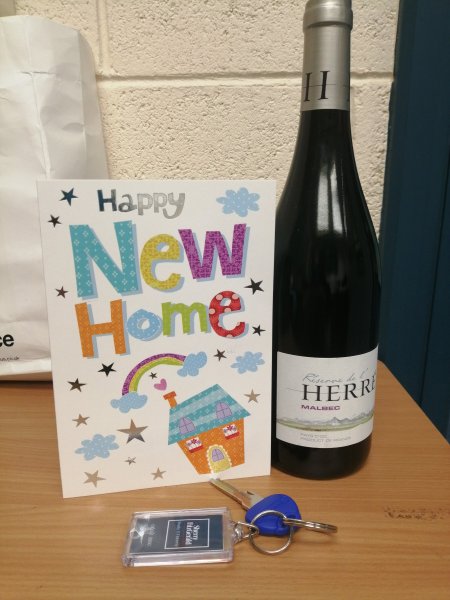
Just after 5pm yesterday I got a phone call from my solicitor telling me that all the formalities relating to my purchase of a house had been completed and the keys had been released. That gave me just enough time to finish what I was doing and head to the Estate Agent before they closed to get the keys. When I got there I found that a card and a bottle of wine were included, which was nice.

So now I own a house in Ireland, a rather lovely bungalow to be precise. It’s rather empty at the moment but I’ll be moving things in gradually over the next few days from my flat which I have until the end of the month. It will still be rather empty after I’ve done that because a lot of my stuff is still in Wales. I’ll have to figure out a plan to get over there and arrange to have it moved here to Ireland, though the timing of  that is rather dependent on Covid-19 restrictions…

I have bought and sold properties in England (and Wales) a few times. The process here in Ireland as many similarities but also some differences. One big difference is the auction process. Estate agents here in Ireland are generally called auctioneers, actually. In order to register to bid you have to first show that you have the necessary funds and then you can place a bid online and then there’s a genuine auction, with bid and counter-bid. It’s easy in an auction to get drawn in so far that you end up spending more than you wanted to, so I decided on an absolutely upper limit on how high I would go. Fortunately on the house I ended up buying the bidding stopped well below that.

There are a few other differences. One is that stamp duty is just 1% in Ireland (for properties up to €1M) whereas in England it is much more complicated but for a property  in England of similar value to mine it would be 5%. Incidentally there is also a Local Property Tax (LPT) based on the value of your home – similar to the old system of rates in the UK. The amount payable however is much lower, which is why local councils have so little money in Ireland and many services are privately run. You have to pay a private refuse and recycling company to deal with your garbage, for example. Which reminds me that I have to organize that.

I have to say I found the business of getting a mortgage a bit painful. Banks in Ireland are still saddled with bad mortgage debt from the time of the Credit Crunch about a decade ago so they are extremely cautious. I had to supply a huge amount of paperwork – about my income, savings, previous residences, etc  – before the bank agreed to lend me money. Then the Covid-19 lockdown intervened and by the time we got moving again, in June, I had to supply all that information again because the documents were then out of date.

You also have to take out mortgage protection insurance, a form of life insurance policy. For that I had to have a full medical examination – the second such I’ve had in three years. (The previous one was when I joined the staff here at Maynooth). There’s also buildings insurance. If I have one word of advice for anyone thinking of buying a house in Ireland it is to do with the insurance policies. Banks and other lenders tend to be tied agents of certain insurance companies so if you ask your mortgage lender to arrange the insurance they will go with one company. When I did that I found the policies were at least 50% more expensive than the market rate. Fortunately I was able to get some local advice and got mine sorted independently at a very much more reasonable cost than those offered by the bank itself.

Other than that the business of mortgages and valuations and surveys and Land Registry is all tediously familiar.

One of the good things about having lived in Maynooth for a while before buying a house is that I know people who can give local recommendations. The solicitor who did the conveyancing was very efficient and competent, though it was very strange doing everything by Zoom, including witnessing the signing of documents!

Once I’d had my offer accepted, the process of actually taking possession of the house took about two months. I’m told that is exceptionally fast as these things go in Ireland, but the vendor and I both wanted to move quickly – I really wanted to get everything sorted before the start of term – and we were both prepared to nag the various people involved to make it happen.

Now all I have to is to arrange with the various utilities companies to have accounts switched to my name, notify various changes of address, buy some bits and bobs, and finish the moving of my gear. Lots to do, but it’s a nice feeling to have my own place once again.

P.S. I bought a piano from the vendor, but it badly needs tuning!


Covid-19 in Ireland: No End in Sight

Posted in Covid-19, Maynooth with tags , , , on August 19, 2020 by telescoper

Yesterday the Irish Government put the brakes on the relaxation of the restrictions imposed because of the Covid-19 pandemic and tightened up some existing rules. The reason for this move is obvious when you look at the data:

After dropping to very low numbers of new cases a couple of months ago, the curve has been steadily rising. On Saturday 200 new cases were reported and yesterday the figure was 190. The average number of cases per day over the last 7 days is now over a hundred. The last time it was that high was in early May.

So what has gone wrong?

A large fraction of the cases appearing in the latest outbreaks is associated with either meat (or other food) processing plants and with direct provision centres. These are particularly vulnerable to outbreaks because of the difficulty of maintaining social distancing. Most of the people involved however are under the age of 40, so these outbreaks are not (yet) associated with a significant increase in mortality. Until recently it was hoped these localised `events’ could be contained by testing, contact-tracing and isolation.

Unfortunately these outbreaks are happening at a time when public adherence to Covid-19 restrictions has also been declining. I have noticed over the past few weeks that many people in Maynooth are congregating outside, especially in Courthouse Square, without any attempt at social distancing and with nobody wearing a face masks. Pubs in the area are serving drinks to take away and people are just taking them outside and treating the public areas as a big beer garden. The law it seems can do nothing about this, and pub landlords are doing nothing to discourage it.

The problem in this respect started back in June when the (then) Taoiseach Leo Varadkar decided to accelerate the stages of the Roadmap. I didn’t understand this at the time. The plan was carefully thought out and was working. Why change it? The answer is of course intensive lobbying from vested interests worried about the impact on their own finances.

Anyway, the effect of this change was immediately noticeable in that a sizeable contingent of the public clearly thought it was a signal that the Covid-19 outbreak was over and became complacent about the continuing risk of community transmission.

I think of the outbreaks in factories and direct provision centres as sparks that can hopefully be snuffed out quickly. The real risk to the public however is from these sparks spreading the conflagration into the general population. Social distancing acts like a sort of fire break – that’s what the new restrictions are trying to achieve.

What this means for the next month or so I can’t say, but I wouldn’t rule out a full lockdown being imposed again.I hope that doesn’t happen because I am looking forward to getting back to teaching, but it’s looking touch-and-go at the moment.


The U-turn and After …

Posted in Education, Politics with tags , , , on August 18, 2020 by telescoper

One of the many things that Winston Churchill never said (referring to Americans) is that they “…will always do the right thing – after exhausting all the alternatives”. Yesterday the UK Government performed a U-turn on its approach to A-level results but only after extensive protests and after causing immense stress to a great many students. All of this could have been avoided had the Secretary of State for Education bothered to look at the results of the downgrading algorithm. This morning he said that he “wasn’t aware” of what the outcomes would be and tried to put the blame on OfQual. Well, it’s actually his job to be aware of these things and that statement shows he’s not doing his job.

While many students will be mighty relieved that their official A-level grades will go up, that won’t be the end of this fiasco. Many students will find that their places have been already been filled through last week’s clearing process. The Government has lifted the number cap on places in imposed earlier this year, but that won’t help many departments, especially those in the sciences, who have severe constraints on, e.g., laboratory capacity (more so with social distancing in place).

I feel very sorry for friends and former colleagues in UK universities having to deal with this shambles. The Government will be quite happy that it has managed to throw this particularly hot potato into the hands of admissions tutors across the land. Ministers will be hoping that whatever blame now accrues will be attributed to universities being “inflexible” when it is entirely down to incompetence elsewhere. As always it’s the front-line staff who will have to deal with it, as if their job was not stressful enough having to deal with Covid-19.

Meanwhile, here in Ireland, the Government’s plan for “standardisation” of this year’s Leaving Certificate results looks alarmingly similar to the failed approach tried – and subsequently abandoned – in the United Kingdom. Minister for Education Norma Foley has been making statements about the accuracy and reliability of her Department’s plans that sound eerily similar to those issued by officials across the Irish Sea. I hope that I’m wrong about this – and that there’s some frantic activity going on behind the scenes to change the approach ahead of the release of this year’s Leaving Certificate grades (due on September 7th) – but I have a feeling that we’re going to see yet another slow-motion car crash. It wouldn’t be the first time that, having observed something truly shambolic happening in the UK Education system, an Irish Government then proceeds to do exactly the same thing…

Phase Four Postponed

Posted in Covid-19, Maynooth with tags , , on August 5, 2020 by telescoper

Yesterday the Irish government decided to postpone the last phase of its (already revised) Roadmap for Reopening and also make mandatory the wearing of face masks in shops. Phase Four was supposed to start on August 10th and was to include, among other things, the opening of pubs.

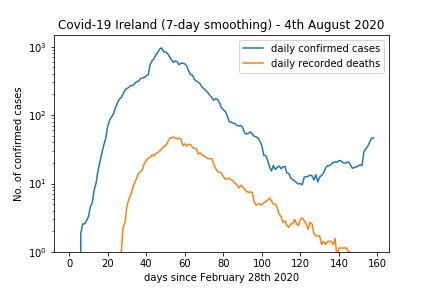
The reason for not proceeding with Phase Four is obvious when you look at yesterday’s  new cases graph:

(I keep updating the data here.

Note that the graph is logarithmic on the y-axes so the number of new cases is not large (currently averaging about 45 per day), but the trend is concerning; last week’s average was about 18. Most of the new cases are aged under 45 which perhaps accounts at least partly for the fact that the death curve is not rising: younger people are at lower risk of developing serious problems. The pattern of increasing infections but decreasing mortality figures is quite widespread across Europe, actually.

The recent cases in Ireland are occurring in clusters in particular locations. Of the 45 cases reported yesterday, for example, 33 were in County Kildare most of them at a single factory in Kildare itself (which has now been shut).

There has also been an increase in community transmission, though, which is perhaps even more dangerous than individual outbreaks.

It seems to me that pausing the planned relaxation of restrictions is a sensible thing to do at this stage. To open pubs now – which many continue to argue for – would in my view be extremely foolhardy.

I’m not sure what all this means for the new academic year which is due to start in September nor even the repeat examination period which are due to start next week but if cases continue to increase at their current rate it will severely impact our ability to return to on-campus activities.


Trustan with Usolde

Posted in Literature, Opera with tags , , , , , , , , on August 1, 2020 by telescoper

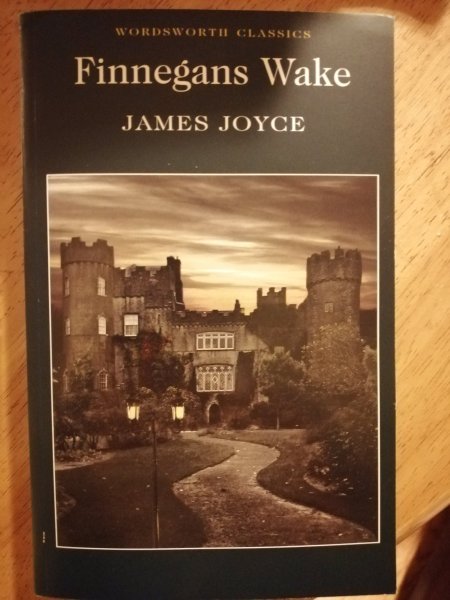
It is, I think, fairly well known that physicist Murray Gell-Mann was inspired to pick the name quark for the name of a type of subatomic particle by a passage from Finnegans Wake by James Joyce:

— Three quarks for Muster Mark!
Sure he hasn’t got much of a bark
And sure any he has it’s all beside the mark.

What is perhaps less well known is the identity of “Muster Mark” in that quote. In fact it is King Mark of Cornwall, husband of Queen Iseult in the legend of Tristan and Iseult. The Iseult in that legend is Irish. She has has an affair with Tristan, nephew of King Mark, with tragic consequences. This legend appears in many literary forms including, most famously, Richard Wagner’s Opera Tristan und Isolde. It also comes up frequently in Finnegans Wake including this passage on the same page (in the edition I have) as the Muster Mark quote above:

That song sang seaswans.
The winging ones. Seahawk, seagull, curlew and plover, kestrel
and capercallzie. All the birds of the sea they trolled out rightbold
when they smacked the big kuss of Trustan with Usolde.

See how Joyce plays with the substitution of “u” for “i” here as in “Muster”. Either that or the “I” key on his typewriter didn’t work properly. Or he had fat fingers and kept hitting the wrong key; U and I are next door on the keyboard.

Incidentally there is a small village in Dublin called Chapelizod which is where a church was built dedicated to Queen Iseult. Whether there is any real connection between this place and the historical Iseult is very doubtful.

Now, where was I. Oh yes. Back to Opera.

Years ago, when I lived in Nottingham, on a warm summer evening I decided to listen to some of the live broadcast on BBC Radio 3 of a performance of Wagner’s Tristan und Isolde from Glyndebourne. I made myself a cocktail and took the radio out into the garden with the intention of listening to a bit of it before going out for the evening. This was back in the days when I actually used to go out on the town on Saturday nights; now I’m too old for that sort of thing.

Anyway, I was hooked right from the Prelude. Act I came and went and I decided to make some dinner in the interval, opened a bottle of wine, and returned to listen to the rest of it. The glorious music washed over me in the sultry twilight. Darkness fell, a second bottle of wine was opened, and still I listened – no doubt to the consternation of my neighbours. The final Liebestod was so beautiful I almost cried. Eventually I retreated to the house having experienced my first all-out Wagner trip.

My enjoyment of that occasion was of course helped by the fact I could get up and walk around occasionally, as well as by the liberal intake of fine wine. Nevertheless I do think Tristan and Isolde works very well on the radio – nothing very much happens on stage anyway (especially in Act II) so you can just let the music work it’s magic.

The reason for all this rambling is that there is a special broadcast of Tristan und Isolde on RTÉ Lyric FM. This performance, recorded in 2012, features as Isolde the celebrated dramatic soprano Miriam Murphy who very sadly passed away suddenly a few weeks ago. Tonight’s programme is a tribute to her memory. I believe Miriam Murphy is the only Irish soprano to have sung the role of Isolde. I’ve heard a few clips from it and her voice sounds amazing.

The Opera is preceded on the radio by a documentary about the production, the first in Ireland for 50 years and the first by a brand new company based in Ireland. I think James Joyce would have approved.

So that’s my Saturday evening sorted out!

Update: I listened to the broadcast and it is an astonishingly wonderful performance by Miriam Murphy.

Time, Money and Guidance in Higher Education

Posted in Covid-19, Education, Maynooth with tags , , , , on July 27, 2020 by telescoper

There was a welcome announcement last week of a package of supports for further and higher education institutions and students in Ireland to cover costs incurred by third level institutions during the Covid-19 pandemic and enable further and higher education students to return to college this September.

There wasn’t much sign of any help at all coming under the previous Government, so this is perhaps a sign that the new Department of Further and Higher Education, Research, Innovation and Science might be a force to be reckoned with in the new administration.

If this funding is to achieve its aim, however, it will have to reach its targets very quickly. The new academic year is to commence at the end of September, which is just two months away. The slice that is intended to go directly to students to help them buy laptops or tablets can probably be spent quite quickly, but the money intended for colleges and universities to buy equipment will take much longer to filter through.

Speaking for myself, as Head of a Department of Theoretical Physics I’d say we desperately need better video equipment for both live and recorded material. At present we have no lecture capture facilities at all in any lecture theatres. We also need graphics tablets to help lecturers show mathematical working via remote means. There is likely to be a big rush for this sort of thing between now and September, and no guarantee we will have it in time for the start of lectures.

You might well ask `why don’t you buy this stuff now?’. The answer is simple: I haven’t got the money!

Things are even tougher for schools. Here there is another big support package on the way, this time of €350 million to allow them to open at the end of August. Getting kids back to school is obviously important not only for their education but also to allow their parents to return to work. However, the time available to prepare all the things necessary is just a month, even shorter than it is at third level.

Among the funds being made available is €75 million for `building works’. I’m sure that investment is very welcome, but can it do anything between now and the end of August? It’s actually rather difficult to spend money that quickly if due process is followed. Just look at how the UK government has squandered tens of millions on phony contracts, such as the £12 million it blew on a Covid-19 tracing app that never worked.

On top of that 1000 new schoolteachers are going to be provided. Will they be recruited in time?

Another announcement to appear last week contained guidance for further and higher education on returning to on-site activity in 2020. This guidance has been interpreted in the media in a rather unhelpful way, causing many of my colleagues to go into a panic. This, for example, from the Irish Times:

Physical distancing rules of two metres will apply on college campuses from September in a move which will severely limit the ability of universities to hold lectures and graduation ceremonies.

A strict requirement of 2 metre distancing at all times would indeed severely reduce the capacity of lecture theatres, but if you look at the guidance it is considerably more nuanced than this. The real problem with this guidance is that it is so vague. We can only hope we get something a bit more concrete soon so we can plan for September. Alternatively we could just wing it. All of it. At the moment this seems the only viable strategy.

Three Funerals and a Cartoon

Posted in Biographical, Football, Maynooth with tags , , , on July 21, 2020 by telescoper

I was later than usual coming to the office today as I had to arrange some things to do with the house I’m buying in Maynooth. It was mid morning when I walked up towards campus. I was a little bit confused to see a large crowd of people walking along Main Street, but when I got closer I realized they were all walking behind a hearse on their way to a funeral service at St Mary’s Church. I followed the procession all the way along Main Street and up Mill Street where another large group of people was waiting outside the Church. I don’t know who had passed away but judging by the attendance they must have been popular in the community.

This is the first time I’d seen such a procession here in Ireland, though I was of course already aware that the Irish treat funerals very differently from the English. Coincidentally, though, today saw the funeral of Jack Charlton which began with a procession through the streets of Ashington, the cortege led by piper playing the Northumbrian pipes. Many hundreds turned up to show their respects.

Because of Covid-19 restrictions, only about 20 people could attend the funeral service, which was held at the West Road Crematorium in Newcastle upon Tyne. As it happens, that was where the funeral of my Mam took place about 9 months ago. There were no Covid-19 restrictions then, which makes it seem like a different age altogether.

Anyway, going back to Jack Charlton, I saw last week marvellous comic book tribute to him called The Life and Times of Jack Charlton by David Squires in the Guardian. The poignant last panel is beautifully done.

R. I. P. Jack Charlton (1935-2020)

Posted in Football with tags , , , , on July 11, 2020 by telescoper

Sad news today of the death at the age of 85 of legendary footballer and manager Jack Charlton.

The tributes to Jack Charlton here in Ireland focus on his time as manager of the Republic of Ireland national team, during which he produced many great results, including qualifying for two World Cups (in 1990 and 1994). Ireland got to the quarter-finals in 1990, which was an amazing achievement. Jack Charlton created some marvellous memories and became like an adopted son in the hearts of Irish folk, spending a lot of his time here in his retirement. He had a house in Ballina (County Mayo) and enjoyed going fishing. I suspect he rarely had to buy a drink in the local pubs! As a fellow Geordie living in Ireland I can understand very well why he loved it here.

He gave up the house in Ireland a few years ago when his health started to fail and moved to Stamfordham in Northumberland, the County of his birth. Jack was actually born in Ashington and was the nephew of legendary Newcastle United centre-forward Jackie Milburn.

As a player he was an old-school centre half: tall and tough and not prone to try anything fancy. He knew his limitations as a footballer and concentrated on what he could do well. He spent his entire professional playing career of 21 years at Leeds United. He wasn’t capped for England until he was 29 and a year later he was a member of the team that won the 1966 World Cup, as was his brother Bobby.

I remember an interview with Jack Charlton during which he recalled asking manager Sir Alf Ramsay why he had been picked for the England team when there were many better players than him around. Ramsay’s reply was that he didn’t always pick the best players, he picked the best team. What I think he meant by that is that he saw Jack’s steadiness as a providing an ideal blend in the centre of the defence balance to the less conventional Bobby Moore.

My own memories of Jack Charlton are dominated by his time as manager of Newcastle United between 1984 and 1985; see the picture, which is from this time, including Peter Beardsley (left) and Chris Waddle (right). I was a student at Cambridge at this time and there was quite a large Newcastle United Supporters’ Club of which I was a member. We travelled to quite a few games in the 84/85 season. The Club Secretary wrote a letter to Jack Charlton inviting him to visit us for a dinner and speech. We couldn’t even offer him travel expenses so I assumed he would just ignore the request, but he didn’t. He actually wrote a very nice letter politely declining the invitation but thanking us for our support and good wishes. He also reminded us not to neglect our studies because of football as he regretted not having had “much of an education”.

It’s worth mentioning that 1984/5 was the time of the Miners’ Strike during which Jack Charlton was a staunch supporter of the Miners. He even lent his car to help miners on flying pickets. He was rather left-wing generally, actually.

Jack Charlton brought to football management the same approach he had brought to his own playing. It was by focusing on doing the basics well that he was able to get outstanding results using limited resources. He wouldn’t have been a good manager of a huge club full of luxury players, but in his niche he was superb.

As a person Jack Charlton was as strong-minded and uncompromising as he was as a player and a manager, but he was also down to earth, completely unpretentious, funny and self-deprecating, and as honest as the day is long.

Rest in peace, Jack Charlton (1935-2020)

The R in Ireland

Posted in Covid-19 with tags , , , on July 9, 2020 by telescoper

I was playing about with different ways of presenting the Covid-19 data I’ve been collecting here to make the trends clearer. This is what the daily confirmed cases and reported deaths look like if smoothed with a simple 7-day moving average and plotted on a log-linear scale:

This confirms something I’ve suspected over the last couple of weeks: that the number of confirmed cases has been edging upwards. This is not so clear in the raw counts, but is suggested: the smoothing makes this easier to see by reducing the noise and removing any weekend reporting artefacts:

This recent upward trend is consistent with the latest estimates of the basic reproduction number R that suggest it has crept up to around unity.

The number of cases per day remains low and confined to particular clusters. Hopefully contact tracing and isolation will prevent the increase getting out of hand.

It seems about two thirds (15 out of 23) of the new cases are associated with travel, though, so any loosening of restrictions on overseas travel would be very unwise.

The maximum age of any of the new cases reported yesterday is 44 and 77% are under 25. Perhaps its younger people who are less likely to observe social distancing.

I worry a bit that Ireland may be unlocking too quickly and people may be getting a bit complacent about the situation.

This is not over.

Evicted – Elizabeth Thompson (Lady Butler)

Posted in Art, History with tags , , , , , on July 1, 2020 by telescoper

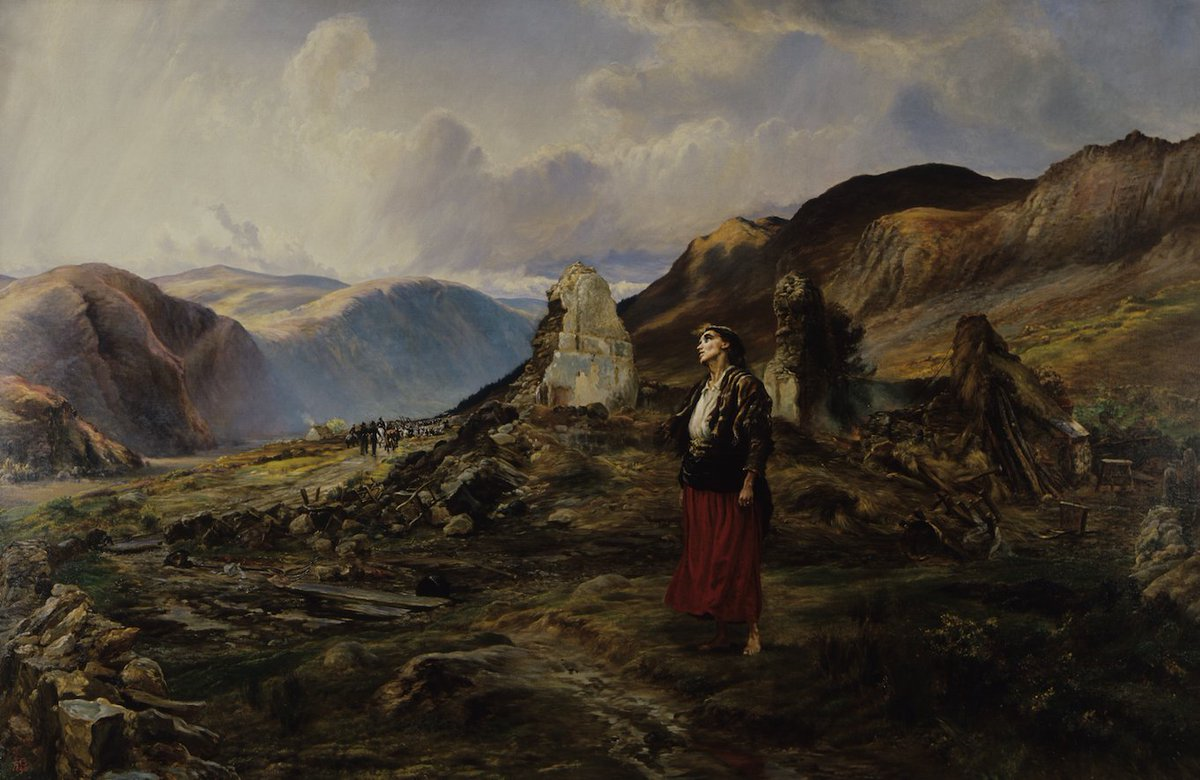
I was listening to an interesting radio programme the other day about artistic depictions of Ireland and Irish history. One of the paintings discussed  was a work called Evicted which was painted in 1890 by Elizabeth Thompson (Lady Butler). I haven’t seen the actual painting – the original (oil on canvas) is apparently somewhere in University College Dublin – but i found the discussion intriguing and decided to see if I could find a representation on the internet. Here it is in reasonably high resolution.


I’m not a proper art critic or anything, but I found this a remarkably powerful work of art made all the more interesting when I read a little bit about the artists. Elizabeth Thompson married Lieutenant General Sir William Butler after which she became Lady Butler. She made her name as an artist painting heroic depictions of British soldiers in, for example, the Crimean War. When her husband retired from military service the couple moved to Ireland, and at the time this painting was made they were living in Wicklow where one of their neighbours was none other than Charles Stewart Parnell. The late 19th Century was the time of the Land War, a period of intense social unrest in rural Ireland caused by the exploitative practices of landlords and the unfair treatment of tenants. Parnell was a vigorous campaigner for land reform and the Butlers became staunch supporters of the cause.

One day Elizabeth witnessed the eviction of a Irishwoman from her cottage in the Wicklow mountains and was so moved by it that she made this wonderful painting. When it was exhibited in London it was met with disapproval for being “too political”. The British establishment of the time did not appreciate anything too critical of the Empire.

In the painting itself there are some striking touches. The eviction party, its job done, can be seen to the left disappearing back down the valley. By all accounts the people who did this sort of thing were sadistic brutes who very much enjoyed their work. Tenants were not only evicted, but their homes  and possessions completely destroyed in order to prevent them returning.  The standing figure of the woman seems to form a group with the pieces of her cottage that are still standing, her own devastation mirroring that of her home. A few glowing embers can be seen among the wreckage.

But it’s the depiction of the woman herself which in my opinion gives the painting most of its power. You might have expected her to be shown in obvious distress, hunched, perhaps crying or wringing her hands. Instead she is standing up with her hands by her sides, looking up at the sky. Is she praying? Resigned to her fate? Or perhaps just traumatized? The painting seems to ask the viewer: how would you react if this happened to you?