Archive for Irish Language

Summer Solstice 2025

Posted in Irish Language, The Universe and Stuff with tags , , , , on June 21, 2025 by telescoper

In case you weren’t aware, the Summer Solstice in the Northern hemisphere took place this morning Saturday June 21, 2025 at 02:42 UTC (03:42am local Irish Time). Among other things, this means that today is the longest day of the year (as defined by the interval between sunrise and sunset).

According to this website, the interval between sunrise and sunset in Dublin today will be 17 hours and 12 seconds. which is a whole second longer than yesterday (!) and six seconds longer than tomorrow.

In the Northern hemisphere, days will get shorter from the Summer Solstice until the Winter Solstice in December.

The nights are drawing in. Although sunset does carry on getting a bit later for a few days, the days definitely start getting shorter from now on. I explained this in earlier posts here.

Incidentally, the word for “solstice” in the Irish language is grianstad which translates literally as “sun-stop”. The Summer Solstice is Grianstad an tSamhraidh“. The nominative singular word for “Summer”, a masculine noun in Irish, is Samhradh, but in the construction used here, “of summer”, it is in the genitive case so becomes Samhraidh. Moreover, when a masculine noun beginning with s- in the singular genitive is preceded by the definite article an) it experiences an initial mutation in the form of a t-prothesis; hence (an tSamraidh is “of the Summer”.

The Winter Solstice is Grianstad an Gheimhridh. The word for winter is Geimhreadh, which is masculine, and has a genitive form Geimhridh. In this case, however, because it doesn’t begin with “S” there is no t-prothesis but instead a lenition (séimhiú) that softens the initial “G” indicated by the “h”. Hence Grianstad an Gheimhridh, “Sun-stop of the Winter”.

I hope this clarifies the situation.

Language on Dry Land

Posted in Football, Irish Language with tags , , , , , , , , , on July 13, 2024 by telescoper

Since I’ve got my own computer again now I thought I’d celebrate by doing one of those rambling, inconsequential posts I haven’t had time to do recently.

Last week, in the run up to the European Championship semi-final between England and The Netherlands, I for some reason decided to look up what “The Netherlands” is in the Irish language. I did know this once, as it came up when I was trying to learn Irish a few years ago but I had forgotten. I remembered “England”, which is Sasana (cf. Saxon). Anyway, the answer is An Ísiltír. I’ll return to that in a moment.

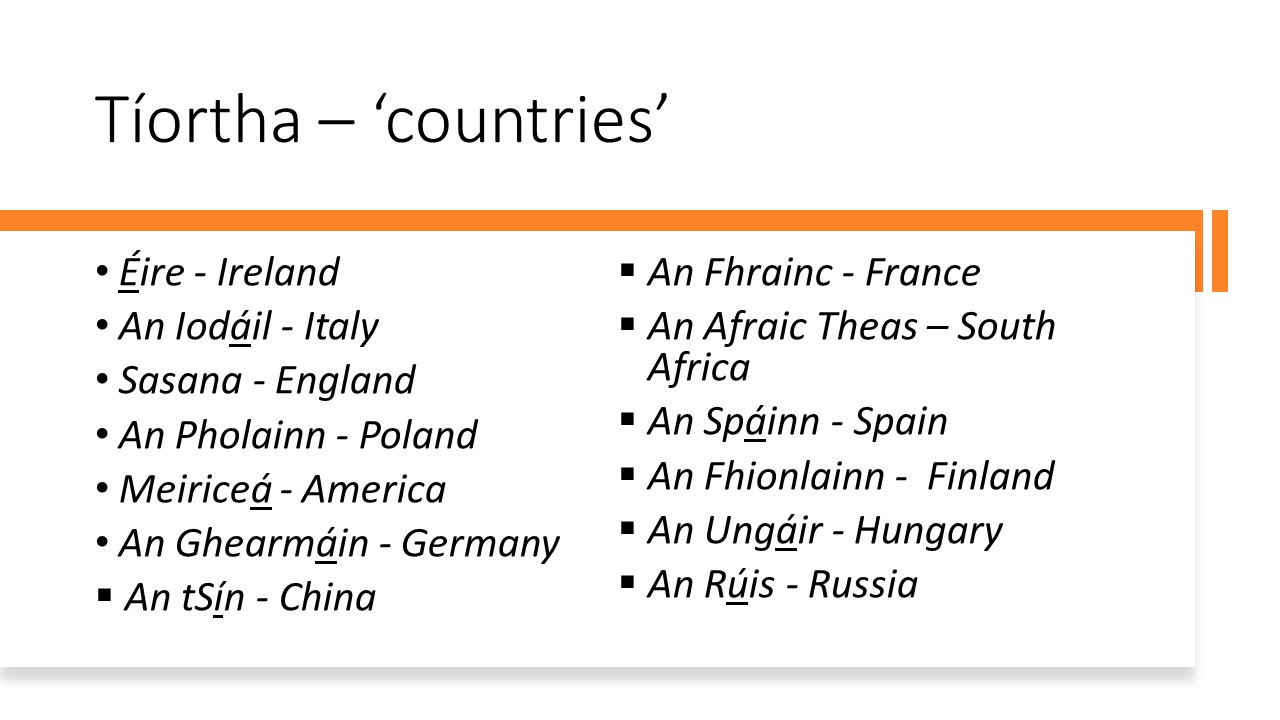
Here are some other names:

Anyway, a couple of things may be interest. One is that you can see that most country names in Irish are introduced by An. This is the definite article in Irish; there is no indefinite article. This contrasts with English in which only a few names start with the definite article, “The Netherlands” being one. The exceptions in Irish include England (Sasana) and Scotland (Albain). Wales is An Bhreatain Bheag (literally “Little Britain”). Of relevance to the final of the European Championship, Spain is An Spáinn.

I should also mention that some nouns suffer an initial consonant mutation (in the form of lenition, i.e. softening) after the direct article. In modern Irish this is denoted by an h next to the initial consonant, hence Fhrainc, for example; the Irish word for “French” is Fraincis.

The second interesting thing pertains to An Ísiltír itself. The second part of this, tír, means “country” or “nation” – see the plural in the heading above – and the first, Ísil, means “low”. An Ísiltír is therefore literally “The Low Country”. I shared this fascinating insight on social media and found in the replies a mention that the Welsh name for The Netherlands is Yr Iseldiroedda meaning literally “The Low Lands”. The first part of this is clearly similar to the Irish, but the second is the plural of a different word meaning ground or earth or an area of land. There is a word tir in Welsh that means ground or earth or an area of land but it does not mean country or nation like the very similar Irish word; the word for that is gwlad. In Irish the word for land or ground or earth (or turf) is talamh.

Welsh and Irish belong to distinct branches of the Celtic group of languages, the first wave of Indo-European languages to sweep across Europe. I blogged about this here.  Celtic languages therefore share roots with many other Indo-European languages and very basic words in many branches of the tree often bear some similarity in form, if slight but significant differences in meaning. It seems that tír/tir illustrates this rather well. These two words also have a very similar form to the French terre which is derived from the Latin terra. And so I disappeared down an etymological rabbit hole and found that all these words are probably derived from a Proto-Indo-European word meaning “dry”, presumably through reference to “that which is dry” as opposed to the wet bits (although neither Ireland nor Wales is famous for being particular dry).

And to bring this little excursion back full circle, the Irish word tirim means “dry”…

Tá mé sa bhaile – Biden’s Irish

Posted in Irish Language, Politics with tags , , , , , , on April 14, 2023 by telescoper

TRIGGER WARNING: CONTAINS PRONOUNS!

Yesterday, President of the United States of America, Joe Biden, addressed a joint sitting of the houses of Oireachtas in Dublin. Predictably he included an attempt at Irish in his speech to the obvious appreciation of those attending. I was a bit confused by the way what he said was reported in the Irish media, however, e.g.

My confusion was that I didn’t think he said tá mé seo abhaile as widely reported. For one thing, even I as a beginner could see that phrase means “I am this home”, which doesn’t make any sense (not to me, anyway). There are various possibilities for what Joe Biden did say. For what it’s worth I thought it was tá mé sa bhaile which, loosely, means “I am at home”. I note that the news media have generally changed their accounts (e.g. here) to reflect this, although other forms of words are possible. I’m not surprised that Biden struggled with the pronunciation – most of us beginners do, but I think the writers and editors of the newspapers above might at least have corrected his grammar.

The phrase illustrates a couple of interesting curiosities about the Irish language. Expressing the verb “to be” in Irish isn’t as straightforward as it is English. There are two grammatically distinct ways of doing this. The two Irish forms are , which is like the English verb “to be” and the so-called copula, is, which is sometimes called a defective verb. It’s admittedly a bit confusing that the copula looks like the third-person singular of the verb “to be” in English, but there you go.

Going back to, it is frequently referred to as tá (its present tense form as in the phrase above). It can be fully conjugated in all tenses and persons but it is highly irregular. Grammatically, is also just like any other verb, coming first in the sentence, followed by a subject (either a separate noun or pronoun or a suffix, depending on the tense and person, as shown in the conjugations), and then its predicate and any remaining adverbial information. Thus tá mé is “I am” with the pronoun . The accents (síneadh fada)  mean that this is pronounced taw-may.

The copula, however, is not fully conjugated for different subjects, which are always expressed by separate nouns or pronouns, and it only has two forms for different tenses: is can be used for present or future meaning, and ba (with lenition) is used for past or conditional meanings.

Among the specific situations in which the copular is must be used instead of but the main one is to be followed by a noun. You can’t say “I am a Professor” using – it has to be Is Ollamh – but to say “I am old” it is Tá mé sean.

One final remark. If you’re scared of pronouns please look away now. There are over 120 different pronouns in the Irish language. There’s a special version of the pronoun written mise which has two uses that I am aware of. One is when the copular is used for identification – so “I am Peter” is Is mise Peadar – and the other is for emphasis, when it is roughly equivalent to “myself” in English.

P.S. The Irish word for “pedantry” is pedantraí

Rainy Season

Posted in Biographical, Cricket, Irish Language with tags , , , , on September 30, 2022 by telescoper

Yesterday saw the end of this year’s County Championship cricket season*, which many people regard as the official end of summer. As if to prove the point today, strong westerly winds have brought a deluge of rain all morning.

While I was waiting for my coffee to brew before venturing out into the rain this morning I was thinking about some idiomatic expressions for heavy rain. The most familiar one in English is Raining Cats and Dogs which, it appears, originated in a poem by Jonathan Swift that ends with the lines:

Drowned puppies, stinking sprats, all drenched in mud,
Dead cats and turnip tops come tumbling down the flood.

My French teacher at school taught me the memorable if slightly indelicate Il pleut comme vache qui pisse, although there are other French expressions involving, among other things nails, frogs and halberds.

One of my favourites is the Welsh Mae hi’n bwrw hen wragedd a ffyn which means, bizarrely, “It’s raining old ladies and sticks”. There is also Mae hi’n bwrw cyllyll a ffyrc – “It’s raining knives and forks”.

Related idiomatic expressions in Irish are constructed differently. There isn’t a transitive verb meaning “to rain” so there is no grammatical way to say “it rains something”. The way around this is to use a different verb to represent, e.g., throwing. For example Tá sé ag caitheamh sceana gréasaí which means “It’s throwing cobblers’ knives”.

Talking (of) cobblers, I note that in Danish there is Det regner skomagerdrenge – “It’s raining shoemakers’ apprentices” and in Germany Es regnet Schusterjungs – “It’s raining cobblers’ boys”.

Among the other strange expressions in other languages are Está chovendo a barba de sapo (Portuguese for “It’s raining toads’ beards”), Пада киша уби миша (Serbian for “It’s raining and killing mice”),  Det regner trollkjerringer (Norwegian for “It’s raining female trolls”) and Estan lloviendo hasta maridos (Spanish for “It is even raining husbands”).

No sign of any husbands outside right now so I’ll get back to work. My PhD student is giving a seminar this afternoon so I have to think of some difficult questions to ask her! (Joking).

*For the record I should mention that Glamorgan drew their last game of the County Championship against Sussex (at Hove) and thus finished in 3rd place in Division 2. They might have beaten Middlesex to second place had they won and Middlesex lost their final matches but in the end both games were high scoring draws. Glamorgan lost to Middlesex in feeble style a couple of weeks ago so I think it was fair outcome.

Tywysog and Taoiseach

Posted in History, Irish Language with tags , , , , on September 12, 2022 by telescoper

When I heard that King Charles III has conferred the title “Prince of Wales, Tywysog Cymru”, on his eldest son and heir William, I was intrigued by the appearance of the Welsh word Tywysog because of its similarity to the Irish word Taioseach. There aren’t that many words that sound so similar in Welsh and Irish because the two language groups to which they belong diverged in the distant past. Their similarity suggests to me a common etymology that pre-dates the development of the two distinct branches of the Celtic languages that we now refer to as Goidelic and Brythonic. There isn’t any literature to go on, as ancient Celtic languages were primarily oral, but the theory is that both words are derived from a Proto-Celtic form towissākos.

The Goidelic group comprises Irish, Manx and Scottish Gaelic; and the Brythonic group comprises Welsh, Cornish and Breton. These are sometimes referred to as q-Celtic and p-Celtic, respectively, although not everyone agrees that is a useful categorization. It stems from the fact that the “q” in Indo-European languages morphed into a “p” in the Brythonic languages. The number five in Irish is a cúig which has a q sound (though there is no letter q in the Irish alphabet); five in Welsh is pump. Contrast with the number two: a dó in Irish and dau in Welsh.

Incidentally, Scottish Gaelic is not the language spoken by the Picts, the Celtic people who lived in Scotland at the time of the Romans, which is lost. Scottish Gaelic is actually descended from Middle Irish due to migration and trading contacts. The Ulster dialect of Irish is in turn much influenced by reverse migration from Scotland. Languages do not evolve in isolation or in any simple linear trajectory.

Contrary to popular belief, Breton is not a Continental Celtic language but was taken to Brittany by a mass migration of people, which peaked in the 6th Century AD, from South-West Britain, fleeing the Anglo-Saxons. The Saxons won a great victory in battle at Dyrham (near Bath) in 577 after which they advanced through Somerset and Devon, splitting the Celts of Cornwall and Wales and leading to the formation of two distinct Brythonic language groups, Welsh and Cornish. Breton is much closer to Cornish than it is to Welsh.

The Continental Celtic languages are all extinct, except for fascinating remnants that linger here and there in local dialect words in French and Spanish.

Anyway, both modern words tywysog and taioseach originally meant “leader”. In Scots Gaelic, tòiseach was the name given to a clan chief; the Irish taioseach had a similar usage. The capitalized form “Taioseach” has only been used for the Head of the Irish Government since 1937 when the name was introduced in the Constitution. It was remarked at the time that An Taoiseach – the equivalent of Prime Minister – has the same literal meaning as “Il Duce” or “Die Führer“…

The last native Welsh Tywysog was Owain Glyndŵr after whose demise in c1415 the title was appropriated by the English monarchy no doubt as part of its rigorous suppression of Welsh identity. The term doesn’t actually mean “Prince” and the “Prince of Wales” is certainly not a leader. If anything the word should be applied to the First Minister of Wales, an office currently held by Mark Drakeford.

P.S. The presence of the “e” in taioseach indicates that the “s” is pronounced like “sh” (as in “Seán”) so the word should not be pronounced “tea sock”…


The Perfect Afters

Posted in Irish Language with tags , on June 18, 2022 by telescoper

When I first arrived in Ireland, one thing I noticed about the way Irish people use the English language is a construction using the word “after” and the present participle of a verb. I first heard it in the context of a football match on the television, actually, during which the commentator said “the ball is after going out for a corner” or words to that effect.

This construction is basically an alternative way of constructing what is called in Latin called (past) perfect tense of a verb, indicating an action which is now completed. In Latin this would be formed by a particular ending of the verb but when translated into English it would either be a simple past verb form (usually ending in -ed) or using the auxiliary verb “to have”. For instance, in the football example above you would interpret the meaning as “the ball has gone out for a corner” or the “the ball went out for a corner”.

(Now I’m regretting using the irregular verb “to go” in the football example but I hope you catch my drift…)

The “after” construction is not just an alternative way of writing the past tense, however, as it can (and usually does) specifically imply an action that has been completed in the very recent past, something you might express in English by inserting the word “just”. This is sometimes called the immediate perfective. It can also be used to form the pluperfect tense (expressing an action already completed at some time in the past) by using the past of the verb “to be”, though in modern Irish it seems to be more-or-less exclusively used for actions only recently completed.

Examples include:

  • He is after writing a letter – He has (just) written a letter
  • I’m only after getting here – I’ve just got here
  • He was after walking the dog – He had walked the dog
  • I’m after reading James Joyce’s Ulysses for the second time – I have just read James Joyce’s Ulysses for the second time…

In the book English As We Speak It In Ireland, the author P.W. Joyce writes that no such form ‘would be understood by an Englishman, although they are universal in Ireland, even among the higher and educated classes’.

It’s certainly the case that I didn’t really understand it when I first heard it, but I have heard it used on countless occasions by friends and neighbours since then. I think I was initially confused because “he is after..” can appear in English. phrases such “he is after a new job” expressing something like “looking for” (i.e. with intent) but that is not suggested in the examples above.

I think poll my readers on this, which will probably demonstrate how few Irish readers I have. If someone were to say “I’m after getting a cup of tea” would this mean:

It’s reasonable to wonder how this construction came about. The answer is that in Irish the verb “to be” is very peculiar, existing in two distinct forms, and there is no direct equivalent of the verb “to have” as it is used in the formation of verb tenses in English. There is a simple past in Irish that basically works like the English equivalent but tenses involving “have” or “had” as an auxiliary verb are impossible to render word for word. For example, translating I have just done it into Irish could give you  Tá mé tar éis é a dhéanamh or Tá mé i ndiaidh é a dhéanamh, both of which literally mean I am after doing it. (Tá mé means “I am” and the underlined phrases essentially mean after).

I suppose you can think of this interesting construction as being a relic of the Irish language surviving after the imposition of English on the population. Whatever its origins, though, I’m after concluding that this construction, although not standard in British English, is perfectly sound from a grammatical point of view.

Finally, and incidentally, the lack of an appropriate verb “to have” causes some other interesting expressions in Irish. One of my favourites is exemplified by the phrase “I have a cold” which, translated into Irish is “Tá slaghdán orm” which means, literally, “A cold is on me”…

Anyway, I’m after finishing.
The Tironian et…

Posted in History with tags , , , , , on May 30, 2021 by telescoper

Last week I had my last Irish language lesson at Level 1. Although I struggled to find the time to do anything outside the actual classes, and am consequently struggling generally with the language, I have enjoyed it a lot and do intend to go again next year to try to learn a bit more and get better at the basics.

One thing that came up in passing last week was the abbreviation “srl” which I’d seen a few times but although I didn’t understand it I didn’t ask – largely because there were so many other things I didn’t understand. Anyway, it turns out that “srl” is short for agus araile which means “and others”, so is the Irish equivalent of “etc” (et cetera in Latin).

In English “etc” can be abbreviated to &c, where the ampersand is a ligature of the e and t that make up “et” and so stands for “and”. After some googling and discussions on Twitter I learn that Old Irish had quite a lot of special symbols for abbreviations which are no longer used in modern Irish. In fact “srl” used to be “⁊rl” where the “⁊” is not a seven (7) but a Tironian et. It looks like 7 in modern typefaces but in older Irish script it looks more like the ligature “koto” found in Japanese (ヿ). Thys symbol is not entirely extinct – I’ve seen it a few times (e.g. above) and also on old post boxes. Here’s another example from a pub sign in Galway.

This is not a name, by the way. The sign means “bar” and “restaurant” (bialann = bia +-lann, the suffix “-lann” meaning place, usually an enclosed space, so it’s literally food place; the Irish word for “library” is leabharlann, srl.)

The Tironian et is one of the characters in a system of shorthand invented by Marcus Tullius Tiro, the slave (subsequently freed) who worked as private secretary to Cicero (aka Marcus Tullius Cicero). This system was used extensively in monasteries until the mediaeval period, which explains how its use came into Irish through Irish monks. It went out of fashion when printing presses became widely available and the Tironian et is one of the few still in use in the age of computers – it does have a unicode and is available in various fonts that come free with most operating systems in use today.

I think one of the reasons I am struggling to learn everyday Irish is that I keep going off at tangents like this, something I tend to do in all kinds of contexts.

Cá bhfuil tú i do chónaí?

Posted in Biographical, Irish Language, Maynooth with tags , , , on April 3, 2021 by telescoper

I had another Irish language class on Thursday, in between various other things. I’m finding it a struggle since I don’t get much time in between the classes to revise or practice and also because there is quite a lot to learn that is very different from languages with which I am familiar. I spent a lot of time at school learning Latin and tend to filter new languages through that experience, which works reasonably well for French, Spanish and Italian but isn’t very good for Irish.

Some things in Irish are simpler than Latin: there are effectively only four cases for nouns in Irish as there is no real distinction between nominative and accusative. I mean the two cases are grammatically distinct but there is no difference in the word depending on whether it is subject or object of a verb. The other three cases are vocative (preceded by the particle a), genitive and dative. There is no ablative case; the dative is used instead.

Other things are more complicated. Last week we discovered that there are two versions of the verb “to be”. One is bí (which, as in most other European languages, is irregular in declination); the other is called the copula (“an chopail”)  which is used in limited (but quite common) circumstances such as linking a noun with a predicate clause. Confusingly, the form of the copula used in the present tense is “is” but it’s not part of the verb “to be”.

We learnt about these things when talking discussing the question

Cá bhfuil tú i do chónaí?

which is “where do you live?”, literally “Where are you in your habitation?”.  The way to answer this is something like

Tá mé i mo chónaí i Maigh Nuad. 

these sentences both involve the verb to be in the second person and first person respectively. Instead of Tá mé you could use Táim which is the equivalent of using “I’m” for “I am” in English.

It’s more complicated than that though because some place names have to be modified in this construction using an urú (eclipsis):

Maigh Nuad (Maynooth) begins with an M which is not modified but Doire (Derry) becomes nDoire, etc. The mutation from c to g after the preposition i also happens in Welsh, e.g. in the phrase Croeso i Gymru but in Irish you add the changed letter in front of the original rather than replacing it. For example, if I were living in Cork I would say

Tá mé i mo chónaí i gChorchai. 

The g is understood to replace the C for pronunciation purposes.

That brings us on to Irish place names, which are often very different from their anglicized versions. Here are a few examples:

  • Maigh Nuad (Maynooth)
  • Corcaigh (Cork)
  • Port Láirge (Waterford)
  • Doire (Derry)
  • Tir Eoghain (Tyrone)
  • Aontroim (Antrim)
  • Fear Manach (Fermanagh)
  • Béal Feirste (Belfast)
  • Gaillimh (Galway)
  • Thiobraid Árann (Tipperary)

The last one is not actually a long way from where I am. You can guess most of them but it’s a little confusing that the English versions are often conflations of two Irish words.

In the Name of the Fada

Posted in Biographical, Irish Language, Television with tags , , on March 13, 2021 by telescoper

As we head into next week’s study break in the middle of which is the St Patrick Day Bank Holiday, I thought I’d share this video. It’s the first episode of a series in which comedian Des Bishop, who missed out on Irish language lessons at school, moves to Conamara for 9 months to learn Irish. In the Name of the Fada is not to be confused with famous film, the “Fada” of the title referrring to the síneadh fada, the only diacritic mark in modern Irish. I wrote about it here.

This programme actually covers quite a lot of the vocabulary I’ve learned in the last six weeks or so. The rest of the episodes can easily be found on Youtube too.

Bíodh deireadh seachtaine agus sos deas agaibh!

Seachtain na Gaeilge

Posted in Biographical, Irish Language with tags , on March 4, 2021 by telescoper

Thursdays are very busy days for me this Semester not least because I have to squeeze in my Irish language class at lunchtime in between lectures meetings and an afternoon computational physics lab.

Although learning a new language is challenging I am enjoying it very much and slowly getting the hang of it. I find the pronunciation rather difficult. Today we encountered the difference between the broad “c” and the slender “c” which I found indistinguishable at first hearing, but figured it out well enough to get all the questions correct on the listening test. It’s basically a slight difference in the position of the back of your tongue against the palate.

Another thing in Irish that takes some getting used to is that many words contain a string of vowels, not all of which are pronounced. At least part of the reason for that is that vowels next to consonants are often only there in order to tell you how to pronounce the consonant rather than being voiced themselves.

In today’s class we also learned how to ask such questions as Cé as tú? (which means “where are you from?”) and during the course of that we learned the Irish form of some names of countries. Interestingly some countries, such as France (An Fhrainc), have an article in front whereas others, such as England (Sasana) do not. I also learned that the Irish word for Wales is An Bhreatain Bheag which translates literally as “Little Britain”. I’m not sure the Welsh will be best pleased to learn that…

Anyway, from now until St Patrick’s Day is Seachtain na Gaeilge an annual festival of the Irish language and culture during which we are all encouraged to use our Irish language skills, however limited.

Here is the President of Ireland Michael D. Higgins introducing this year’s Seachtain na Gaeilge.

[twitter_follow screen_name=’telescoper’]