Archive for Irish Times

Crosaire Puzzles

Posted in Biographical, Crosswords with tags , , on November 27, 2025 by telescoper

Every now and then I get talking over lunch to a distinguished Emeritus Professor at Maynooth University, Tony O’Farrell, about various things. A topic that came up recently was crossword puzzles, which reminded me that I haven’t posted much on that subject for a while. Regular readers of this blog will know that in the past I used to do a lot of crosswords, including the Guardian puzzles almost every day and Azed and Everyman in the Observer on Sundays. Since I moving to Ireland I have weaned myself off the UK newspapers so my regular crossword-solving is nowadays limited to the Times Literary Supplement and Cyclops in Private Eye. Since my TLS subscription has now lapsed, the only one I do regularly is Cyclops.

When I first arrived here almost eight years ago I had a look at the crosswords in the Irish Times. I had a go at the cryptic puzzle – called Crosaire – but didn’t find it particularly challenging (and there’s no prize competition) so never got into the habit of doing it. It’s about the same level of difficulty as Everyman, in my opinion, which I used to do mainly to limber up for Azed. I buy the Weekend Edition on paper and have an online subscription, but rarely look at the crossword.

After chatting with Tony, however, I decided to look at Crosaire again. I had a class test to supervise today so thought I would look at the puzzle that appeared in Saturday’s Weekend Edition as I still had the paper copy. The solution has already been published so I won’t be spoiling anyone’s fun!

Anyway, here is Saturday’s puzzle (obtained from the Irish Times website)
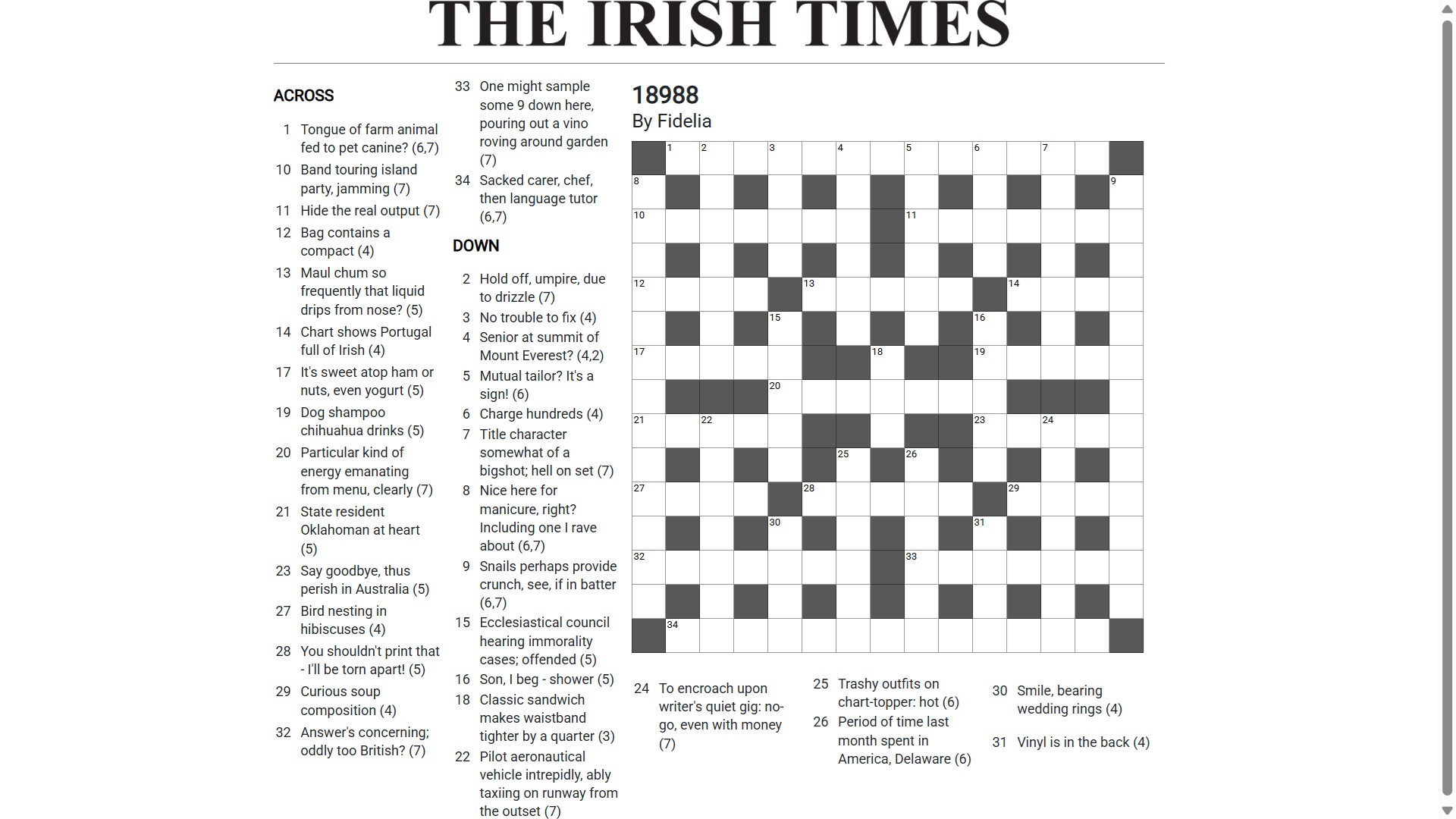
I see that the screen grab misses the clue for 23 across, which is “Say goodbye, thus perish in Australia (5)”. That’s one of the easy clues; the solution is ADIEU. Other easy ones are 18 down (BLT) and 20 across (NUCLEAR)

Overall, it’s a fairly straightforward cryptic puzzle, with conventional wordplay, but there are one or two points of interest.

The first – and this seems to be a trademark – is that the four clues around the perimeter (1 across, 8 down, 9 down and 34 across) are thematically linked. The theme is also sometimes referenced elsewhere. Obviously getting these solutions is an enormous help in completing the grid. When I looked at 1 across I immediately suspected that “Tongue” might mean a language. I then saw an anagram for RIVIERA on 8 down and the starting word “Nice” gave the game away entirely. The four perimeter clues are thus: FRENCH BULLDOG, FRENCH RIVIERA, FRENCH CUISINE and FRENCH TEACHER; 33 down also refers to the French theme.

Other than that I see that there are more ‘hidden word’ type clues than one would normally see in a UK cryptic, such as the clue for NUCLEAR mentioned above. Another one is “Dog shampoo chihuaua drinks (5)” which is “pooch”, although I am not convinced by “drinks” as the indicator!

I also had to think about 14 across “Chart shows Portugal full of Irish (4)”; I thought it had to be PLAN but couldn’t parse the rest until I found out that lán is “full” in the Irish language, hence “full of Irish” with “P” for “Portugal”. I don’t think there are many references to Irish words in Crosaire, generally.

I’m no speed merchant when it comes to crosswords, but this one took me 10 minutes to solve. If you’re interested, the full solution with notes can be found here. Maybe I’ll try to get into the habit of solving this more frequently. That might provide a little compensation for the generally woeful Opinion pieces cluttering up the newspaper. Also, with retirement on my mind, I wonder if the Irish Times – or any other newspaper – is looking for any more setters?

P.S. Crosaire was the pseudonym taken by the original setter John Derek Crozier, as a play on his own name and on the Irish word for “crossroad”. The Irish word for “crossword” is crosfhocal.
In the Good Books

Posted in Biographical, Literature with tags , , , , on March 25, 2025 by telescoper

It seems like eternity since I was on sabbatical and had enough time to get stuck in to some reading not related to work. Since I got back from Barcelona last September I’ve lapsed and haven’t read many books since then. I keep reading reviews in the Times Literary Supplement but that’s as close as I generally get.

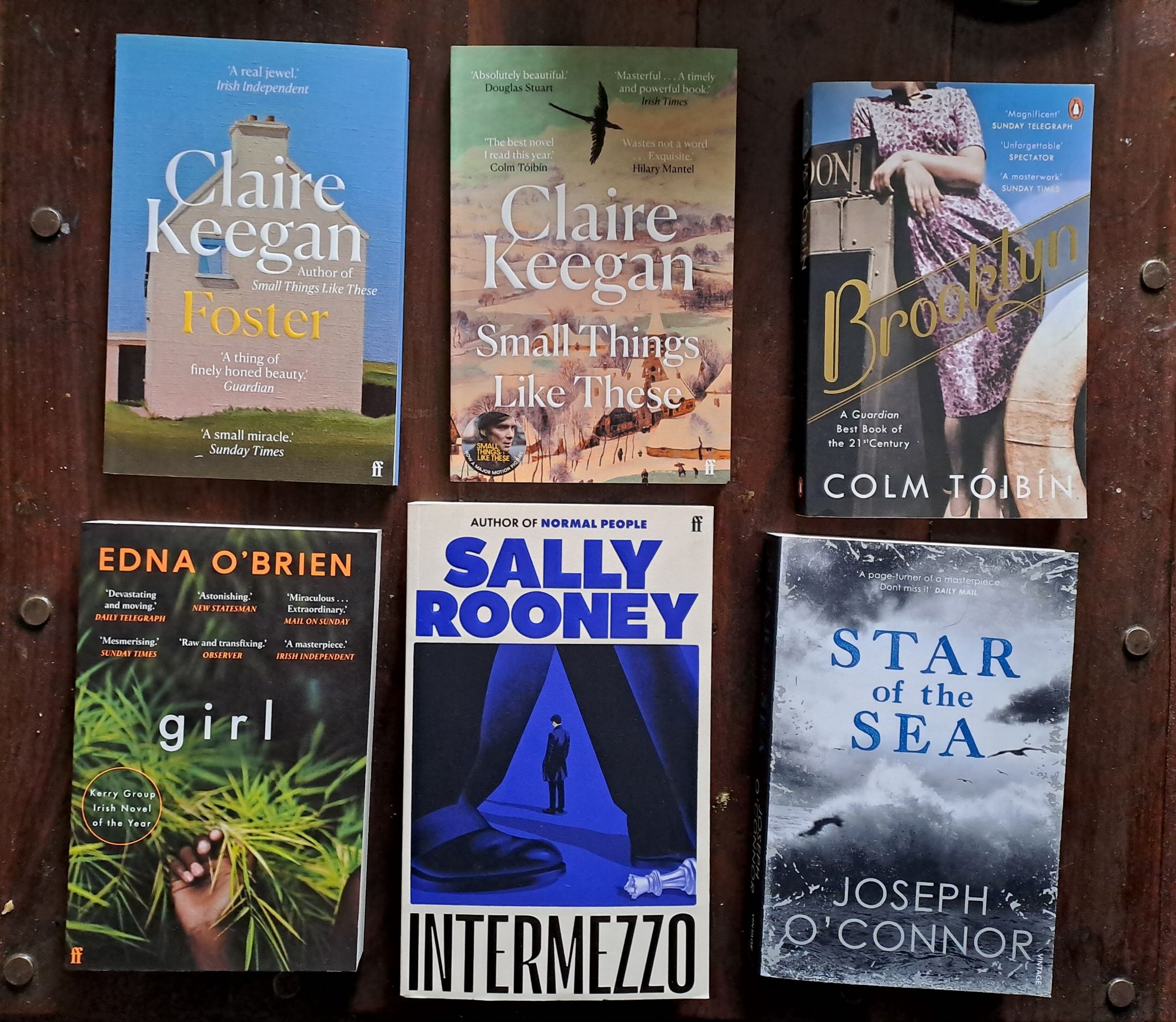
It’s been in my mind for a while to rejuvenate my interest in literature but last week I had two specific triggers. One was the news that Amazon has opened a dedicated website in Ireland. I view that as a trigger not in a positive way but because it will make life even harder for our excellent local bookshop in Maynooth so I felt I should do more to support them. The other trigger was that the Irish Times published a list of the “best” 100 Irish novels of the 21st Century. When I saw I had only read a few of them, and feel I should read more contemporary literary fiction emanating from Ireland, I decided I should use the list as a guide to help me get back into a reading habit. Anyway, I went to the bookshop last week and bought these six to start with:

These aren’t the top six, by the way. They’re just the ones that caught my fancy while I was browsing in the store.

I’m going to start with Claire Keegan’s novella Foster, as it was this work that inspired the beautiful Irish language film An Cailín Ciúin which I blogged about here. It’s quite short, so it should provide me with a relatively gentle re-introduction to reading. I have’t decided in what sequence I will read the others. It remains to be seen when I can get another six let alone how long it will take for me to read all the books on the list!

Any comments on these books, or indeed any others either on the top 100 list or not would be welcome!

Blue Sky Research in Ireland

Posted in Maynooth, Science Politics, The Universe and Stuff with tags , , , , on January 31, 2025 by telescoper

There’s a new piece in the Irish Times (sponsored by the recently formed Research Ireland, but probably behind a paywall) that makes promising noises about “Blue Skies” research. No jokes about the Irish weather, please. I quote:

The merger of Science Foundation Ireland (SFI) and the Irish Research Council (IRC) to form Research Ireland on August 1st, 2024, has opened up new possibilities and opportunities for the Irish research community. The new organisation now oversees competitive research funding across all disciplines, ranging from the arts, humanities and social sciences through to science, technology, engineering and maths, as well as across the full spectrum spanning curiosity-driven to applied research.

“SFI was enterprise and Stem-focused,” explains Research Ireland deputy chief executive Dr Ciarán Seoighe. “The IRC was not set up on a statutory basis so that meant that the arts, humanities and social sciences [AHSS] were not in the statutory research funding system. That put us behind other countries. We weren’t getting the full benefit of research in those areas. By creating Research Ireland we are able to support the full spectrum.”

He also points out that SFI wasn’t able to fund blue-skies, fundamental research, but Research Ireland can. “We need that research to create the new ideas and innovations that become applied research in years to come. By creating Research Ireland, we now have the ability to tap into and unlock the full potential of research in Ireland.”

The last bit is encouraging – or at least less discouraging – for those of us who work in fundamental science than the previous regime. The thing that struck me immediately when arriving in Ireland from the UK that funding for basic or fundamental research – especially in the sciences – is extremely poor. That is still the case now. This situation is largely the result of a high-level report published in 2012. This identified 14 priority areas of research that are most likely to give demonstrable economic and societal return, and where Ireland should focus the majority of competitive funding. Four criteria were used in selecting the 14 priority areas for future, competitively-awarded investment for economic objectives:

  1. the area is associated with a large global market or markets in which Irish-based enterprises already compete or can realistically compete;
  2. publicly performed R&D in Ireland is required to exploit the area and will complement private sector research and innovation in Ireland;
  3. Ireland has built or is building (objectively measured) strengths in research disciplines relevant to the area; and,
  4. the area represents an appropriate approach to a recognized national challenge and/or a global challenge to which Ireland should respond.

The `vast majority’ of SFI’s funding was directed towards the 14 areas so defined, leaving virtually nothing for anything else, an outcome which has dire implications for `blue skies’ research.

I think this is a deeply misguided short-term policy, which has had and will continue to have strongly negative effects on science in Ireland in the medium to long term, especially because Ireland spends so little of its GDP on research in the first place. There’s simply no point in trying to persuade world-leading researchers to come to Ireland if insufficient funds are available to enable them to establish here; the politicians’ welcoming platitudes will never be enough. This makes appointment of world-class researchers to Irish universities extremely difficult so, given that is what we are trying to do in Maynooth now, the change of tone is welcome.

The problem is that the creation of Research Ireland has not involved any more money that was previous allocated to the SFI and IRC separately. Unless there is a budget uplift – which in my view would be a good use for at least part of the huge windfall tax from Apple – any increase in basic research will have to be offset by cuts elsewhere.

It seems appropriate re-iterate part of my response to a previous funding crisis in the UK, about using taxpayer’s money to fund research in universities:

… “commercially useful” research should not be funded by the taxpayer through research grants. If it’s going to pay off in the short term it should be funded by private investors, venture capitalists of some sort or perhaps through some form of National Investment Bank. When the public purse is so heavily constrained, it should only be asked to fund those things that can’t in practice be funded any other way. That means long-term, speculative, curiosity driven research.

This is pretty much the opposite of what Irish government thinks. It wants to concentrate public funds in projects that can demonstrate immediate commercial potential. Taxpayer’s money used in this way ends up in the pockets of entrepreneurs if the research succeeds and, if it doesn’t, the grant has not fulfilled its stated objectives and the funding has therefore, by its own standards, been wasted.

My proposal, therefore, would be to phase out research grants for groups that want to concentrate on commercially motivated research and replace them with research loans. If the claims they make to secure the advance are justified, they should have no problem repaying the funds from the profits they make from patent income or other forms of exploitation. If not, then they will have to pay back the loan from their own funds (as well as being exposed as bullshit merchants). In the current economic situation the loans could be made at very low interest rates and still save a huge amount of the current research budget. I suggest these loans should be repayable in 3-5 years, so in the long term this scheme would be self-financing. I think a large fraction of research in, e.g., the applied sciences and engineering should be funded in this way. I think it is wrong to nationalise the risk only to privatise the profits.

The money saved by replacing grants to commercially driven research groups with loans could be re-invested in those areas where public investment is really needed, such as purely curiosity-driven science. Here grants are needed because the motivation for the research is different. Much of it does, in fact, lead to commercial spin-offs, and when that happens it is a very good thing, but these are likely to appear only in the very long term. But just because this research does not have an immediate commercial benefit does not mean that it has no benefit. For one thing, it is subjects such as Astronomy and Particle Physics that inspire young people to get interested in science in the first place.

A Piece of Euclid

Posted in Biographical, Euclid, Maynooth, The Universe and Stuff with tags , , on January 6, 2022 by telescoper

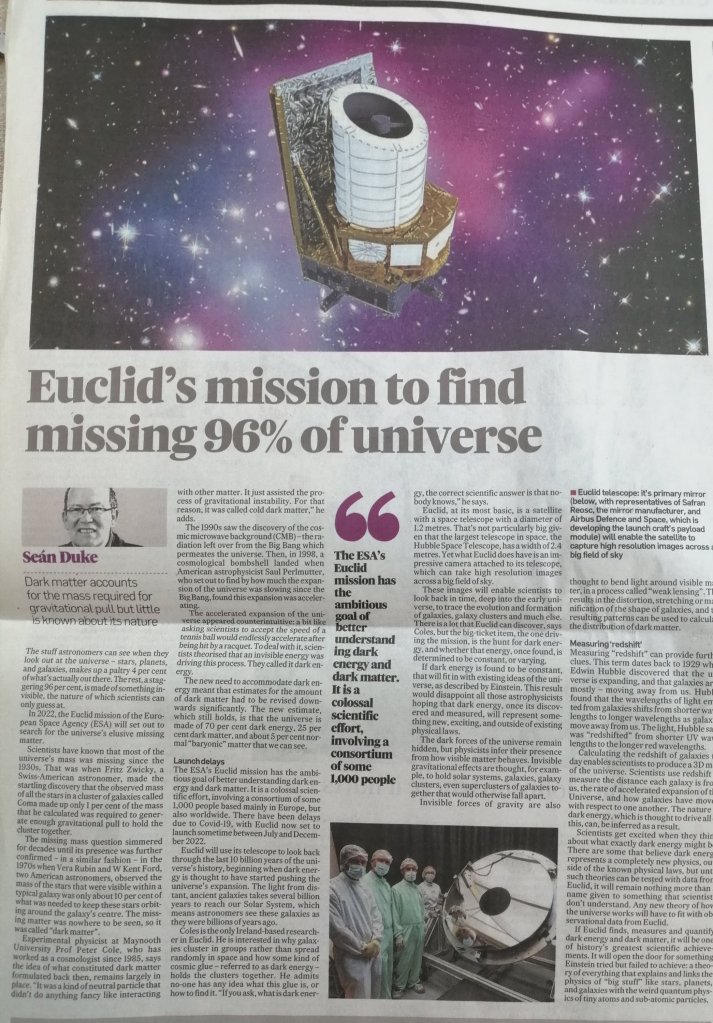
Fame at last! A colleague from the Department of Theoretical Physics at Maynooth University told me the above piece appeared in today’s Irish Times so I rushed out and bought the paper. My rapture was rapidly modified however when I discovered that my name was given incorrectly (as Cole instead of Coles), but that was to some extent offset by the amusement it would give my colleagues to see me described as an “Experiment Physicist”. These two slips are now corrected in the online version of the article which you can find here.

I was quite surprised by the sudden appearance of the article today because I spoke to the writer, Seán Duke, about Euclid well over a year ago (May 2020). That’s the reason that some things are a bit out of date. For example, the launch of Euclid will now not take place until the first quarter of 2023. Also the piece states that the largest telescope in space is the Hubble Space Telescope (HST) which is no longer the case (as of Christmas Day 2021…).

I’ll leave it as an exercise for the student to spot any other errors. Please feel free to point them out through the Comments Box. If you’re not banned, that is…

Covid-19 in Ireland: where it all went wrong

Posted in Covid-19, Politics with tags , , on January 10, 2021 by telescoper

I don’t buy a daily paper, but I am a regular reader of the Irish Times Weekend edition. The reporting, especially on international news, is generally good and although it is basically an Establishment newspaper it is fairly balanced. That can’t be said for the opinion pieces however, which are frequently execrable. A particularly shitty example is provided by a column by Political Editor Pat Leahy in this Weekend’s edition.

It’s bad enough that he writes as if the most important thing about the pandemic is not that people are dying but that there might be implications for Ireland’s political establishment. And that he takes the opportunity to take churlish swipes like “Many public servants have, of course, been working furiously hard. Some haven’t.” As a public servant who has put in countless hours of unpaid overtime over the past year that snide comment really got my goat, coming as it does from a Political Editor who trots out lazy evidence-free rubbish for a living.

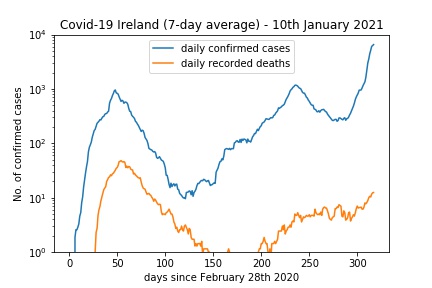
This is the trajectory of the Covid-19 pandemic in Ireland.

Restrictions were lifted on 1st December. New cases started to climb steeply almost immediately, doubling roughly every 7 days. It was obvious then – by simple extrapolation of the exponential curve – that there would be around 1000 new cases per day by Christmas and about 2000 by New Year.

The only reason we didn’t have 2000 cases per day by 31st December was that the system couldn’t cope with so many positive test results and a backlog developed. Today, 10th January, 6888 cases were reported. Hospitalizations, ICU admissions and, sadly, deaths are now tracking upwards after the inevitable delay.

Loosening the restrictions with new cases at hundreds per day always looked to me to be very wrong-headed. I’m not happy to have been proven right.

Against this backdrop Pat Leahy says this:

What?

This is simply untrue. It is true that there was a general expectation that the growth curve would not be so steep, with perhaps 500 cases by Christmas. That was wrong by about a factor two but given the doubling time and no interventions 1000 would have been reached a week later. As someone who argued for relaxation in December, Mr Leahy is rather obviously trying to rewrite history to make him appear less culpable.

In my view the reason why the residual restrictions in December did not slow the increase in Covid-19 cases was that the messaging from the Government was too complicated, had too many exceptions, and gave the appearance that it was arbitrary and without clear justification. This, together with persistent lobbying by vested interests in the hospitality sector, encouraged enough people to ignore even the weakened restrictions in the run-up to Christmas and through the holiday period. In short, the Government has lost the room. Worryingly, I don’t think that it understands this even now.

Even now with a dire health emergency in clear view, I still see people circulating in groups without face coverings. What went wrong, in my opinion, is that the Government was too weak to stick to the advice given to it from the National Public Health Emergency Team and instead started tinkering about trying to satisfy various lobby groups.

But back to Mr Leahy. The statement that “nobody suggested the price for Christmas would be so severe” is plainly untrue: plenty of people knew exactly what was coming and said so loudly and publicly. Neither he nor the politicians listened. If there’s any justice the “political fallout” from this catastrophic weakness will be severe.

Anyway, after being angered by that dreadful Opinion column I’m seriously thinking of switching to a different paper. Any suggestions?

The War of Independence

Posted in History with tags , , on June 3, 2020 by telescoper

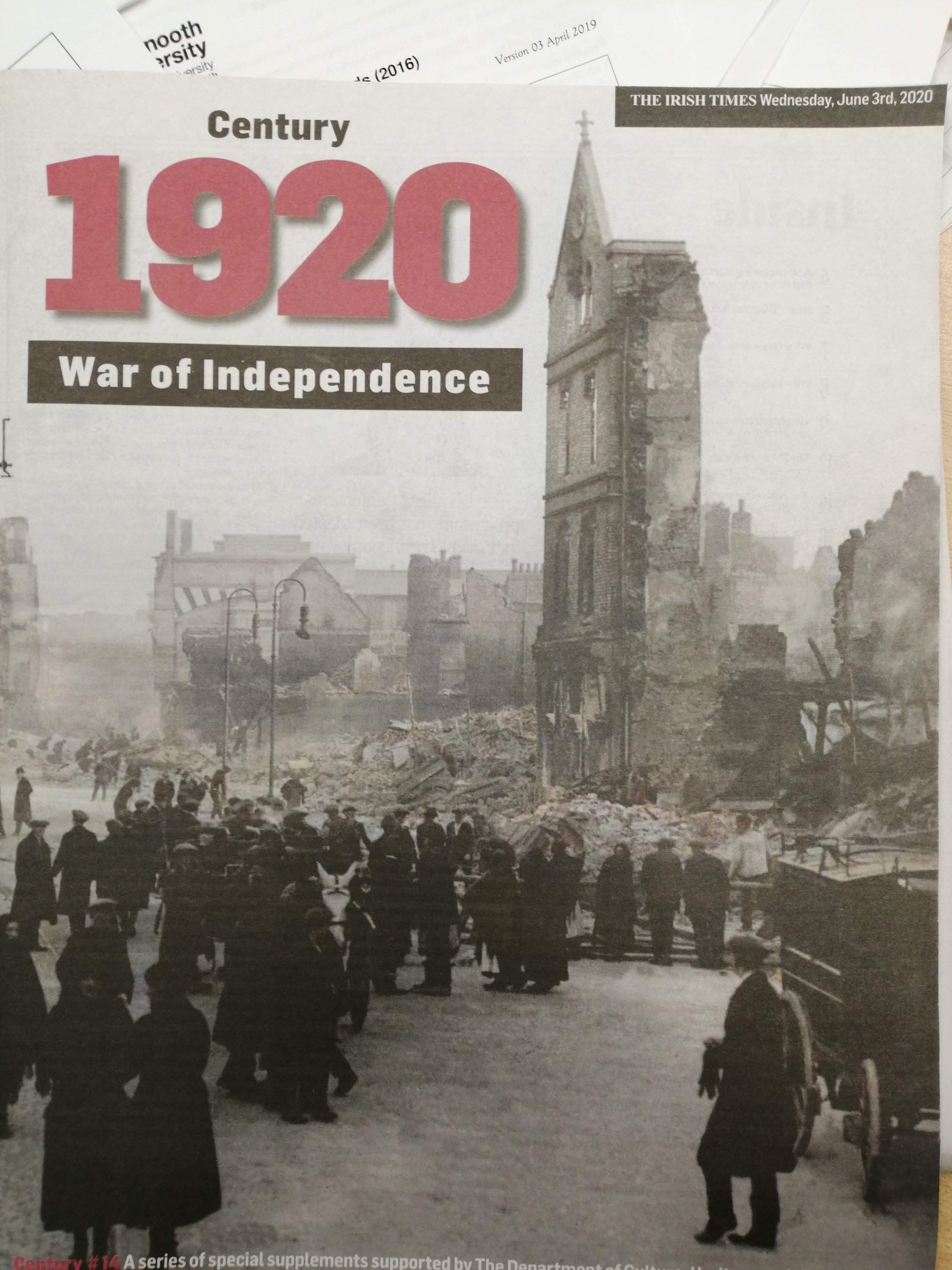
There is an excellent magazine supplement with today’s Irish Times looking back at the Irish War of Independence, which was raging a century ago. There’s a lot to digest in the magazine and it will take me a while to read all the articles in it.

The War of Independence began in earnest at the start of 1920 but the cycle of violence ramped up rapidly with the arrival of the infamous Blank and Tans in March and, later on, the equally infamous Auxiliaries. It was the latter who burned the city of Cork to the ground in October 1920, the aftermath of which event which provides the cover picture to the supplement.

The War of Independence ended in summer 1921 with a ceasefire and subsequently the Treaty that led to Partition and a Civil War.

The centenary commemorations of the Easter Rising of 1916 and the War of Independence in Ireland have generally taken the form of the heroic narrative of a liberation struggle, but the Civil War is a matter that many still find painful to confront. It will be interesting to see what the mood of the country will be like when that centenary arrives.

Not Really Irish?

Posted in Biographical, Politics with tags , , , on October 23, 2019 by telescoper

I’m taking a quick break for coffee and remembered an article I saw in the Irish Times at the weekend about British immigrants in Ireland. Being one such myself I find a lot of it rings true. You can read the article here (I don’t think it’s behind a paywall). I think it’s well worth a look.

I found quite a few things in it resonate quite strongly with my experiences since I arrived here a couple of years ago. Top of these was the realization of just how ignorant I was about Irish history, thanks to the almost total neglect of this topic in British schools. Lack of education inevitably leads to lack of understanding and more often than not leads to prejudice and one finds a lot of that in the attitude of British people, even senior figures (many of them “educated” at Oxford) who are supposed to know better.

Another point I recognize is how many people ask me to explain Brexit, as if being British means that I should be able to do that. I don’t understand the madness that has descended on Britain but I feel it in my bones that the United Kingdom is headed for very dark times indeed.

I was also struck by the “Not Really Irish” tag, which I think about rather a lot. It’s not really just a question of whether or not you have Irish citizenship or an Irish passport, it’s about the extent to which you belong. I spent over fifty years living in England and Wales so I’m missing a huge amount of cultural background. I won’t ever be able to catch up so I don’t suppose I’ll ever feel `really Irish’. Of course people speak English here but I’m very conscious that I have a funny accent. I suppose that means I’ll always feel like a stranger in Ireland. If there is predominant attitude towards the British over here, however, in my experience it is one of sympathy rather than hostility. And the general friendliness of the locals means that this isn’t a bad place at all to be a stranger.

One final comment: it was mentioned in the Irish Times piece that there are a lot of British TV programmes on Irish television. I do not regard that as a positive at all! In fact I stopped watching UK television long before leaving the UK and have not started again since I moved here.

I wonder how different it feels to be an Irish person living in Britain right now? That might make for an interesting complementary article for a future edition of the Irish Times?

University News

Posted in Education, Politics with tags , , , , , , on April 28, 2019 by telescoper

As we stagger towards Week 11 of this twice-interrupted Semester I’m back in the office preparing stuff for another set of lectures. This term seems to have gone on forever, largely because of the two breaks (one at half-term around St Patrick’s Day, and other other for Easter). Now, though, the end is in sight. Or at least the examination period is: there are just two more weeks of lectures, ending on 10th May then a short break, then examinations start (on 17th May). Then, of course, there is marking, checking, conflating exam grades with coursework marks, examination boards, and all the other stuff that go on behind the scenes.

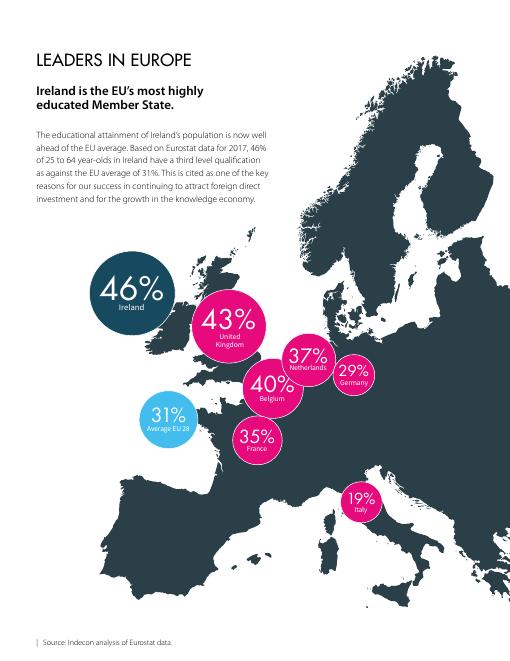
I noticed that this weekend’s edition of the Irish Times included a hard copy of a report called Delivering for Ireland: The Impact of Irish Universities which was produced by the Irish Universities Association. In fact the thing given away with the paper is just a summary report (you can download it in PDF format here). The full report (all 86 pages of it) can be downloaded here.

The report is full of interesting information, including this (which I didn’t know before):

The report was produced with the aim of making the case for further investment in Ireland’s universities. It remains to be seen whether the current Irish government will be persuaded. I’m not holding my breath. right-wing governments never seem to be interested in investing in the future. I think the best we can hope for is that Ireland does not continue its policy of slavishly copying English Higher Education policy, especially with the introduction of student loans and high tuition fees.

And talking of the idiocies of the English University system, there is a story going around that the UK Government is planning to make EU students pay full `Overseas’ fees after Brexit. Actually, Higher Education policy is a devolved matter so this can only be directly enforced on English universities. It will, however, be hard for Scottish Welsh and Northern Irish institutions to resist the consequences.

In fact I’ve long felt that the existing system – in which Home and EU students have to be treated the same way as a matter of law but non-EU students can be charged different (i.e. higher) fees is completely immoral. Once at university students are all taught the same way so why should some be charged more than others because they happen to come from China? What would you think of a shop that tried to charge people different prices for the same goods depending on the nationality of the customer?

This decision is of course an inevitable consequence of Theresa May’s interpretation of the EU referendum result as a mandate for policies of extreme xenophobia, as is the withdrawal from Erasmus. It is just another symptom of the UK’s descent into narrow-minded insularity. The message this decision sends out is that Britain hates foreigners but it likes their money so the rich ones who can pay extortionate fees will be graciously allowed to come here to get fleeced. Does the government really think that EU citizens are daft enough to come to a country that identifies itself in such a way? I don’t think they are. They’ll just find somewhere else to go, and the consequence for UK universities will be severe. I am confident this will push more than one UK higher education institution into bankruptcy.

Anyway, even if the the Irish university continues to be under-resourced, it will at least continue to welcome students from the EU on the same basis as before. So if you’re a European student who was thinking about studying in England, why not come to Ireland instead? It’s far cheaper, and we even have the same weather…

160 Years of the Irish Times

Posted in Biographical, Crosswords, Politics with tags , , on March 30, 2019 by telescoper

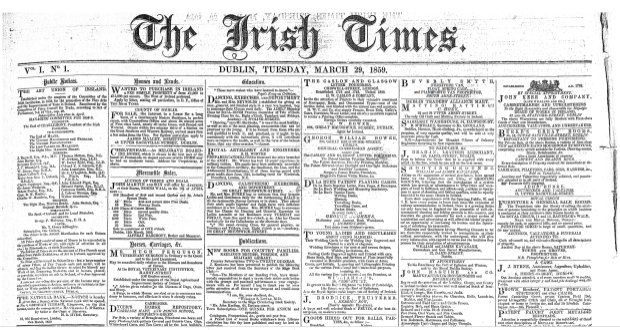
With all the shenanigans surrounding yesterday’s non-Brexit Day I quite missed the news that March 29th 2019 was an important for my newspaper of choice, The Irish Times, which was first published on March 29th 1859, the front page of which is reproduced above. Initially The Irish Times was only published on Tuesdays, Thursdays and Saturdays but it became a daily paper a few months after its launch, in June 1859.

The first edition promised to

make a first-rate Irish newspaper, complete in its details, sagacious and consistent in its policy and faithfully reflecting the opinions of the most independent, intelligent and truly progressive portion of Irish society.

That pretty much applies to it now, I’d say. Interestingly, though, it started out as a staunchly Unionist paper and every one of its editors until 1986 was a Protestant.

I don’t buy a paper every day but I do always get the Weekend Edition, which is full of excellent writing (even if often disagree with its take on various things).

It’s interesting to note that the front page of the first edition was dominated by goings-on in the House of Commons in Westminster, as is today’s edition. Plus ça change..

The only real drawback to the Irish Times is that it doesn’t have a very good cryptic crossword. Fortunately, the UK papers give theirs away for free so I now do the Financial Times, Guardian and Observer Prize Crosswords without buying them.