This poster, advertising a forthcoming Summer School in honour of the famous mathematician Paul Erdös arrived this morning, so I thought I’d advertise it through this blog.
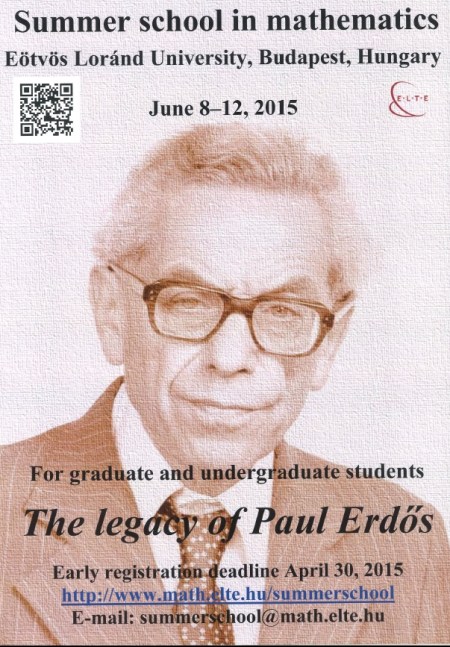
In case you didn’t know, Paul Erdős (who died in 1996) was an eccentric yet prolific Hungarian mathematician who wrote more than 1000 mathematical papers during his life but never settled in one place for any length of time. He travelled constantly between colleagues and conferences, mostly living out of a suitcase, and showed no interest at all in property or possessions. His story is a fascinating one, and his contributions to mathematics were immense and wide-ranging, and I’m sure the conference in his honour will be fascinating.
A strange offshoot of his mathematical work is the Erdős number, which is really a tiny part of his legacy, but one that seems to have taken hold. Some mathematicians appear to take it very seriously, but most treat it with tongue firmly in cheek, as I certainly do.
So what is the Erdős number? It’s actually quite simple to define. First, Erdős himself is assigned an Erdős number of zero. Anyone who co-authored a paper with Erdős then has an Erdős number of 1. Then anyone who wrote a paper with someone who wrote a paper with Erdős has an Erdős number of 2, and so on. The Erdős number is thus a measure of “collaborative distance”, with lower numbers representing closer connections. I say it’s quite easy to define, but it’s rather harder to calculate. Or it would be were it not for modern bibliographic databases. In fact there’s a website run by the American Mathematical Society which allows you to calculate your Erdős number as well as a similar measure of collaborative distance with respect to any other mathematician. Also, a list of individuals with very low Erdős numbers (1, 2 or 3) can be found here. I did a quick poll around the Department of Mathematics here at the University of Sussex and it seems that the shortest collaborative distance among the staff belongs to Dr James Hirschfeld who has an Erdos Number of 2. There is a paper of his, with M. Deza and P. Frankl, Sections of varieties over finite fields as large intersection families, Proc. London. Math. Soc. 50 (1985), 405-425 and both Michel Deza and Peter Frankl have joint papers with Paul Erdős.
Given that Erdős was basically a pure mathematician, I didn’t expect first to show up as having any Erdős number at all, since I’m not really a mathematician and I’m certainly not very pure. However, his influence is clearly felt very strongly in physics and a surprisingly large number of physicists (and astronomers) have a surprisingly small Erdős number. Anyway, my erstwhile PhD supervisor Professor John D. Barrow emailed to point out that he had written a paper with Robin Wilson, who once co-authored a paper (on graph theory) with Erdős himself. That means that John’s Erdős number is now 2, mine is consequently 3 (unless, improbably, I have unkowingly written a paper with someone who has written a paper with Erdős). Anyone I’ve ever written a paper with has an Erdős number no greater than 4; they of course may have other routes to Erdős than through me.
Anyway, none of that is important compared to the real legacy of Erdős, which is his mathematical work. I’m sure the Summer School will be both rewarding and enjoyable!



 In the Dark