Archive for James Webb Space Telescope

The First Deep Field from JWST

Posted in Astronomy Lookalikes, The Universe and Stuff with tags , , , , , on July 12, 2022 by telescoper

I have to say that I didn’t stay up to watch the live stream of last night’s preview of this afternoon’s release of the first images from the James Webb Space Telescope. It started very late and I got sick of listening to the dreary music on the feed so went to bed. Nevertheless here is the first picture:
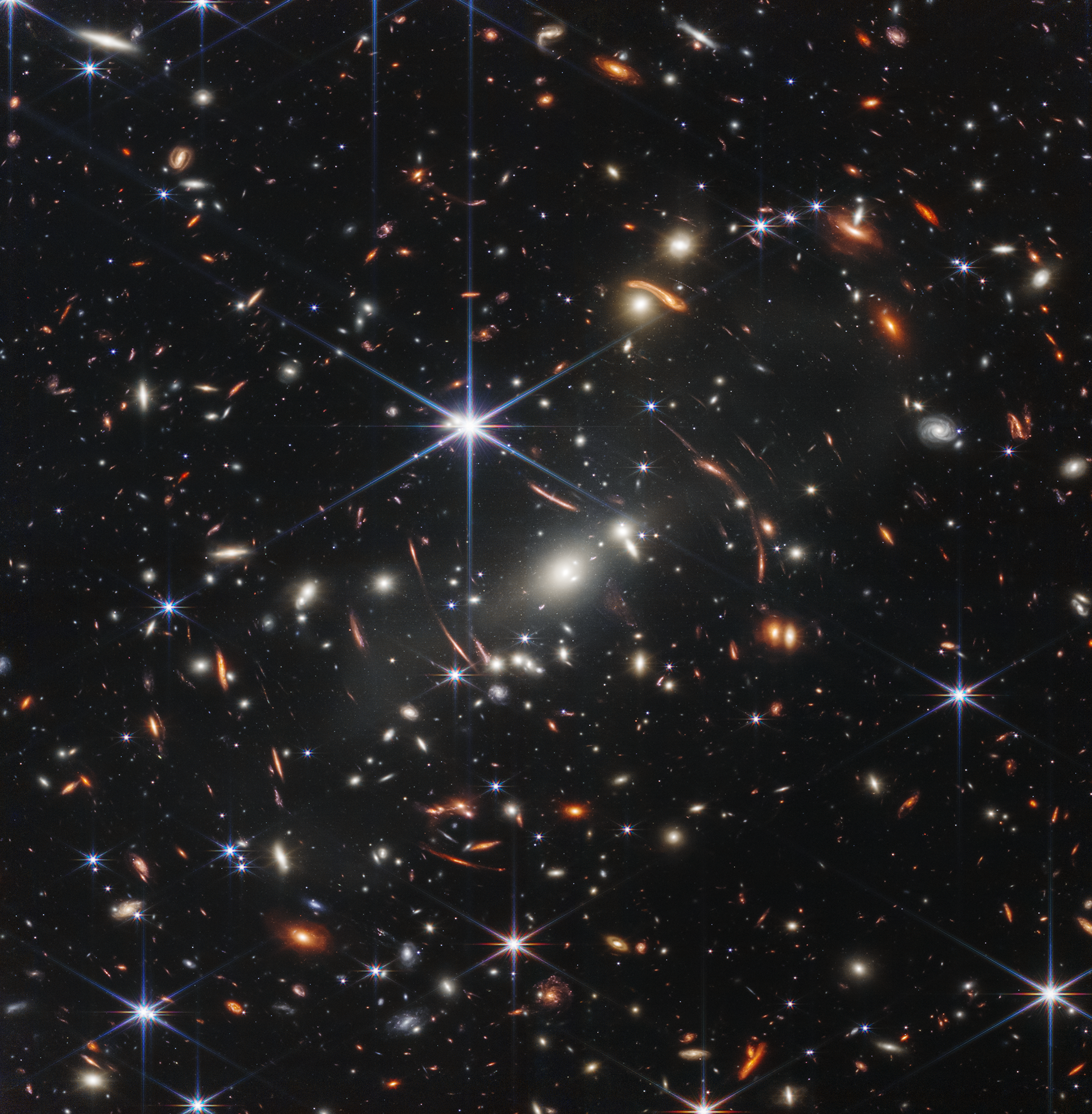
Credits: NASA, ESA, CSA, and STScI

This is a deep field image taken using JWST’s NIRCAM (Near-Infrared Camera). Note that the artifacts you see around some objects are diffraction spikes which occur around bright sources; their six-fold symmetry reflects the hexagonal structure built into the JWST’s mirror assembly. Sources sufficiently bright and compact enough to cause these spikes in deep field images are foreground stars: the extended, fainter objects are all much more distant galaxies.

The description from the NASA page is:

NASA’s James Webb Space Telescope has produced the deepest and sharpest infrared image of the distant universe to date. Known as Webb’s First Deep Field, this image of galaxy cluster SMACS 0723 is overflowing with detail.

Thousands of galaxies – including the faintest objects ever observed in the infrared – have appeared in Webb’s view for the first time. This slice of the vast universe is approximately the size of a grain of sand held at arm’s length by someone on the ground.

This deep field, taken by Webb’s Near-Infrared Camera (NIRCam), is a composite made from images at different wavelengths, totaling 12.5 hours – achieving depths at infrared wavelengths beyond the Hubble Space Telescope’s deepest fields, which took weeks. 

The image shows the galaxy cluster SMACS 0723 as it appeared 4.6 billion years ago. The combined mass of this galaxy cluster acts as a gravitational lens, magnifying much more distant galaxies behind it. Webb’s NIRCam has brought those distant galaxies into sharp focus – they have tiny, faint structures that have never been seen before, including star clusters and diffuse features. Researchers will soon begin to learn more about the galaxies’ masses, ages, histories, and compositions, as Webb seeks the earliest galaxies in the universe

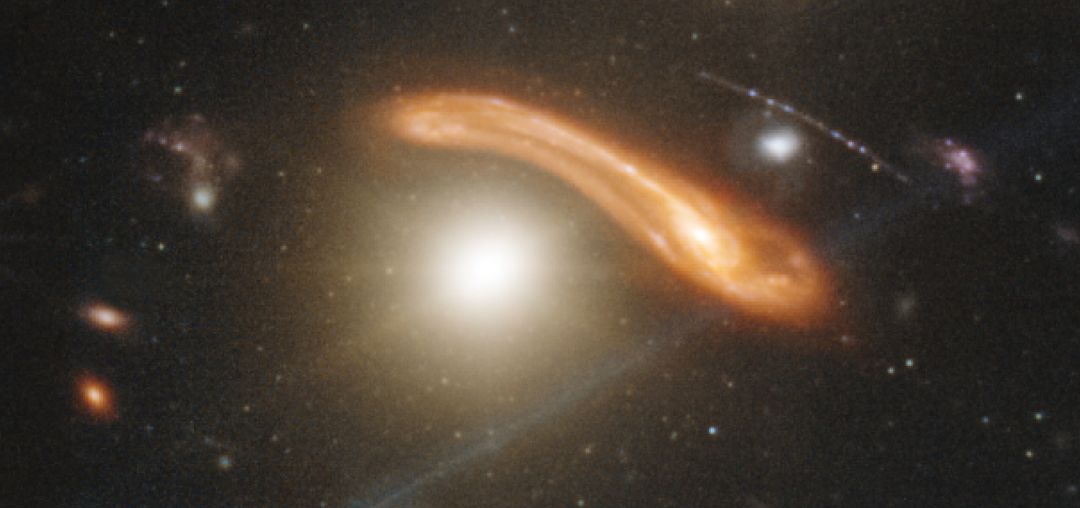
Here is a close-up of one of the distorted galaxy images and othe features produced by gravitational lensing:
We’re having a special viewing in Maynooth this afternoon of the press conference which will unveil more new images from JWST – nice telescope, shame about the name. I may add comments on here if anything particularly exciting turns up. You can watch it here:

Let’s hope this one starts on time!
First Light at L2 for JWST

Posted in History, The Universe and Stuff with tags , , , on February 5, 2022 by telescoper

After a successful launch, subsequent deployment of its sunshield and mirrors, and arrival at its orbit around the Second Lagrange Point, the goal now for the James Webb Space Telescope is to align the optical components of the telescope to the required accuracy. This is not a simple task – each of the segments of the main mirror has to be aligned to within a fraction of a wavelength of the light it will observe (in the near-infrared part of the electromagnetic spectrum) – and it will take several months to complete. However, we did hear yesterday that the telescope has now seen “first light”, in the sense that the first photons have landed on its detectors. The first images to be formed will be blurry and distorted, but these will be used to adjust the components until they reach the required sharpness.

For more details of this process see here.

Incidentally, it is worth saying a little bit about L2, the second Lagrange point of the Earth-Sun system. As the diagram below shows, this orbits the Sun at a greater distance from the Sun than the Earth. According to Kepler’s Laws, and ignoring the Earth’s gravitation, a test particle placed in a circular orbit at this radius would move more slowly than the Earth and would not therefore hold a fixed position relative to the Earth and Sun as it went around. The effect of the Earth’s gravity however is to supply an extra force to speed it up a bit, so it can keep up and thus remain in a fixed configuration relative to both Earth and Sun.

The opposite applies to L1: an object placed here would, in the absence of Earth’s gravity, move more quickly and thus pull ahead of the Earth. Having the Earth there holds it back by just the right amount to maintain a fixed position in the rotating frame.

The interesting thing about L1 & L2 is that while they are both equilibrium points, they are both unstable to radial perturbations. An object placed at either of these points would move away if disturbed slightly. JWST does not therefore just sit passively at L2 – it moves in a so-called halo orbit around L2 a process which requires some fuel. It’s not that there’s an actual mass at L2 for it to orbit around, but that its motion produces a Coriolis Force that keeps it from moving away. It’s very clever, but does require a bit of energy to keep it in this orbit.

Unlike L1 & L2, the Lagrange Points L4 & L5 are stable and therefore attract all kinds of space junk, such as asteroids, cometary debris, and preprints by Avi Loeb.

Another interesting Lagrange Point is that Joseph-Louis Lagrange was born in 1736 in Turin, but that does not mean that he was Italian. At that time Italy did not exist as a political entity; in 1736 Turin was part of the Kingdom of Sardinia. Although born in the part of the world now known as Italy, he was never an Italian citizen. In fact he lived most of his life in Berlin and Paris and died in 1813, long before the Kingdom of Italy was founded (in 1861).

Webb Deployment

Posted in Biographical, The Universe and Stuff with tags on January 8, 2022 by telescoper

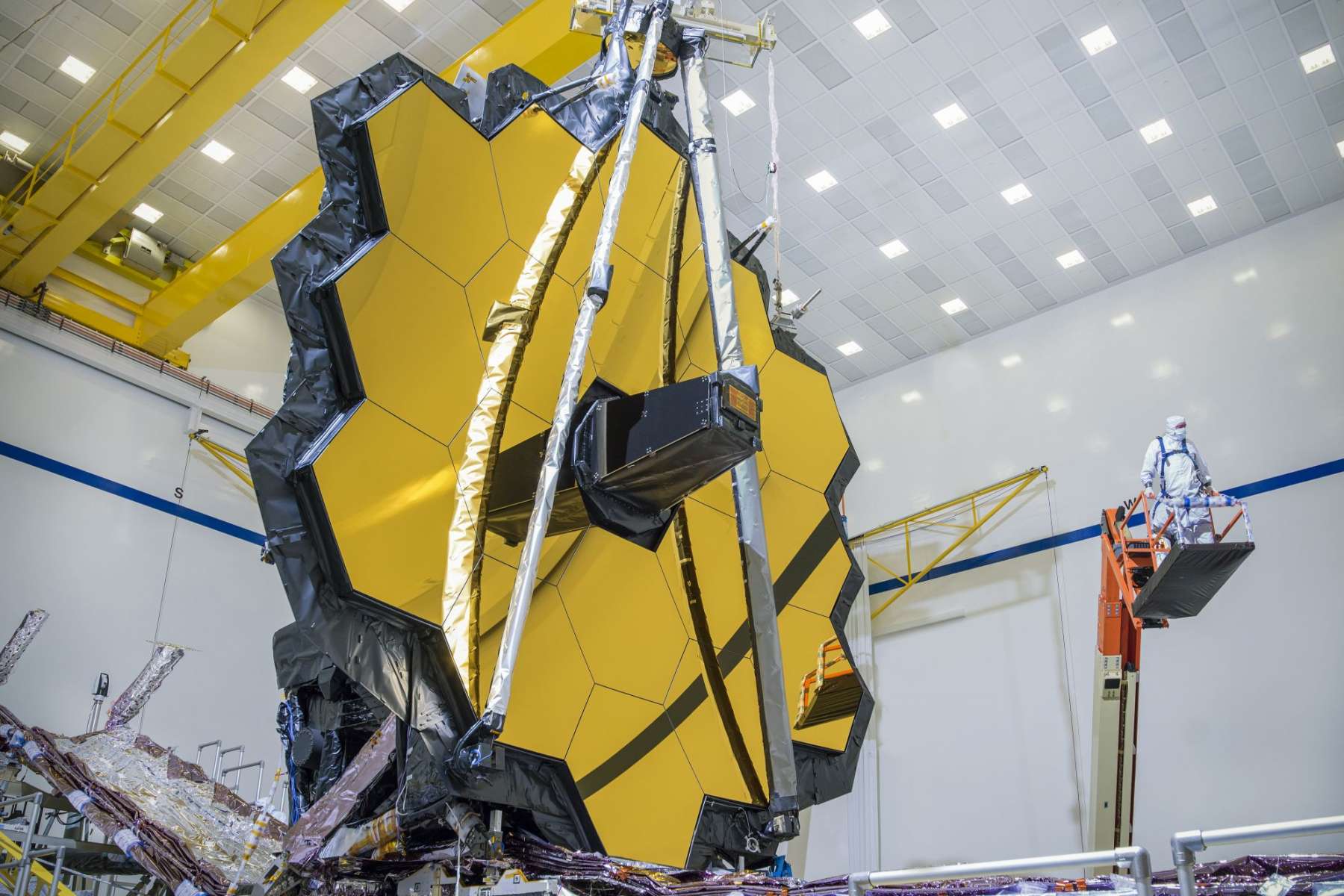
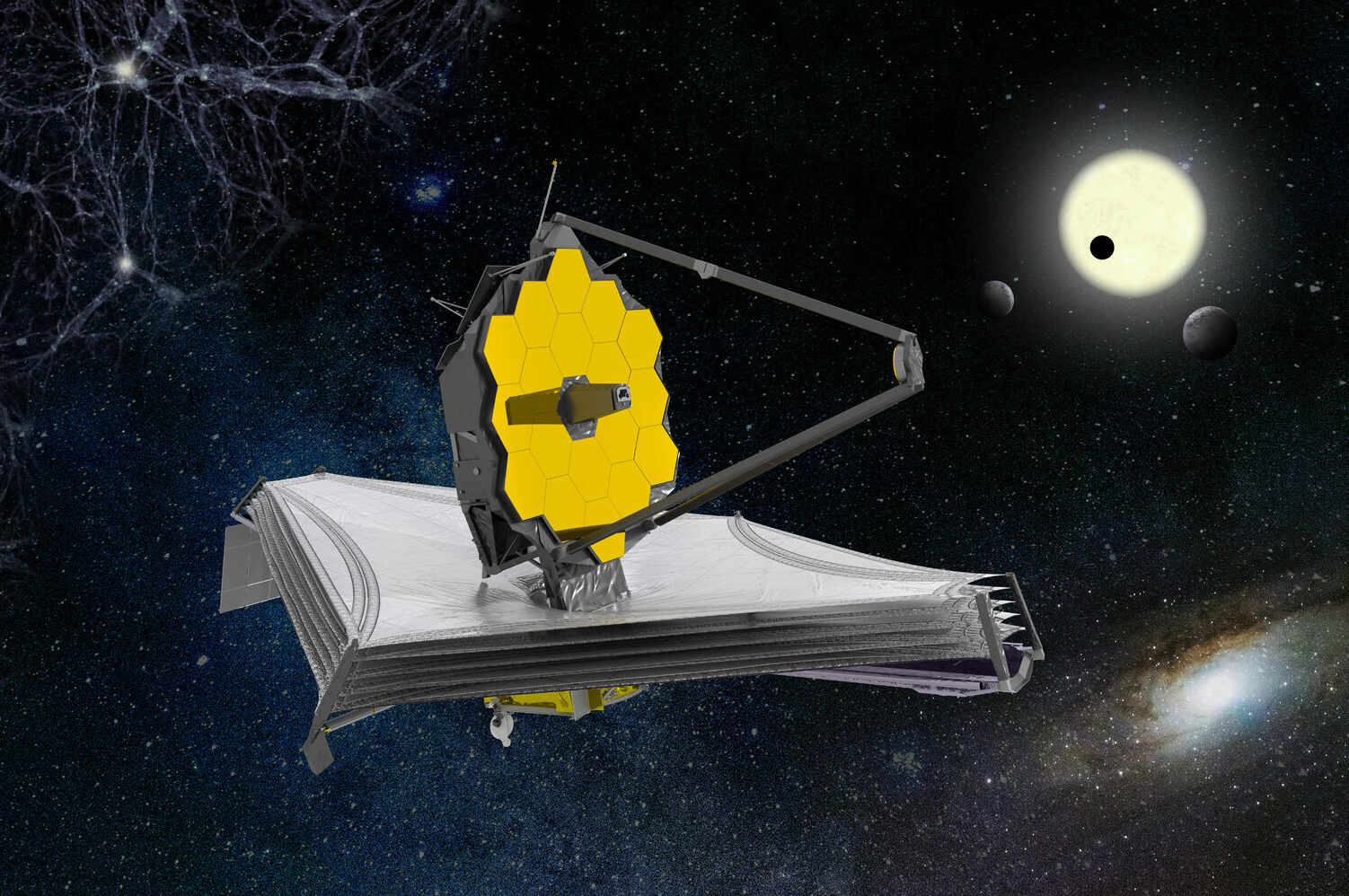
I’ve been busy all afternoon supervising an online examination and I’m now about to cook my dinner, which means I haven’t got time to post anything much but I will pass on the very welcome news that the James Webb Space Telescope has now completed the lengthy sequence of operations that were required to deploy a large sunshield, the primary and secondary mirrors and other bits and bobs needed to turn it into a proper observatory rather than just a basket of deployables. The whole thing should now look something like this:

Artists impression of Webb (with, by the look of it, a bit of the Cosmic Web)

There were over 300 potential single-point failures in this sequence so these last couple of weeks have been as stressful as the launch. Now commissioning work can begin.

This all gives me the excuse to have a celebratory drink just like I did on Christmas Day. Cheers!

On Nominal

Posted in The Universe and Stuff with tags , on December 26, 2021 by telescoper

Yesterday’s launch of the James Webb Space Telescope reminded me of something I blogged about many years ago. At regular intervals during the launch we heard staff at Mission Control in Kourou saying that everything was “nominal”. As always when wondering about the meaning of words, I searched in the One True Chambers Dictionary, where I found:

nominal, adj relating to or of the nature of a name or noun; of names; by name; only in name; so-called, but not in reality; inconsiderable, small, minor, in comparison with the real value, hardly more than a matter of form…

So was the so-called launch of JWST only in name, but not in reality? Was it faked? Is the telescope real?

That reminds me that years and years ago I had an idea for a crime novel with a plot that revolves around the murder of a prominent cosmologist just as some important scientific discovery is about to be announced. Suspicion gathers that the whole thing is an enormous hoax and the discovery bogus. But the experiment is shrouded in secrecy, and was so expensive that it can’t easily be repeated, so  who can tell, and how?

I wouldn’t put it past some conspiracy theorist to argue that the data from JWST (assuming there is some) is manufactured.

It’s very difficult to know for sure whether any scientific discoveries are genuine or not, even if the data and analysis procedures are made public. There’s always the possibility that everything might have been fabricated or simulated, but in most cases the experiment can be repeated at a later date and the fraud eventually exposed, such as in the Schön Scandal.  In Big Science, this may not be practicable. However, Big Science requires big teams of people and the chances are someone would blow the whistle, or try to…

Anyway, I know that there are people out there who take everything I write on this blog absurdly literally so I’ll spell it out that I am in no way suggesting that the James Webb Space Telescope is a fraud. Or predicting that there’ll be a murder just before the first observations are released. Any similarity purely coincidental and all that. And I’ve never had time to write the book anyway – perhaps a publisher might read this and offer me an advance as an incentive?

Moreover, going back to the Chambers Dictionary, I note the final definition given there and omitted above i

…according to plan (space flight)

So that’s that. Nothing sinister. I’m not sure how “nominal” acquired that meaning, mind you, but that’s another story…

Merry JWSTmas!

Posted in The Universe and Stuff with tags , , , , on December 25, 2021 by telescoper

Well it’s 10.20am on Christmas Day and I’ve got up specially early in order to be ready for the launch at 12.20pm today (Irish Time) of the James Webb Space Telescope from Kourou in French Guiana. The JWST project has been almost thirty years in the making and it is great that it is finally going to be heading into space. The launch however is just the start – JWST has a very complicated journey in front of it – as demonstrated by the following little video.

In particular, JWST should separate from the Ariane 5 launcher at about 27 minutes after takeoff so look out for that.

I have no direct personal involvement with JWST but I am still feeling a bit nervous. I can’t imagine how it must feel to have spent decades working on it. I know a great many astronomers around the world who are waiting anxiously and hoping all goes well. Fingers crossed!

If you want to watch the launch live you can do so on Youtube here:

You can find alternative viewing options here.

The launch window opens at 12.20 UTC and lasts for 31 minutes but I understand they’re going to launch as early as possible within that so it looks like we’re in for a launch before lunch rather than the other way round.

I’ll update with any news as the day goes on.

UPDATE: 12.28pm Launched right on time, everything nominal as JWST leaves Earth’s atmosphere propelled by Stage One of the Ariane 5.

UPDATE: 12.31pm Stage One jettisoned, Stage 2 ignition. All still nominal.

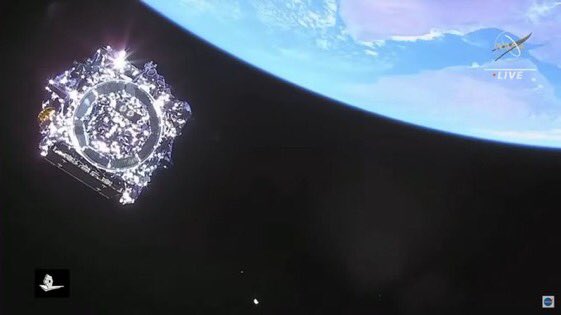
UPDATE: 12.48pm JWST has separated from the launch vehicle and is on its way. The solar panel is deployed and is working. The spectacular onboard video showing the separation of JWST from the Ariane 5 launch vehicle and the deployment of the solar panels was supplied by Irish company Réaltra.

P.S. I still think JWST should have had a different name.

Top Ten JWST Facts!

Posted in The Universe and Stuff with tags , , on December 4, 2021 by telescoper

The James Webb Space Telescope looks nothing like the Hubble Space Telescope shown here.

As excitement mounts ahead of the launch of the James Webb Space Telescope (JWST) later this month I thought I would, as a service to the community, for the edification of the public at large, and despite popular demand, present my list of Top Ten JWST Facts.

  1. The JWST spacecraft will orbit the Sun near the Second Lagrange Point, L2, because it took so long to get built that tickets were no longer available for L1.
  2. JWST cost $10bn but its telescope is so sensitive that it can see back to redshifts greater than ten, meaning that it sees light that was emitted when its budget was less than $1 bn.
  3. To provide secure backup storage of the complete JWST data set, NASA has commandeered the world’s entire stock of 3½ inch floppy disks.
  4. As well as observing the Universe’s first galaxies and revealing the birth of stars and planets, JWST will look for signs that there might be intelligent life somewhere in the Universe.
  5. JWST’s unique 6.5m deployable mirror was  especially designed by experts from the IKEA company in Sweden who are famous for making items for ‘easy self-assembly’.
  6. The angular resolution of JWST is  0.1 arc seconds, which means  it could resolve a football at a distance of 550 km (or even further if it had Sky Sports).
  7. The Near-Infrared Spectrograph on JWST will be able to make simultaneous measurements of up to 100 sources while at the same time making a cup of coffee and washing the dishes.
  8. The BBC will be shortly be broadcasting a new 26-part TV series about JWST. Entitled WOW! JWST! That’s Soo Amaazing… it will be presented by Britain’s leading expert on infra-red astronomy, Professor Brian Cox.
  9. Er…
  10. That’s it.

The Curious Incident of the JWST and the Clamp Band…

Posted in The Universe and Stuff with tags , , , on November 23, 2021 by telescoper


Just a quick newsflash to pass on the news that the launch of the James Webb Space Telescope has been pushed back until at least 22nd December 2021 owing to an “incident” that occurred during preparations for its launch.

It seems the sudden release of a “clamp band” – or is it band clamp? – caused unwanted vibrations through the observatory and it now has to be thoroughly checked before it can be declared safe for launch.

This is not the news anyone wanted to hear, but the previous launch date was 18th December, so hopefully the few days’ delay won’t cause too much difficulty.

I was going say that for JWST to work there has to be something incident on its mirror, but on reflection I decided that wasn’t a very good joke.


The Great Photon Escape

Posted in The Universe and Stuff with tags , on March 14, 2016 by telescoper

Although it won’t be launched for a few years yet, the communications team behind the James Webb Space Telescope project, or JSWST for short, is already gearing up. Here’s a nice video they’ve made which I came across the other day and thought I would share on here..

JWST: Over and Out?

Posted in Science Politics, The Universe and Stuff with tags , , , , on August 23, 2011 by telescoper

News filtered through recently that the cost of the James Webb Space Telescope, which is already  threatened with cancellation owing to cuts in NASA’s budget, is now estimated to be around $8.7 billion dollars, about $2.2 billion higher than previous figures. In fact about a decade ago, when I was a lad, and chair of the old PPARC Astronomy Advisory Panel, the price tag of  the NGST (Next Generation Space Telescope), as it was then called, was put at significantly less than one billion dollars.

The implications of cancelling JWST are profound on both sides of the Atlantic. As Mark McCaughrean explains in detail over on the e-astronomer, the European Space Agency has already made a substantial investment in JWST and planned future contributions include the launch and substantial operating costs. The instrument development is nearly finished, but whether there will actually be a telescope to put instruments on remains to be seen. It’s clear that this, together with previous unilateral decisions by NASA, is putting some strain on the relationship with ESA.

There were many who reacted to the initial suggestion that JWST should be cancelled by arguing that it was mere political posturing by Republicans in the House of Representatives and that it could and would be reversed if appropriate campaigning took place. To this end there has been, e.g.,  a letter to the White House Science Advisor (here for non-US astronomers and there for US ones). There’s also been a letter of support from the President of the Royal Astronomical Society. NASA’s administrators have also apparently come up with a plan to divert funds from other projects to support it. These efforts notwithstanding I get the distinct feeling that cancellation of JWST is a very real prospect and it goes without saying that the chances of avoiding it are not helped by  the increased estimated expense.

I’ve talked about this to a number of astronomers and cosmologists over the summer and found very mixed views not only about  (a) whether JWST will be cancelled or not but also about (b) whether it should be cancelled or not. Even astronomers have expressed exasperation with the spiralling cost of JWST and pointed out that if we had known a decade ago that it would take so long and involve such an outlay then it would never have gone ahead in the first place.

So let me try a straw poll:

JWST: Too Big to Fail?

Posted in Finance, Science Politics, The Universe and Stuff with tags , , , , , on July 7, 2011 by telescoper

News emerged last night that the US Government may be about to cancel the  James Webb Space Telescope, which is intended to be the successor to the Hubble Space Telescope. I’m slow out of the blocks on this one, as I had an early night last night, but there’s already extensive reaction to the JWST crisis around the blogosphere: see, for example, Andy Lawrence, Sarah Kendrew, and Amanda Bauer; I’m sure there are many more articles elsewhere.

The US House Appropriations Committee has released its Science Appropriations Bill for the Fiscal Year 2012, which will be voted on tomorrow. Among other announcements (of big cuts to NASA’s budget) listed in the accompanying press release we find

The bill also terminates funding for the James Webb Space Telescope, which is billions of dollars over budget and plagued by poor management.

It is undoubtedly the case that JWST is way over budget and very late. Initial estimates put the cost of the at $1.6 billion and that it would be launched this year (2011). Now it can’t launch until at least 2018,  and probably won’t fly until as late as 2020, with an estimated final price tag of $6.8 billion. I couldn’t possibly comment on whether that is due to poor management or just that it’s an incredibly challenging project.

There’s a very informative piece on the Nature News Blog that explains that this is an early stage of the passage of the bill and that there’s a long way to go before JWST is definitely axed, but it is a worrying time for all those involved in it. There are serious implications for the European Space Agency, which is also involved in JWST, to STFC, which supports UK activity in related projects, and indeed for many groups of astronomers around the world who are currently engaged in building and testing instruments.

One of the arguments against cancelling JWST now is that all the money that has been spent on it so far would have been wasted, in other words that it’s “too big to fail”, which is an argument that obviously can’t be sustained indefinitely. It may be now it’s so far over budget that it’s become a political liability to NASA, i.e. it’s too big to succeed. It’s too early to say that JWST is doomed – this draft budget is partly a political shot across the bows of the President by the Republicans in the House – but it does that the politicians are prepared to think what has previously been unthinkable.

UPDATE: A statement has been issued by the American Astronomical Association.