Archive for Kilo-Degree Survey

The KiDS Legacy

Posted in The Universe and Stuff with tags , , , , , , , , on March 30, 2025 by telescoper

What with all the cosmological goings-on of the past couple of weeks – see here, here and here – I quite forgot to mention another important set of results. These are from the final data release Kilo-Degree Survey known as KiDS for short and represent a final analysis of the complete dataset. For those of you not in the know, KiDs is a weak lensing shear tomography survey and its core science drivers are to map the large scale matter distribution in the Universe and constrain the equation of state of Dark Energy. The results can be found in three papers on arXiv, which you can add to your reading list:

As far as I’m concerned, the main result to leap out from the cosmological analysis, which primarily constrains the clumpiness of matter in the universe, expressed by the density parameter Ωm and a fluctuation amplitude σ8 in the combined parameter “S8“, which is constrained almost independently from Ωm. The value obtained for this parameter by KiDS has previously been “in tension” with values from other experiments (notably Planck) ; see here for a discussion. The new results, however, seem consistent with the standard cosmological model. Here is a figure from the last paper in the above list that illustrates the point:
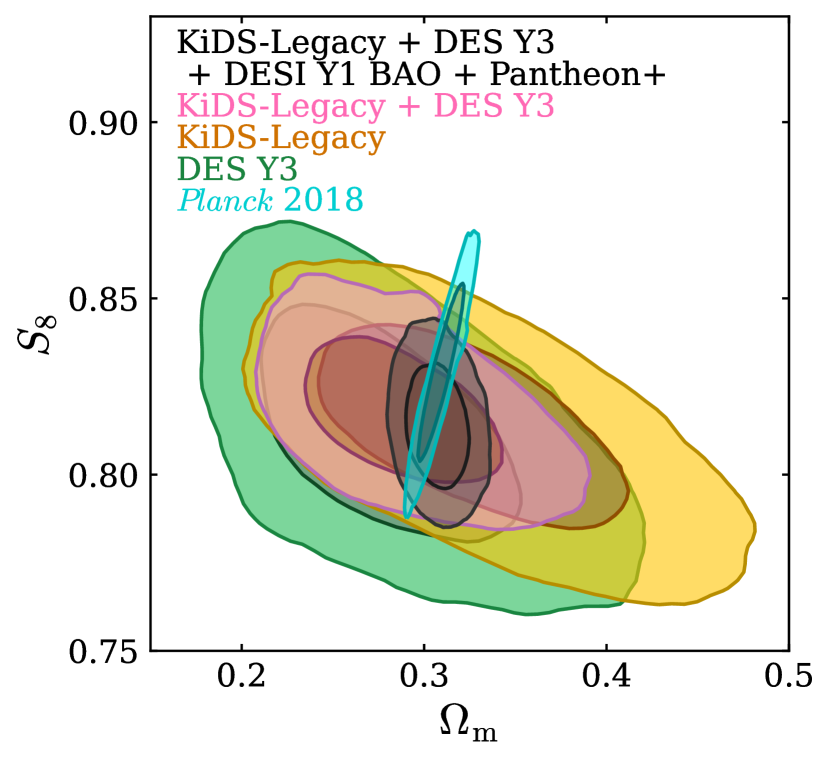
As is often the case, there’s also one of those nice Cosmology Talks videos that discusses this and other aspects of the KiDS Legacy results to which I refer you for more details!

New Publication at the Open Journal of Astrophysics

Posted in OJAp Papers, Open Access, The Universe and Stuff with tags , , , , , on October 22, 2023 by telescoper

It’s Sunday but I’ll be a bit busy next week so I’m taking the opportunity today to announce yet another new paper at the Open Journal of Astrophysics. This one was published on Friday 20th October.

The latest paper is the 41st  so far in Volume 6 (2023) and the 106th in all. It is a product of the Dark Energy Survey team and the Kilo-Degree Survey Collaboration, which amounts to about 160 authors altogether. The corresponding author for this article was the Astronomer Royal for Scotland Professor Catherine Heymans, no less.

The primary classification for this paper is Cosmology and NonGalactic Astrophysics and its title is “DES Y3 + KiDS-1000: Consistent cosmology combining cosmic shear surveys”. The article presents a joint analysis of the Dark Energy Survey Year 3 data and the Kilo-Degree Survey data, with a discussion of the implications for cosmological parameters. The key figure – a very important one – is this:

If you want to know more about the result and why it is so important you could read the paper. It is, however, rather long: 40 pages including 21 figures and 15 tables. Do not despair, though, because here is a video explaining the work in the series of Cosmology Talks presented by Shaun Hotchkiss:

Anyway, here is the overlay of the paper containing the abstract:

You can click on the image of the overlay to make it larger should you wish to do so. You can find the officially accepted version of the paper on the arXiv here.

Cosmology Talks: Marika Asgari on Kids 1000

Posted in Cardiff, Maynooth, The Universe and Stuff with tags , , , , on January 18, 2021 by telescoper

It’s time I shared another one of those interesting cosmology talks on the Youtube channel curated by Shaun Hotchkiss. This channel features technical talks rather than popular expositions so it won’t be everyone’s cup of tea but for those seriously interested in cosmology at a research level they should prove interesting. Since I haven’t posted any of these for a while I’ve got a few to catch up on – this one is from September 2020.

In this talk Marika Asgari tells us about the recent Kilo-Degree Survey (KiDS) cosmological results. These are the first results from KiDS after they have reached a sky coverage of 1000 square degrees. Marika first explains how they know that the results are “statistics dominated” and not “systematics dominated”, meaning that the dominant uncertainty comes from statistical errors, not systematic ones. She then presents the cosmological results, which primarily constrain the clumpiness of matter in the universe, and which therefore constrain Ωm and σ8. In the combined parameter “S8“, which is constrained almost independently from Ωm by their data they see a more than 3σ tension with the equivalent parameter one would infer from Planck.

P. S. The papers that accompany this talk can be found here and here.