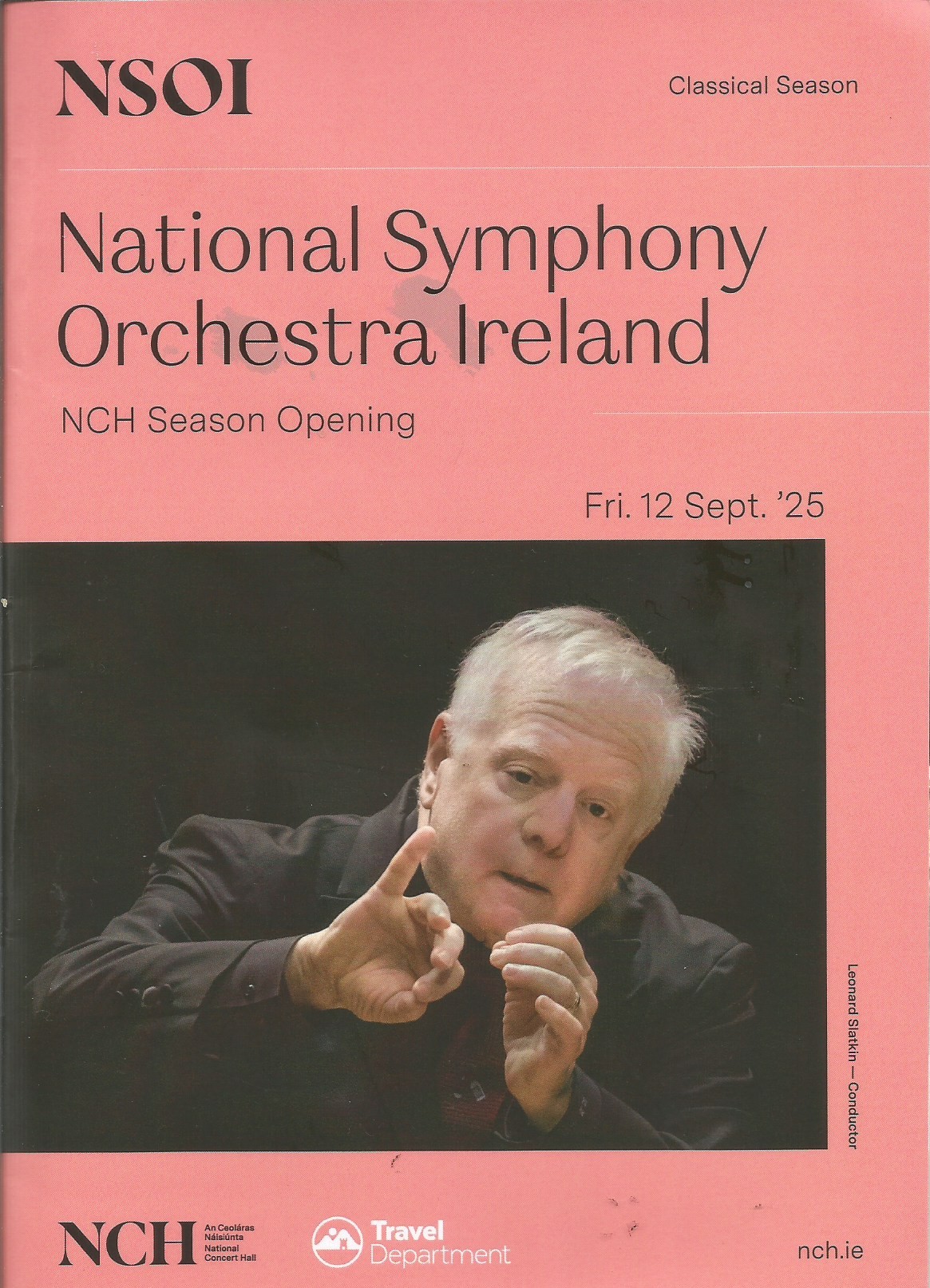
As it was foretold, last night I went to the National Concert Hall in Dublin for the opening performance of the new season by the National Symphony Orchestra Ireland, this time under the baton of veteran conductor Leonard Slatkin.
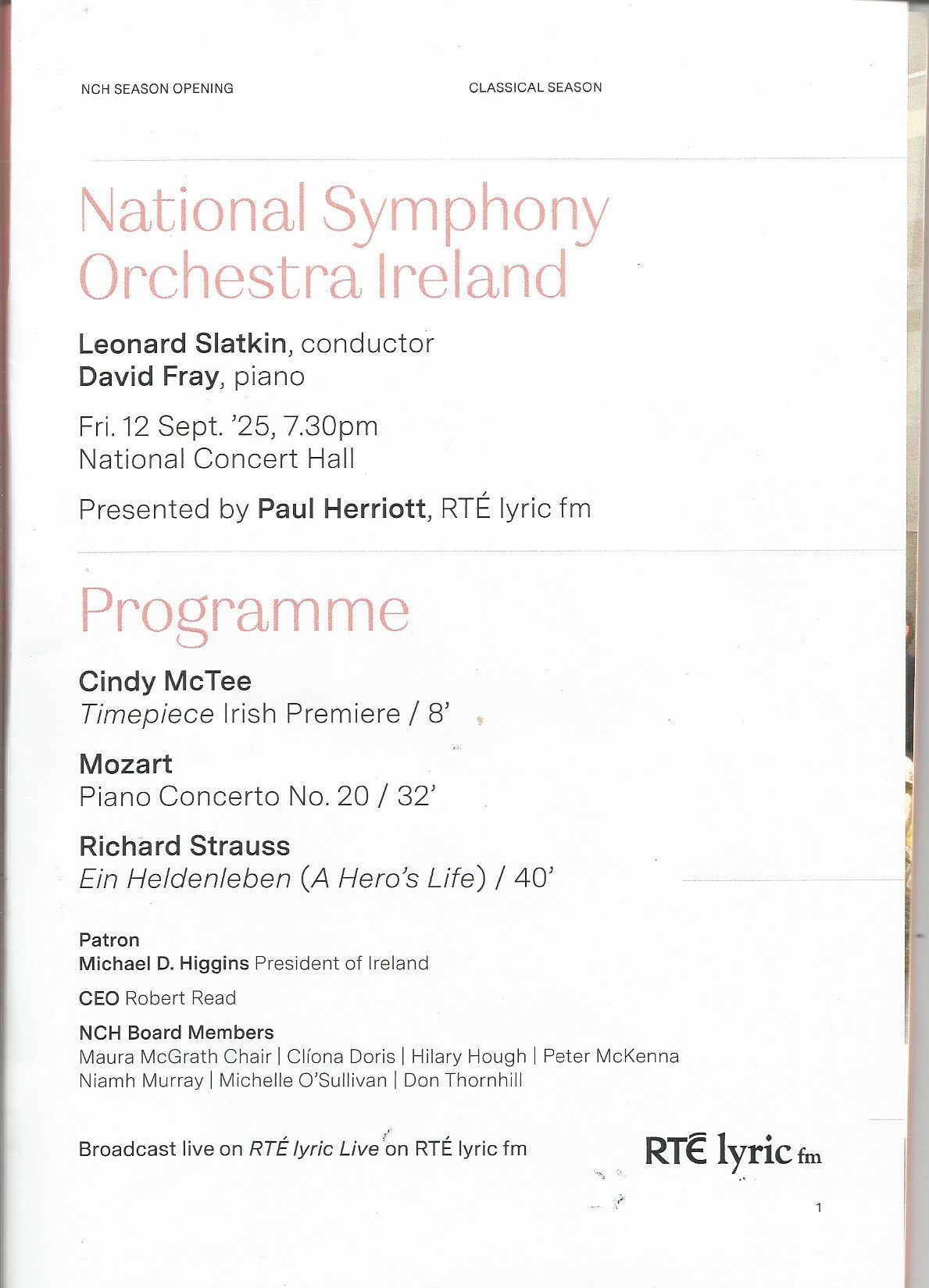
The appetiser for this concert was Timepiece by American composer Cindy Mctee. It’s a short piece, quite new to me before last night, with a slowish introduction leading into a very energetic main body of the work. This piece brought out some fine playing by the orchestra, especially the percussion section. You can read more about this intriguing and enjoyable composition in the composer’s own words here. She was in the audience last night, and came up on stage at the end of the performance to receive the plaudits.
Next we had a very familiar piece: the Piano Concerto No. 20 in D Minor by Wolfgang Amadeus Mozart, with David Fray at the piano. Mozart apparently composed this in a rush to meet the deadline of its first performance, but it doesn’t seem that way. The three movements (marked Allegro, Romanza and Allegro Assai) are very different in mood: the first (which is quite long) is brooding and rather Sturmy and Drangy, while the second is much gentler; both these movements feature memorable tunes; the third is much more pyrotechnical, with a very propulsive start and some virtuosic cadenzas. I think the last was played the best. David Fray is a curious performer to watch: he sat in the same sort of chair as the members of the orchestra – one with a back – rather than the usual stool, and had a very unusual posture. He slouched, in fact; he often turned round to look at the musicians behind him too. Anyway, he played very well indeed and for an encore he gave us some Bach (a solo piano arrangement of Air on the G String), which was lovely.
After the wine break we came back for a performance of Ein Heldenleben (“A Hero’s Life”) by Richard Strauss. I had never heard this piece in full before last night, and I have to say I didn’t like it much. There are some very nice passages in it, and there was some excellent playing by the brass and solo violin by NSOI leader Elaine Clark, but overall I found it a rather aimless reworking of some of Strauss’s other tone poems (some of which are actually very good). It’s also far too long for what it has to say.
The “Hero” of the title is of course meant to be the composer himself, which says something of the high regard in which Strauss held himself. At times the piece is tediously bombastic. The composer was 34 when he wrote this piece; about the same age that Mozart was when he died. I don’t think had he lived the latter would have written a self-indulgent piece like this crowing about his own achievements, which were far greater than those of the former.
Still, at least I can now say I’ve heard Ein Heldenleben…
P.S. For those of you wondering: no, the President of Ireland did not attend this concert.
Last night found me once again at the National Concert Hall in Dublin for a concert by the National Symphony Orchestra conducted this time by Leonard Slatkin, who has a long association with the NSO and who was 80 years old on 1st September. I must say he looked very sprightly for a man eighty years of age!
To start the programme we had the world premiere of a piece by Leonard Slatkin’s son, Daniel. Voyager 130 was inspired by the Voyager space mission, and especially by the Golden Records carried by the Voyager probes. Among the pieces of music included on those records is the exquisite Cavatina from Beethoven’s String Quartet No. 13 (Opus 130) from which the composer borrows thematic material for this piece. Daniel Slatkin was actually in the audience for this – in fact he was sitting just two rows in front of me – and went up on stage after the very enjoyable performance.
After that, and some rearranging on stage, we had a performance of Beethoven’s Piano Concerto No. 4 with Dublin-born soloist Hugh Tinney. Although for its time it was very unconventional in structure, this is now a very familiar piece in the concert hall. For the most part it was played very well but I did think the orchestra were a bit stiff and lacking in expression in places. The performance was warmly received by the NCH audience, and Hugh Tinney received a standing ovation at the end.
After the wine break we had another familiar work, the Symphony No. 3 by Johannes Brahms, which Leonard Slatkin conducted without a score. I’m persevering with Brahms. I still don’t find that he moves me as much as many other composers and so many people rave about him that I think I must be missing something. The 3rd Symphony is a very fine work, offering lots of variety across its four movements while maintaining a strong sense of coherence and remaining relatively concise – it lasts about 33 minutes in performance. I’m no expert on Brahms but it seems to me that the 3rd Symphony is where he really found his voice as a symphonic composer and stepped out from the shadow of Beethoven.
Apart from the first piece, it was a very conventional programme but I enjoyed it as did the audience. It’s a pity there weren’t more people there, though. I’d guess that the NCH was about 2/3 full at most.
P.S. Last night Leinster rugby were playing a match at Landsdowne Road (beating the Dragons 34-6) and Shelbourne were playing Sligo Rovers at home in the League of Ireland (a 0-0 draw) so the train home was a bit busier than last time but still uneventful. When I got home later I decided to listen to a recording of the Beethoven Strong Quartet No. 13 before bed…
I thought I’d do a quick round-up of my little trip around cultural and historic Dublin yesterday after being stood down from duty at the Higher Options fair at the Royal Dublin Society (RDS). I have to say it was wonderful to see so many people out and about in the City’s beautiful parks and public spaces enjoying the September sunshine as I walked around.
The RDS is in the Ballsbridge area in of Dublin, to the East of the City. My route into town from there took me along Northumberland Road, where I took this picture outside Number 25:
A little further along I went across Mount Street Bridge, passing this memorial.
If you want to know more about the significance of these memorials to the events of the Easter Rising in 1916, see my post here.
My main intention during my afternoon off was to visit the National Gallery of Ireland which is situated on one side of Merrion Square. I have to say that this was even better than I’d expected, and I’m sure to visit again many times in the future. The ground floor is dominated by the work of Irish artists from about 1660 to 1965, together with European Art from 1835 to 1965. You will find works by Monet and Picasso in this section, which has much to savour. Among the Irish artists represented in this show is Jack B. Yeats (brother of poet W.B. Yeats), an extremely interesting artist in his own right.
The highlights for me, however, were found on the 3rd floor which displays examples of European Art from the early Renaissance (c. 1300) to the Enlightenment. One of the interesting things about this collection is that it is arranged thematically rather than by artist (or nationality thereof). There is, for example, an entire room of paintings inspired and influenced by Caravaggio, all of them with an intensely dramatic use of light and shadow. The gallery is worth it just for that room, but there are also fascinating juxtapositions of religious paintings from the renaissance with icons and altarpieces from the Byzantine and Russian orthodox traditions from the same period.
Elsewhere in the collection there are notable works by Vermeer, Rembrandt and Perugino as well as a number of British works by, for example, Gainsborough and Reynolds.
The work that really stopped me in my tracks, however, was this:
This is St Francis Receiving The Stigmata by El Greco. I knew about this painting but had no idea it was in Dublin. Seeing it close up is a revelation: the swirling brushstrokes give it an extraordinary texture that makes it hard to bring the image completely into focus. The hypnotic feel that results is a brilliant depiction of a man undergoing a kind of ecstatic vision. This work has an unbelievably powerful effect on the viewer (or at least on this one).
After a break for a sit down and a cup of coffee I visited the Natural History Museum (which is practically next door to the National Gallery). This is a surprisingly old-fashioned affair, with hundreds of stuffed animals and birds crammed into two large rooms:
It reminded me a lot of visits to the Hancock Museum in Newcastle when I was a kid. It’s interesting, but more than a little creepy and would make an excellent setting for a horror story!
After adjourning to a pub for a pint of Guinness the final stop of the day was the National Concert Hall for yesterday’s Culture Night concert. On the way there I saw a big queue of people trying to get into one of the many free events around Dublin. It turns out this Culture Night was the grand opening of the Museum of Literature Ireland, which is situated in Newman House on the South Side of St Stephen’s Green. There’s another one to put on my list of places to visit.
The Culture Night concert was by the RTÉ National Symphony Orchestra conducted by Leonard Slatkin. The opening piece, Kinah, was a composition by the conductor himself and is a sort of memorial to his parents, both of whom were classical musicians, one a violinist and the other a cellist, and together they formed half of the famous Hollywood String Quartet. It was a new piece for me, and I found it very moving indeed. After that there was a bit of reorganization on stage to make way for the Steinway on which the brilliant Xiayin Wang played the Piano Concerto by Samuel Barber, which consists of two fast and furious movements either side of a beautifully lyrical slower movement. This must be a ferociously difficult piece to play – especially the last movement which is at a breakneck pace in 5/8 time – requiring not only dexterity but physical strength. It was a wonderful performance by Xiayin Wang, who rounded off the first half with an encore in the form of a transcription of George Gershwin’s song The Man I Love.
After the wine break interval came the main course in the form of the Symphony No. 4 in E Minor by Johannes Brahms. This is of course a much more familiar work than the previous two, but I really like concerts that mix unfamiliar material with the standard concert repertoire. It also gave me the chance to persevere with Brahms as my friends keep telling me to. It’s not that I don’t like Brahms, it’s just that I don’t find that he moves me as much as many other composers and so many people rave about him that I think I must be missing something. The 4th Symphony is a very fine work, and was performed beautifully last night under the direction of Leonard Slatkin (conducting, incidentally, without a score), but I couldn’t stop myself thinking how much like Beethoven it sounds. That’s not meant to be derogatory, by the way.
But you don’t need to take my word for it. You can listen to (and watch) the whole concert here:
Anyway, after the applause had died down I headed out towards Pearse Station for the train back to Maynooth. I was a bit tired after a very full day and wanted to get the 10.08 train so I didn’t stop to watch any of the numerous musical and artistic events I passed on the way, including an intriguing installation involving images projected onto one of the buildings to the side of St Stephen’s Green. I made it to the station with 5 minutes to spare and discovered that, because it was Culture Night, the train home was free!
The views presented here are personal and not necessarily those of my employer (or anyone else for that matter).
Feel free to comment on any of the posts on this blog but comments may be moderated; anonymous comments and any considered by me to be vexatious and/or abusive and/or defamatory will not be accepted. I do not necessarily endorse, support, sanction, encourage, verify or agree with the opinions or statements of any information or other content in the comments on this site and do not in any way guarantee their accuracy or reliability.


 In the Dark