Archive for LIGO

The Great Gravitational Wave Source Follow-Up

Posted in The Universe and Stuff with tags , , , on March 1, 2016 by telescoper

I recently noticed on the arXiv  an interesting paper with 1562 authors!

Here is the abstract:

A gravitational-wave transient was identified in data recorded by the Advanced LIGO detectors on 2015 September 14. The event candidate, initially designated G184098 and later given the name GW150914, is described in detail elsewhere. By prior arrangement, preliminary estimates of the time, significance, and sky location of the event were shared with 63 teams of observers covering radio, optical, near-infrared, X-ray, and gamma-ray wavelengths with ground- and space-based facilities. In this Letter we describe the low-latency analysis of the gravitational wave data and present the sky localization of the first observed compact binary merger. We summarize the follow-up observations reported by 25 teams via private Gamma-ray Coordinates Network Circulars, giving an overview of the participating facilities, the gravitational wave sky localization coverage, the timeline and depth of the observations. As this event turned out to be a binary black hole merger, there is little expectation of a detectable electromagnetic signature. Nevertheless, this first broadband campaign to search for a counterpart of an Advanced LIGO source represents a milestone and highlights the broad capabilities of the transient astronomy community and the observing strategies that have been developed to pursue neutron star binary merger events. Detailed investigations of the electromagnetic data and results of the electromagnetic follow-up campaign will be disseminated in the papers of the individual teams.

This is interesting not so much for the result – there wasn’t really any expectation of finding an electromagnetic counterpart of a binary black-hole merger – but that it’s the first example of the kind of mass mobilisation of astronomers that will be needed when gravitational-wave astronomy gets going in earnest. Astronomers working on transient sources such as gamma-ray bursts are already used to this kind of operation, but there’s going to be a lot more of it in the future!


Making Massive Black Hole Binaries Merge

Posted in The Universe and Stuff with tags , , , , , on February 16, 2016 by telescoper

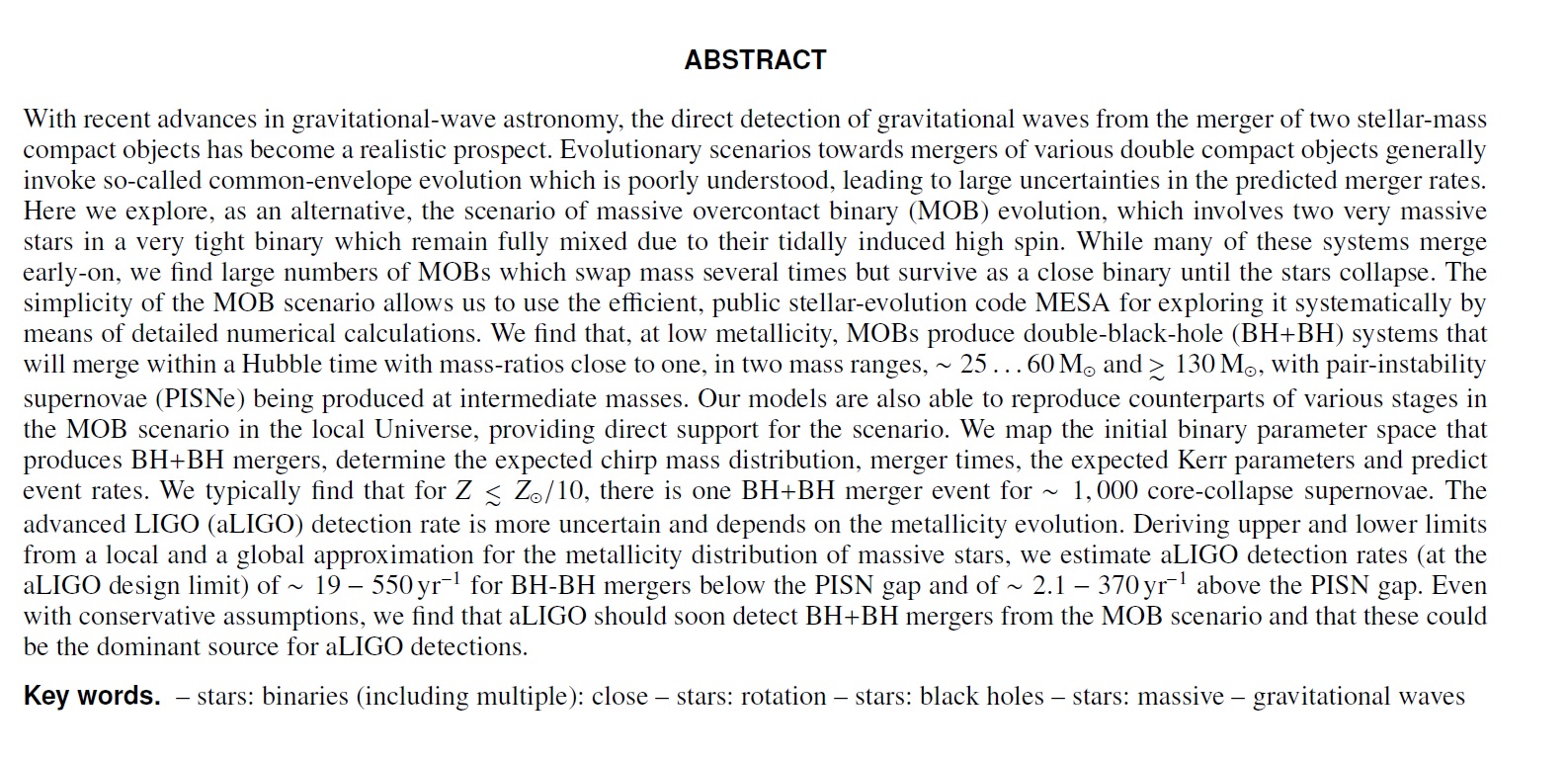
Many fascinating questions remain unanswered by last week’s detection of gravitational waves produced by a coalescing binary black hole system (GW150914) by LIGO. One of these is whether the fact that the similarity of the component masses (29 and 36 times the mass of the Sun respectively) is significant.

An interesting paper appeared on the arXiv last week by Marchant et al. that touches on this. Here is the abstract (you can click on it to make it larger):

BinaryBH


Although there is some technical jargon, the point is relatively clear. It appears that very masssive, very low metallicity binary stars can evolve into black hole binary systems via supernova explosions without disrupting their orbit. The term ‘low metallicity’ characteristises stars that form from primordial material (i.e. basically hydrogen and helium) early in the cycle of stellar evolution. Such material has very different opacity properties from material with significant quantities of heavier elements in it, which alters the dynamical evolution considerably.

(Remember that to an astrophysicist, chemistry is extremely simple. Hydrogen and helium make up most of the atomic matter in the Universe; all the rest is called “metals” including carbon, nitrogen, and oxygen…. )

Anyway, this theoretical paper is relevant because the mass ratios produced by this mechanism are expected to be of order unity, as is the case of GW150914.  One observation doesn’t prove much, but it’s definitely Quite Interesting…

Incidentally, it has been reported that another gravitational wave source may have been detected by LIGO, in October last year. This isn’t as clean a signal as the first, so it will require further analysis before a definitive result is claimed, but it too seems to be a black hole binary system with a mass ratio of order unity…

You wait forty years for a gravitational wave signal from a binary black hole merger and then two come along in quick succession…


Lessons from LIGO

Posted in The Universe and Stuff with tags , , , on February 13, 2016 by telescoper

At the end of a very exciting week I had the pleasure last night of toasting LIGO and the future of gravitational wave astronomy with champagne at the RAS Club in London. Two members of the LIGO collaboration were there, Alberto Vecchio and Mike Cruise (both from Birmingham); Alberto had delivered a very nice talk earlier in the day summarising the LIGO discovery while Mike made a short speech at the club.

This morning I found this interesting video produced by California Institute of Technology (CalTech) which discusses the history of the LIGO experiment:

It has taken over 40 years of determination and hard work to get this far. You can see pictures of some of the protagonists from Thursday’s press conference, such as Kip Thorne, when they were much younger. I bet there were times during the past four decades when they must have doubted that they would ever get there, but they kept the faith and now can enjoy the well-deserved celebrations. They certainly will all be glad they stuck with gravitational waves now, and all must be mighty proud!

Mike Cruise made two points in his speech that I think are worth repeating here. One is that we think of the LIGO discovery is a triumph of physics. It is that, of course. But the LIGO consortium of over a thousand people comprises not only physicists, but also various kinds of engineers, designers, technicians and software specialists. Moreover the membership of LIGO is international. It’s wonderful that people from all over the world can join forces, blend their skils and expertise, and achieve something remarkable. There’s a lesson right there for those who would seek to lead us into small-minded isolationism.

The other point was that the LIGO discovery provides a powerful testament for university research. LIGO was a high-risk experiment that took decades to yield a result. It’s impossible to imagine any commercial company undertaking such an endeavour, so this could only have happened in an institution (or, more correctly, a network of institutions) committed to “blue skies” science. This is research done for its own sake, not to create a short-term profit but to enrich our understanding of the Universe. Asking  profound questions and trying to answer them is one of the things that makes us human. It’s a pity we are so obsessed with wealth and property that we need to be reminded of this, but clearly we do.

The current system of Research Assessment in the UK requires university research to generate “impact” outside the world of academia in a relatively short timescale. That pressure is completely at odds with experiments like LIGO. Who would start a physics experiment now that would take 40 years to deliver?  I’ve said it time and time again to my bosses at the University of Sussex that if you’re serious about supporting physics you have to play a long game because it requires substantial initial investment and generates results only very slowly.  I worry what future lies in store for physics if the fixation on market-driven research continues much longer.

Finally, I couldn’t resist making a comment about another modern fixation – bibliometrics. The LIGO discovery paper in Physical Review Letters has 1,004 authors. By any standard this is an extraordinarily significant article, but because it has over a thousand authors it stands to be entirely excluded by the Times Higher when they compile the next World University Rankings.  Whatever the science community or the general public thinks about the discovery of gravitational waves, the bean-counters deem it worthless. We need to take a stand against this sort of nonsense.


LIGO at the Royal Astronomical Society

Posted in Biographical, The Universe and Stuff with tags , , on February 12, 2016 by telescoper

image

My monthly trip to London for the Royal Astronomical Society Meeting allowed me not only to get out of the office for the day but also to attend a nice talk by Alberto Vecchio about yesterday’s amazing results.

I hear that we will be having champagne at the club later on to celebrate. In the meantime here’s a little Haiku I wrote on the theme:

Two black holes collide
A billion years ago.
LIGO feels the strain.

LIGO: Live Reaction Blog

Posted in The Universe and Stuff with tags , , , , on February 11, 2016 by telescoper

So the eagerly awaited press conference happened this afternoon. It started in unequivocal fashion.

“We detected gravitational waves. We did it!”

As rumoured, the signal corresponds to the coalescence of two black holes, of masses 29 and 36 times the mass of the Sun.

The signal arrived in September 2015, very shortly after Advanced LIGO was switched on. There’s synchronicity for you! The LIGO collaboration have done wondrous things getting their sensitivity down to such a level that they can measure such a tiny effect, but there still has to be an event producing a signal to measure. Collisions of two such massive black holes are probably extremely rare so it’s a bit of good fortune that one happened just at the right time. Actually it was during an engineering test!

Here are the key results:


LIGO


Excellent signal to noise! I’m convinced! Many congratulations to everyone involved in LIGO! This has been a heroic effort that has taken many years of hard slog. They deserve the highest praise, as do the funding agencies who have been prepared to cover the costs of this experiment over such a long time. Physics of this kind is a slow burner, but it delivers spectacularly in the end!

You can find the paper here, although the server seems to be struggling to cope! One part of the rumour was wrong, however, the result is not in Nature, but in Physical Review Letters. There will no doubt be many more!

And right on cue here is the first batch of science papers!

No prizes for guessing where the 2016 Nobel Prize for Physics is heading, but in a collaboration of over 1000 people across the world which few will receive the award?

So, as usual, I had a day filled with lectures, workshops and other meetings so I was thinking I would miss the press conference entirely, but in the end I couldn’t resist interrupting a meeting with the Head of the Department of Mathematics to watch the live stream…

P.S. A quick shout out the UK teams involved in this work, including many old friends in the Gravitational Physics Group at Cardiff University (see BBC News item here) and Jim Hough and Sheila Rowan from Glasgow. If any of them are reading this, enjoy your trip to Stockholm!

The Search for Gravitational Waves

Posted in The Universe and Stuff with tags , , on February 8, 2016 by telescoper

Regardless of what will or will not be announced on Thursday, I thought it would be worth sharing this nice colloquium talk by Dr Alan Weinstein of Caltech about the search for gravitational waves, featuring the Laser Interferometric Gravitational-wave Observatory (LIGO). I’ve picked this not only because it’s a nice and comprehensive overview, but also that Professor Weinstein doesn’t call them gravity waves!


LIGO Newsflash

Posted in The Universe and Stuff with tags , on February 5, 2016 by telescoper

This morning I heard the same rumour from two distinct (and possibly independent) sources. That’s not enough to prove that the rumour is true, but perhaps enough to make it  repeating here.

The rumour is that, on Thursday 11th February in Washington DC at 10.40am 10.30am local time (15.40 15.30GMT), the Laser Interferometry Gravitational Wave Observatory (LIGO) will announce the direct experimental detection of gravitational waves.

If true this is immensely exciting, but I reiterate that it is, for the time being at least, only a rumour.

I will add more as soon as I get it. Please feel free to provide updates through the comments. Likewise if you have information to the contrary…


UPDATE: 9th February 2016. An official announcement of the forthcoming announcement has now been announced. It will take place at 10.30 local time in Washington (15.30 GMT), although it is believed the first ten minutes will involve a couple of songs by the popular vocal artist Beyoncé.


Bad News for Astrophysics from ESA

Posted in Science Politics, The Universe and Stuff with tags , , , , , , , , on April 18, 2012 by telescoper

Just a quick post to pass on the news (which I got from Steinn Sigurdsson’s blog) that the ESA Executive (see correction in comments below) Space Science Advisory Committee (SSAC) of the European Space Agency (ESA) has made a recommendation as to the next large mission to be flown. The short list consisted of a mission to Jupiter’s moons (JUICE), an X-ray observatory (ATHENA), and a gravitational wave observatory (NGO). The last two of these are severely de-scoped versions of missions (IXO and LISA respectively) that had to be re-designed in the aftermath of decisions made in the US decadal review not to get involved in them.

Not unexpectedly, the winner is JUICE. Barring a rejection of this recommendation by the ESA Science Programme Committee (SPC) this will be the next big thing for ESA space science.

The School of Physics and Astronomy at Cardiff University has a considerable involvement in gravitational wave physics, so the decision is disappointing for us but not entirely surprising. It’s not such a big blow either, as we are mainly involved in ground-based searches such as LIGO.

The biggest local worry will be for the sizeable community of X-ray astronomers in the UK. With no big new facilities likely for well over a decade one wonders how the expertise in this area can be sustained into the future, even if LOFT is selected as one of the next medium-sized missions. Or, given that STFC funding is already spread extremely thin, perhaps this is time for the UK to organize a strategic withdrawal from X-ray astronomy?

Much Ado About a Null Result

Posted in Science Politics, The Universe and Stuff with tags , , , on August 20, 2009 by telescoper

In today’s Nature there’s an article outlining the current upper limits on the existence of a stochastic cosmological background of gravitational waves. The basis of the analysis presented in the paper is a combination of data from two larger international collaborations, called VIRGO and LIGO. Cardiff University is a member of the latter, so I suppose I should be careful about what I say…

These experiments have achieved incredible sensitivity – they can measure distortions that are a tiny fraction of an atomic nucleus in scale – but because gravity is such a very weak force they still haven’t managed to find direct evidence of gravitational waves. The next generation of these laser interferometers – Advanced LIGO – should get within hailing distance of a detection but in the meantime we have to do with upper limits. Since the sensitivity of the instruments is so well calibrated, the lack of a signal can yield interesting information. The Nature paper is quite interesting in that it summarizes the constraints that can be placed in such a way on some models of the early Universe. Mostly, though, these are “exotic” models that have already been excluded by other means. If I’ve got my sums right the stochastic gravitational wave background expected to be produced within the standard “concordance” cosmology, in which gravitational wave modes are excited by cosmic inflation, is at least three orders of magnitude lower than current experimental sensitivity.

I can’t resist including the following excerpts from a press release, produced by the Media Relations Department at Caltech whose spin doctors have apparently been hard at work.

Pasadena, Calif.—An investigation by the LIGO (Laser Interferometer Gravitational-Wave Observatory) Scientific Collaboration and the Virgo Collaboration has significantly advanced our understanding the early evolution of the universe.

Analysis of data taken over a two-year period, from 2005 to 2007, has set the most stringent limits yet on the amount of gravitational waves that could have come from the Big Bang in the gravitational wave frequency band where LIGO can observe. In doing so, the gravitational-wave scientists have put new constraints on the details of how the universe looked in its earliest moments.

Much like it produced the cosmic microwave background, the Big Bang is believed to have created a flood of gravitational waves—ripples in the fabric of space and time—that still fill the universe and carry information about the universe as it was immediately after the Big Bang. These waves would be observed as the “stochastic background,” analogous to a superposition of many waves of different sizes and directions on the surface of a pond. The amplitude of this background is directly related to the parameters that govern the behavior of the universe during the first minute after the Big Bang.

and

“Since we have not observed the stochastic background, some of these early-universe models that predict a relatively large stochastic background have been ruled out,” says Vuk Mandic, assistant professor at the University of Minnesota.

“We now know a bit more about parameters that describe the evolution of the universe when it was less than one minute old,” Mandic adds. “We also know that if cosmic strings or superstrings exist, their properties must conform with the measurements we made—that is, their properties, such as string tension, are more constrained than before.”

This is interesting, he says, “because such strings could also be so-called fundamental strings, appearing in string-theory models. So our measurement also offers a way of probing string-theory models, which is very rare today.”

“This result was one of the long-lasting milestones that LIGO was designed to achieve,” Mandic says. Once it goes online in 2014, Advanced LIGO, which will utilize the infrastructure of the LIGO observatories and be 10 times more sensitive than the current instrument, will allow scientists to detect cataclysmic events such as black-hole and neutron-star collisions at 10-times-greater distances.

“Advanced LIGO will go a long way in probing early universe models, cosmic-string models, and other models of the stochastic background. We can think of the current result as a hint of what is to come,” he adds.

“With Advanced LIGO, a major upgrade to our instruments, we will be sensitive to sources of extragalactic gravitational waves in a volume of the universe 1,000 times larger than we can see at the present time. This will mean that our sensitivity to gravitational waves from the Big Bang will be improved by orders of magnitude,” says Jay Marx of the California Institute of Technology, LIGO’s executive director.

“Gravitational waves are the only way to directly probe the universe at the moment of its birth; they’re absolutely unique in that regard. We simply can’t get this information from any other type of astronomy. This is what makes this result in particular, and gravitational-wave astronomy in general, so exciting,” says David Reitze, a professor of physics at the University of Florida and spokesperson for the LIGO Scientific Collaboration.

If hyperbole is what you’re looking for, go no further. There’s nothing wrong with presenting even null results in a positive light but, I don’t think this paints a very balanced picture of the field. For examples, early Universe models involving cosmic strings were already severely constrained before these results, so we know that they don’t have a significant effect on the evolution of cosmic structure anyway.

Clearly the political intention was to flag the importance of Advanced LIGO, although even that will probably be unable to detect the cosmological gravitational-wave background.  Overstatements contained in press releases of this type usually prove counterproductive in the long run.