Yesterday (8th March 2025) was the 150th anniversary of the birth of Maurice Ravel and the National Symphony Orchestra celebrated it in fine fashion with all-Ravel programme for last night’s concert under the direction of guest conductor Speranza Scappucci (whose name aquired an extra p for the printed programme):

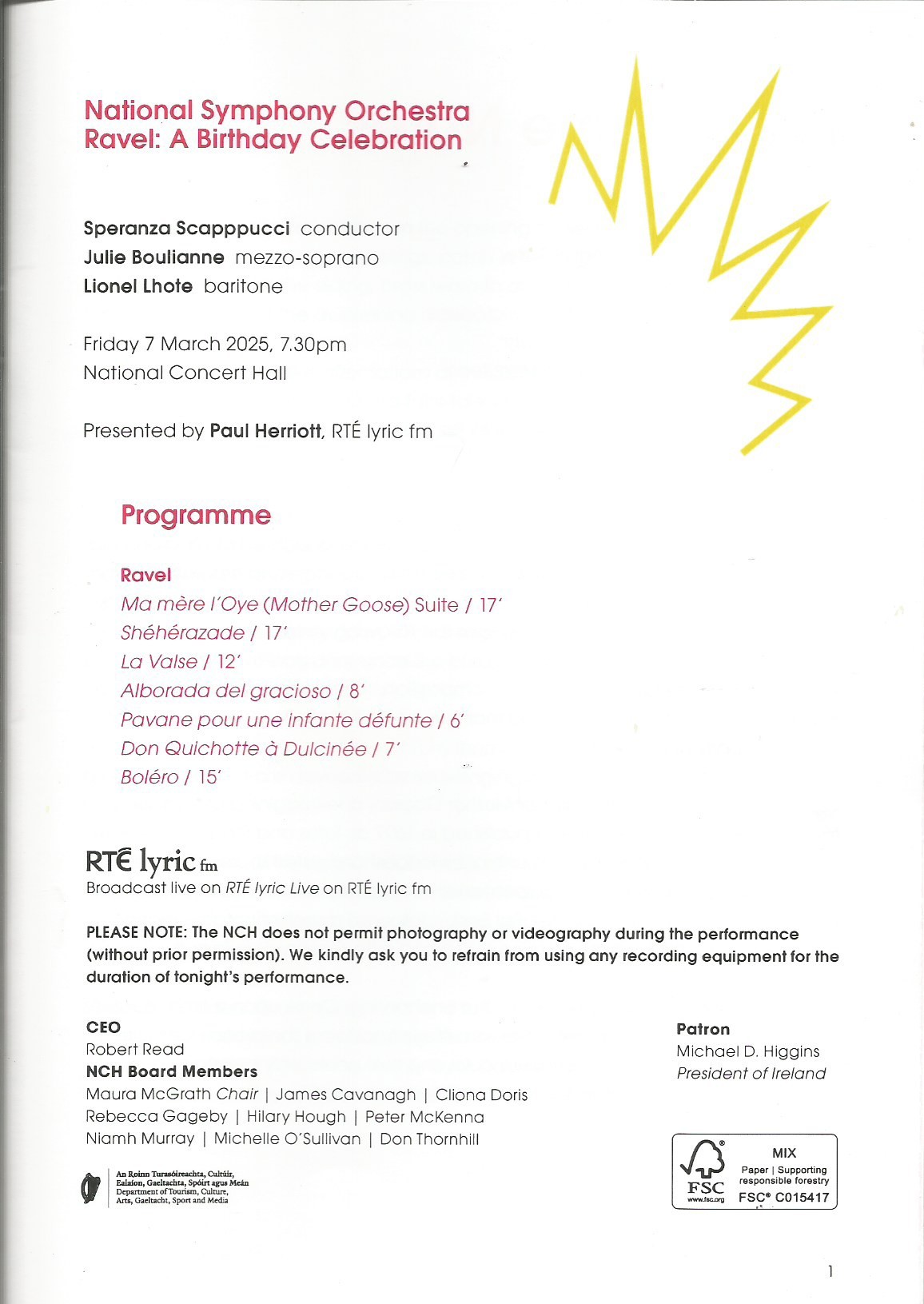
As you can see, it was basically a selection of Ravel’s greatest hits and there’s no surprise that the concert ended with a performance of Boléro, which is by no means the most interesting of Ravel’s compositions but is easily his most famous. Ravel himself said that `it has no music in it’, meaning that it doesn’t have any variation or thematic development or invention, but was written deliberately as an experiment to see how far he could get in writing a work that was entirely based on rhythm and repetition. The result was a smash hit and earned him a very great deal of money, but he grew to resent the fact that it was so much more popular than the other works he himself thought were much better. I know some people who hate this piece, but I think it’s great fun and always enjoy hearing it. Last night was no exception.
The composition of Boléro is so simple that even a non-musician like me can play it. It’s basically written in a slow 3/4 time signature on which is superimposed the following figure:

The second part is basically a repeat of the first, with the last two eighth notes replaced with triplet. The whole pattern consists of 24 notes. I once tried to count how many times it is repeated in a performance of Boléro, but gave up when I got to 100. I think it must be over 200 times. This figure is introduced first on a single snare drum, which carries on playing it for the duration, i.e. for about 15 minutes in total. As the piece develops the same pattern is picked up by various other instruments, either alone in combination. A second snare drum joins in too. The key to the piece is to keep this all very strictly in tempo, as the piece gradually gets louder.
As I’ve mentioned before on this blog, my Father was a (jazz) drummer. I remember once borrowing his snare drum and attempting to play along with a recording of Boléro. The pattern shown above is not that hard to play in itself, but it’s not as easy as you probably think to keep in tempo as you play it louder and louder. At the start it’s fine: you begin by tapping the sticks on the skin of the drum very close to the rim. To increase the volume you gradually move the point of impact closer to the centre of the drum, which naturally makes it louder. However, to get louder still you have to increase the distance the sticks move, and that makes it tougher to keep to tempo. Playing along at home is one thing, but playing the percussionist playing this in an orchestra must leave the drummer feeling very exposed. One mistake, any speeding up or slowing down, and the whole performance will be ruined. Percussionists very often have little to do for long passages in an orchestral work, but this takes it to the opposite extreme. It requires constant concentration, but no variation or embellishment is allowed. I suppose professional musicians just get into the zone and don’t think about the possibility of screwing up. Last night the task fell to Section Leader Rebecca Celebuski, who performed it flawlessly.
The bolero rhythm is just one element of the composition, of course. There is a melody, in two parts. The first simple and catchy, the second bluesier and a bit syncopated. Each part is played twice, passed around the instruments of the orchestra, first individually and then in combinations. Sometimes the melodic line is doubled, but there are no complicated harmonies and the piece stays in C major throughout, apart from a sudden change of key near the very end. The second part of the melody allows the musicians to release their inner jazz a bit, playing behind or across the beat to generate the feeling that the tune is trying to escape the confines of the incessant rhythm. As is the case in jazz, this sense of tension only works if the basic rhythm is kept strictly in tempo as the crescendo builds
The third element of the composition is the simplest of all, but I feel that it is very important in determining whether a performance of Boléro really rocks. That is a rhythmic pulse based on the three beats of the underlying 3/4. When they’re not playing the melody or shadowing the bolero pattern, the orchestra play this figure and it ends up being boomed out by the timpani in tremendous style but also as the piece progresses the stress shifts between the three beats as different instruments contribute.
I know it’s a familiar piece but I really enjoyed last night’s performance. I’ll also reiterate that as well as making a great sound, a full symphony orchestra playing during a piece like this is also a tremendous thing to watch.
Anyway, it wasn’t all about Boléro. In the first half we had the orchestral suite Ma mère l’Oye (My Mother the Goose), the song cycle Shéhérazade with vocals by excellent mezzo-soprano Julie Boulianne, and La Valse. The last of these is a masterpiece, originally conceived as a tribute to the Viennese waltz, but not composed until after TheFirst World War, and turned into a kind of tragic parody, starting out sombre and brooding, gradually building into a garish intensity and then into a brutal, almost chaotic, ending.
After the wine break we heard Alborado del Gracioso, a beautifully atmospheric with a strong Spanish influence and the orchestral version of Pavane pour une infante défunte, played well but a little too slowly for my tastes, and the only piece of the evening that I’d never heard before, Don Quichotte à Dulcinée, a miniature song cycle lasting just 7 minutes, comprised of settings of three poems by Paul Morand. Soloist was baritone Lionel Lhote who not only sang very well but had a very engaging stage presence.
And then it was Boléro, received with great applause and a standing ovation, and then by train back to Maynooth. There were a lot of French people in Dublin last night, presumably not for the Ravel, but for this afternoon’s rugby. They will be enjoying themselves in the city right now, as France convincingly beat Ireland 27-42 in the Six Nations, to end the home team’s hopes of a grand slam. Disappointment for the Boys in Green, but France were excellent and thoroughly deserved to win. Losing to a side as good as that is no disgrace.

 In the Dark