Archive for literature

Letter in November – Sylvia Plath

Posted in Poetry with tags , , , , , on November 15, 2024 by telescoper
Love, the world
Suddenly turns, turns color. The streetlight
Splits through the rat's tail
Pods of the laburnum at nine in the morning.
It is the Arctic,

This little black
Circle, with its tawn silk grasses - babies hair.
There is a green in the air,
Soft, delectable.
It cushions me lovingly.

I am flushed and warm.
I think I may be enormous,
I am so stupidly happy,
My Wellingtons
Squelching and squelching through the beautiful red.

This is my property.
Two times a day
I pace it, sniffing
The barbarous holly with its viridian
Scallops, pure iron,

And the wall of the odd corpses.
I love them.
I love them like history.
The apples are golden,
Imagine it ----

My seventy trees
Holding their gold-ruddy balls
In a thick gray death-soup,
Their million
Gold leaves metal and breathless.

O love, O celibate.
Nobody but me
Walks the waist high wet.
The irreplaceable
Golds bleed and deepen, the mouths of Thermopylae.

by Silvia Plath (1932-1963)

Bloomsday Barcelona

Posted in Barcelona, LGBTQ+, Literature with tags , , , , , , on June 16, 2024 by telescoper

So it’s June 16th which means it is Bloomsday. I looked around for ways to celebrate this day in Barcelona and found that there is a Irish bar on La Rambla called Bloomsday. When I went there, though, I was disappointed to find it not only closed, but apparently abandoned:

Barcelona gets a mention – just one – in James Joyce’s Ulysses:

Noon slumbers. Kevin Egan rolls gunpowder cigarettes through fingers smeared with printer’s ink, sipping his green fairy as Patrice his white. About us gobblers fork spiced beans down their gullets. Un demi sétier! A jet of coffee steam from the burnished caldron. She serves me at his beck. Il est irlandais. Hollandais? Non fromage. Deux irlandais, nous, Irlande, vous savez ah, oui! She thought you wanted a cheese hollandais. Your postprandial, do you know that word? Postprandial. There was a fellow I knew once in Barcelona, queer fellow, used to call it his postprandial. Well: slainte! 

I can confirm that there is no shortage of queer fellows here, but I’ll have to have my lunch before I can have a postprandial but slainte! to you too.

A Reminiscence of Cricket

Posted in Cricket, Literature, Poetry with tags , , , , on August 19, 2019 by telescoper

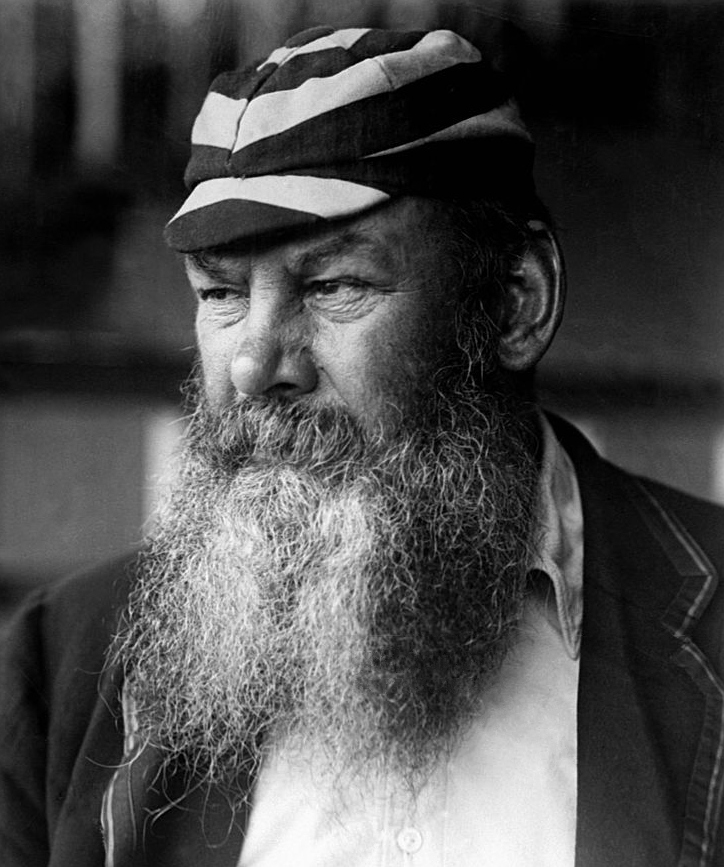
W.G. Grace, photographed in 1902

Not a lot of people know that Sir Arthur Conan Doyle, the creator of Sherlock Holmes, was a keen amateur cricketer who played ten first-class matches (for the MCC). He was an occasional bowler who only took one wicket in a first-class game, that of W.G. Grace, which was such a momentous event for him that he wrote this poem about it:

Once in my heyday of cricket,
One day I shall ever recall!
I captured that glorious wicket,
The greatest, the grandest of all.

Before me he stands like a vision,
Bearded and burly and brown,
A smile of good humoured derision
As he waits for the first to come down.

A statue from Thebes or from Knossos,
A Hercules shrouded in white,
Assyrian bull-like colossus,
He stands in his might.

With the beard of a Goth or a Vandal,
His bat hanging ready and free,
His great hairy hands on the handle,
And his menacing eyes upon me.

And I – I had tricks for the rabbits,
The feeble of mind or eye,
I could see all the duffer’s bad habits
And where his ruin might lie.

The capture of such might elate one,
But it seemed like one horrible jest
That I should serve tosh to the great one,
Who had broken the hearts of the best.

Well, here goes! Good Lord, what a rotter!
Such a sitter as never was dreamt;
It was clay in the hands of the potter,
But he tapped it with quiet contempt.

The second was better – a leetle;
It was low, but was nearly long-hop;
As the housemaid comes down on the beetle
So down came the bat with a chop.

He was sizing me up with some wonder,
My broken-kneed action and ways;
I could see the grim menace from under
The striped peak that shaded his gaze.

The third was a gift or it looked it-
A foot off the wicket or so;
His huge figure swooped as he hooked it,
His great body swung to the blow.

Still when my dreams are night-marish,
I picture that terrible smite,
It was meant for a neighboring parish,
Or any place out of sight.

But – yes, there’s a but to the story –
The blade swished a trifle too low;
Oh wonder, and vision of glory!
It was up like a shaft from a bow.

Up, up like a towering game bird,
Up, up to a speck in the blue,
And then coming down like the same bird,
Dead straight on the line that it flew.

Good Lord, it was mine! Such a soarer
Would call for a safe pair of hands;
None safer than Derbyshire Storer,
And there, face uplifted, he stands

Wicket keep Storer, the knowing,
Wary and steady of nerve,
Watching it falling and growing
Marking the pace and curve.

I stood with my two eyes fixed on it,
Paralysed, helpless, inert;
There was ‘plunk’ as the gloves shut upon it,
And he cuddled it up to his shirt.

Out – beyond question or wrangle!
Homeward he lurched to his lunch!
His bat was tucked up at an angle,
His great shoulders curved to a hunch.

Walking he rumbled and grumbled,
Scolding himself and not me;
One glove was off, and he fumbled,
Twisting the other hand free

Did I give Storer the credit
The thanks he so splendidly earned?
It was mere empty talk if I said it,
For Grace had already returned.

by Sir Arthur Conan Doyle (1859-1930).


Leave the kids alone!

Posted in Education, Literature with tags , , , , on February 6, 2012 by telescoper

I’ve been annoyed ever since I woke up this morning because there was an item on the 7am news that irked me. A person called Claire Tomalin was quoted as saying, among other things, that

Children are not being educated to have prolonged attention spans and you have to be prepared to read steadily for a Dickens novel and I think that’s a pity.

She goes on to lay most of the blame for this shortcoming on television, as such people tend to do.

It’s a facile argument. For one thing most of Dickens’ novels were originally published in short installments, so reading them  that way seems quite a sensible approach to me, and one that should probably be encouraged not criticized.  There’s no getting away either from the fact that some of Dickens’ output is very heavy going indeed. Dare I say that not all Dickens is particularly good? Not liking Dickens is a matter of taste, not a mental defect caused by watching Big Brother.

And another thing: what fraction of children in Dickens’ time could read at all? Much lower than today, I suspect.

Claire Tomalin’s comment is  not just a lazy generalization, it’s also yet another easy shot at the  younger generations who have to put up with this sort of gibe from middle-aged grouches over and over again.

Examination results usually provoke similar outbursts, related to “dumbing down”. I actually do think that, at least in some subjects, examinations are much easier than they were “in my day”, but I don’t think that’s a reason to criticize the examinees. It’s more a fault with the examiners, who have decided that the young can’t cope with difficult challenges. That’s an insult in its own right. I maintain my view that education, especially higher education, is not about making things easy.  It’s about showing students that they can do things that are hard. Most importantly, though, dumbing down examinations is not the same as dumbing down people.

It’s not just young schoolkids that attract such ill-informed invective. I come across it quite regularly with respect to the (alleged) lack of skills possessed by the young adults (usually 18-22) we teach as undergraduates, some of it even from colleagues.

I was thinking the other day what a boon it is for a middle-aged fogey – and obvious potential grouch – like myself to have the pleasure of actually talking to so many younger people at work, and listening to what they have to say. That way I’ve come to my own conclusions about what they’re really like. You know, like you do with people. Most folk  of my age don’t have jobs that bring them into contact with younger folk, so they have  to rely on articles in the Daily Telegraph to tell them  what to think. That, sadly, even goes for those lecturers who have fixed ideas about the inferiority of “students nowadays”.

I think I’ve been very lucky, especially over the last few years, to have had the opportunity to work with a wide range of students as, e.g., project supervisor or tutor. Interactions like this provide a constant reminder not to generalize about the generations. There is of course a range of ability and commitment, but there was in my day too. The majority  still work hard,  learn quickly, and are friendly and courteous. There’s also no doubt in my mind that the best students nowadays are as good as they have ever been, if not better.

It’s the oldies who are the problem.