This morning’s arXiv mailing presented me with a distraction from examination marking in the form of a paper by Naidu et al. with this abstract:
This paper has been submitted to the Open Journal of Astrophysics. In the relatively recent past, papers like this about record-breaking galaxies would normally be submitted to Nature so perhaps we’re at last starting to see a change of culture?
I usually feel a bit conflicted in situations when a paper has been submitted for editorial review there. In this case I am posting it here for two reasons: one is that I am not the Editor responsible for this paper; the other is that the arXiv submission specifically says
Submitted to the Open Journal of Astrophysics. Comments greatly appreciated and warmly welcomed!
In order to generate flagging it here to encourage people to comment, either through the box below or by contacting the authors.
For reference, here is the key plot showing the spectrum from which the redshift is determined. It is rather noisy, but the Lyman break seems reasonably convincing and there are some emission lines that appear to offer corroborative evidence:
You might want to read this article (another OJAp paper) which contains this plot showing how galaxies at redshift z>10 challenge the standard model:
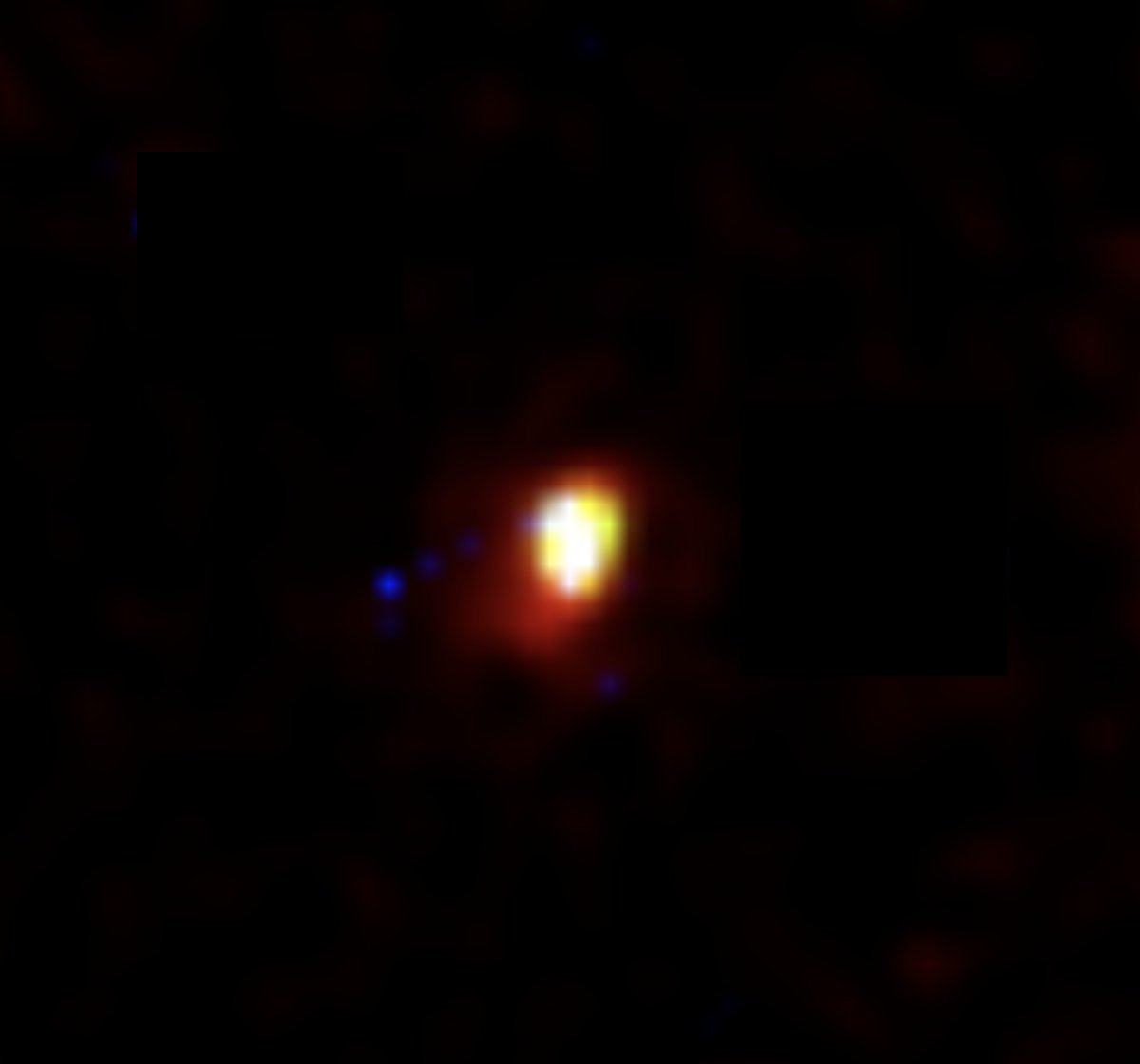
As with the previous object the redshift of this one is not obtained via spectroscopy (which usually involves the identification of spectral lines) but via fitting a spectral profile to photometric imaging data seen in different bands. The process for this galaxy is illustrated by this diagram from the paper:
There are 7 images along the top showing the source through various broad band filters. Suitably calibrated these can be converted to the flux measurements shown on the graph. Notice the first three images are significantly fainter than the others, so the first three points on the left of the graph are lower.
If this is a galaxy its spectrum is expected to possess a Lyman Break resulting from the fact that radiation of shorter wavelength than the Lyman Limit (912 Å) is absorbed by neutral gas surrounding the regions where stars are formed in the galaxy. In the rest frame of a galaxy this break is the ultraviolet region of the spectrum but because of the cosmological redshift it is observed in the infrared part of the spectrum for very distant galaxies. In this case the best fit is obtained if the break is positioned as shown, with the first three fainter points to the left of the break and the rest to the right. The break itself is straddled by two observational bands. Employing a number of different estimates the authors conclude that the redshift of this galaxy is z=16.7 or thereabouts.
There is no direct evidence for the sharp edge associated with the Lyman Break – and no spectral lines are observed either – so this all depends on the object being correctly identified as a high-redshift galaxy and not some other object at lower redshift. You have to assume this to get a redshift, but then all inferences are based on assumed models so there’s nothing unusual about this approach. The authors discuss other possibilities and conclude that there is no plausible alternative source. Take away the green template spectrum and you just see a spectrum that rises to a peak and falls again. The authors claim that there is no plausible low-redshift source with such a spectrum.
So is this now the earliest galaxy ever observed? And what object will I be asking this question about next week? One thing I can predict is that there are going to be many more such objects in the very near future!
The views presented here are personal and not necessarily those of my employer (or anyone else for that matter).
Feel free to comment on any of the posts on this blog but comments may be moderated; anonymous comments and any considered by me to be vexatious and/or abusive and/or defamatory will not be accepted. I do not necessarily endorse, support, sanction, encourage, verify or agree with the opinions or statements of any information or other content in the comments on this site and do not in any way guarantee their accuracy or reliability.