Archive for Mihhail Gerts

Rachmaninov (×2) + Tubin at the National Concert Hall

Posted in Biographical, Music with tags , , , , , , , , , on May 27, 2023 by telescoper

Yesterday, after a nice walk through the sunny streets of Dublin, at the National Concert Hall for the final concert of the season by the National Symphony Orchestra, under the direction of Mihhail Gerts, who were joined, for the second half, by the National Symphony Chorus directed by David Young and three star vocalists. The progamme consisted of two pieces by Sergei Rachmaninov (who was born 150 years ago this year) and one by Eduard Tubin (an Estonian composer who was new to me before last night).
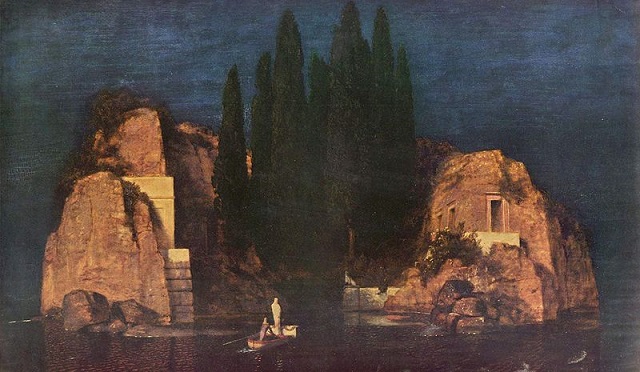
The Isle of the Dead, by Arnold Böcklin

The first item one the menu was The Isle of the Dead, Op. 29 by Sergei Rachmaninov,  inspired by a painting of the same name by Arnold Böcklin and written around 1908. The rhythms of the opening passage evoke the motion of a boat moving across the sea to the island, from which point the piece develops among a cloud of increasingly dense harmonic layers into a dark atmosphere full of foreboding.  It’s a darkly dramatic work that I’ve enjoyed every time I heard it and last night was no exception.

There then followed the Sinfonietta on Estonian Motifs by Eduard Tubin introduced by conductor Mihhail Gerts, who is himself from Estonia. It’s a work in three movements inspired by the folk songs the composer heard as a child growing up in Estonia. I knew that much before the performance started but didn’t realize it would turn out to be such a weighty composition. The two outer movements are rhythmically complex in a way that’s reminiscent of Stravinksy (especially Petrushka) and the overall mood is far from the pastoral tranquility I’d expected: the music is rather edgy, in fact. I suppose that’s not surprising given that it was written in 1940. I enjoyed this but it is strange how much it reminded me of other composers: as well as Stravinsky, there are clear nods in the direction of Sibelius and at times it also reminded me of Arnold Bax. You might say it is a little bit derivative. I couldn’t possibly comment.
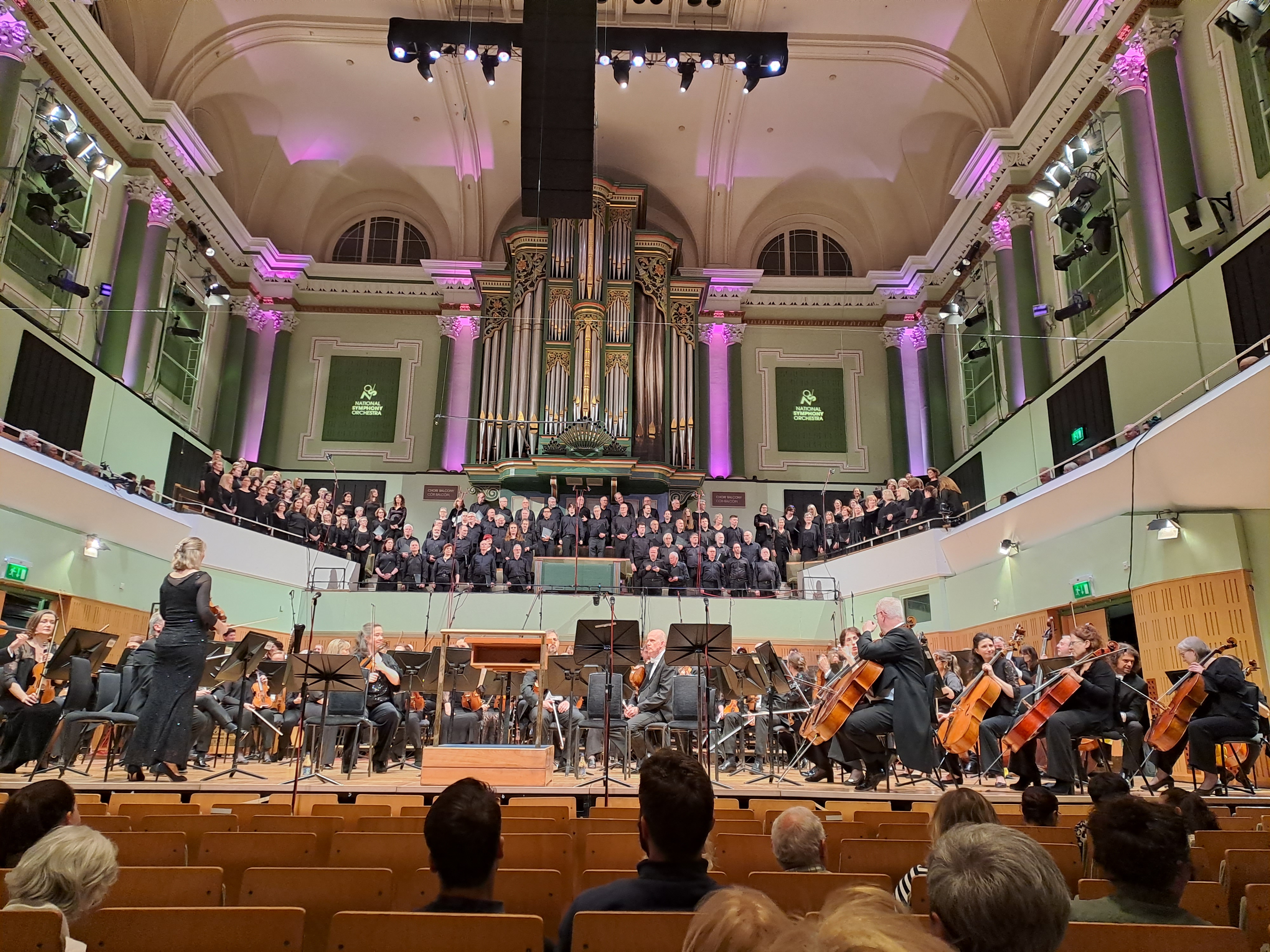
After the interval

After the wine break we had The Bells, a choral symphony for soprano, tenor, bass-baritone, chorus and large symphony orchestra by Sergei Rachmaninov (Op. 35). The words are based on a Russian translation of the poem The Bells by Edgar Allan Poe which was very popular in Russia in the early 20th century and which clearly resonated with Rachmaninov:

The sound of church bells dominated all the cities of Russia I used to know, they accompanied every Russian from childhood to the grave and no composer could escape their influence. Most of my life was lived amid vibrations of of the bells of Moscow.

Sergei Rachmaninov

The Bells is in four movements, echoing the four stanzas of the poem, and representing the journey “from childhood to the grave”, the last movement being a Lento subtitled The Mournful Iron Bells. The three soloists sing in one part each; the third movement involves orchestra and chorus only. Ukrainian tenor Valentyn Dytiuk sang in the first movement, Estonian soprano Mirjam Mesak the second and Ukrainian baritone Andrei Bondarenko the fourth. All three soloists were superb but particularly enjoyed the sinewy muscularity of Bondarenko’s baritone which gave a sense of rawness to his performance.

It was a fitting finale to the season. Congratulations to the National Symphony Orchestra for a great performance, and to the National Symphony Orchestra who were outstanding too.

Walking back to Pearse Station to get the train for Maynooth I found myself wondering when my next visit to the National Concert Hall will be. I’ll be away on sabbatical most of next year. Still, there’ll be plenty of music where I’m going…

Wagner & Bruckner at the National Concert Hall

Posted in Music with tags , , , , , , , on February 22, 2020 by telescoper

I had to brave some very inclement weather on the way to last night’s performance at the National Concert Hall in Dublin for a performance by the RTÉ National Symphony Orchestra, under the direction of Mihhail Gerts (deputising for Natalie Stutzmann who had to withdraw “due to unforeseen circumstances”). The concert consisted of the Prelude to Act I and the Good Friday Music from the Opera Parsifal by Richard Wagner followed by Symphony No. 7 by Anton Bruckner. To my surprise these pieces were performed without a wine break interval.

As was the case a couple of weeks ago for Bruckner 8, a big orchestra was required, including a quartet of Wagnertuben.

While not everyone likes Wagnerian Opera performed in entirety there must be very few people who don’t enjoy the overtures. A programme consisting entirely of Richard Wagner’s Preludes would make for a wonderful concert, and the Prelude to Act I of Parsifal, although very familiar, is so beautiful that it bears repeated listening. Whenever I hear it I can’t help thinking of the poignant last scene of the very last episode of Inspector Morse: `Goodbye Sir’, says Lewis and kisses the dead Morse on the forehead to the accompaniment of this music from Parsifal.

The Good Friday Music occurs at the start of the Third Act of Parsifal so is in a sense also a Prelude. Even out of the context of the Opera, it provides a wonderful opportunity for reflection and contemplation because it is so subtle and understated, somewhat uncharacteristically for Wagner.

These two pieces last about half an hour, and normally one would expect an interval after them, especially since the Symphony is over an hour in duration. I’m not sure what the reason was for playing the Bruckner straight after the Wagner, but it seems to have been a last minute decision. The printed programme contains the usual `INTERVAL_ 20 minutes’ so I had ordered a drink for the interval; nobody had told the bar staff there wouldn’t be one. I got my money back, though.

One positive aspect of the lack of a pause was that it made the connection between Bruckner’s composition and Wagner even more obvious. The radiant first movement of Bruckner’s Seventh Symphony, with its noble melody soaring over shimmering violin tremolos is very reminiscent of Wagner, as is much of the rest of the Symphony (including the orchestration). Bruckner famously idolized Wagner and this composition is at least partly a tribute to his musical hero. It is said that Bruckner had a premonition of Wagner’s death in 1883 and the cymbal crash during the second (slow) movement symbolizes the moment that he found out that his premonition had come true. That whole movement (marked Sehr feierlich und sehr langsam; very solemn and very slow) is very moving: sombre though not excessively mournful. The third movement Scherzo is marked Sehr Schnell (very fast) but I found the tempo last night rather restrained. I was expecting something a bit wilder. The last movement actually sounded to me more like Mahler than Wagner.

The Seventh is probably Bruckner’s best known and most performed Symphony. It was certainly a big hit for him when it was first performed in 1884. I enjoyed last night’s performance. Usually videos of these concerts are put on the Lyric FM Youtube channel shortly after the performance, but when I looked just now last night’s wasn’t there yet. I’ll put a link up as soon as it appears.

UPDATE: Here, as promised, is the recording:


The picture above was taken a while before the performance and, although quite a few more people came in before it started, there were still quite a few empty seats. The National Concert Hall posted a (small) financial loss last year. I do the best I can to support it by attending as frequently as I can, but I am always saddened a bit to see so many empty seats. Anyway, I shall be back there this evening for a special event which is part of the Beethoven 250 celebrations, so watch this space!

Bruckner: Symphony No. 8

Posted in Music with tags , , , , , on February 8, 2020 by telescoper

Last night I once again found myself settling into a seat at the National Concert Hall in Dublin for a performance by the RTÉ National Symphony Orchestra, this time under the direction of Mihhail Gerts. There was only one item on the menu – the Symphony No. 8 by Anton Bruckner – but what a feast it turned out to be!

Bruckner had a habit of making multiple revisions to his scores, and the Eighth Symphony is no exception to this. There are two major versions (usually referred to as the 1887 and 1890 versions) but also numerous edited variations of these two. For the record last night we heard the edition made by Robert Haas, based mainly on the 1890 version, but replacing some pieces which had been edited out of the 1887, perhaps most notably a quiet passage in the Third (Adagio) Movement.

This is a colossal work, lasting about 90 minutes in performance and requiring a huge orchestra so the stage was very crowded when the concert got under way.

As well as larger than usual string sections, the brass section comprises no less than eight horns, three trumpets, three trombones and a tuba as well as a quartet of Wagnertuben which you don’t often see in a symphony orchestra. These instruments have a sound somewhere between that of the horns and the trombones and they add an immense solidity to the section that produces a wall of sound that has an extraordinary effect when heard live, especially during the fortissimo passages (of which there are several in this work).

Woodwinds include a bass clarinet and a contrabassoon alongside the more usual clarinets and flutes, and there are three harps and percussion. A special mention must be made of the timpanist (Grahame King) who was given a huge amount to do, and did it all exceptionally well.

The work is structured in four movements, each of which involves a shift from minor to major (the piece opens in C minor) but each covers a very varied musical landscape. The overall atmosphere of the work varies too. At times it is tranquil (or perhaps merely resigned) but it often evokes a sense of conflict and sometimes even terror. It does, however, end in a glorious crescendo that gives a sense of triumph. Along the way there is some truly memorable passages: a gorgeous dialogue between flutes and clarinets in the 2nd Movement (Scherzo) comes to mind, and the Adagio as a whole is just magnificent.

I have never heard this work performed live, and have to admit I got completely lost in the performance. Despite the length of the concert, I never looked at my watch once during the whole thing. Congratulations to Mihhail Gerts and the entire orchestra for taking us on such an epic journey. I enjoyed every second of it, and so I think did the rest of the audience, because the end was greeted with a standing ovation.

But you don’t need to rely on my opinion. You can’t beat live music, but the entire concert is here for you to enjoy as live on the Lyric FM stream. Enjoy!