Archive for National Symphony Chorus

Puccini 100 at the National Concert Hall

Posted in Music with tags , , , , , , , , on October 26, 2024 by telescoper

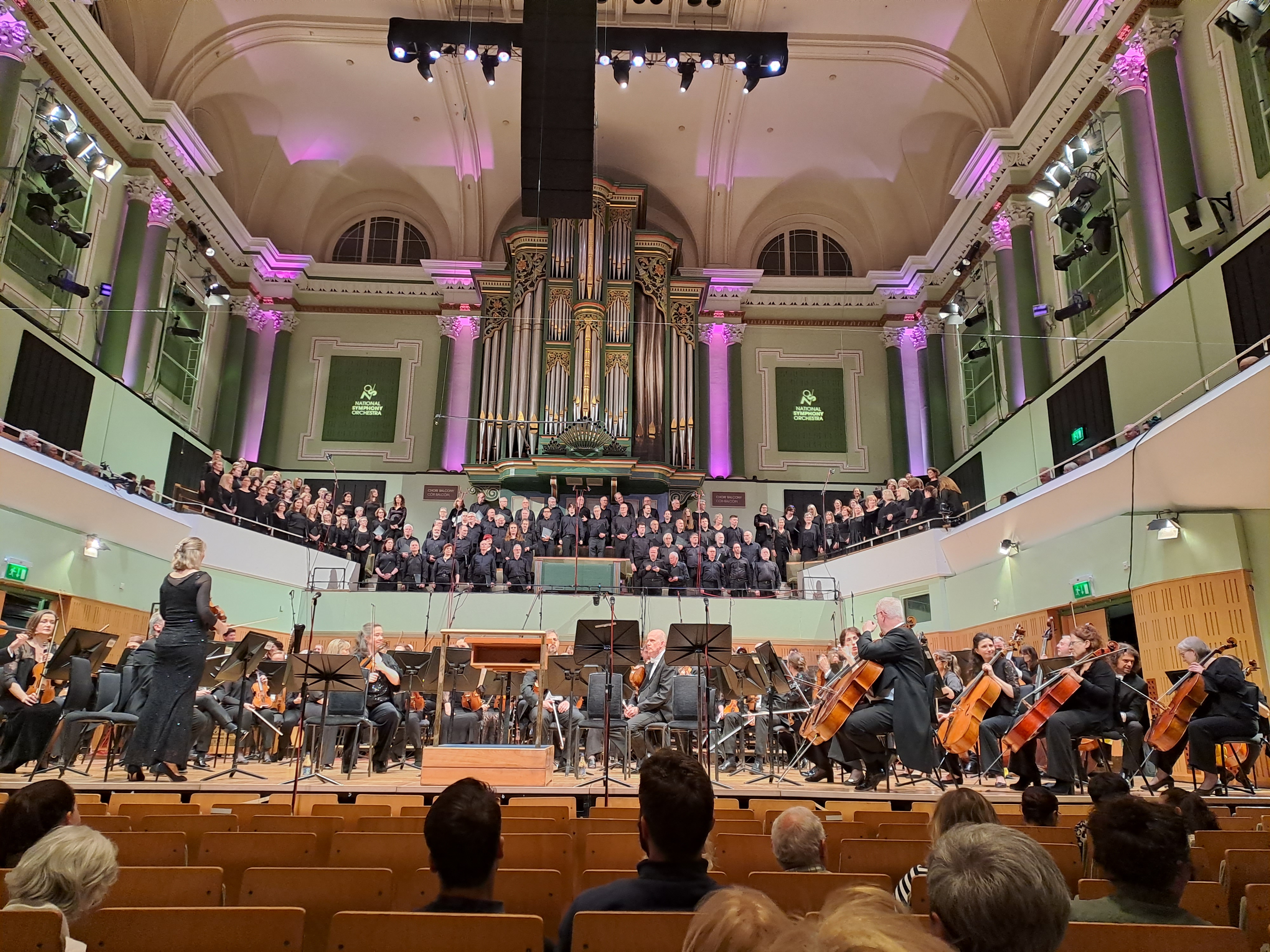
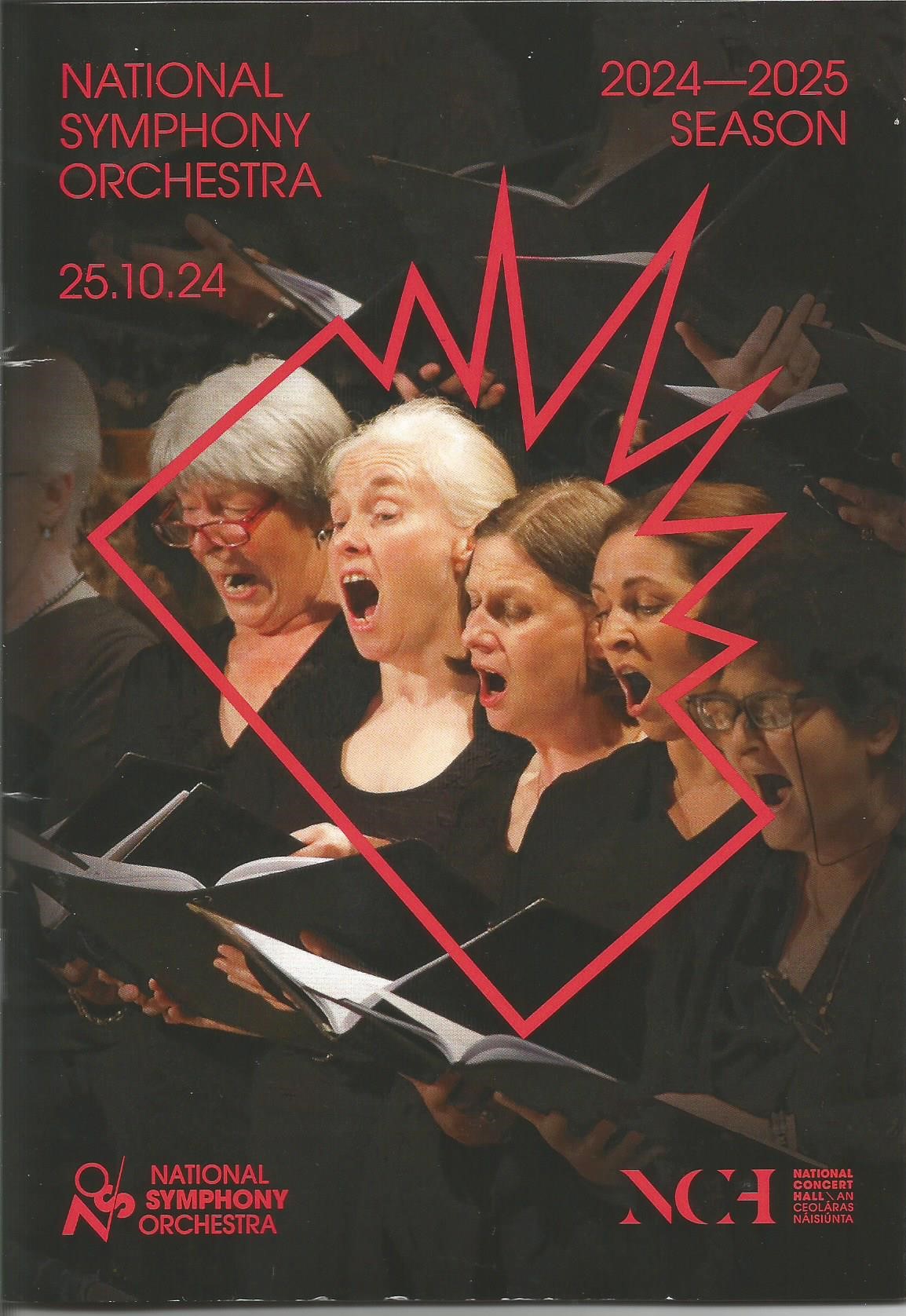
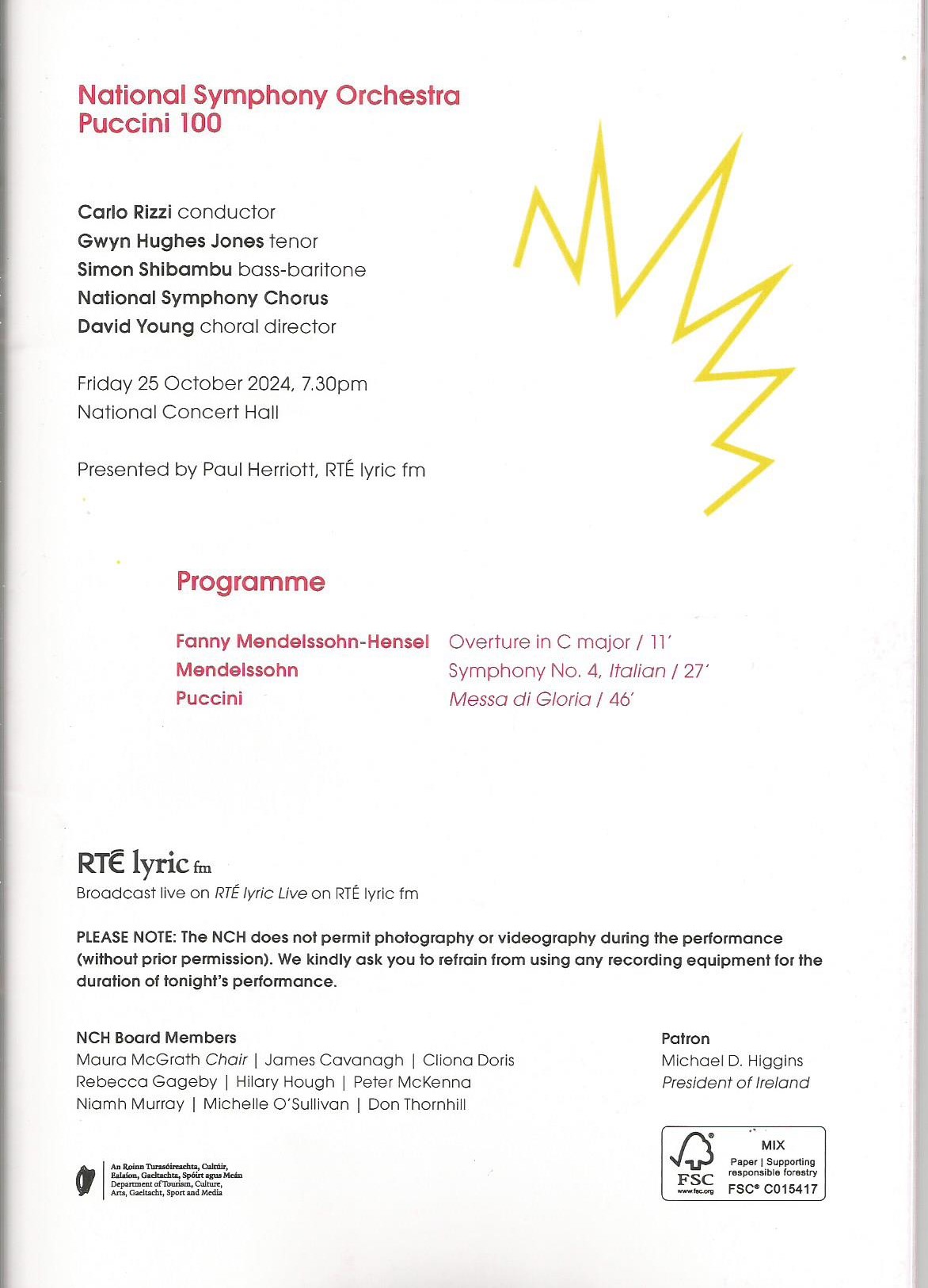
Last night’s Concert at the National Concert Hall in Dublin was billed as Puccini 100 as it was primarily intended to mark the centenary of the death of Giacomo Puccini. Guest conductor Carlo Rizzi had a long association with Welsh National Opera and is well-versed in Puccini’s operatic repertoire but this concert featured a rare treasure in the form of the Messa di Gloria, a large-scale work for choir, two soloists and orchestra Puccini wrote as a graduation piece when he was still a music student in Milan. Contrary to what you might infer from the title, it’s actually a full setting of the Latin Mass. Although written when the composer was only 20, the piece was never officially published until 1952, long after Puccini’s death. He did, however, recycle some pieces from it during his career as a composer of operas, chiefly in Manon Lescaut.
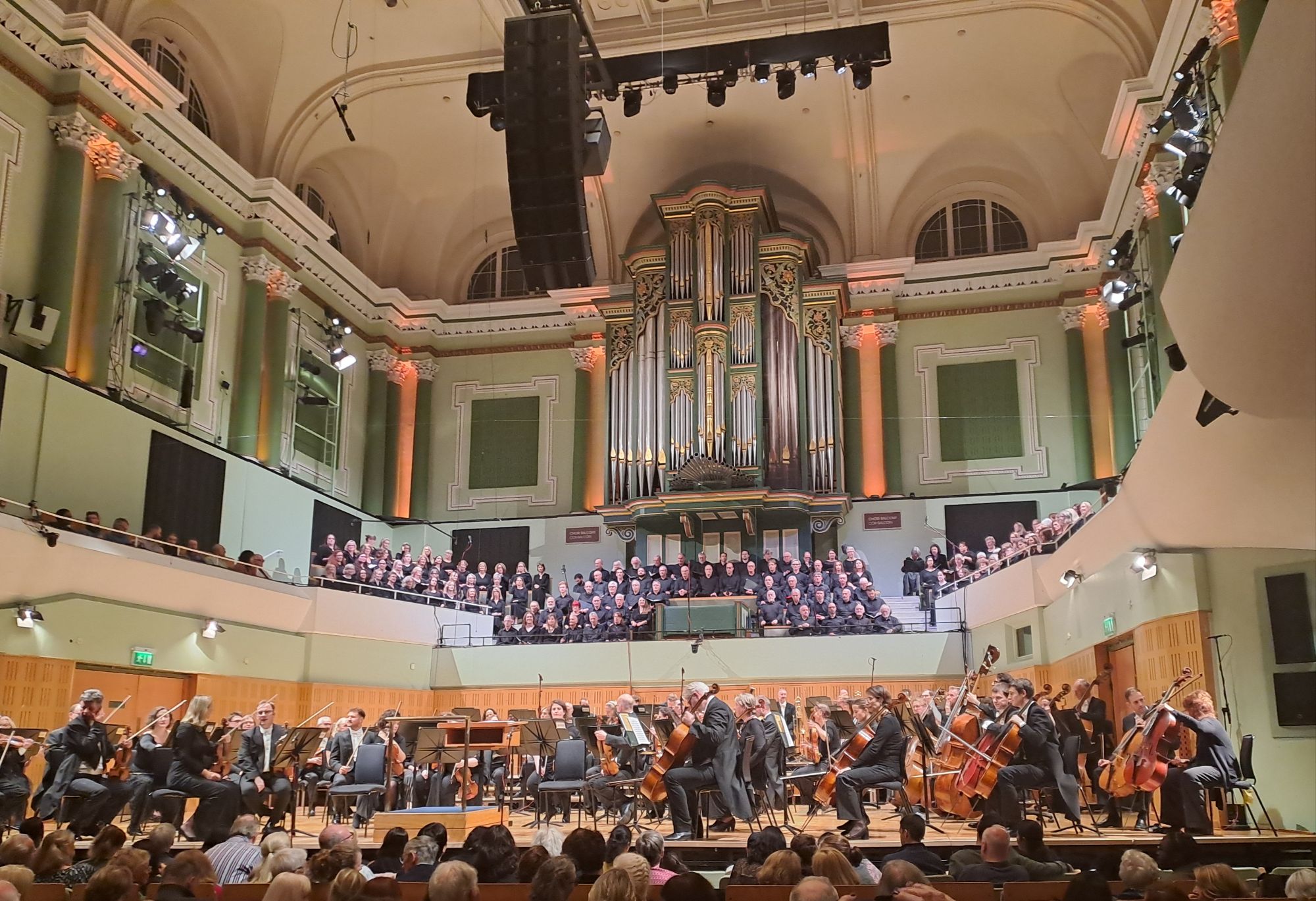
Before the Messa..

Although I’m a fan of Puccini’s operas I had never heard the Messa before and didn’t really know what to expect. It was turned out to be quite a revelation. As you might have anticipated it does sound more “operatic” than you might expect of a religious work and that dramatic certainly heightens the impact of the performance. I’m told that the National Symphony Chorus worked like crazy last week in rehearsals for this concert, and it certainly showed. The choir sounded absolutely amazing. Congratulations to choral director David Young! The two soloists were Welsh tenor Gwyn Hughes Jones and South African bass-baritone Simon Shibambu, both of whom were in fine voice. I particularly enjoyed the duet between them in the final Agnus Dei that brings the piece to a surprisingly gentle conclusion.

I really enjoy concerts that feature compositions I’ve never heard before, and this was a great example of that. I’m really glad that the Messa was chosen to mark Puccini 100. I must get a recording of it…

But the Puccini was only half the concert. Before the wine break we heard a very nice orchestral overture in C Major by Fanny Mendelssohn and then the evergreen 4th Symphony (“The Italian”) written by her kid brother, Felix, as a celebration of the time he spent in Italy on a Grand Tour. It was interesting to hear the two pieces played together as there is so much in common between the styles of composition, but so many subtle differences in voice. It’s a great pity that the sexism of the day prevented Fanny Mendelssohn from fulfilling her potential as a composer.
Rachmaninov (×2) + Tubin at the National Concert Hall

Posted in Biographical, Music with tags , , , , , , , , , on May 27, 2023 by telescoper

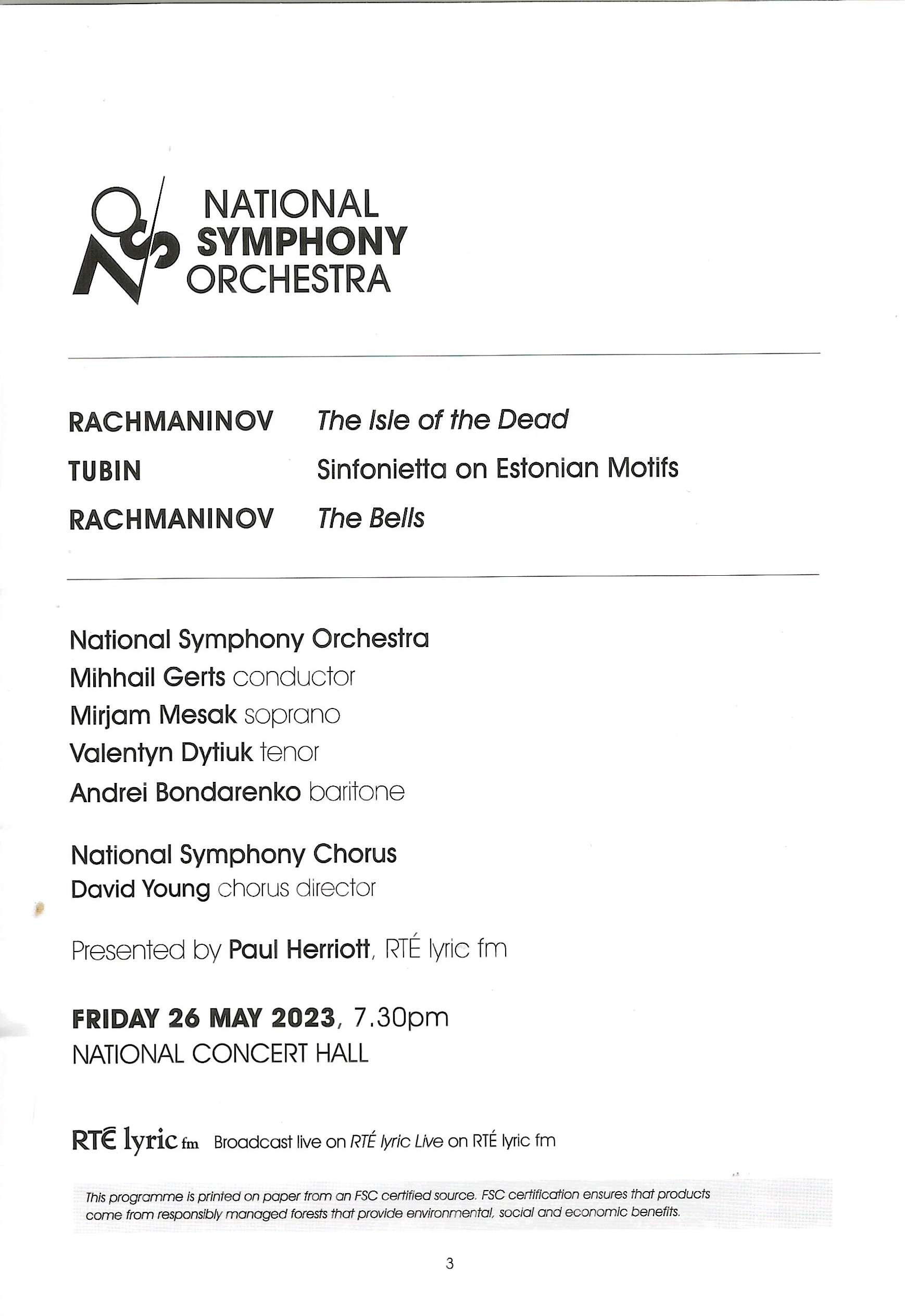
Yesterday, after a nice walk through the sunny streets of Dublin, at the National Concert Hall for the final concert of the season by the National Symphony Orchestra, under the direction of Mihhail Gerts, who were joined, for the second half, by the National Symphony Chorus directed by David Young and three star vocalists. The progamme consisted of two pieces by Sergei Rachmaninov (who was born 150 years ago this year) and one by Eduard Tubin (an Estonian composer who was new to me before last night).

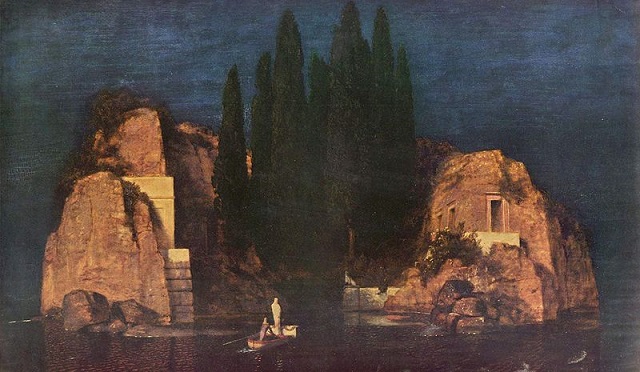
The Isle of the Dead, by Arnold Böcklin

The first item one the menu was The Isle of the Dead, Op. 29 by Sergei Rachmaninov,  inspired by a painting of the same name by Arnold Böcklin and written around 1908. The rhythms of the opening passage evoke the motion of a boat moving across the sea to the island, from which point the piece develops among a cloud of increasingly dense harmonic layers into a dark atmosphere full of foreboding.  It’s a darkly dramatic work that I’ve enjoyed every time I heard it and last night was no exception.

There then followed the Sinfonietta on Estonian Motifs by Eduard Tubin introduced by conductor Mihhail Gerts, who is himself from Estonia. It’s a work in three movements inspired by the folk songs the composer heard as a child growing up in Estonia. I knew that much before the performance started but didn’t realize it would turn out to be such a weighty composition. The two outer movements are rhythmically complex in a way that’s reminiscent of Stravinksy (especially Petrushka) and the overall mood is far from the pastoral tranquility I’d expected: the music is rather edgy, in fact. I suppose that’s not surprising given that it was written in 1940. I enjoyed this but it is strange how much it reminded me of other composers: as well as Stravinsky, there are clear nods in the direction of Sibelius and at times it also reminded me of Arnold Bax. You might say it is a little bit derivative. I couldn’t possibly comment.

After the interval

After the wine break we had The Bells, a choral symphony for soprano, tenor, bass-baritone, chorus and large symphony orchestra by Sergei Rachmaninov (Op. 35). The words are based on a Russian translation of the poem The Bells by Edgar Allan Poe which was very popular in Russia in the early 20th century and which clearly resonated with Rachmaninov:

The sound of church bells dominated all the cities of Russia I used to know, they accompanied every Russian from childhood to the grave and no composer could escape their influence. Most of my life was lived amid vibrations of of the bells of Moscow.

Sergei Rachmaninov

The Bells is in four movements, echoing the four stanzas of the poem, and representing the journey “from childhood to the grave”, the last movement being a Lento subtitled The Mournful Iron Bells. The three soloists sing in one part each; the third movement involves orchestra and chorus only. Ukrainian tenor Valentyn Dytiuk sang in the first movement, Estonian soprano Mirjam Mesak the second and Ukrainian baritone Andrei Bondarenko the fourth. All three soloists were superb but particularly enjoyed the sinewy muscularity of Bondarenko’s baritone which gave a sense of rawness to his performance.

It was a fitting finale to the season. Congratulations to the National Symphony Orchestra for a great performance, and to the National Symphony Orchestra who were outstanding too.

Walking back to Pearse Station to get the train for Maynooth I found myself wondering when my next visit to the National Concert Hall will be. I’ll be away on sabbatical most of next year. Still, there’ll be plenty of music where I’m going…

Mozart, Ravel and Danielle de Niese

Posted in Biographical, Music with tags , , , , , , , , on February 4, 2023 by telescoper

After last week’s magnificent concert I couldn’t miss another chance to see and hear Danielle de Niese in at the National Concert Hall in Dublin, again with the National Symphony Orchestra under the direction of Jaime Martin. It was another fascinating (and very full) programme.

For last week’s concert, the National Concert Hall was only about two-thirds full but this time it was packed. I think the glowing reviews of La Voix Humaine contributed to that, as did the round of media interviews Danielle de Niese has done since then contributed to the full house.

Danielle de Niese seems to like singing 20th century French music and the concert opened with Shéhérazade by Maurice Ravel. This is a cycle of three songs which are settings of poems inspired by The Arabian Nights written by the pseudonymous poet Tristan Klingsor: Asie, La flûte enchantée, and L’Indifférent. Ravel was a real master of orchestration, and he creates a succession of exotic textures to complement the vocal lines. It’s not a long piece -altogether the three songs last about 15 minutes – but it covers a vast territory. There’s more than a nod to Debussy in this work too.

After that Danielle de Niese went off stage to change her frock, which was lime green for the Ravel, while the orchestra played the overture to the singspiel Die Entführung aus dem Serail (The Abduction from the Seraglio) by Wolfgang Amadeus Mozart. I’ve actually reviwed the whole Opera (was that really 12 years ago?) and wrote then (about the plot):

It’s admittedly a bit thin, even by the standards of comic opera but, right from the fabulous overture, the music is lovely and there’s a great deal of good-humoured fun, 

The overture is great fun to listen to, and obviously also to play. Jaime Martin was beaming and bouncing up and down on the podium during the performance.

And then Danielle de Niese returned (this time in a lurid red dress) to sing another piece by Mozart. Exsultate, Jubilate is a piece for solo voice and orchestra usually described as a motet but technically really a cantata. There are three movements, marked Allegro, Andante and Allegro. It’s obviously a work,with a religious theme, and the central Andante movement does sound like it is sacred music, but the outer Allegro movements are very operatic, with demanding coloratura passages, especially in the final Hallelujah. I don’t usually associate such vocal acrobatics with religious music, but it’s certainly a very exuberant and joyful piece. Astonishingly, Mozart was just 17 years old when he wrote it.

That piece by Mozart presented very different challenges to the soloist, Danielle de Niese but she showed herself to be a very accomplished performer in this too. With that her two-week residence in Dublin came to an end. She was presented with a huge bouquet of flowers and a standing ovation before we headed off to the bar for the interval.

After the wine break the National Symphony Orchestra was joined by the National Symphony Chorus for complete performance of the music to the ballet Daphnis et Chloé by Maurice Ravel. As is the case with Stravinsky’s Firebird, music from this ballet is often played in the form of a suite or, in the case of this ballet, two suites, but I have to say the whole is much greater than the sum of the suites and this work has become one of my favourite pieces to hear live. It’s a gloriously sensual and dramatic work, again brilliantly orchestrated, full of vibrant colours and lush textures, and even more wonderful when accompanied by the wordless singing of the massed ranks of the National Symphony Chorus. The score lasts a good hour, but that time seemed to flash by in this performance which was extremely well received by a very appreciative audience.

This was a very full programme and I had to leave during the applause to make sure I got back to Pearse station in time to catch the train back to Maynooth. I’m not as quick on my pins as I used to be. I arrived at Pearse with about five minutes to spare only to find that the train was five minutes late so I didn’t have rushed.

I have to congratulate whoever is doing the programming for these NSO concerts at the NCH. The last few have been excellent, and next week’s recipe of Ives, Beethoven and Sibelius looks great too!