An Antonymous email correspondent this morning drew my attention to an interesting article in the latest Physics World about the trials and tribulations of groups of physicists trying to measure Newton’s Gravitational Constant, G. This is probably the first physical constant that most of us encounter when we’re learning the subject so it might seem strange that it’s the one which is known to the lowest accuracy. That’s not for want of trying to make the measurements more precise, just that gravity is such a very weak force that it’s very difficult to eliminate systematic effects down to the necessary level.
Just how difficult it is to measure Big G is demonstrated by the following graphic which shows the latest measurements:
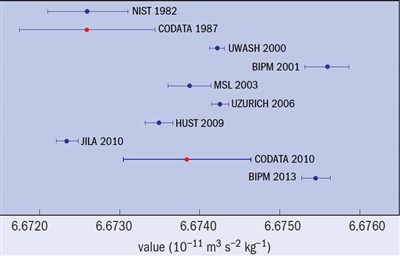
Here’s the caption, so you can identify the various groups responsible for the various measurements:
Disagreeing over “big G” This chart shows wildly differing values of the gravitational constant, G, as measured by various high-profile research groups (blue). The values do not agree even within their error bars. Also shown are two values of G adopted by the Committee on Data for Science and Technology (CODATA) as international standards (red). The groups are based at the National Institute of Standards and Technology (NIST), the University of Washington (UWASH), the International Bureau of Weights and Measures (BIPM), the Measurement Standards Laboratory of New Zealand (MSL), the University of Zurich (UZURICH), the Huazhong University of Science and Technology (HUST) and the Joint Institute for Astrophysics (JILA).
Clearly there’s quite a lot of disagreement between recent results, with some a long way outside each other’s error bars. They can’t all be right, but who’s most likely to be wrong? Answers on a postcard.
I’m by no means an expert on experimental gravity so I won’t attempt to suggest who is right and who is wrong. What I will say is that although this kind of research is clearly extremely important it is clearly also fiendishly difficult. I’m not really surprised that the pieces of the puzzle haven’t fallen into place yet. The dedicated teams who have been tackling this problem for many decades deserve the deep admiration as well as the continued support of the physics community. Theoretical physics is generally perceived to be more glamorous and exciting than its experimental counterpart, but the subject as a whole is nothing without its empirical foundations. That said, I’m glad it’s not my job to measure Big G. I have neither the practical skill nor the patience to cope with so many frustrations!


 In the Dark