It’s very nice to have an opportunity, courtesy of JWST, to congratulate astronomers from my current institution (Maynooth, Ireland) and my previous one (Cardiff, UK) – as well as many others – or their involvement in stunning new observations of the Ring Nebula (aka M57 and NGC 6720), a planetary nebula. There is a full story on the Maynooth University website here detailing the involvement of Dr Patrick Kavanagh in the processing of the images and another on the Cardiff University website here about Dr Roger Wesson, who led the programme. Not surprisingly there has been a lot of news coverage about these wonderful images obtained with the NIRCam and MIRI instruments on JWST here in Ireland and in Wales and elsewhere.
A particular excuse for reproducing the pictures here is to try out the fancy “image comparison” tool on WordPress, which allows the reader – that’s you – to slide one picture over the other. Have a go!
This groovy visual shows two images side by side of the Ring Nebula. The image on the left shows the NIRCam view and the image on the right shows the MIRI image. The left image shows the planetary nebula as a distorted doughnut with a rainbow of colours with a blue/green inner cavity and clear filamentary structure in the inner region. The right image shows the nebula with a red/orange central cavity with a ring structure that transitions from colours of yellow to purple/blue. Picture credits ESA/Webb, NASA, CSA, M. Barlow, N. Cox, R. Wesson
The full paper describing these observations can be found on the arXiv here.
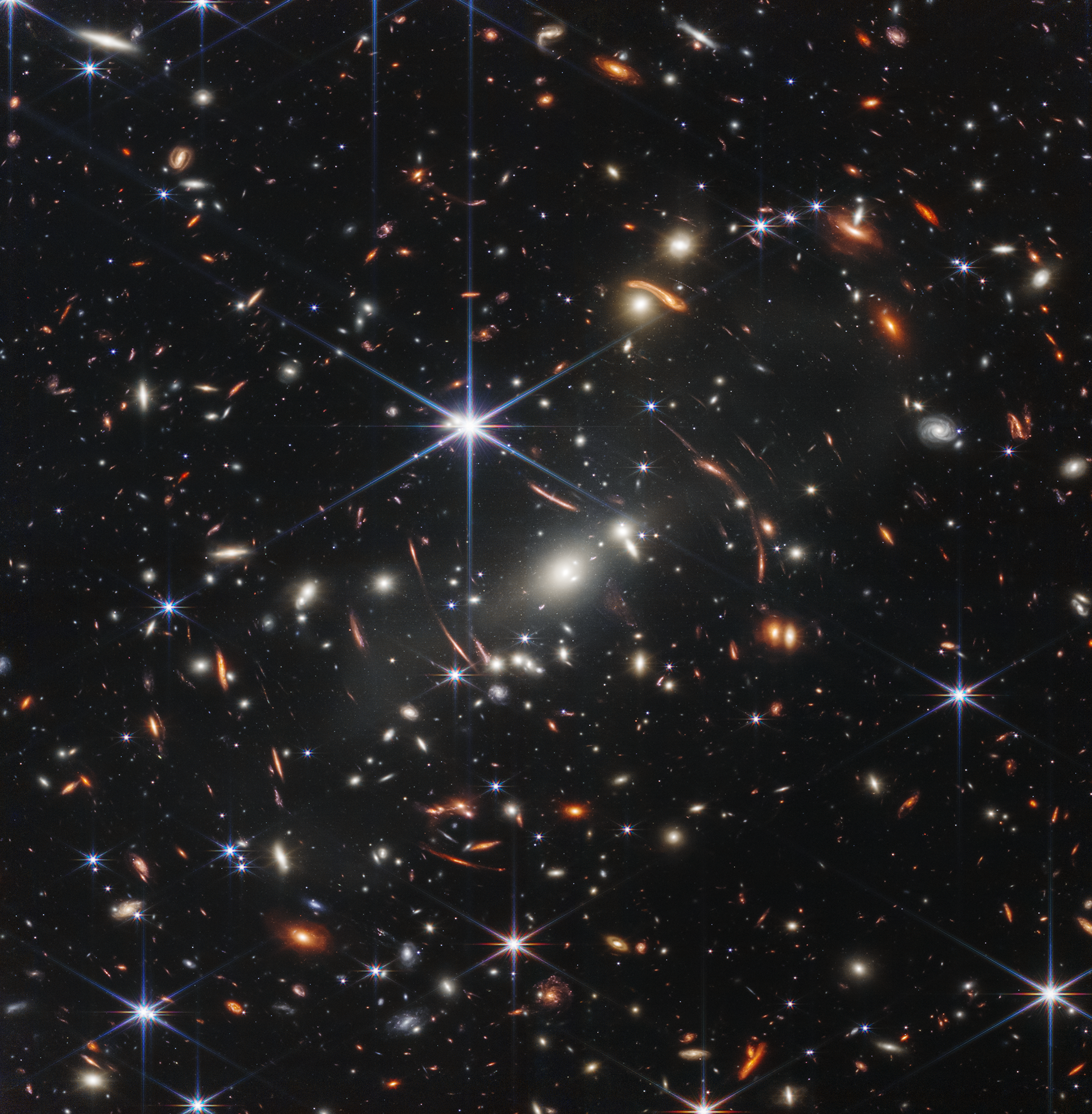
I have to say that I didn’t stay up to watch the live stream of last night’s preview of this afternoon’s release of the first images from the James Webb Space Telescope. It started very late and I got sick of listening to the dreary music on the feed so went to bed. Nevertheless here is the first picture:
Credits: NASA, ESA, CSA, and STScI
This is a deep field image taken using JWST’s NIRCAM (Near-Infrared Camera). Note that the artifacts you see around some objects are diffraction spikes which occur around bright sources; their six-fold symmetry reflects the hexagonal structure built into the JWST’s mirror assembly. Sources sufficiently bright and compact enough to cause these spikes in deep field images are foreground stars: the extended, fainter objects are all much more distant galaxies.
The description from the NASA page is:
NASA’s James Webb Space Telescope has produced the deepest and sharpest infrared image of the distant universe to date. Known as Webb’s First Deep Field, this image of galaxy cluster SMACS 0723 is overflowing with detail.
Thousands of galaxies – including the faintest objects ever observed in the infrared – have appeared in Webb’s view for the first time. This slice of the vast universe is approximately the size of a grain of sand held at arm’s length by someone on the ground.
This deep field, taken by Webb’s Near-Infrared Camera (NIRCam), is a composite made from images at different wavelengths, totaling 12.5 hours – achieving depths at infrared wavelengths beyond the Hubble Space Telescope’s deepest fields, which took weeks.
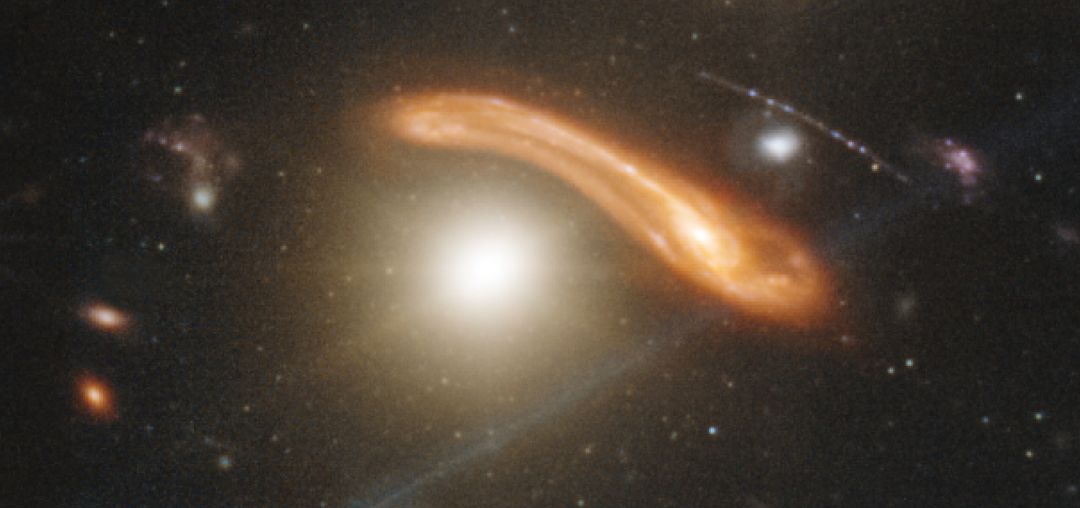
The image shows the galaxy cluster SMACS 0723 as it appeared 4.6 billion years ago. The combined mass of this galaxy cluster acts as a gravitational lens, magnifying much more distant galaxies behind it. Webb’s NIRCam has brought those distant galaxies into sharp focus – they have tiny, faint structures that have never been seen before, including star clusters and diffuse features. Researchers will soon begin to learn more about the galaxies’ masses, ages, histories, and compositions, as Webb seeks the earliest galaxies in the universe
Here is a close-up of one of the distorted galaxy images and othe features produced by gravitational lensing:
We’re having a special viewing in Maynooth this afternoon of the press conference which will unveil more new images from JWST – nice telescope, shame about the name. I may add comments on here if anything particularly exciting turns up. You can watch it here:
The views presented here are personal and not necessarily those of my employer (or anyone else for that matter).
Feel free to comment on any of the posts on this blog but comments may be moderated; anonymous comments and any considered by me to be vexatious and/or abusive and/or defamatory will not be accepted. I do not necessarily endorse, support, sanction, encourage, verify or agree with the opinions or statements of any information or other content in the comments on this site and do not in any way guarantee their accuracy or reliability.



 In the Dark