I’m just back from my second night at the Sydney Opera House, at which I saw Opera Australia’s production of Mozart’s The Magic Flute. What has been a very warm day turned into a very sultry evening, and it was nice to take my drink outside during the interval to admire the view:
I’ve lost track of how many different productions I have seen of this strange and wonderful masterpiece, and this was a distinctly Australian version. Technically it’s not an opera, but a singspiel: the recitative – the bit in between the arias – is spoken rather than sung. It’s really more like a musical comedy in that sense, and was originally intended to be performed in a kind of burlesque style.
The Magic Flute also has many points of contact with the pantomime tradition, including the character of the villainous Monostatos who, in this performance, was reminiscent of Rolf Harris. Papageno was a working class Australian, sporting a mullet, and carrying an Esky in place of the usual array of nets and birdcages. On her first entrance, the Queen of the Night put me in mind of Gloria Swanson in Sunset Boulevard. Sarastro, with long hair and flowing robes, looked like the leader of some sort of New Age cult; his acolytes were dressed in everyday casual clothes. The three boys – referred to as “spirits” in this production – were actually two boys and a girl, but “spirit” is a gender-neutral term so that’s fine.
I won’t even attempt to explain the plot, if you can call it that, because it’s completely daft. It’s daft, though, in a way that much of life is daft, and I think that’s the secret of its enduring popularity. Mozart’s music carries you along and constantly seems to be telling you not to take it all too seriously. It seems to me that it must be hard to get the balance right between the comedy (which frequently border on the slapstick) and the serious. The worst thing to do is to make it too pompous. This production doesn’t fall into that trap, but in playing it virtually entirely for laughs I think it misses the depths that make a truly successful version. The ending – in which the rays of the Sun are supposed to dispel the darkness – involved a big reveal to a picnic with the chorus in beach wear and sunglasses. There’s a lot to be said for sunshine, and I found the idea mildly amusing, but there should be more to the end of this Opera than that. On the other hand, Pamina’s aria in Act II, when she is heartbroken because she thinks Tamino has abandoned her, was intensely moving, so it wasn’t all shallow.
The sets are simple but use clever devices to suggest the extraordinary scene changes required by the libretto, including pyramids, forests, waterfalls and flames. The ordeals by fire and water, for example, are depicted using reflective strip curtains, red for fire and blue for water. The dragon in Act I is conjured up by shadow puppets against a translucent curtain.
Papageno, played by an understudy whose name I didn’t catch, was the pick of the performers but overall the cast was not particularly strong vocally. David Parkin’s basso wasn’t nearly profundo enough for Sarastro and he struggled with the lowest notes. I’m not sure either why he also played The Speaker, who is a distinct role. Giuseppina Grech as the Queen of the Night looked fabulous and hit her high notes, but the elaborate coloratura passages were not well articulated.
This probably seems very negative than I intended. There is much to enjoy in this production. It’s very entertaining, and at times riotously funny. It was just a bit too superficial for my taste.
Last night I fulfilled a longstanding ambition of mine, to see an opera at the Sydney Opera House. It wasn’t that easy to get tickets, but last night I managed to see Opera Australia’s production of La Traviata by Giuseppe Verdi.
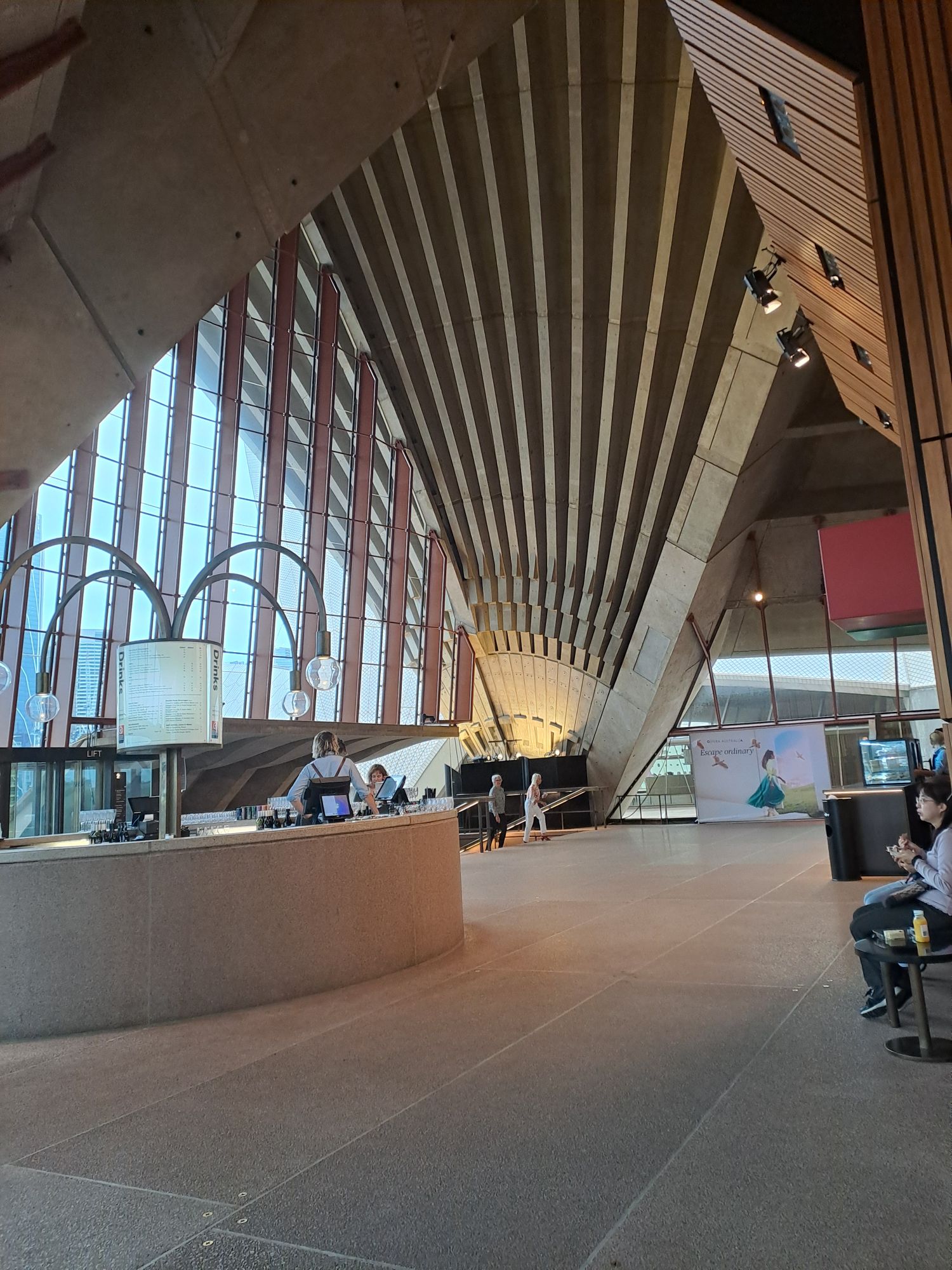
Foyer and BarJoan Sutherland Theatre
First a couple of comments about the Sydney Opera House. It is of course a splendid building but rather complicated inside, with surprising staircases and bizarre balconies. At dinner on Thursday, one of the locals here told me it is like a “1960s vision of The Future”, which is very apt. One of the nice things is that you can take your drink outside to get a breath of fresh air and a view of the harbour, which is very nice in the dark with all the lights from the boats and surrounding houses. The Joan Sutherland Theatre – where the operas are staged – is very nice. I have to say, though, that it’s a bit smaller than I’d anticipated. The seating capacity is just over 1500, while the Wales Millennium Centre – where Welsh National Opera perform – can seat 2500 people.
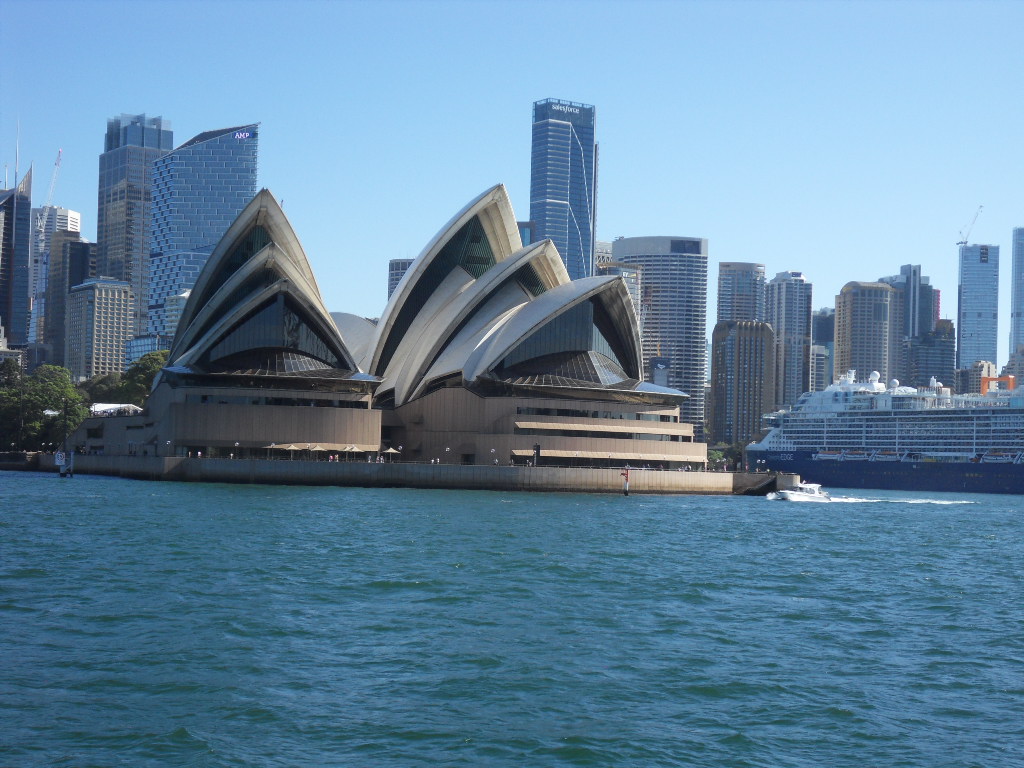
I took this picture from the Harbour Ferry
Sydney Opera House from the Harbour Ferry
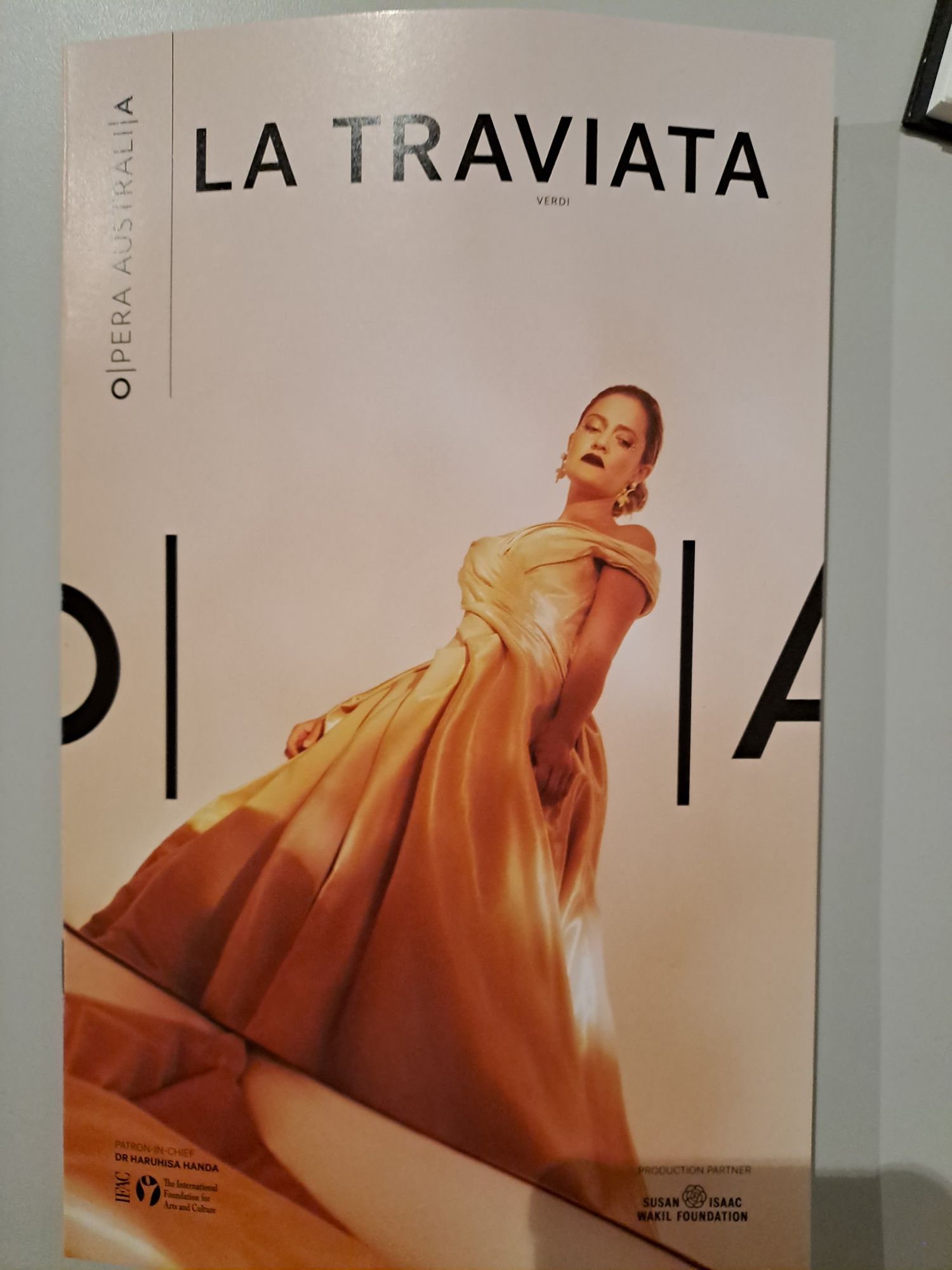
The Joan Sutherland Theatre is actually in the slightly smaller edifice to the left; the other side is a Concert Hall. Anyway, the place has a nice ambience and very friendly staff. They even give out free programmes!
And so to the performance. The staging in this production is relatively simple, with the opulence of the Paris settings achieved by costumes and lighting rather than by scenery. In Act II Scene 1, when Violetta and Alfredo are in the country, the back of the set is opened out to give a view of gardens and a tree. This device returns to touching effect at the end; see below. Costumes and design are pretty much 19th Century, with some (deliberate) anachronisms in dress style for humorous effect.
The Opera is in three acts, lasting about 2 hours and 30 minutes with one interval. When I heard there was only one wine break interval I wondered how they would manage it without making the performance a bit lop-sided. In fact the break came between Scenes 1 and 2 of Act II, with the first scene performed as a continuation of Act 1 and Act III following directly from Scene 2. It worked well, with changes of costume and scenery achieved onstage by the cast in view of the audience.
This production has been running since December 2023 but the principals changed earlier this month (February). We saw Sophie Salvesani as Violetta, Tomas Dalton as Alfredo Germont, and Luke Gabbedy as Giorgio Germont (Alfredo’s Father); all of them Australian born and bred. The performance was sung in Italian.
La Traviata is one of the most enduringly popular of all operas – and is one of the most frequently performed. It’s quite curious that its first performance in Venice was a complete disaster and it took several revisions before it became established as part of the operatic repertoire. A production like the one we saw last night, however, makes it abundantly clear why it is such an evergreen classic. Act I in particular is just one memorable tune after another.
The opera is based on the novel La Dame Aux Caméliaswhich later became a play with the same name. It tells the story of Violetta, a glamorous courtesan and flamboyant darling of the Paris party scene. She meets a young chap called Alfredo at a spectacular do in her house in Act I and he tells her he’s completely in love with her. She laughs him off and he departs crestfallen. When the party’s over and he’s gone, though, she finds herself thinking about him. The trouble with Violetta is that she is already seriously ill with consumption (tuberculosis) at the start. She knows that she is doomed to die and is torn between her desire to be free and her growing love for Alfredo.
Cut to Act II, Scene I, a few months later. Violetta and Alfredo are shacked up in a love nest away from Paris. While Alfredo is away paying off some of Violetta’s bills, Alfredo’s father Giorgio turns up and tries to convince Violetta to abandon her relationship with his son because its scandalous nature threatens their family’s prospects, particular his daughter’s (Alfredo’s sisters) plans to get married. Violetta eventually agrees to do a runner. Alfredo returns and meets his father who tries to convince him to return to his family in Provence. Alfredo is distraught to hear of Violetta’s departure, refuses to go with his father, and vows to find Violetta again.
Scene 2 is back in Paris, at the house of a lady called Flora. There’s a lot of singing and dancing and general riotousness.Alfredo turns up, slightly the worse for drink and proceeds to gamble (winning a huge amout of money). Violetta turns up and Alfredo insults her by throwing his winnings at her. He’s then overcome by remorse but the Baron Douphol, a wealthy friend of Violetta, is outraged and challenges Alfredo to a duel.
Act III is set a few months later in Violetta’s bedroom where she’s clearly dying. Alfredo has run off after wounding the Baron in a duel. The doctor gives Violetta just a few hours to live. Alfredo returns. The lovers forgive each other and embrace. Violetta dies.
I thought Sophie Salvesani was a very convincing and sympathetic Violetta. She has a very nice, fluid voice and engaging stage presence. Violetta is a demanding role- there are several tricky coloratura passages to cope with – but her character is quite complicated too. Although we know she’s ill right from the start she’s not by any means a passive victim. She’s a courtesan who has clearly put it about a bit, but she’s also got a strong moral sense. She’s vulnerable, but also at times very strong.
All the cast sang very well, actually. I particularly liked the baritone of Luke Gabbedy (though even with his make up he looked too young to be Alfredo’s Daddy).
The look of the opera – staging, lighting and costumes – also worked very well. The Paris parties were riots of colour and movement with just as much debauchery as desired. The start of Act III finds the same set as Act I, bare apart from a Chaise Longue, bathed in a ghostly greenish light. A particularly moving touch was right at the end when Violetta is dying. Here last lines (and the last of the Opera) are:
È strano! Cessarono gli spasimi del dolore. In me rinasce – m’agita insolito vigor! Ah! ma io ritorno a viver! Oh gioia! (Ricade sul canapè.)
How strange! The spasms of pain have ceased: A strange vigour has brought me to life! Ah! I shall live – Oh, joy! (She falls down, senseless, upon the sofa.)
Most productions I have seen follow these directions but, in this one, before delivering these lines, Violetta stands up, while the other members of the cast present on stage – Alfredo, Giorgio, the maid Annina, and the Doctor – freeze as she sings the lines in full voice. The back of the set lifts up and shows the tree we saw in Act II and Violetta walks out into the sunshine while a double takes the place of the lifeless Violetta on the sofa. The implication is that she is already dead when she sings these last lines. It’s a powerful device, and puts quite a different perspective on the ending.
Anyway, congratulations to Opera Australia on an excellent production which I enjoyed greatly.
P.S. I’ll be going again to the Sydney Opera House next week, to see their Magic Flute.
The views presented here are personal and not necessarily those of my employer (or anyone else for that matter).
Feel free to comment on any of the posts on this blog but comments may be moderated; anonymous comments and any considered by me to be vexatious and/or abusive and/or defamatory will not be accepted. I do not necessarily endorse, support, sanction, encourage, verify or agree with the opinions or statements of any information or other content in the comments on this site and do not in any way guarantee their accuracy or reliability.




 In the Dark