Archive for Oscar Wilde

“Who was Mr. W.H.”? – and Other Questions

Posted in LGBTQ+, Poetry with tags , , , , , , , on October 2, 2025 by telescoper

Today is National Poetry Day in the UK and Ireland but, instead of posting a poem like I usually do on this occasion, I thought I’d do a bit of reflecting on Shakespeare’s Sonnets. What prompted this is an article in the Times Literary Supplement I mentioned in a post on Monday. The cover picture shows a newly-discovered miniature by Nicholas Hilliard that is claimed to be of Henry Wriothesley, 3rd Earl of Southampton, and patron of William Shakespeare:
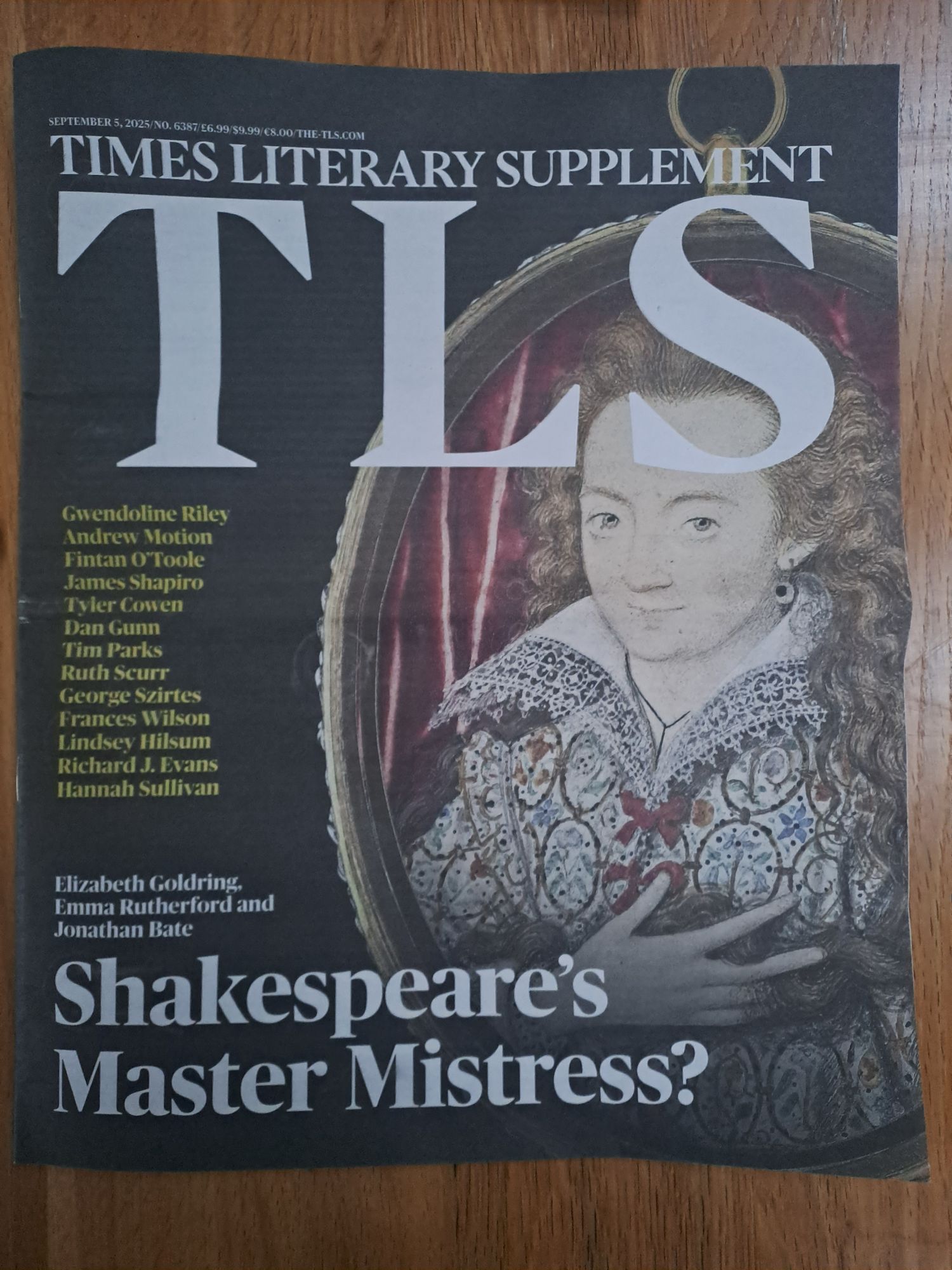
On the 20th May 1609, a collection of 154 Sonnets by William Shakespeare was published, which arguably represents at least as high a  level of literary achievement as his plays. The “Master Mistress” in the title of the TLS article is a reference to Sonnet No. 20 in the collection, published on 20th May 1609, of 154 Sonnets by William Shakespeare, which arguably represents at least as high a  level of literary achievement as his plays. Here is Sonnet No. 20 in the form usually printed nowadays:

A woman’s face with nature’s own hand painted,
Hast thou the master mistress of my passion,
A woman’s gentle heart but not acquainted
With shifting change as is false women’s fashion,
An eye more bright than theirs, less false in rolling:
Gilding the object whereupon it gazeth,
A man in hue all hues in his controlling,
Which steals men’s eyes and women’s souls amazeth.
And for a woman wert thou first created,
Till nature as she wrought thee fell a-doting,
And by addition me of thee defeated,
By adding one thing to my purpose nothing.
But since she pricked thee out for women’s pleasure,
Mine be thy love and thy love’s use their treasure.

The somewhat androgynous facial appearance of Henry Wriothesley – seen in other portraits – has led some to suggest that the above Sonnet was addressed to him. Others think that the poem was addressed to a young male actor (a “boy player“) who played female roles on the stage, as was usual in Shakespeare’s time. It was illegal for women to perform on stage until 1660.
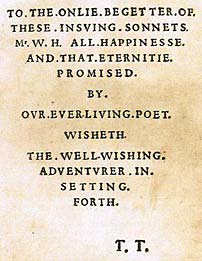
The dedication in the First Folio edition of the Sonnets, published in 1609, is shown on the left. The initials “T.T.” are accepted to stand for the name of the publisher Thomas Thorpe but the identity of “Mr. W.H.” is unknown. Of course “W.H.” is a reversal of the “H.W. ” that could be Henry Wriothesley, but would the publisher really use “Mr” to refer to a member of the nobility? Another curiosity is the prevalence of full stops, which is more characteristic of inscriptions carved in stone than on printed pages.

The First Folio edition was the only edition of the Sonnets published in Shakespeare’s lifetime and the circumstances of its publication remain uncertain to this day and not only because of identity of “Mr W.H.” For example, if it was authorised by Shakespeare, why did Shakespeare himself not write the dedication? Some have argued that it must have been published posthumously, so Shakespeare must have been dead in 1609, whereas most sources say he died in 1616.

Most of the poems (126 out of 154) contain poetic statements of love for a young man,  often called the “Fair Youth”. However, there is also a group of sonnets addressed to the poet’s mistress, an anonymous “dark lady”, which are far much more sexual in content than those addressed to the “Fair Youth”. The usual interpretation of this is that the poet’s love for the boy was purely Platonic rather than sexual in nature.  If Mr W.H. was a boy player then he would have been very young indeed, i.e. 13-17 years old…

Anyway, it was certainly a physical attraction: verse after verse speaks of the young man’s beauty. The first group of sonnets even encourage him to get married and have children so his beauty can continue and not die with his death. Sonnet 20 laments that the youth is not a woman, suggesting that this ruled out any sexual contact.  These early poems seem to suggest a slightly distant relationship between the two as if they didn’t really know each other well. However, as the collection goes on the poems become more and more intimate and it’s hard for me to accept that there wasn’t some sort of involvement between the two.  Although homosexual relationships were not officially tolerated in 17th Century England, they were not all that rare especially in the theatrical circles in which Shakespeare worked.

Oscar Wilde wrote a story called “A Portrait of Mr. W.H.” which suggests he is a young actor by the name of “Will Hughes”. The main evidence for this is Sonnet 20.

Look at the First Folio version:
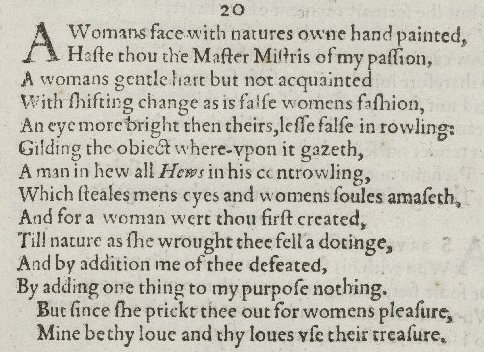
The initial capital and emphasis of “Hews” seen in line 7 is very unusual and suggests that it is a joke (one of many in this poem), in the form of a pun on the preceding “hew”. It is suggested that “Hews” is actually “Hughes”. Ingenious, but I’m not convinced. There were many other meanings of “hew” in use in Shakespeare’s time; it was a variant spelling of “ewe” for example.

We’ll probably never know who Mr W.H. was – presumably not Smith – or indeed what was the real nature of his relationship to Shakespeare but we do not need to know that to read and enjoy the poems.

I do have a fundamental misgiving, though, about the assumption that the “Onlie begetter” of these sonnets means the person to whom they are addressed, or who inspired them. That assumption entirely disregards the “Dark Lady” sequence. There are at least two addressees so neither can be the only begetter, if that is what begetter is supposed to mean.

I think it more likely Mr W.H., whoever he was, is the person who caused the collection to be created and/or published, perhaps by sponsoring the First Folio. It’s also possible that these poems may have been commissioned over the years by Mr. W.H. and/or others – experts think they were written over a period of at least 16 years – and only published together at much later date. It is indeed said that some of verses were circulated in private well before they were published, though they may perhaps have been edited or otherwise tidied up for the 1609 edition. Perhaps Shakespeare supplemented his income by writing sonnets to order?

This line of thought also took me to another question: why does everyone assume that all 126 of the “Fair Youth” sonnets are about the same person? That person is never named and only occasionally described. Some of the 126 are thematically linked, but overall it is a collection rather than a sequence. Some are humorous and some are very serious indeed. Some are downright cryptic. I think it quite possible, especially if the poems really were written over a period of 16 years, that they not all addressed to the same individual. Once you accept the evident truth that there is more than one recipient, then why not more than two?

Some have taken this even further and asked: do we really know that all 154 sonnets were written by the same person? The same question is asked about Shakespeare’s work generally. Was there really one person behind his plays, or were they collaborative efforts.

Finally, I wonder for what purpose these sonnets were written. Were they actually sent to the addressee(s) as expressions of love, like letters, or were they private meditations, like one might write in a journal?

I don’t suppose we’ll ever really know the answers to these questions, but I find it fascinating that the origin of such a famous collection is enshrouded in so many mysteries! I promise to post more of them here in due course.

If Oscar Wilde were a Torus

Posted in mathematics with tags , , , , on March 3, 2025 by telescoper

The Importance of Being Earnest

Posted in Film, Literature with tags , , , on October 16, 2015 by telescoper

I passed through Worthing on the train on the way to Brighton on  Monday – the line is immaterial. Today, Friday 16th October 2015,  is the 161st anniversary of the birth of Oscar Wilde. From that tenuous connection I offer you this glorious clip from the 1952 film of The Importance of Being Earnest. The principals are Michael Redgrave as Mr Ernest Worthing, Joan Greenwood as Gwendolyn and the wondrous Edith Evans as the formidable Lady Bracknell. It’s an absolutely brilliant scene, but if I had to choose one particular excerpt from the script it would be this:

“I do not approve of anything that tampers with natural ignorance. Ignorance is like a delicate exotic fruit; touch it and the bloom is gone. The whole theory of modern education is radically unsound. Fortunately in England, at any rate, education produces no effect whatsoever.”

Britten’s Children

Posted in Music with tags , , , , on April 14, 2013 by telescoper

I’ve recently been working my way through a pile of books I bought over the years but haven’t yet got around to reading. The latest is Britten’s Children by John Bridcut which I think I bought shortly after it was published in 2006 but have only just finished. I don’t know why it took me so long to read this book, but with this year being the centenary of the composer Benjamin Britten’s birth I felt I shouldn’t make any more subconscious excuses.

This book is quite a scholarly work (completely with musicological references, etc)  that describes Britten’s life in music alongside the story of the numerous friendships with adolescent  boys which were a constant theme in his life. I won’t go through a list of these because the wikipedia page about this book contains such an inventory, but it is worth noting that most of these friendships involved good-looking boys around 13/14 and that there certainly was at least an aesthetic element to Britten’s interest; the man himself certainly didn’t attempt to disguise this physical aspect of the attraction. However, it is quite clear from the often passionate letters exchanged between himself and the various boys concerned that these relationships were not exploitative, but based on a strong mutual affection.

In fact only one of the boys Britten befriended, Harry Morris, ever claimed that Britten had made sexual advances to him. Britten often invited his young friends to come with him on holiday, which they did with full parental permission. That in itself seems strange in the light of the reaction the mere suspicion of paedophilia is likely to  provoke nowadays. One would have thought it was much worse in Britten’s day when homosexual behaviour between adults was illegal, never mind between adults and young boys. As it happens, though, Britten was never even investigated for any form of indecent behaviour. His friendship with Harry Morris ended after the abrupt termination of a trip to Cornwall during which, Morris later claimed, Britten made some sort of approach to him. However, there are quite a few inconsistencies in Morris’ telling of the story, so there is considerable doubt over exactly what happened there. Anyway, I’ll resist the temptation to discuss whether the composer may have made overtures to this particular young man, and move on.

Reading the many excerpts from letters and transcriptions of interviews held with a number of the protagonists in later life, I think that Britten’s motivations were fundamentally benign. He just liked to be surrounded by beautiful youths, an attitude likely to be demonized today but actually not so much in the past. Many of Shakespeare’s Sonnets, for example, are addressed to a “fair youth” from an older man. They talk of male beauty,  passionate mutual attraction in such a way that it is easy to assume that they describe  sexual desire. They may do that, of course, but I’m not convinced that’s necessarily the case; there are many kinds of love, including those that do not need to be physically consummated.

This brings me to the origin of the phrase “the love that dare not speak its name” which most take to refer to homosexual desire. In fact it’s not as simple as that. The phrase was coined by Oscar Wilde in the following excerpt taken from the transcript of his criminal trial for gross indecency in 1895:

‘The love that dare not speak its name’, in this century, is such a great affection of an elder for a younger man as there was between David and Johnathan. Such as Plato made the very basis of his philosophy, and such as you may find in the sonnets of Michelangelo or Shakespeare. It is, in this century, misunderstood. So much misunderstood that it may be described as ‘the love that dare not speak its name’, and on account of it I am placed where I am now. It is beautiful. It is fine. It is the noblest form of affection. There is nothing unnatural about it. It is intellectual. And it repeatedly exists between an elder and a younger man when the elder has intellect and the younger man has all the joy, hope and glamour of life before him. That it should be so, the world does not understand. The world mocks at it and sometimes puts someone in the pillory for it.

Anyway, as you can imagine if you haven’t read the book, this is very delicate ground, but John Bridcut is both tactful and direct in the way he presents it. Britten was a complicated man who could be very difficult, so this is no hagiography, but neither does it pander to prurience. He must have done a good job because even the reviewer in the Daily Telegraph wrote:

Nowadays a known homosexual who sought out the company and affection of small boys would probably end up on a police register or behind bars. In treating Britten’s fondness for the young of his own sex as something more than lipsmacking paedophilia, this book does him a service both as a man and an artist.

In many ways the most interesting things to emerge from the book for me (as a non-expert on Britten) are things that are quite separate from the central theme. I hadn’t realized, for example, that Britten was a fine sportsman: he was an accomplished cricketer, swimmer and tennis player and was in fact Victor Ludorum at his school. That contrasts with the somewhat bookish persona I’ve always associated with him based on photographs. I was also fascinated to read that he composed music sitting at a desk. Only when he’d finished a piece (or at least a substantial fraction thereof) would he play it through on the piano. That may be common practice among composers, actually. I don’t know.

The other strand that’s woven into this story is Britten’s relationship with his life partner, Peter Pears. I hadn’t realized that Pears and Britten were actually pretty close friends for a couple of years before their relationship became a physical one. Pears apparently wasn’t always comfortable with Britten’s younger house guests – and their relationship had its ups and downs for other reasons too – but they stayed together until Britten died in 1976. I think the bond between them was all the stronger because it incorporated a mutual love of music. Earlier in his life, Britten was on the periphery of a Bohemian clique that included Christopher Isherwood and W.H. Auden, but both he and Pears decided that wasn’t for them; they settled down to a life of  fogeyish conventionality, a marriage in all but name. When Britten passed away, Her Majesty the Queen sent Peter Pears a telegram expressing her condolences. I look forward to the, hopefully near, future when all same-sex relationships are afforded the same level of respect.

The Name of Love

Posted in Uncategorized with tags , on April 1, 2012 by telescoper

A comment on a recent post pointed out that the ancient Greeks had four distinct name for different aspects of what in English is called, simply, “love”.

Here’s what wikipedia says on the matter:

There are several Greek words for love, as the Greek language distinguishes how the word is used. Ancient Greek has four distinct words for loveagápeérosphilía, and storgē. However, as with other languages, it has been historically difficult to separate the meanings of these words. Nonetheless, the senses in which these words were generally used are given below.

  • Agápe (ἀγάπη agápē[1]) means “love” (unconditional love) in modern day Greek, such as in the term s’agapo (Σ’αγαπώ), which means “I love you”. In Ancient Greek, it often refers to a general affection or deeper sense of “true love” rather than the attraction suggested by “eros“. Agape is used in the biblical passage known as the “love chapter”, 1 Corinthians 13, and is described there and throughout the New Testament as sacrificial love. Agape is also used in ancient texts to denote feelings for one’s children and the feelings for a spouse, and it was also used to refer to a love feast. It can also be described as the feeling of being content or holding one in high regard. Agape was appropriated by Christians for use to express the unconditional love of God.[citation needed] Before agape love there was no other word to express such great love.[citation needed]
  • Éros (ἔρως érōs[2]) is passionate love, with sensual desire and longing. The Modern Greek word “erotas” means “intimate love;” however, eros does not have to be sexual in nature.Eros can be interpreted as a love for someone whom you love more than the philia, love of friendship. It can also apply to dating relationships as well as marriage. Plato refined his own definition: Although eros is initially felt for a person, with contemplation it becomes an appreciation of the beauty within that person, or even becomes appreciation of beauty itself. Plato does not talk of physical attraction as a necessary part of love, hence the use of the word platonic to mean, “without physical attraction.” In the Symposium, the most famous ancient work on the subject, Plato has the middle-aged Athenian philosopher, Socrates argue to aristocratic intellectuals and a young male acolyte in sexual pursuit of him, that eroshelps the soul recall knowledge of beauty, and contributes to an understanding of spiritual truth, the ideal “Form” of youthful beauty that leads us humans to feel erotic desire — thus suggesting that even that sensually-based love aspires to the non-corporeal, spiritual plane of existence; that is, finding its truth, just like finding any truth, leads to transcendence. Lovers and philosophers are all inspired to seek truth through the means of eros.”
  • Philia (φιλία philía[3]) means friendship or affectionate love in modern Greek. It is a dispassionate virtuous love, a concept developed by Aristotle. It includes loyalty to friends, family, and community, and requires virtue, equality and familiarity. In ancient texts, philos denoted a general type of love, used for love between family, between friends, a desire or enjoyment of an activity, as well as between lovers.
  • Storge (στοργή storgē[4]) means “affection” in ancient and modern Greek. It is natural affection, like that felt by parents for offspring. Rarely used in ancient works, and then almost exclusively as a descriptor of relationships within the family. It is also known to express mere acceptance or putting up with situations, as in “loving” the tyrant.

I’m by no means an expert on love, but it seems to me that even with this expanded set of basis states it’s still the case that one’s emotions aren’t described fully by just one. Perhaps love is like quantum mechanics, in which the general state is a superposition?

Anyway, this all reminded me of “the love that dare not speak its name” which most take to refer to homosexual desire. In fact it’s not as simple as that. The phrase was coined by Oscar Wilde in the following excerpt taken from the transcript of his criminal trial for gross indecency in 1895:

‘The love that dare not speak its name’, in this century, is such a great affection of an elder for a younger man as there was between David and Johnathan. Such as Plato made the very basis of his philosophy, and such as you may find in the sonnets of Michelangelo or Shakespeare. It is, in this century, misunderstood. So much misunderstood that it may be described as ‘the love that dare not speak its name’, and on account of it I am placed where I am now. It is beautiful. It is fine. It is the noblest form of affection. There is nothing unnatural about it. It is intellectual. And it repeatedly exists between an elder and a younger man when the elder has intellect and the younger man has all the joy, hope and glamour of life before him. That it should be so, the world does not understand. The world mocks at it and sometimes puts someone in the pillory for it.

This looks to me like it fits in the wider definition of Eros, not necessarily of a sexual nature. It’s a very moving speech, or at least I think so,  but it didn’t do him much good. He was eventually convicted and sentenced to two years’ hard labour. And, over a century later, it’s still “misunderstood”…


The Garden of Eros

Posted in Poetry with tags , on June 9, 2010 by telescoper

I was drawn to the idea of using this poem by Oscar Wilde as a blog post simply because I wanted something timely to celebrate the abundance of lovely flowers in my Garden, especially the Honeysuckle which has started dispensing an extraordinary perfume in the evenings. I hadn’t seen this poem before yesterday, but noticed that the (superb) first verse mentions the month of June, which made it especially timely:

It is full summer now, the heart of June,
Not yet the sun-burnt reapers are a-stir
Upon the upland meadow where too soon
Rich autumn time, the season’s usurer,
Will lend his hoarded gold to all the trees,
And see his treasure scattered by the wild and
spendthrift breeze.


Once I started reading it, however, I was completely captivated. Amongst other things, it’s a lament against the growth of materialism in the 19th Century. Although the language is as over-the-top as you would expect for Oscar Wilde, it’s a beautifully sustained work and Wilde’s natural flair for words shines throughout. He refers in admiration to a large number of other poets (including Keats, Shelley, Swinburne, Rossetti and William Morris), but I think it’s unfortunate that Wilde isn’t as much appreciated as a poet as he is as a playwright.

It’s not really feasible to post the entire text because it’s so very long but fortunately I found an excellent reading that lasts about 15 minutes so it’s split over two youtube-sized chunks. I hope you find time to listen to it all and simply bask in the glow of a true genius…