Archive for P.D. James

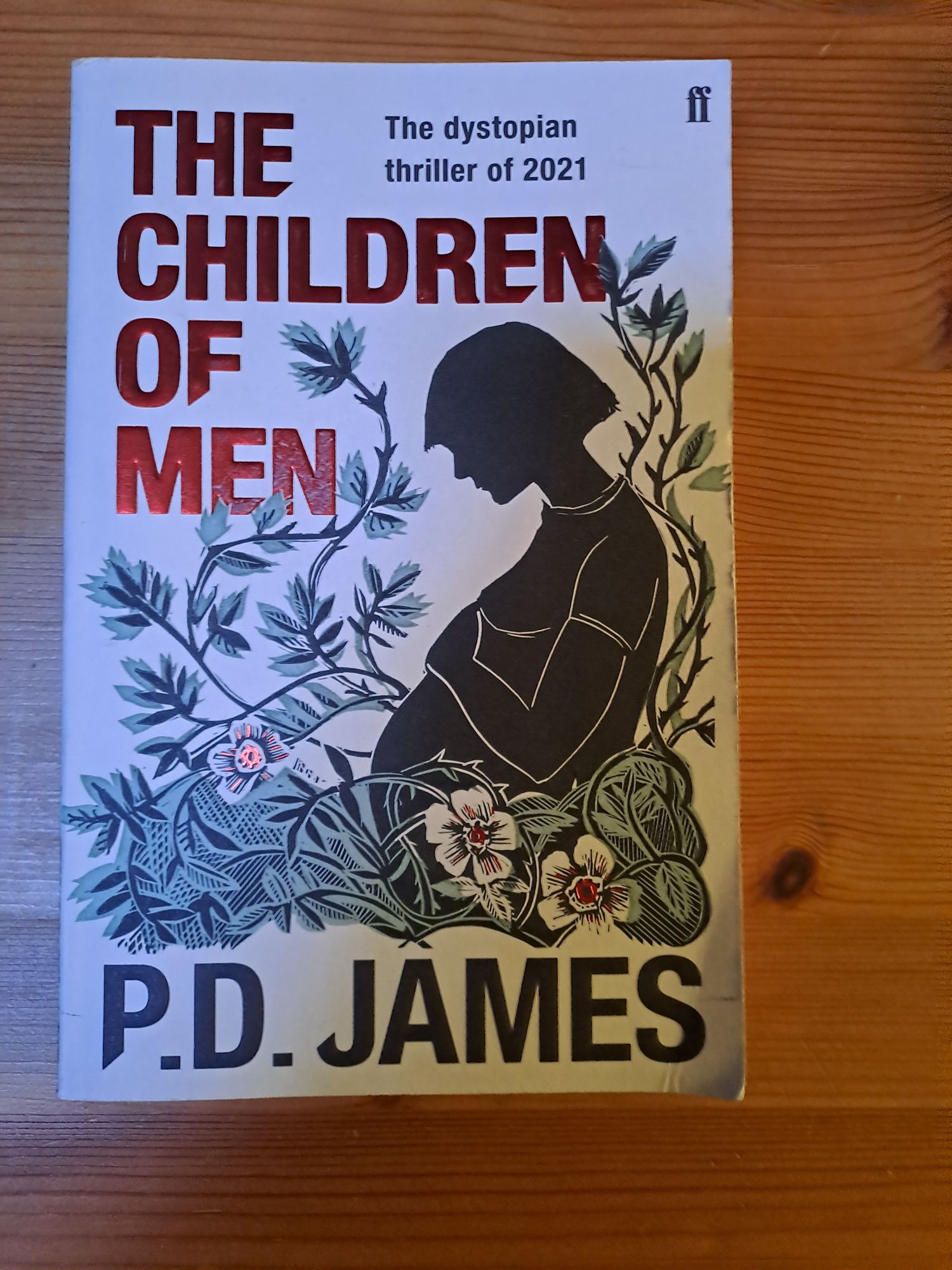
The Children of Men by P.D. James

Posted in Biographical, Literature with tags , , , , , , , on April 28, 2024 by telescoper

When I finished reading Death Comes to Pemberley by P.D. James I realized that there was one other book by the same author that I had never read, the dystopian thriller The Children of Men. I bought the above edition about five years ago, but the novel was first published in 1992.

The premise of this story, set in the (then future) 2021 is that, in 1995, for reasons unknown, the entire human race suddenly lost the ability to reproduce. The book makes no attempt to explain the origins of this mass infertility, and it is a conceit that I found very implausible, but I did manage to suspend my disbelief enough to engage with the author’s ideas about what a society without children might be like. That is basically what the first half of the book tries to do. It’s an interesting idea and what develops is not the kind of post-apocalyptic scenario that has been written about many times before.

In 2021 England is ruled by a dictator, called the Warden, by the name of Xan. He happens to be the cousin of the principal protagonist, Theo. The Powers That Be introduce the concept of a Quietus, at which elderly people are forced to commit mass suicide. A penal colony is set up on the Isle of Man where prisoners are dumped and left to fend for themselves. As the population ages, schools and colleges close, buildings are left to decay, and as numbers decrease people are forced to move to larger towns, the only places where services and utilities can be maintained.

One thing that struck me reading this in 2024 is that the author did not foresee any of the technological advances that were to occur between 1995 and 201. The existence of the internet or even mobile phones would have had significant implications for the plot.

The novel is split into two parts, Book 1 (Omega) and Book 2 (Alpha), and the first part is largely devoted to describing the decay and hopelessness of a society without children. I found it rather heavy-handed, with too much sermonizing. While Book 1 verges on a sort of allegory, no doubt inspired by the author’s own Christian faith, n Book 2 the story becomes a well-plotted thriller. After witnessing the horror of a Quietus, Theo joins a small group of dissidents based in Oxford who carry out a campaign to disrupt such events and think that Theo’s relationship to the Warden might be useful in effecting change at the top. As well as being Xan’s cousin, Theo used to work for Government as an adviser to the Warden.

The group is, however, rumbled and its members have to flee into the countryside. Along the way we find that one of their number, a woman by the name of Julian, is pregnant. Fortunately another member of the group, Miriam, is a midwife (although she obviously hasn’t practiced for 25 years). We learn the identify of the father of Julian’s child but not the reason why she has conceived when apparently nobody else on the planet can. Obviously the Alpha in the title of the second book refers to this child. I won’t say how it all finishes, except that the ending is ambiguous.

The fugitives-on-the-run part of the story in Book 2 is very well crafted and genuinely exciting, but the pregnancy adds yet another level of implausibility to a plot that seemed to me already very contrived. Although it is a page-turner I found it ultimately unsatisfying.

P.S. I understand there is a film based on the book, but I haven’t seen it.
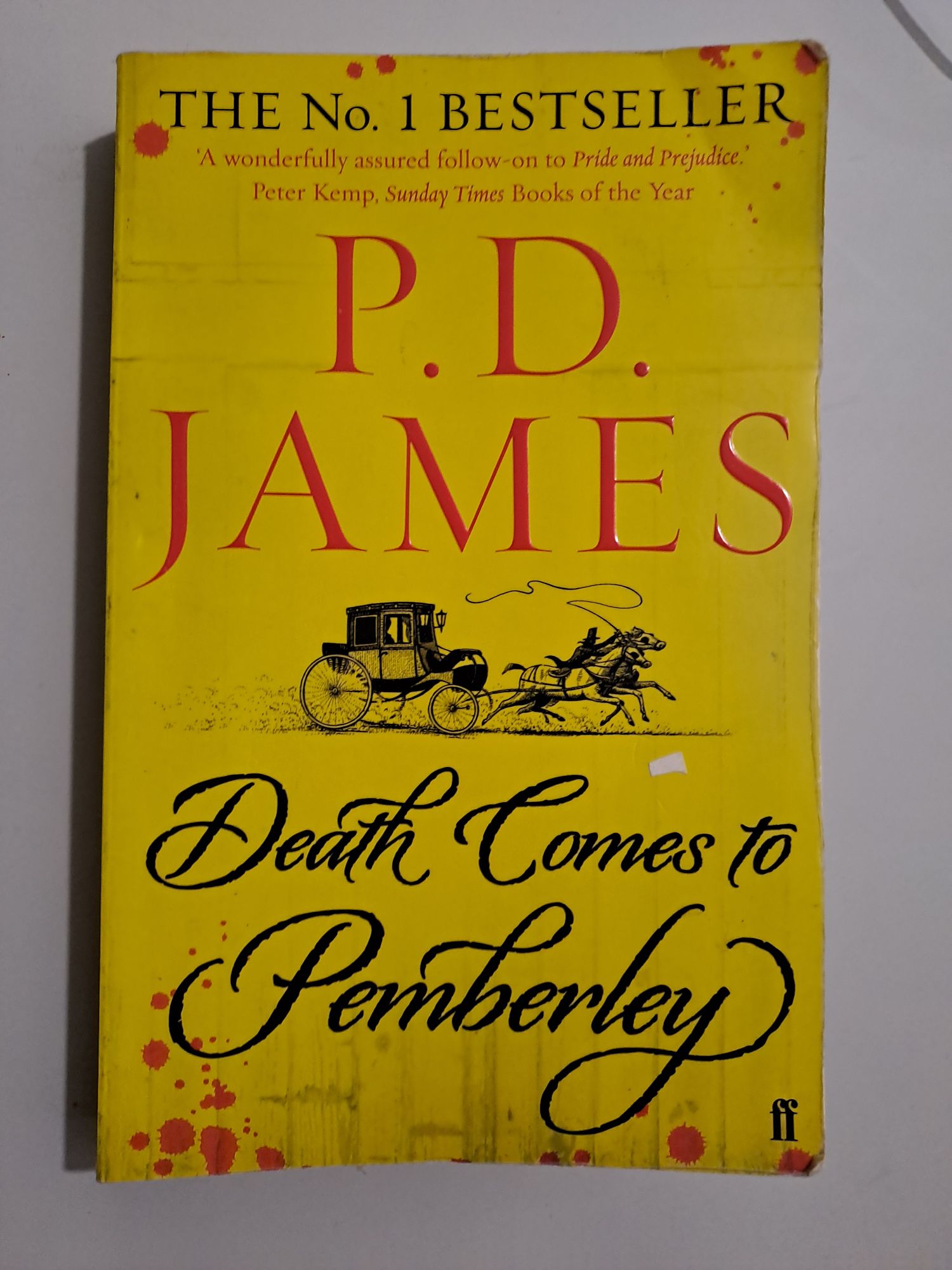
Death Comes to Pemberley by P.D. James

Posted in Literature with tags , , , on February 27, 2024 by telescoper

The latest book on my reading list is Death Comes to Pemberley, by P.D. James, which was published in 2011. The author was 90 years old when she began writing it and in her author’s note she admits that the book gave her a chance to indulge herself by combining her flair as a mystery writer with a love of the books of Jane Austen. This book is a skillful pastiche of the style of Jane Austen set in the world of Pride and Prejudice; this is why I re-read that book before departing for Sydney. It has however taken longer than I thought to get around to reading the P.D. James book as I have been rather busy.

It’s interesting to remark that Pride and Prejudice was actually written between 1796 and 1797, but not published until 1813 (and in a revised form). Jane Austen is a wonderful writer, with an elegant and witty style. It’s a hard act to follow, but P.D. James does a fine job. I’ll also remark that the original novel was written at the height of the Napoleonic Wars, and is set in England at a time when the threat of invasion from France was very real, but this barely registers in the plot.

I’ll let the author herself describe the setting

In Death Comes to Pemberley, I have chosen the earlier date of 1797 for the marriages of both Elizabeth and her older sister Jane, and the book begins in 1803 when Elizabeth and Darcy have been happily together for six years and are preparing for the annual autumn ball which will take place the next evening.

With their guests, which include Jane and her husband Bingley, they have been enjoying an informal family dinner followed by music and are preparing to retire for the night when Darcy sees from the window a chaise being driven at seed down the road from the wild woodlands. When the galloping horses have been pulled to a standstill, Lydia Wickham, Elizabeth’s youngest sister, almost falls from the chaise, hysterically screaming that her husband has been murdered. Darcy organises a search party and, with the discovery of a blood-smeared corpse in the woodland, the peace both of the Darcys and of Pemberley is shattered as the family becomes involved in a murder investigation.

P.D. James, Author’s Note, Death Comes to Pemberley

As this is a mystery novel, I will refrain from saying too much about the plot as that would spoil the book for readers. I will say that it is unusual for P.D. James that it isn’t a detective story as such because there isn’t actually a detective. The mystery of the murder is solved in the end by a spontaneous confession.

I get the impression that P.D. James wanted to use this book to add her own explanation of some of the events in Pride and Prejudice so there is a lengthy section at the end that functions to explain the back story. Most of the characters from Pride and Prejudice appear in the present book as bystanders, but they are well described and the overall atmosphere of the book is convincing. Darcy and Elizabeth have changed, but I imagine six years of marriage will do that. Although it’s a pastiche, this book is not at all superficial; the author seems to understand Austen’s characters and, rather than being merely imitative, the result is a genuine homage.

P.D. James passed away in 2014 at the age of 94. I bought Death Comes to Pemberley in 2014 too. The fact that it has taken me a decade to get around to reading it tells you something of how far I had got out of the reading habit. There’s also the point that I knew this was her last book and I was a bit reluctant to finish it knowing that there would be no more. Still, better late than never. I’m very glad I have read it at last as I enjoyed it greatly.

There’s something distinctively English about the novels of P.D. James, although that something is a something that clearly tends to polarize people. Some find her approach a bit too detached and genteel, some find it, “cosy”, snobbish and class-ridden, and some think that she was just an anachronism, harking back too much to the era of Agatha Christie and Dorothy L. Sayers. Yet others can’t understand the attraction of the genre at all. People are welcome to their opinions of course, but I think that the best detective fiction is not just about setting a puzzle for the reader to solve, but also posing questions about the nature of a society in which such crimes can happen. Far from being “cosy”, great crime writing actually unsettles complacent bourgeois attitudes. The solution of the mystery may offer us a form of comfort, but the questions exposed by the investigation do not go away. This is just as true for books set in the present as it is for those set two centuries ago in the world of stately homes and the threat of invasion from Napoleon.

Rest in Peace, P.D. James

Posted in Literature with tags , , on November 28, 2014 by telescoper

I was saddened yesterday to hear of the death, at the age of 94, of the great crime novelist P.D. James so decided to take a few minutes out of my lunch break to post this little tribute. I’ve long been a fan of detective fiction in general but there was something very special about the writing of P.D. James; the initials stand for Phyllis Dorothy, by the way. I think she was one of the few crime novelists who managed to transcend the whodunnit genre  to produce work of authentic literary merit in its own right; Ruth Rendell is the only other that springs to mind among contemporary writers of detective fiction. Her style was as polished and the subject matter as meticulously researched was you would expect from a direct descendant of Dorothy L. Sayers, one of the leading exponents of the “Golden Age” of detective fiction.

P.D. James is most famous for her series of fourteen books featuring the poetry-loving detective Adam Dalgleish, the first of which, Cover Her Face, was published in 1962. That series contained many superb stories, such as Shroud for a Nightingale, Devices and Desires, and Death of an Expert Witness. She also wrote two novels about the female private detective Cordelia Gray, including An Unsuitable Job for a Woman. More recently she wrote a murder mystery  sequel to Jane Austen’s Pride and Prejudice called Death Comes to Pemberley. I bought this last year, but somehow never got around to reading it but will definitely do so now, as I now know it her last; I have read all her other books.

As well as numerous awards for her writing, P.D. James was honoured by the Establishment with an OBE in 1983 and a Life Peerage in 1999. It’s says most however that so many other authors, even those whose style is markedly different have offered heartfelt tributes to her (including these in the Guardian). The main reason why she was held in such high regard by fellow authors was simply that she was bloody good at being a writer; she cared about her craft and was proud of what she did.

There’s something distinctively English about the detective novels of P.D. James, although that something is a something that clearly tends to polarize people. Some find her approach a bit too detached and genteel, some find it, “cosy”, snobbish and class-ridden, and some think that she was just an anachronism, harking back too much to the era of Agatha Christie and Dorothy L. Sayers. Yet others can’t understand the attraction of the genre at all. People are welcome to their opinions of course, but I think that the best detective fiction is not just about setting a puzzle for the reader to solve, but also posing questions about the nature of a society in which such crimes can happen. Far from being “cosy”, great crime writing actually unsettles bourgeois attitudes. The solution of the mystery may offer us a form of comfort, but the questions exposed by the investigation do not go away. As Val McDermid
wrote in the Guardian
, “People who know no better sometimes describe her work as cosy. If a scalpel is cosy, then so was Phyllis”.

Rest in Peace, P.D. James (1920-2014).