Archive for perihelion

Sunrise, Sunset, Solstice and Perihelion

Posted in The Universe and Stuff with tags , , , , on January 2, 2026 by telescoper

I was on the train earlier today when I remembered that we are getting close to the time when Earth reaches its perihelion, i.e. the point in its orbit when it is closest to the Sun. This occurs at 17.15 GMT tomorrow (Saturday 3rd January 2026), in fact. At this time the distance from the Sun’s centre to Earth’s centre will be 147,099,894 km  This year, aphelion (the furthest distance from the Sun) is at 18.30 GMT on July 6th 2026 at which point the centre of the Earth will be 152,087,774 km from the centre of the Sun. You can find a list of times and dates of perihelion and aphelion for future years here.

Earth’s elliptical orbit viewed at an angle (which makes it look more eccentric than it is – in reality is very nearly circular).

At perihelion the speed of the Earth in its orbit around the Sun is greater than at aphelion (about 30.287 km/s versus 29.291 km/s). This difference, caused by the Earth’s orbital eccentricity, contributes to the difference between mean time and solar time which, among other things, influences the time of sunrise and sunset at the winter solstice that happened a couple of weeks or so ago.

Incidentally, although the Solstice took place on 21st December, it was not until the end of 2025 that we experienced the latest sunrise. The longest day means neither the latest sunrise nor the earliest sunset. The earliest sunset was actually on December 15th in Dublin.

It surprises me how many people think that the existence of the seasons has something to do with the variation of the Earth’s distance from the Sun, thinking that the closer to the Sun we get the warmer the weather will be. The fact that perihelion occurs in the depth of winter should convince anyone living in the Northern hemisphere that this just can’t be the case, as should the fact that it’s summer in the Southern hemisphere while it is winter in the North.

The real reason for the existence of seasons is the tilt of the Earth’s axis of rotation. I used to do a little demonstration with a torch – flashlight to American readers- to illustrate this when I taught first-year astrophysics. If you shine a torch horizontally at a piece of card it will illuminate a patch of the card. Keep the torch at the same distance but tilt the card and you will see the illuminated patch increase in size. The torch is radiating the same amount of energy but in the second case that energy is spread over a larger area than in the first. This means that the energy per unit area incident on the card is decreases when the card is tilted. It is that which is responsible for winter being colder than summer. In the summer the Sun is higher in the sky (on average) than in winter. From this argument you can infer that the winter solstice not the perihelion, is the relevant astronomical indicator of winter.

That is not to say that the shape of the Earth’s orbit has no effect on terrestrial temperatures. It may, for example, contribute to the summer in the Southern hemisphere being hotter than in the North, although it is not the only effect. The Earth’s surface possesses a significant North-South asymmetry: there is a much larger fraction of ocean in the Southern hemisphere, for example, which could be responsible for moderating any differences in temperature due to insolation. The climate is a non-linear system that involves circulating air and ocean currents that respond in complicated ways and on different timescales not just to insolation but to many other parameters, including atmospheric composition (especially the amount of water vapour).

The dates when Earth reaches the extreme points on its orbit (the apsides) are not fixed because of the variations in its orbital eccentricity so, in the short-term, the dates can vary up to 2 days from one year to another. The perihelion distance varies slightly from year to year too; it will be slightly larger next year than this year, for example. There is however a long-term trend for perihelion to occur later in the year. For example, in 1246, the December Solstice (Winter Solstice for the Northern Hemisphere) was on the same day as the Earth’s perihelion. Since then, the perihelion and aphelion dates have drifted by an average of one day every 58 years. This trend will continue, meaning that by the year 6430 the timing of the perihelion and the March Equinox will coincide, although I hope to have retired by then…
Google Garbage

Posted in History, mathematics with tags , on January 5, 2025 by telescoper

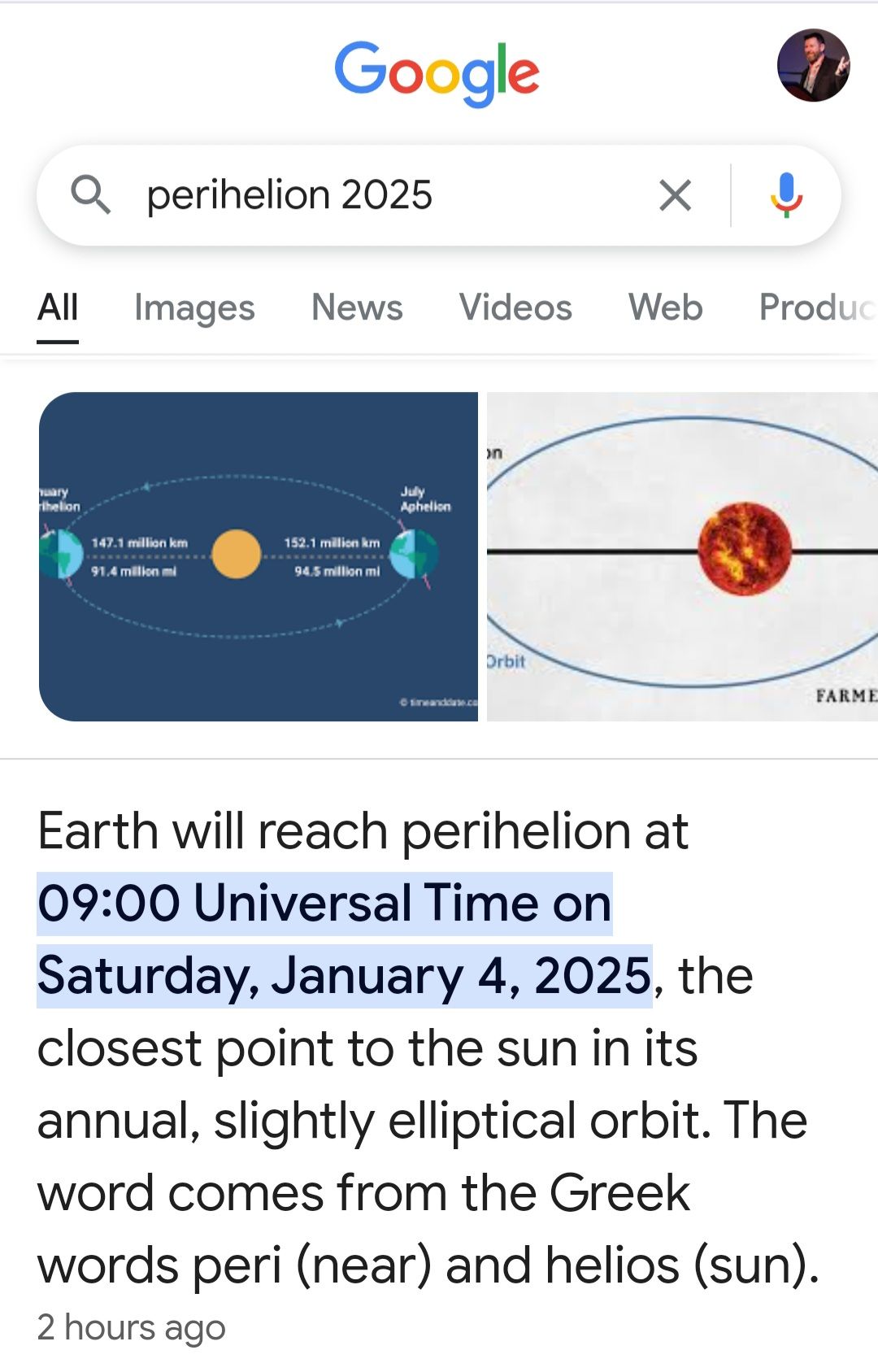
In the course of double-checking the time of perihelion for yesterday’s post I did a quick Google search. What came up first was this:

Google search results nowadays are prefaced by a short summary like this one, presumably generated by some sort of AI. This one – like many others I’ve seen recently – is just plain wrong. The time of perihelion was 13.28 Universal Time, not 09.00.

I am old enough to remember when Google Search first appeared in 1998. It was so much better than other search engines at that time, largely because of the PageRank algorithm; see this piece for a bit of the history and the reason it worked so well. Some years ago, however, Google Search underwent a transition from being a useful facility for web browsers to a piece of adtech useful only for marketing companies who pay to have their sites artificially boosted. Every time you do a search nowadays you have to scroll through a deluge of promoted pages that have very little to do with what you searched for. Google is now so corrupted as to be virtually useless. Adding garbled AI junk to the mixture is just making it worse. It’s not only frustrating but potentially dangerous. Information can be manipulated for purposes other than selling things; the systematic spread of misinformation by those in power has potentially catastrophic consequences.

Time for Perihelion

Posted in The Universe and Stuff with tags , , , on January 4, 2025 by telescoper

Earth’s elliptical orbit viewed at an angle (which makes it look more eccentric than it is – in reality is very nearly circular).

At 13.28 GMT today (Saturday 4th January 2025), the Earth reaches its perihelion. At this time the distance from the Sun’s centre to Earth’s centre will be 147,103,686 km. This year, aphelion (the furthest distance from the Sun) is at 20.54 GMT on July 3rd 2025 at which point the centre of the Earth will be 152,087,738 km from the centre of the Sun. You can find a list of times and dates of perihelion and aphelion for future years here.

At perihelion the speed of the Earth in its orbit around the Sun is greater than at aphelion (about 30.287 km/s versus 29.291 km/s). This difference, caused by the Earth’s orbital eccentricity, contributes to the difference between mean time and solar time which, among other things, influences the time of sunrise and sunset at the winter solstice that happened a couple of weeks or so ago.

It surprises me how many people think that the existence of the seasons has something to do with the variation of the Earth’s distance from the Sun as it moves in its orbit in that the closer to the Sun we get the warmer the weather will be. The fact that perihelion occurs in the depth of winter should convince anyone living in the Northern hemisphere that this just can’t be the case, as should the fact that it’s summer in the Southern hemisphere while it is winter in the North.

The real reason for the existence of seasons is the tilt of the Earth’s axis of rotation. I used to do a little demonstration with a torch (flashlight to American readers) to illustrate this when I taught first-year astrophysics. If you shine a torch horizontally at a piece of card it will illuminate a patch of the card. Keep the torch at the same distance but tilt the card and you will see the illuminated patch increase in size. The torch is radiating the same amount of energy but in the second case that energy is spread over a larger area than in the first. This means that the energy per unit area incident on the card is decreases when the card is tilted. It is that which is responsible for winter being colder than summer. In the summer the sun is higher in the sky (on average) than in winter. From this argument you can infer that the winter solstice not the perihelion, is the relevant astronomical indicator of winter.

That is not to say that the shape of the Earth’s orbit has no effect on temperatures. It may, for example, contribute to the summer in the Southern hemisphere being hotter than in the North, although it is not the only effect. The Earth’s surface possesses a significant North-South asymmetry: there is a much larger fraction of ocean in the Southern hemisphere, for example, which could be responsible for moderating any differences in temperature due to insolation. The climate is a non-linear system that involves circulating air and ocean currents that respond in complicated ways and on different timescales not just to insolation but to many other parameters, including atmospheric composition (especially the amount of water vapour).

The dates when Earth reaches the extreme points on its orbit (apsides) are not fixed because of the variations in its orbital eccentricity so, in the short-term, the dates can vary up to 2 days from one year to another. The perihelion distance varies slightly from year to year too; it’s slightly larger this year than last year, for example.

There is however a long-term trend for perihelion to occur later in the year. For example, in 1246, the December Solstice (winter solstice for the Northern Hemisphere) was on the same day as the Earth’s perihelion. Since then, the perihelion and aphelion dates have drifted by an average of one day every 58 years. This trend will continue, meaning that by the year 6430 the timing of the perihelion and the March Equinox will coincide, although I hope to have retired by then…

The Time of Perihelion

Posted in The Universe and Stuff with tags , , , on January 3, 2024 by telescoper

Earth’s elliptical orbit viewed at an angle (which makes it look more eccentric than it is – in reality is very nearly circular).

I haven’t received a Royal Astronomical Society diary this year, which I’m sad about as it has been a bit of a tradition, as well as being a useful source of astronomical information. According to other sources,  however, today (Wednesday 3rd January 2024) at approximately 00.39 GMT the Earth reached the point on its orbit  closest to the Sun, i.e. its perihelion. At this time the distance from the Sun’s centre to Earth’s centre was  147,100,632 km. This year, aphelion (the furthest distance from the Sun) is at 06.06 GMT on July 6th 2023 at which point the centre of the Earth will be 152,099,968 km from the centre of the Sun. You can find a list of times and dates of perihelion and aphelion for future years here.

At perihelion the speed of the Earth in its orbit around the Sun is greater than at aphelion (about 30.287 km/s versus 29.291 km/s). This difference, caused by the Earth’s orbital eccentricity, contributes to the difference between mean time and solar time which, among other things, influences the time of sunrise and sunset at the winter solstice that happened a couple of weeks or so ago.

It surprises me how many people think that the existence of the seasons has something to do with the variation of the Earth’s distance from the Sun as it moves in its orbit in that the closer to the Sun we get the warmer the weather will be. The fact that perihelion occurs in the depth of winter should convince anyone living in the Northern hemisphere that this just can’t be the case, as should the fact that it’s summer in the Southern hemisphere while it is winter in the North.

The real reason for the existence of seasons is the tilt of the Earth’s axis of rotation. I used to do a little demonstration with a torch (flashlight to American readers) to illustrate this when I taught first-year astrophysics. If you shine a torch horizontally at a piece of card it will illuminate a patch of the card. Keep the torch at the same distance but tilt the card and you will see the illuminated patch increase in size. The torch is radiating the same amount of energy but in the second case that energy is spread over a larger area than in the first. This means that the energy per unit area incident on the card is decreases when the card is tilted. It is that which is responsible for winter being colder than summer. In the summer the sun is higher in the sky (on average) than in winter. From this argument you can infer that the winter solstice not the perihelion, is the relevant astronomical indicator of winter.

That is not to say that the shape of the Earth’s orbit has no effect on temperatures. It may, for example, contribute to the summer in the Southern hemisphere being hotter than in the North, although it is not the only effect. The Earth’s surface possesses a significant North-South asymmetry: there is a much larger fraction of ocean in the Southern hemisphere, for example, which could be responsible for moderating any differences in temperature due to insolation. The climate is a non-linear system that involves circulating air and ocean currents that respond in complicated ways and on different timescales not just to insolation but to many other parameters, including atmospheric composition (especially the amount of water vapour).

The dates when Earth reaches the extreme points on its orbit (apsides) are not fixed because of the variations in its orbital eccentricity so, in the short-term, the dates can vary up to 2 days from one year to another. The perihelion distance varies slightly from year to year too; it’s slightly larger this year than last year, for example.

There is however a long-term trend for perihelion to occur later in the year. For example, in 1246, the December Solstice (winter solstice for the Northern Hemisphere) was on the same day as the Earth’s perihelion. Since then, the perihelion and aphelion dates have drifted by an average of one day every 58 years and this trend will continue. This means that by the year 6430 the timing of the perihelion and the March Equinox will coincide, although I hope to have retired by then…

Perihelion Again

Posted in The Universe and Stuff with tags on January 4, 2023 by telescoper

Earth’s elliptical orbit viewed at an angle (which makes it look more eccentric than it is – in reality is very nearly circular).

According to my new RAS Diary,  today (Wednesday 4th January 2023) at approximately 16.17 GMT the Earth reaches at the point on its orbit which which it is at its closest to the Sun, i.e. its perihelion. At this time the distance from the Sun’s centre to Earth’s centre will be  147,098,925 km. This year, aphelion (the furthest distance from the Sun) is at 21.06 GMT on July 6th 2023 at which point the centre of the Earth will be 152,093,251 km from the centre of the Sun. You can find a list of times and dates of perihelion and aphelion for future years here.

At perihelion the speed of the Earth in its orbit around the Sun is greater than at aphelion (about 30.287 km/s versus 29.291 km/s). This difference, caused by the Earth’s orbital eccentricity, contributes to the difference between mean time and solar time I blogged about when discussing the Winter Solstice a couple of weeks ago.

It surprises me how many people think that the existence of the seasons has something to do with the variation of the Earth’s distance from the Sun as it moves in its orbit in that the closer to the Sun we get the warmer the weather will be. The fact that perihelion occurs in the depth of winter should convince anyone living in the Northern hemisphere that this just can’t be the case, as should the fact that it’s summer in the Southern hemisphere while it is winter in the North.

The real reason for the existence of seasons is the tilt of the Earth’s axis of rotation. I used to do a little demonstration with a torch (flashlight to American readers) to illustrate this when I taught first-year astrophysics. If you shine a torch horizontally at a piece of card it will illuminate a patch of the card. Keep the torch at the same distance but tilt the card and you will see the illuminated patch increase in size. The torch is radiating the same amount of energy but in the second case that energy is spread over a larger area than in the first. This means that the energy per unit area incident on the card is decreases when the card is tilted. It is that which is responsible for winter being colder than summer. In the summer the sun is higher in the sky (on average) than in winter. From this argument you can infer that the winter solstice not the perihelion, is the relevant astronomical indicator of winter.

That is not to say that the shape of the Earth’s orbit has no effect on temperatures. It may, for example, contribute to the summer in the Southern hemisphere being hotter than in the North, although it is not the only effect. The Earth’s surface possesses a significant North-South asymmetry: there is a much larger fraction of ocean in the Southern hemisphere, for example, which could be responsible for moderating any differences in temperature due to insolation. The climate is a non-linear system that involves circulating air and ocean currents that respond in complicated ways and on different timescales not just to insolation but to many other parameters, including atmospheric composition (especially the amount of water vapour).

The dates when Earth reaches the extreme points on its orbit (apsides) are not fixed because of the variations in its orbital eccentricity so, in the short-term, the dates can vary up to 2 days from one year to another. The perihelion distance varies slightly from year to year too; it’s slightly smaller this year than last year, for example.

There is however a long-term trend for perihelion to occur later in the year. For example, in 1246, the December Solstice (Winter Solstice for the Northern Hemisphere) was on the same day as the Earth’s perihelion. Since then, the perihelion and aphelion dates have drifted by an average of one day every 58 years and this trend will continue. This means that by the year 6430 the timing of the perihelion and the March Equinox will coincide, although I will probably have retired by then…


A Perihelion Poser

Posted in Cute Problems, The Universe and Stuff with tags , , , on January 4, 2014 by telescoper

Today (January 4th) the Earth is at perihelion, ie its closest approach to the Sun. This may surprise folk in the Northern hemisphere who think that winter and summer are determined the Earth’s distance from the Sun…

Anyway, here’s an easy little question. The eccentricity of the Earth’s orbit is 0.017. Estimate the percentage difference in the flux of energy arriving at Earth from the Sun at the extremes of its orbit (ie at perihelion and aphelion). Is this difference likely to have any significant effect?

Answers through the comment box please..