Archive for Physics

Physics Proverbs

Posted in The Universe and Stuff with tags , on July 2, 2013 by telescoper

I was a bit bored on the bus this morning, as it got stuck in a traffic jam, so decided to amuse myself (and probably nobody else) by thinking up physics-related versions of traditional proverbs and tweeting them (hashtag #physicsproverbs). I thought it might be fun to use them to indulge in a bit of audience participation, by asking the blogosphere to contribute their own through  the comments box below.

Here are some of my offerings:

  • Never mind the Q-factor, feel the FWHM
  • Don’t throw stones if there are periodic boundary conditions
  • A stitch in time may violate causality
  • A thing of beauty is now generally known as a bottom
  • No amplifier, no gain
  • Nothing is certain, except death and deterministic processes
  • Blood is thicker than dark matter
  • May the Devil take the Hindmarsh
  • Don’t change potentials in mid streamline
  • Angular momentum makes the world go round
  • Many a micro makes a mega
  • When the cat’s away the mice will annoy Dr Schrödinger
  • Ask a silly question, and you might well get a research grant
  • Discreteness is the greater part of granularity
  • There’s no time like t=0
  • The course of a random walk never did run smooth
  • Many hadrons make very few Higgs Bosons at CERN
  • Actions speak louder than differential equations
  • Radiation pressure makes light work
  • Don’t cast your PRLs before swine
  • Nature abhors most of the papers submitted there
  • Photons should be seen and not heard. As opposed to phonons.
  • Power corrupts. Absolute power has exactly the same effect because power is always positive.

You can see all the tweets resulting from the Twitter version of this game here.

Punch and Judy meet Quantum Technology

Posted in The Universe and Stuff with tags , , , , , , on June 28, 2013 by telescoper

It’s an Open Day here on campus, and there’s quite a crowd of potential students and parents gathering in the School of Mathematical and Physical Sciences here at the University of Sussex to find out a bit more about the School in advance of making decisions about where to apply next year.

I noticed the other day that quite a few of these have appeared on campus over the last few days:

IMG-20130627-00139

Apparently they’re information points manned by various helpers to help visitors find their way around the place. When I first saw this one, I thought it was a Punch and Judy box, so assumed that there was some sort of conference of Punch and Judy performers going on. That wouldn’t be inappropriate for a University campus, actually, because the traditional name for a Punch & Judy puppeteer is a “Professor”. Not a lot of people know that.

Anyway, none of that is really relevant to what I wanted to post today. I stumbled across this video featuring Winfried Hensinger (one of my colleagues from the Department of Physics & Astronomy within the School of Mathematical and Physical Sciences). I thought it would be fun to share it here, just to give an idea of some of the work that’s going on here outside my own speciality of astrophysics. I hope this will complement the real open day with a mini virtual open day on the blog.

Winfried is Reader in Quantum, Atomic and Optical Physics at the University of Sussex and he works in the group we generally call “AMO” (Atomic, Molecular and Optical). In this TEDX lecture he talks about the future of quantum computers and the role the team he is part of, at Sussex University, plays as they develop large scale quantum computers using ions cooled to extremely low temperatures using lasers. Enjoy!

The South-East Physics Network – The Sequel

Posted in Education, Science Politics with tags , , , , , , , , , , , , , on June 18, 2013 by telescoper

Every now and again I’m at a loss for something to blog about when a nice press release comes to the rescue. This announcement has just gone live, and I make no apology for repeating it here!


UPDATE: You can now read the University of Sussex take on this announcement here.

–0–

SEPnet_extratext_black

New Investment in Physics Teaching and Research in South East England

The South East Physics network (SEPnet) and HEFCE are delighted to announce their plans to invest £13.1 million pounds to sustain physics undergraduate and postgraduate teaching provision, and world class research facilities, staff and doctoral training over the 5 years up to 2018. HEFCE will provide £2.75 million to maintain and expand the network, to establish a dedicated regional graduate training programme for physics postgraduate students and address physics specific issues of student participation and diversity. On top of the HEFCE contribution, each SEPnet partner will support and fund programmes of Outreach, Employability and Research.

The South East Physics Network (SEPnet) was formed after receiving a £12.5 million grant from HEFCE in 2008 as a network of six Physics departments in South East England at the Universities of Kent, Queen Mary University of London, Royal Holloway University of London, Southampton, Surrey and Sussex. The Science and Technology Facilities Council and Rutherford Appleton Laboratory provided additional funds and resources for collaborations in particle physics and astrophysics. The University of Portsmouth joined in 2010. The Open University and the University of Hertfordshire will join the network effective the 1st August 2013.

SEPnet Phase One has been tremendously successful for the partners in SEPnet and for physics in the region. The Outreach programme, regarded as an exemplar for collaborative outreach, uses the combined knowledge and resources of each partner to provide greater impact and reach and demonstrates that the whole is greater than the sum of its parts. It has succeeded in effectively exploiting the growing national interest in physics through its wide range of public engagement and schools activities. There has been a substantial increase in applications and intake for physics undergraduate courses and undergraduate numbers are now 90% higher in the SEPnet physics departments compared with 2007 and applications up approximately 115% – well above national trends.

Announcing the investment, SEPnet’s Independent Chair Professor Sir William Wakeham said “This is a major success for physics both in the region and nationally. HEFCE’s contribution via SEPnet has enabled the partners in the consortium to grow and develop their physics departments for the long term. Before SEPnet, physics departments had falling student numbers and lacked research diversity. Now they are robust and sustainable and the SEPnet consortium is an exemplar of collaboration in Higher Education.”

David Sweeney, Director of Research, Innovation and Skills, HEFCE said: “We are delighted to see the fruits of a very successful intervention to support what was once a vulnerable subject. HEFCE are pleased to provide funding for a new phase, particularly to address new challenges in the field of postgraduate training and widening participation. The expansion to include new physics departments is a testament to the success of the network and can only act to strengthen and diversify the collaboration.”

Sir Peter Knight, President of the Institute of Physics, expressed strong support for the government’s continued investments in the sciences generally and in physics specifically. “SEPnet has been an undoubted success in sustaining physics in the South East region and has strongly participated in contributing to its beneficial effects nationally. It is an exemplar of collaborative best practice in outreach, employability and research and we now look forward to collaborating in the critical areas of graduate training, public engagement and diversity.”

The specific programmes already being developed by the network include:

  1. a regional Graduate Network built on the strength of current SEPnet research collaborations and graduate training whose  primary objectives  will be to:
  • develop and deliver an exemplar programme of PhD transferable and leadership skills training delivered flexibly to create employment-ready physics doctoral graduates for the economic benefit of the UK;
  • increase employer engagement with HEIs including PhD internships,  industrially-sponsored  studentships and Knowledge Transfer fellowships;
  • enhance the impact  of SEPnet’s research via a clear, collaborative impact strategy;
  • enhance research environment diversity through engagement with Athena SWAN and the IoP’s Project Juno.
  1. Expansion of its employer engagement and internship programmes, widening the range of work experiences available to enhance undergraduate (UG) and postgraduate (PG) employability and progress to research degrees.
  2. Enhancement of its Outreach Programme  to deliver and disseminate  best practice in schools and public engagement and  increase diversity in  physics education.

The inclusion of new partners The Open University and University of Hertfordshire broadens the range of teaching and postgraduate research in the network. The University of Reading, about to introduce an undergraduate programme in Environmental Physics (Department of Meteorology), will join as an associate partner.

A key part of the contributions from each partner is the provision of “SEPnet PhD Studentships”, a programme to attract the brightest and best physics graduates to engage in a programme of collaborative research within the network, of joint supervision and with a broad technical and professional graduate training programme within the SEPnet Graduate Network.

The network will be led by the University of Southampton. Its Vice-Chancellor, Professor Don Nutbeam: “I am delighted that the University of Southampton, in partnership with nine other universities in the region, is able to build on the success of the SEPnet initiative to reinvigorate the university physics teaching and research and take it to a new level in the turbulent period ahead for the higher education sector. The SEPnet training programme brings novelty, quality and diversity to the regions physics postgraduates that we expect to be a model for other regions and subjects.”

A Question of Bores

Posted in Cute Problems, The Universe and Stuff with tags , , , on June 7, 2013 by telescoper

I was at a lengthy meeting this morning so naturally there popped into my mind the subject of bores. The most prominent of these that will be familiar to British folk is the Severn Bore, but they happen in a variety of locations, including Morecambe Bay (which is in the Midlands):

Tidal_Bore_-_geograph.org.uk_-_324581

As you can see, a bore consists of a steep wavefront that travels a long distance without disruption, and is one manifestation of a more general phenomenon called a hydraulic jump; in a coordinate frame that moves with the wavefront, a bore is basically identical to a stationary hydraulic jump.

Anyway, I while ago I decided to set an examination question about this, which I reproduce here in severely edited form for your amusement and edification; you can click on it to make it larger if you have difficulty reading the question. With the examination season over I’m sure there are many people out there missing the opportunity to grapple with physics problems! Or perhaps not…

Bore

If you need hints, I suggest first working out how the pressure P varies with depth and then using the result to work out to work out the balance of forces either side of the discontinuity. Then deploy Bernoulli’s theorem and Bob’s your uncle!

P.S. For another hint, try the yellow pages:

Boring

The Curious Case of Weinstein’s Theory

Posted in The Universe and Stuff with tags , , , , , on May 29, 2013 by telescoper

I’m late onto this topic, but that’s probably no bad thing given how heated it seems to have been. Most of you have probably heard that, last week,  Marcus du Sautoy (who is the Simonyi Professor for the Public Understanding of Science at the University of Oxford), wrote a lengthy piece in the Grauniad about some work by a friend of his, Eric Weinstein. The Guardian piece was headed

Eric Weinstein may have found the answer to physics’ biggest problems
A physicist has formulated a mathematical theory that purports to explain why the universe works the way it does – and it feels like ‘the answer’

I’m not sure whether du Sautoy wrote this heading or whether it was added by staff at the newspaper, but Weinstein is not actually working as a physicist; he has a PhD from Harvard in Mathematical Physics, right enough, but has been working for some time as an economics consultant. Anyway, Weinstein also presented his work in a two-hour lecture at the Mathematics Department at Oxford University. Unfortunately, it appears that few (if any) of Oxford’s physicists received an invitation to attend the lecture which, together with the fact that there isn’t an actual paper (not even a draft, unrefereed one) laying out the details, led to some rather scathing responses from Twitterland and Blogshire. Andrew Pontzen’s New Scientist blog piece is fairly typical. This talk was followed by a retraction of an allegation that physicists were not invited to the talk; it turns out the invitation was sent, but not distributed as widely as it should.

Anyway, what are we to make of this spat? Well, I think it would be very unfortunate if this episode led to the perception that physicists feel that only established academics can make breakthroughs in their own field. There are plenty of historical examples of non-physicists having great ideas that have dramatically changed the landscape of physics; Einstein himself wasn’t an academic when he did his remarkable work in 1905. I think we should all give theoretical ideas a fair hearing wherever they come from. And although Marcus du Sautoy is also not a physicist, he no doubt knows enough about physics to know whether Weinstein’s work is flawed at a trivial level. And even if it is wrong (which, arguably, all theories are) then it may well be wrong in a way that’s interesting, possibly precisely because it does come from outside the current mainstream (which, in my opinion, is too obsessed with string theory for its own good).

That aside, I do have a serious issue with the way Marcus du Sautoy used his media connections to plug some work that hasn’t even been submitted to, let alone passed, the gold standard of peer review. I can’t comment on the work because I wasn’t at the talk and there is no paper for me to study and form my own conclusions. The accompanying blog post isn’t enough to make an informed decision either. It may or not be brilliant. I assure you I have an open mind on that, but I don’t think it’s apppropriate for a Professor of Public Understand of Science to indulge in such hype. It reminds me of a recent episode involving another famous Oxford mathematician, Roger Penrose. Perhaps he’ll get together with Eric Weinstein and look for evidence supporting the new theory in the cosmic microwave background?

Don’t get me wrong. I don’t at all object to Weinstein being given an opportunity to air his work at a departmental seminar or colloquium. Actually, I wish more departmental talks were of a speculative and challenging nature, rather than just being rehashes of already published work. The problem with talking about work in progress, though, is (as I know from experience) is that if you talk too openly about ideas then someone quicker and cleverer than yourself can work out the details faster than you can; while it’s a bit frustrating when that happens, in the long run it’s good for science. Or so I tell myself. Anyway, the problem is not with that: it’s with airing this in the wider media inappropriately early, i.e. before it has received proper scrutiny. This could give the impression to the public that science is just a free-for-fall and that anyone’s ideas, however half-baked, are equally valid. That is irresponsible.

Anyway, that’s my take on this strange business. I’d be interested to hear other opinions through the comments box. Please bear in mind, however, that the word “defamation” has been bandied about, so be careful, and note that this piece expresses my opinion. That’s all.

Tuition Fee Caps

Posted in Education, Finance, Politics with tags , , , , , , , on May 27, 2013 by telescoper

I know it’s a Bank Holiday, but I’ve been thinking…

About a week ago I posted an item arguing that the current system of higher education funding is detrimental to the health of STEM disciplines (i.e. Science, Technology, Engineering and Mathematics). The main reason for this is that present funding arrangements fail to address the real difference in cost of degree courses in various disciplines: the income to a University for a student doing Physics is about £10.5K whereas for a student doing, say, English it is £9K. I would  estimate the extra cost for the former corresponds to at least a factor two and probably more. That’s partly because Physics requires laboratory space and equipment (and related technical support) that English does not, but also because Physics students receive many more contact hours with academic staff.  The issue is just as much about arts students being ripped off (as they undoubtedly are being) as it is a strategic failure to protect the sciences.

The problem is that the Council responsible for distributing funding (HEFCE) is strapped for cash, so is unable to fund STEM disciplines at the higher level of resource that it used to.  Since the government has decided, in its  (finite) wisdom, to transfer most of the cost of higher education to the students, HEFCE can now exert very little influence on how universities plan their portfolio of courses. Since it is a lot cheaper and easier to expand capacity in Arts & Social Sciences faculties than in the more expensive STEM disciplines, this is an incentive for Universities to turn away from the Sciences. Given our economic predicament this policy is simply perverse. We need more scientists and engineers, not fewer.

This morning I read an article in the Times Higher about the present £9K tuition fee cap. Not surprisingly the Russell Group of self-styled “elite” Universities wants it lifted, presumably so its Vice-Chancellors can receive even bigger pay rises. But that’s not the point. The article made me think of a cunning (or perhaps daft) plan, which I’m floating here with the prediction that people will shoot it down through the comments box.

Now before I go on, I just want to make it clear that I’m not – and never have been – in favour of the present funding system. I don’t object to the principle that students who can afford to should contribute to the cost of higher education, but the arrangements we’re stuck with are indefensible and I don’t think they will last long into the next Parliament. It’s telling that, only a decade after introducing tuition fees, Germany is now scrapping them. I’d prefer a hybdrid system in which the taxpayer funds scholarships for STEM disciplines and other strategically important areas, while leaving universities to charge fees for other disciplines.

However, since we’ve been lumbered with a silly system, it’s worth exploring what might be achieved by working within it. There doesn’t seem to be much creative thinking going on in the coalition, and the Labour Party just says it would reduce the fee cap to £6K which would squeeze all academic disciplines equally, without doing anything about the anomalies mentioned above.

My  idea is quite simple. I propose that universities be entitled to lift their fee levels for STEM subjects by an amount X, provide that they reduce the fees for Arts and Social Sciences students by the same amount. The current fee level is £9K for all disciplines, so an example might be for STEM subjects to charge £12K while A&SS (if you pardon the abbreviation) get £6K. That would achieve the factor of two differential I mentioned above.

The advantages of this proposal are that it gives an incentive for universities to promote STEM disciplines and more properly reflects the difference in cost of the different subjects, without increasing the cost to the Treasury. In fact only about 25% of students study in STEM disciplines, at least for the moment, so the cost of fee loans will actually go down

The biggest potential flaw is  that increasing the cost to STEM students would put them off. There’s simply no data on which to base an argument as to whether this would be the case or not. I suspect however that a difference in price would be perceived by many as a difference in value.

Anyway, it’s just an idea. That’s what blogs are for. Thinking out loud as it were. Feel free to object..

IQ in different academic fields – Interesting? Quite!

Posted in Bad Statistics with tags , , , on May 26, 2013 by telescoper

You all know how much I detest league tables, especially those that are based on entirely arbitrary criteria but nevertheless promote a feeling of smug self-satisfaction for those who lucky enough to find themselves at the top. So when my attention was drawn to a blog post that shows (or purports to show) the variation of average IQ across different academic disciplines I decided to post the corresponding ranking with the usual health warning that IQ tests only measure a subject’s ability to do IQ tests. This isn’t even based on IQ test results per se, but on a conversion between the Graduate Record Examination (GRE) results and IQ which may be questionable. Moreover, the differences are really rather small and (as usual) no estimate of sampling uncertainty is provided.

Does this list mean that physicists are smarter than anyone else? You might say that. I couldn’t possibly comment…

  • 130.0 Physics
  • 129.0 Mathematics
  • 128.5 Computer Science
  • 128.0 Economics
  • 127.5 Chemical engineering
  • 127.0 Material science
  • 126.0 Electrical engineering
  • 125.5 Mechanical engineering
  • 125.0 Philosophy
  • 124.0 Chemistry
  • 123.0 Earth sciences
  • 122.0 Industrial engineering
  • 122.0 Civil engineering
  • 121.5 Biology
  • 120.1 English/literature
  • 120.0 Religion/theology
  • 119.8 Political science
  • 119.7 History
  • 118.0 Art history
  • 117.7 Anthropology/archeology
  • 116.5 Architecture
  • 116.0 Business
  • 115.0 Sociology
  • 114.0 Psychology
  • 114.0 Medicine
  • 112.0 Communication
  • 109.0 Education
  • 106.0 Public administration

All models are wrong

Posted in The Universe and Stuff with tags , , , , , , , , , on May 17, 2013 by telescoper

I’m back in Cardiff for the day, mainly for the purpose of attending presentations by a group of final-year project students (two of them under my supervision, albeit now remotely).  One of the talks featured a famous quote by the statistician George E.P. Box:

Essentially, all models are wrong, but some are useful.

I agree with this, actually, but only if it’s not interpreted in a way that suggests that there’s no such thing as reality and/or that science is just a game.  We may never achieve a perfect understanding of how the Universe works, but that’s not the same as not knowing anything at all. 

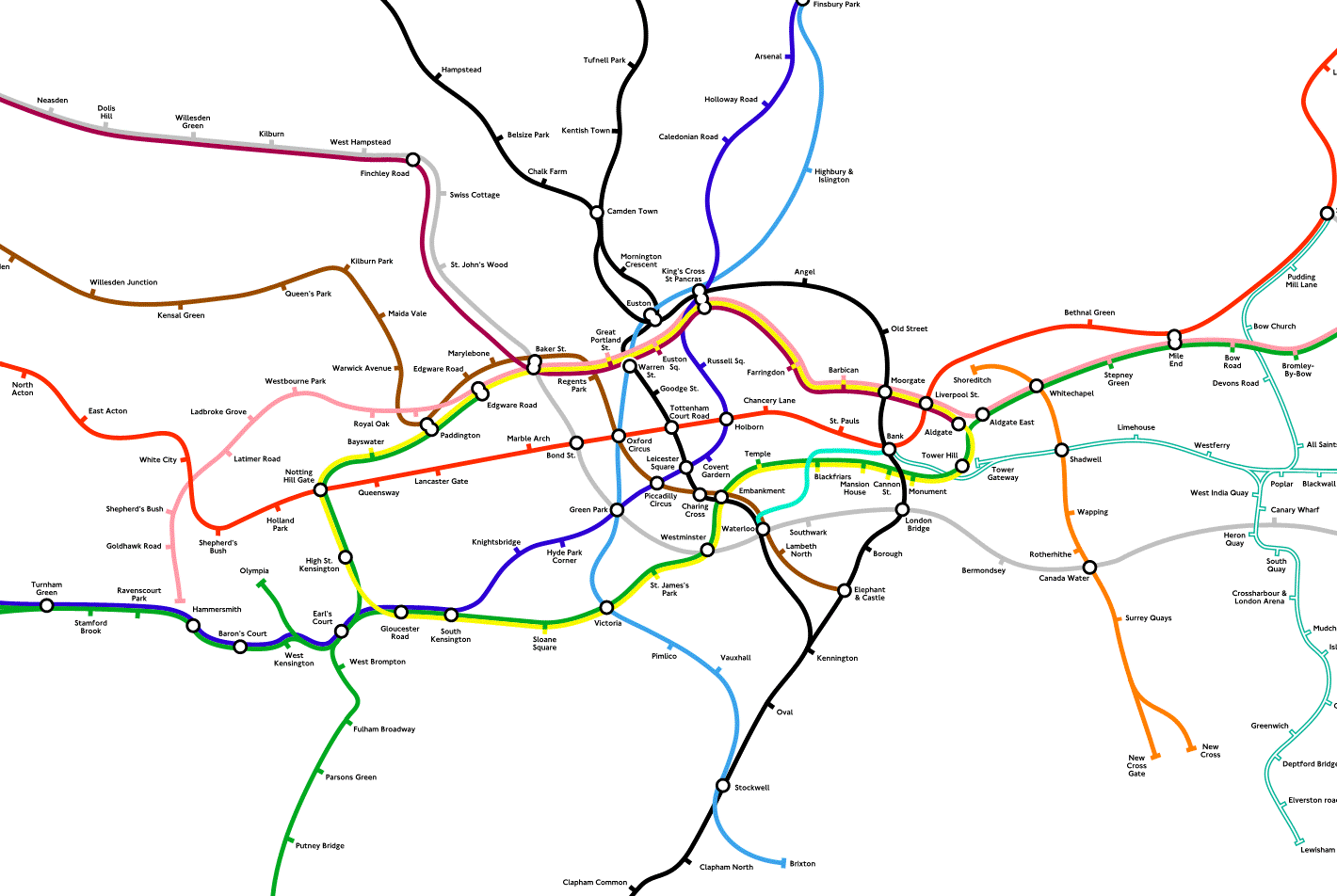
A familiar example that nicely illustrates my point  is the London Underground or Tube map. There is a fascinating website depicting the evolutionary history of this famous piece of graphic design. Early versions simply portrayed the railway lines inset into a normal geographical map which made them rather complicated, as the real layout of the lines is far from regular. A geographically accurate depiction of the modern tube network is shown here which makes the point:

geo_tubemap

A revolution occurred in 1933 when Harry Beck compiled the first “modern” version of the map. His great idea was to simplify the representation of the network around a single unifying feature. To this end he turned the Central Line (in red) into a straight line travelling left to right across the centre of the page, only changing direction at the extremities. All other lines were also distorted to run basically either North-South or East-West and produce a much more regular pattern, abandoning any attempt to represent the “real” geometry of the system but preserving its topology (i.e. its connectivity).  Here is an early version of his beautiful construction:

Note that although this a “modern” map in terms of how it represents the layout, it does look rather dated in terms of other design elements such as the border and typefaces used. We tend not to notice how much we surround the essential things with embellishments that date very quickly.

More modern versions of this map that you can get at tube stations and the like rather spoil the idea by introducing a kink in the central line to accommodate the complexity of the interchange between Bank and Monument stations as well as generally buggering about with the predominantly  rectilinear arrangement of the previous design:

I quite often use this map when I’m giving popular talks about physics. I think it illustrates quite nicely some of the philosophical issues related with theoretical representations of nature. I think of theories or models as being like maps, i.e. as attempts to make a useful representation of some  aspects of external reality. By useful, I mean the things we can use to make tests. However, there is a persistent tendency for some scientists to confuse the theory and the reality it is supposed to describe, especially a tendency to assert there is a one-to-one relationship between all elements of reality and the corresponding elements in the theoretical picture. This confusion was stated most succintly by the Polish scientist Alfred Korzybski in his memorable aphorism :

The map is not the territory.

I see this problem written particularly large with those physicists who persistently identify the landscape of string-theoretical possibilities with a multiverse of physically existing domains in which all these are realised. Of course, the Universe might be like that but it’s by no means clear to me that it has to be. I think we just don’t know what we’re doing well enough to know as much as we like to think we do.

A theory is also surrounded by a penumbra of non-testable elements, including those concepts that we use to translate the mathematical language of physics into everday words. We shouldn’t forget that many equations of physics have survived for a long time, but their interpretation has changed radically over the years.

The inevitable gap that lies between theory and reality does not mean that physics is a useless waste of time, it just means that its scope is limited. The Tube  map is not complete or accurate in all respects, but it’s excellent for what it was made for. Physics goes down the tubes when it loses sight of its key requirement, i.e. to be testable, and in order to be testable it has to be simple enough to calculate things to be compared with observations. In many cases that means a simplified model is perfectly adequete.

Another quote by George Box expands upon this point:

Remember that all models are wrong; the practical question is how wrong do they have to be to not be useful.

In any case, an attempt to make a grand unified theory of the London Underground system would no doubt produce a monstrous thing so unwieldly that it would be useless in practice. I think there’s a lesson there for string theorists too…

Many modern-day physicists are obsessed with the idea of a “Theory of Everything” (or TOE). Such a theory would entail the unification of all physical theories – all laws of Nature, if you like – into a single principle. An equally accurate description would then be available, in a single formula, of phenomena that are currently described by distinct theories with separate sets of parameters. Instead of textbooks on mechanics, quantum theory, gravity, electromagnetism, and so on, physics students would need just one book. But would such a theory somehow be  physical reality, as some physicists assert? I don’t think so. In fact it’s by no means clear to me that it would even be useful..

How to make a knotted vortex ring

Posted in The Universe and Stuff with tags , , , , on May 15, 2013 by telescoper

Not long ago I posted a short item about the physics of vortex rings. More recently I stumbled across this video that shows how University of Chicago physicists have succeeded in creating a vortex knot—a feat akin to tying a smoke ring into a knot. Linked and knotted vortex loops have existed in theory for more than a century, but creating them in the laboratory had previously eluded scientists. I stole that bit shamelessly from the blurb on Youtube, by the way. I’m not sure whether knotting a vortex tube has any practical applications, but then I don’t really care  much about that because it’s fun!

(Lack of) Diversity in STEM Subjects

Posted in Science Politics with tags , , , , , , on May 10, 2013 by telescoper

Among the things I learnt over the last few days was some interesting information about the diversity (or, rather, lack of diversity) of undergraduates taking undergraduate degrees in STEM subjects in the UK universities. For those of you not up on the lingo, `STEM’ is short for Science, Technology, Engineering and Mathematics. Last year the Institute of Physics produced a report that contains a wealth of statistical information about the demographics of the undergraduate population, from which the following numbers are only a small component.

Physics

Maths

Chemistry

Engineering

Female

21%

41%

44%

12%

BME

11%

24%

20%

30%

Socio-Economic

37%

42%

43%

51%

Non-EU

5%

12%

7%

32%

For completeness I should point out that these numbers refer to first-year undergraduates in 2010-11; I have no particular reason to suppose there has been a qualitative change since then. “BME” stands for “Black and Minority Ethnic”, and “Socio-Economic” refers to students whose with parents not employed in managerial or professional positions.

Overall, the figures here at the University of Sussex are roughly in line with, but slightly better than, these national statistics; the proportion of female students in our Physics intake for 2010/11, for example, was 27%.

There are some interesting (and rather disappointing) things to remark. First is that the proportion of Physics students who are female remains low; Physics scores very badly on ethnic diversity too. Mathematics on the other hand seems a much more attractive subject for female students.  Notice also how Physics and Chemistry attract a very small proportion of overseas students compared to Engineering.

In summary, therefore, we can see that Physics is a subject largely studied by white  middle-class European males. What are we doing wrong?

Despite considerable efforts to promote Physics to a more diverse constituency,  the proportion of, e.g., female physics students seems to have been bumping along at around 20% for ages.  Interestingly, all the anecdotal evidence suggests that those women who do Physics at University do disproportionately well, in the sense that female students constitute a  much larger fraction of First-class graduates than 20%. This strongly suggests that the problem lies at school level; some additional IOP information and discussion on this can be found here.

I’m just passing these figures on for information, as I’m quite often asked about them during, e.g., admissions-related activities. I don’t have any really compelling suggestions, but I would like to invite the blogosphere to comment and/or make suggestions as to promote diversity in STEM disciplines.