Archive for Physics

The Perils of Modern Living

Posted in Poetry, The Universe and Stuff with tags , , , on July 15, 2011 by telescoper

Well up above the tropostrata
There is a region stark and stellar
Where, on a streak of anti-matter
Lived Dr. Edward Anti-Teller.

Remote from Fusion’s origin,
He lived unguessed and unawares
With all his antikith and kin,
And kept macassars on his chairs.

One morning, idling by the sea,
He spied a tin of monstrous girth
That bore three letters: A. E. C.
Out stepped a visitor from Earth.

Then, shouting gladly o’er the sands,
Met two who in their alien ways
Were like as lentils. Their right hands
Clasped, and the rest was gamma rays.

by Prof. Harold P. Furth (1930-2002)

A Simple Problem in Statistical Physics

Posted in Cute Problems with tags , , , , on July 11, 2011 by telescoper

In physics we often have to resort to computer simulations in which continuously varying quantities are modelled on a discrete lattice. We also have recourse from time to time to model physical properties of a system as random quantities with some associated probability distribution. The following problem came up in a conversation recently, and I think it’s rather cute so thought I’d post it here.

Consider a regular three-dimensional Cartesian grid, at each vertex of which is defined a continuous variable x which varies from site to site with the same probability distribution function F(x) at each location. The value of x at any vertex can be assumed to be statistically independent of the others.

Now define a local maximum of the fluctuating field defined on the lattice to be a point at which the value of x is higher than the value at all surrounding points, defined so that in D dimensions there are 3^{D}-1 neighbours.

What is the probability that an arbitrarily-chosen point is a local maximum?

Solution

Well, the most popular answer is in fact the correct one but I’m quite surprised that a majority got it wrong! Like many probability-based questions there are quick ways of solving this, but I’m going to give the laborious way because I think it’s quite instructive (and because I’m a bit slow).

Pick a point arbitrarily. The probability that the associated value lies between x and x+dx is f(x)dx, where f(x)=dF(x)/dx is the probability density function. According to the question there are 3^3-1=26 neighbours of this point. The probability that all of these are less than x isF(x)\times F(x)\times \ldots F(x) 26 times, i.e. [F(x)]^{26}  becauses they are independent. Note that this is a continuous variable so the probability of any two values being equal is zero. The probability of the chosen point being a local maximum with a given value of x is therefore f(x)dx\times [F(x)]^{26}. The probability of it being a local maximum with any value of x is obtained by integrating this expression over all allowed values of x, i.e. \int f(x) dx [F(x)]^{26} . But the integrand can be re-written

\int f(x) dx [F(x)]^{26} = \int dF \times F^{26} = \frac{1}{27} \int d\left(F^{27}\right) = \frac{1}{27},

because  F=1 at the upper limit of integration and F=0  at the bottom.

So you don’t need to know the form of F(x) – but the calculation does rely on it being a continuous distribution.

This long-winded method demonstrates the applicability of the product rule and the process of marginalising over variables, but the answer should tell you a much quicker way of getting there.  The central point and the 26 neighbours constitute a set of 27 points. The probability that any particular one is the largest of the set is just 1/27, as each is equally likely to be the largest. This goes for the central value too, hence the answer.


LHC Hasn’t Destroyed Earth Yet (via Today’s New Reason to Believe)

Posted in The Universe and Stuff with tags , , , , , , on June 19, 2011 by telescoper

I thought I’d reblog this as it relates to the pronouncements about the LHC by Otto Rössler I mentioned yesterday.

LHC Hasn’t Destroyed Earth Yet As I predicted nearly two-and-a-half years ago, it looks like the Earth will survive the most powerful accelerator ever built. A recent article validates my prediction. On September 8, 2008, I recorded a Science News Flash podcast addressing concerns that the Large Hadron Collider (LHC) would produce a shower of black holes that would, in turn, consume Earth from the inside out. I predicted that Earth would not only survive the experiments perfor … Read More

via Today's New Reason to Believe

You might also want to read this older blog post about the kerfuffle when the LHC was switched on. I quote:

Rössler turns out to be quite a strange fellow. He is an MD who stayed in academia, moved into biochemistry, and then made a name in the relatively new field of chaos theory. He seems to think of himself as a visionary, having founded a new field of physics called “endophysics,” which is supposed to take into account the observer’s inner state. Or something like that. Have you heard of it? Neither had I.

Recently, at the age of sixty-eight, Rössler, despite having no particle physics or blackhole physics credentials, announced that he had found important new results, alarmingly relevant to the destructive potential of microscopic black holes in LHC proton-proton collisions. Rössler variously estimates the likelihood of such blackhole production by LHC as being from 10% to 50% though he appears to have pulled these numbers out of a hat.

And there’s also this most excellent video that John Butterworth told me about because he’s in it…

The Final Analysis

Posted in Education with tags , , , , on June 14, 2011 by telescoper

It’s that time of year again. The annual meeting of the Board of Examiners of the School of Physics & Astronomy at Cardiff University met this afternoon to consider the marks for students due to graduate this year and to draw up recommendations for the final degree classifications.

This year’s meeting was actually quite interesting and, at just over two hours, somewhat shorter than some we’ve had in previous years.  A group of students has already gathered in the foyer waiting for the dreaded list to be posted, and many will no doubt be celebrating or drowning their sorrows in local hostelries shortly after their fate is revealed.

Cardiff is a little old-fashioned in the way the final examiners’ meetings are conducted. For a start we still have a system of viva voce examinations for borderline candidates; they happened yesterday, in fact. Many universities have dispensed with this aspect of the process, but I still think they’re worthwhile. The Board of Examiners, including the two External Examiners,  also still has some discretion in how it arrives at the degree boundaries (which are nominally at 70% for a first, 60% for a 2.1, 50% for a 2.2, and 40% for a 3rd).

The tide is turning against this very traditional approach, however, and there are moves here to dispense with the viva examinations and with academic discretion. I’m not sure when this will happen, but it’s likely to be sooner rather than later. I think the main reason for this is to make the system more automatic so there’s less chance of legal challenge. In any case there doesn’t seem to me that there can be any educational reason for it.

The one thing that strikes me about the system we have is that it’s the whole business of classifying degrees into broad categories which is where the problem lies.  It was suggested some time ago that we should dispense with, e.g., the “Desmond” (2.2) and the “Thora Hird” (3rd) and instead simply give each student a transcript containing details of the entire spectrum of their academic performance. It’s been suggested again just recently too. That would seem to me to make much more sense than the current system of classifying degrees which involves (a) trying to condense a huge amout of information – examination marks, coursework, project assignments and the like – into a single number and then (b) drawing boundaries based on this number precisely where the distribution is most densely peaked. However, years have passed and nothing concrete has happened. The academic world is good at inertia.

Anyway, this isn’t the time or the place for a lengthy diatribe about the ins-and-outs of degree classifications. I’ve got to go back to marking my 1st year examination papers shortly in fact; these are considered by a separate meeting of the Board of Examiners.

It is time, however, for me to congratulate all our graduating students on their success. It’s the first group of Cardiff MPhys students that I’ve seen all the way through from entry  to graduation. I’ll be sad to see them go, but wish them all the best as they venture forth into the real world. At least I hope to see them back next month for graduation.  Until then, however, all I’ll  say is

Congratulations!

Topological Escapology

Posted in Education, The Universe and Stuff with tags , on June 13, 2011 by telescoper

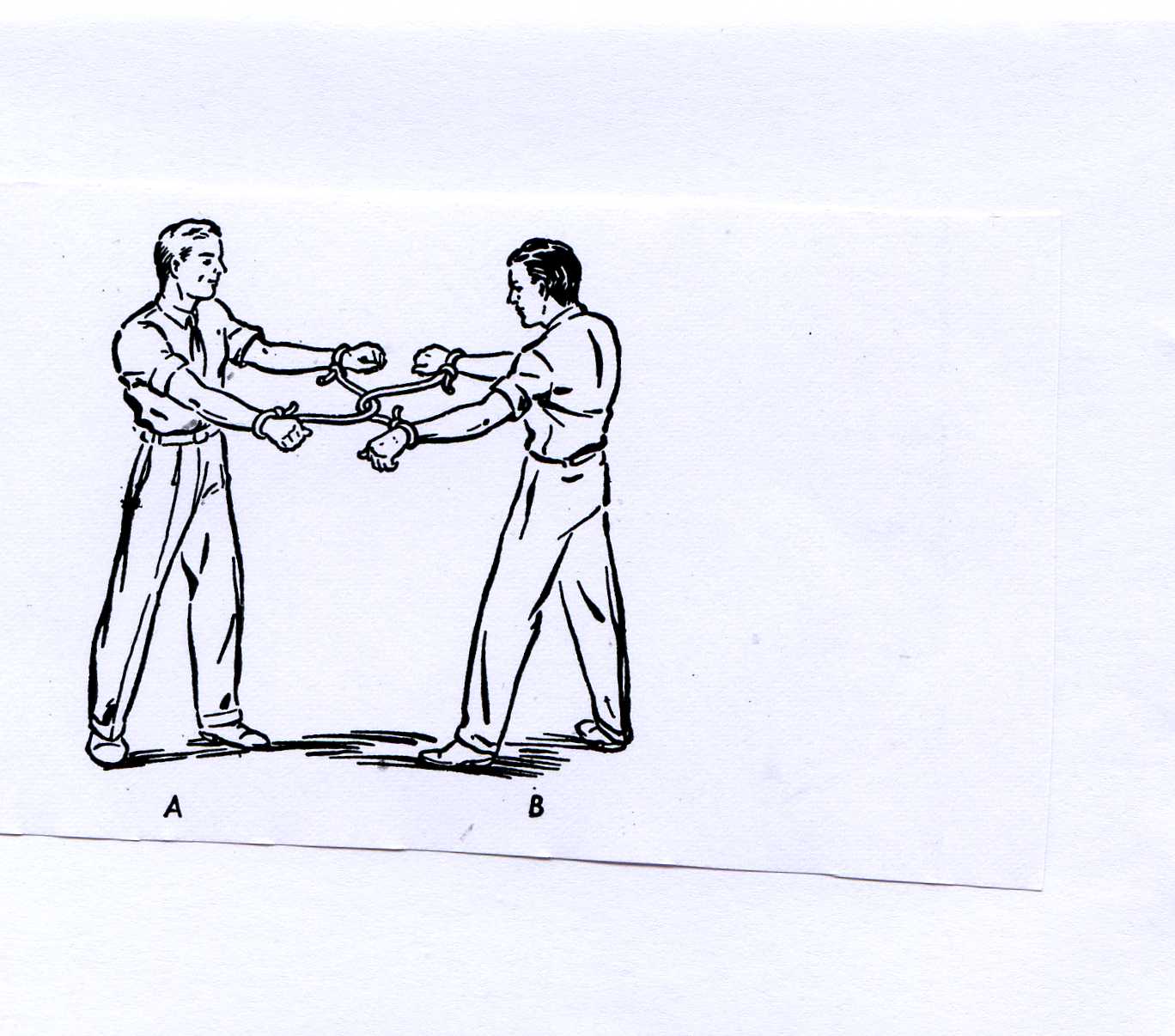
The occasional  teasers I post on here seem to go down quite well so I thought I’d try this one on you.  I recently found it in an old book on the topic of  topology, a fascinating field that finds many applications in physics, including several in my own field of  cosmology.

It’s probably best not to ask why, but the two gentlemen in the picture, A and B, are tied together in the following way. One end of a piece of rope is tied about A’s right wrist, the other about his left wrist. A second rope is passed around the first and its ends are tied to B’s wrists.

Can A and B free each other without cutting either rope, performing amputations,  or untying the knots at either person’s wrists?

If so, how?

A Paradox of Galileo

Posted in Cute Problems with tags , , , on June 1, 2011 by telescoper

Going by the popularity of the little physics problem I posted last week, I thought some of you might be interested in this little conundrum which dates back to the 17th Century (to Galileo Galilei, in fact). It’s not a problem to which there’s a snappy answer, so no poll this time, but I think it’s quite a good one to think about – and please try to resist the temptation to google it!

The above figure shows a large circular wheel, which rolls from left to right, without slipping, on a flat surface, along a straight line from P to Q, making exactly one revolution as it does so. The distance PQ is thus equal to the circumference of the wheel.

Now, consider the small circle, firmly fixed to the larger circle with the two centres coincident. The small circle also makes one complete revolution as the wheel rolls, and  it travels from R to S. Similarly, therefore, the distance RS must be the circumference of the small circle.

Since RS is clearly equal to PQ it follows that the circumferences of the large wheel and the small circle must be equal!

Since the radii of the large and  small circles are different,  this conclusion is clearly false so what’s wrong with the argument?

An easy physics problem…

Posted in Cute Problems with tags , , , on May 26, 2011 by telescoper

Based on the popularity of something I posted last week, I thought some of you might find this little problem amusing. It’s from a Physics A-level paper I took in 1981. The examination comprised two papers in those days (and a practical exam); one paper had long questions, similar to the questions we set in university examinations these days, and the other was short questions in a multiple-choice format. This is one of the latter type, from the mechanics section.

And here is a poll in which you may select your answer:

Whatever happened to Euclid?

Posted in Education, The Universe and Stuff with tags , , , , , , on May 24, 2011 by telescoper

An interesting article on the BBC website about the innate nature of our understanding of geometry reminded me that I have been meaning to post something about the importance of geometry in mathematics education – and, more accurately, the damaging consequences of the lack of geometry in the modern curriculum.

When I was a lad – yes, it’s one of those tedious posts about how things were better in the old days – we grammar school kids spent a disproportionate amount of time learning geometry in pretty much the way it has been taught since the days of Euclid. In fact, I still have a copy of the classic Hall & Stevens textbook based on Euclid’s Elements, from which I scanned the proof shown below (after checking that it’s now out of copyright).

This, Proposition 5 of Book I of the Elements, is in fact quite a famous proof known as the Pons Asinorum:

The old-fashioned way we learned geometry required us to prove all kinds of bizarre theorems concerning the shapes and sizes of triangles and parallelograms, properties of chords intersecting circles, angles subtended by various things, tangents to circles, and so on and so forth. Although I still remember various interesting results I had to prove way back then – such as the fact that the angle subtended by a chord at the centre of a circle is twice that subtended at the circumference (Book III, Proposition 20) – I haven’t actually used many of them since. The one notable exception I can think of is Pythagoras’ Theorem (Book I, Proposition 47), which is of course extremely useful in many branches of physics.

The apparent irrelevance of most of the theorems one was required to prove is no doubt the reason why “modern” high school mathematics syllabuses have ditched this formal approach to geometry. I think this was a big mistake. The bottom line in a geometrical proof is not what’s important – it’s how you get there. In particular, it’s learning how to structure a mathematical argument.

That goes not only for proving theorems, but also for solving problems; many of Euclid’s propositions are problems rather than theorems, in fact. I remember well being taught to end the proof of a theorem with QED (Quod Erat Demonstrandum; “which was to be proved”) but end the solution of a problem with QEF (Quod Erat Faciendum; “which was to be done”).

You can see what I mean by looking at the Pons Asinorum, which is a very simple theorem to prove but which illustrates the general structure:

  1. GIVEN
  2. TO PROVE
  3. CONSTRUCTION
  4. PROOF

When you have completed many geometrical proofs this way it becomes second nature to confront any  problem in mathematics (or physics) by first writing down what is given (or can be assumed), often including the drawing of a diagram. These are key ingredients of a successful problem solving strategy. Next you have to understand precisely what you need to prove, so write that down too. It seems trivial, but writing things down on paper really does help. Not all theorems require a “construction”, and that’s usually the bit where ingenuity comes in so is more difficult. However, the “proof” then follows as a series of logical deductions, with reference to earlier (proved) propositions given in the margin.

This structure carries over perfectly well to problems involving algebra or calculus (or even non-Euclidean geometry) but I think classical geometry provides the ideal context to learn it because it involves visual as well as symbolic logic – it’s not just abstract reasoning in that compasses, rulers and protractors can help you!

I don’t think it’s a particular problem for universites that relatively few students know how to prove the perpendicular bisector theorem, but it definitely is a problem that so many have no idea what a mathemetical proof should look like.

Come back Euclid, all is forgiven!

Share/Bookmark

The joy of viXra

Posted in The Universe and Stuff with tags , , , , , on May 19, 2011 by telescoper

From time to time on this blog I post rants about the state of scientific publishing, open access, the importance of the arXiv for astronomy and cosmology, and so on.

This morning, however, I discovered an “alternative” side to the whole business of online science, a site by the name of viXra. Most readers will probably be familiar with this site already – many no doubt publish there, in fact – but I have to say that it’s completely new to me. I urge you to check it out.

The structure and layout of viXra is almost identical to the arXiv, but the content is a bit … er … different. Naturally, I went straight for the section that mirrors astro-ph on the arXiv. The viXra version of astro-ph so far contains only 88 publications, but among them are papers of such outstanding quality that I’m sure this remarkable collection will grow very quickly when like-minded authors around the world find out about it.

I thought I’d post my favourite as an example. Initially, I was going to go with one entitled Ball Lightning, Micro Comets, Sprite-Fireballs and X-Ray/gamma Flashes According to Quantum FFF Theory, with the abstract

FUNCTION FOLLOWS FORM in Quantum FFF THEORY. The FORM and MICROSTRUCTURE of elementary particles, is supposed to be the origin of FUNCTIONAL differences between Higgs- Graviton- Photon- and Fermion particles. As a consequence, a NEW splitting, accelerating and pairing MASSLESS BLACK HOLE, able to convert vacuum energy (ZPE) into real energy by entropy decrease, seems to be able to explain quick Galaxy- and Star formation, down to Sunspots, (Micro) Comets, Lightning bolts, Sprite Fireballs and Ball Lightning.

I decided against this one, however, because of the tendency to burst inexplicably into upper case every now and again, which I found rather alarming.

I was also forced to reject this one, The Structuring Force of the Natural World, on the grounds that (a) it’s in Chinese so I can’t read it and (b) I don’t know what a “basket graph” is. Otherwise I’m sure its a splendid piece of work.

The assumption that the mass distribution of spiral galaxies is rational was suggested 11 years ago. The rationality means that on any spiral galaxy disk plane there exists a special net of orthogonal curves. The ratio of mass density at one side of a curve (from the net) to the one at the other side is constant along the curve. Such curve is called a proportion curve. Such net of curves is called an orthogonal net of proportion curves. I also suggested that the arms and rings are the disturbance to the rational structure. To achieve the minimal disturbance, the disturbing waves trace the orthogonal or non-orthogonal proportion curves. I proved 6 years ago that exponential disks and dual-handle structures are rational. Recently, I have also proved that rational structure satisfies a cubic algebraic equation. Based on these results, this paper ultimately demonstrates visually what the orthogonal net of proportion curves looks like if the superposition of a disk and dual-handle structures is still rational. That is, based on the natural solution of the equation, the rate of variance along the ‘radial’ direction of the logarithmic mass density is obtained. Its image is called the ‘basket graph’. The myth of galaxy structure will possibly be resolved based the further study of ‘basket graphs’.

In the end I decided to go for this impressive article, A Cantorian Superfluid Vortex and the Quantization of Planetary Motion

This article suggests a preliminary version of a Cantorian superfluid vortex hypothesis as a plausible model of nonlinear cosmology. Though some parts of the proposed theory resemble several elements of what have been proposed by Consoli (2000, 2002), Gibson (1999), Nottale (1996, 1997, 2001, 2002a), and Winterberg (2002b), it seems such a Cantorian superfluid vortex model instead of superfluid or vortex theory alone has never been proposed before. Implications of the proposed theory will be discussed subsequently, including prediction of some new outer planets in solar system beyond Pluto orbit. Therefore further observational data is recommended to falsify or verify these predictions. If the proposed hypothesis corresponds to the observed facts, then it could be used to solve certain unsolved problems, such as gravitation instability, clustering, vorticity and void formation in galaxies, and the distribution of planet orbits both in solar system and also exoplanets.

I’m not an expert on the “Cantorian superfluid vortex theory”, but I suspect the author may well be correct in saying that it has not previously been proposed as an explanation for the planetary orbits…

Share/Bookmark

Cute Physics Problem

Posted in Cute Problems, The Universe and Stuff with tags , on May 17, 2011 by telescoper

I heard this nice physics problem today so I thought I’d try it out on here. You will probably be able to find the answer on the net somewhere but please try to figure it out yourself before doing so!

There are two identical chambers, A and B containing identical metal balls which begin the experiment at the same temperature. Apart from the balls, each chamber is a perfect vacuum and has thermally conducting walls at a lower temperature than the ball it contains.

In A the ball is resting on the floor, which is made of material which is a perfect thermal insulator.

In B the ball is hanging from the ceiling by a piece of light inextensible string, not touching the floor. Both the string and the ceiling are also made of perfectly insulating material.

Which ball cools down faster?

Please put your answer through the poll here. When enough people have voted, I’ll tell you the answer…

Share/Bookmark