Archive for Physics

Hawking and the Mind of God

Posted in Books, Talks and Reviews, Science Politics, The Universe and Stuff with tags , , , , , on September 2, 2010 by telescoper

I woke up this morning to the news that, according to Stephen Hawking, God did not create the Universe but it was instead an “inevitable consequence of the Law of Physics”. By sheer coincidence this daft pronouncement has come out at the same time as the publication of Professor Hawking’s new book, an extract of which appears in todays Times.

It’s interesting that such a fatuous statement managed to become a lead item on the radio news and a headline in all the national newspapers despite being so obviously devoid of any meaning whatsoever. How can the Universe be  “a consequence” of the theories that we invented to describe it? To me that’s just like saying that the Lake District is a consequence of an Ordnance Survey map. And where did the Laws of Physics come from, if not from God?

Stephen Hawking is undoubtedly a very brilliant theoretical physicist. However, something I’ve noticed about theoretical physicists over the years is that if you get them talking on subjects outside physics they are generally likely to say things just as daft as some drunk bloke  down the pub. I’m afraid this is a case in point.

Part of me just wants to laugh this story off, but another part is alarmed at what must appear to many to be an example of an arrogant scientist presuming to pass judgement on subjects that are really none of his business. When scientists complain about the lack of enthusiasm shown by sections of the public towards their subject, perhaps they should take seriously the alienating effect that such statements can have. This kind of thing isn’t what I’d call public engagement. Quite the opposite, in fact.

In case anyone is interested, I am not religious but I do think that there are many things that science does not – and probably will never –  explain, such as why there is  something rather than nothing. I also believe that science and religious belief are not in principle incompatible – although whether there is a conflict in practice does depend of course on the form of religious belief and how it is observed. God and physics are in my view pretty much orthogonal. To put it another way,  if I were religious, there’s nothing in theoretical physics that would change make me want to change my mind. However, I’ll leave it to those many physicists who are learned in matters of theology to take up the (metaphorical) cudgels with Professor Hawking.

No doubt this bit of publicity will increase the sales of the new book, so I’ve decided  to point out that I have  written a book myself on precisely this question, which is available from all good airports bookshops. I’m sure you’ll understand that there isn’t a hint of opportunism in the way I’m drawing this to your attention. If you think this is a cynical attempt to cash in then all I can say is

BUY MY BOOK!

I also noticed that today’s Grauniad is offering a poll on the existence or non-existence of God. I noticed some time ago that there’s a poll facility on WordPress, so this gives me an excuse to try repeating it here. Anything dumb the Guardian can do, I can do dumber. However, owing to funding cuts I’ve decided to do a single poll encompassing several topical news stories at the same time.


Share/Bookmark

Dragons and Unicorns

Posted in Education, The Universe and Stuff with tags , , , , , , , on August 30, 2010 by telescoper

When I was an undergraduate I was often told by lecturers that I should find quantum mechanics very difficult, because it is unlike the classical physics I had learned about up to that point. The difference – or so I was informed – was that classical systems were predictable, but quantum systems were not. For that reason the microscopic world could only be described in terms of probabilities. I was a bit confused by this, because I already knew that many classical systems were predictable in principle, but not really in practice. I blogged about this some time ago, in fact. It was only when I had studied theory for a long time – almost three years – that I realised what was the correct way to be confused about it. In short, quantum probability is a very strange kind of probability that displays many peculiarities and subtleties  that one doesn’t see in the kind of systems we normally think of as “random”, such as coin-tossing or roulette wheels.

To illustrate how curious the quantum universe is we have to look no further than the very basic level of quantum theory, as formulated by the founder of wave mechanics, Erwin Schrödinger. Schrödinger was born in 1887 into an affluent Austrian family made rich by a successful oilcloth business run by his father. He was educated at home by a private tutor before going to the University of Vienna where he obtained his doctorate in 1910. During the First World War he served in the artillery, but was posted to an isolated fort where he found lots of time to read about physics. After the end of hostilities he travelled around Europe and started a series of inspired papers on the subject now known as wave mechanics; his first work on this topic appeared in 1926. He succeeded Planck as Professor of Theoretical Physics in Berlin, but left for Oxford when Hitler took control of Germany in 1933. He left Oxford in 1936 to return to Austria but fled when the Nazis seized the country and he ended up in Dublin, at the Institute for Advanced Studies which was created especially for him by the Irish Taoiseach, Eamon de Valera. He remained there happily for 17 years before returning to his native land at the University of Vienna. Sadly, he became ill shortly after arriving there and died in 1961.

Schrödinger was a friendly and informal man who got on extremely well with colleagues and students alike. He was also a bit scruffy even to the extent that he sometimes had trouble getting into major scientific conferences, such as the Solvay conferences which are exclusively arranged for winners of the Nobel Prize. Physicists have never been noted for their sartorial elegance, but Schrödinger must have been an extreme case.

The theory of wave mechanics arose from work published in 1924 by de Broglie who had suggested that every particle has a wave somehow associated with it, and the overall behaviour of a system resulted from some combination of its particle-like and wave-like properties. What Schrödinger did was to write down an equation, involving a Hamiltonian describing particle motion of the form I have discussed before, but written in such a way as to resemble the equation used to describe wave phenomena throughout physics. The resulting mathematical form for a single particle is

i\hbar\frac{\partial \Psi}{\partial t} = \hat{H}\Psi = -\frac{\hbar^2}{2m}\nabla^2 \Psi + V\Psi,

in which the term \Psi  is called the wave-function of the particle. As usual, the Hamiltonian H consists of two parts: one describes the kinetic energy (the first term on the right hand side) and the second its potential energy represented by V. This equation – the Schrödinger equation – is one of the most important in all physics.

At the time Schrödinger was developing his theory of wave mechanics it had a rival, called matrix mechanics, developed by Werner Heisenberg and others. Paul Dirac later proved that wave mechanics and matrix mechanics were mathematically equivalent; these days physicists generally use whichever of these two approaches is most convenient for particular problems.

Schrödinger’s equation is important historically because it brought together lots of bits and pieces of ideas connected with quantum theory into a single coherent descriptive framework. For example, in 1911 Niels Bohr had begun looking at a simple theory for the hydrogen atom which involved a nucleus consisting of a positively charged proton with a negatively charged electron moving around it in a circular orbit. According to standard electromagnetic theory this picture has a flaw in it: the electron is accelerating and consequently should radiate energy. The orbit of the electron should therefore decay rather quickly.

Bohr hypothesized that special states of this system were actually stable; these states were ones in which the orbital angular momentum of the electron was an integer multiple of Planck’s constant. This simple idea endows the hydrogen atom with a discrete set of energy levels which, as Bohr showed in 1913, were consistent with the appearance of sharp lines in the spectrum of light emitted by hydrogen gas when it is excited by, for example, an electrical discharge. The calculated positions of these lines were in good agreement with measurements made by Rydberg so the Bohr theory was in good shape. But where did the quantised angular momentum come from?

The Schrödinger equation describes some form of wave; its solutions \Psi(\vec{x},t) are generally oscillating functions of position and time. If we want it to describe a stable state then we need to have something which does not vary with time, so we proceed by setting the left-hand-side of the equation to zero. The hydrogen atom is a bit like a solar system with only one planet going around a star so we have circular symmetry which simplifies things a lot. The solutions we get are waves, and the mathematical task is to find waves that fit along a circular orbit just like standing waves on a circular string. Immediately we see why the solution must be quantized. To exist on a circle the wave can’t just have any wavelength; it has to fit into the circumference of the circle in such a way that it winds up at the same value after a round trip. In Schrödinger’s theory the quantisation of orbits is not just an ad hoc assumption, it emerges naturally from the wave-like nature of the solutions to his equation.

The Schrödinger equation can be applied successfully to systems which are much more complicated than the hydrogen atom, such as complex atoms with many electrons orbiting the nucleus and interacting with each other. In this context, this description is the basis of most work in theoretical chemistry. But it also poses very deep conceptual challenges, chiefly about how the notion of a “particle” relates to the “wave” that somehow accompanies it.

To illustrate the riddle, consider a very simple experiment where particles of some type (say electrons, but it doesn’t really matter; similar experiments can be done with photons or other particles) emerge from the source on the left, pass through the slits in the middle and are detected in the screen at the right.

In a purely “particle” description we would think of the electrons as little billiard balls being fired from the source. Each one then travels along a well-defined path, somehow interacts with the screen and ends up in some position on the detector. On the other hand, in a “wave” description we would imagine a wave front emerging from the source, being diffracted by the screen and ending up as some kind of interference pattern at the detector. This is what we see with light, for example, in the phenomenon known as Young’s fringes.

In quantum theory we have to think of the system as being in some sense both a wave and a particle. This is forced on us by the fact that we actually observe a pattern of “fringes” at the detector, indicating wave-like interference, but we also can detect the arrival of individual electrons as little dots. Somehow the propensity of electrons to arrive in positions on the screen is controlled by an element of waviness, but they manage to retain some aspect of their particleness. Moreover, one can turn the source intensity down to a level where there is only every one electron in the experiment at any time. One sees the dots arrive one by one on the detector, but adding them up over a long time still yields a pattern of fringes.

Curiouser and curiouser, said Alice.

Eventually the community of physicists settled on a party line that most still stick to: that the wave-function controls the probability of finding an electron at some position when a measurement is made. In fact the mathematical description of wave phenomena favoured by physicists involves complex numbers, so at each point in space at time \Psi is a complex number of the form \Psi= a+ib, where i =\sqrt{-1}; the corresponding probability is given by |\Psi^2|=a^2+b^2. This protocol, however, forbids one to say anything about the state of the particle before it measured. It is delocalized, not being definitely located anywhere, but only possessing a probability to be any particular place within the apparatus. One can’t even say which of the two slits it passes through. Somehow, it manages to pass through both slits. Or at least some of its wave-function does.

I’m not going to into the various philosophical arguments about the interpretation of quantum probabilities here, but I will pass on an analogy that helped me come to grips with the idea that an electron can behave in some respects like a wave and in others like a particle. At first thought, this seems a troubling paradox but it only appears so if you insist that our theoretical ideas are literal representations of what happens in reality. I think it’s much more sensible to treat the mathematics as a kind of map or sketch that is useful for us to do find our way around nature rather than confusing it with nature itself. Neither particles nor waves really exist in the quantum world – they’re just abstractions we use to try to describe as much as we can of what is going on. The fact that it doesn’t work perfectly shouldn’t surprise us, as there are are undoubtedly more things in Heaven and Earth than are dreamt of in our philosophy.

Imagine a mediaeval traveller, the first from your town to go to Africa. On his journeys he sees a rhinoceros, a bizarre creature that is unlike anything he’s ever seen before. Later on, when he gets back, he tries to describe the animal to those at home who haven’t seen it.  He thinks very hard. Well, he says, it’s got a long horn on its head, like a unicorn, and it’s got thick leathery skin, like a dragon. Neither dragons nor unicorns exist in nature, but they’re abstractions that are quite useful in conveying something about what a rhinoceros is like.

It’s the same with electrons. Except they don’t have horns and leathery skin. Obviously.


Share/Bookmark

Open Admissions

Posted in Education with tags , , , , , , , on August 21, 2010 by telescoper

As I predicted  last week, the A-level results announced on Thursday showed another increase in pass rates and in the number of top grades awarded, although I had forgotten that this year saw the introduction of the new A* grade. Overall, about 27% of students got an A or an A*, although the number getting an A* varied enormously from one course to another. In Further Maths, for example, 30% of the candidates who took the examination achieved an A* grade.

Although I have grave misgivings about the rigour of the assessment used in A-level science subjects, I do nevertheless heartily congratulate all those who have done well. In no way were my criticisms of the examinations system intended to be criticisms of the students who take them and they thoroughly deserve to celebrate their success.

Another interesting fact worth mentioning is that the number of pupils taking A-level physics rose again this year, by just over 5%, to a total of just over 30,000. After many years of decline in the popularity of physics as an A-level choice, it has now grown steadily over the past three years. Of course not everyone who does physics at A-level goes on to do it at university, but this is nevertheless a good sign for the future health of the subject.

There was a whopping 11.5% growth in the number of students taking Further Mathematics too, and this seems to be part of a general trend for more students to be doing science and technology subjects.

The newspapers have also been full of  tales of a frantic rush during the clearing process and the likelihood that many well-qualified aspiring students might miss out on university places altogether. Part of the reason for this is that the government recently put the brake on the expansion of university places, but it’s not all down to government cuts. It’s also at least partly because of the steady increase in the performance of students at A-level. More students are making their offers than before, so the options available for those who did slightly less well than they had hoped very much more limited.

In fact if you analyse the figures from UCAS you will see that as of Thursday 19th August 2010, 383,230 students had been secured a place at university. That’s actually about 10,000 more than at the corresponding stage last year. There were about 50,000 more students eligible to go into clearing this year (183,000 versus 135,000 in 2009), but at least part of this is due to people trying again who didn’t succeed last year. Clearly they won’t all find a place, so there’ll be a number of very disappointed school-leavers around, but they also can try again next year. So although it’s been a tough week for quite a few prospective students, it’s not really the catastrophe that some of the tabloids have been screaming about.

I’m not directly involved in the undergraduate admissions process for the School of Physics & Astronomy at Cardiff University, where I work, but try to keep up with what’s going on. It’s an extremely strange system and I think it’s fair to say that if we could design an admissions process from scratch we wouldn’t end up with the one we have now. Each year our School is given a target number of students to recruit; this year around 85. On the basis of the applications we receive we make a number of offers (e.g.  AAB for three A-levels, including Mathematics and Physics, for the MPhys programme). However, we have to operate a bit like an airline and make more offers than there are places. This is because (a) not all the people we make offers to will take up their offer and (b) not everyone who takes up an offer will make the grades.

In fact students usually apply to 5 universities and are allowed to accept one firm offer (CF) and one insurance choice (CI), in case they missed the grades for their firm choice. If they miss the grades for their CI they go into clearing. This year, as well as a healthy bunch of CFs, we had a huge number of CI acceptances, meaning we were the backup choice for many students whose ideal choice lay elsewhere. We usually don’t end up recruiting all that many students as CIs – most students do make the grades they need for their CF, but if they miss by a whisker the university they put first often takes them anyway. However, this year many of our CIs held CFs with universities we knew were going  to be pretty full, and in England at any rate, institutions are going to be fined if they exceed their quotas. It therefore looked possible that we might go over quota because of an unexpected influx of CIs caused by other universities applying their criteria more rigorously than they had in the past. We are, of course, obliged to honour all offers made as part of this process. Here in Wales we don’t actually get fined for overshooting the quota, but it would have been tough fitting excess numbers into the labs and organizing tutorials for them all.

Fortunately, our admissions team (led by Helen Hunt Carole Tucker) is very experienced at reading the lie of the land. As it turned out, the feared influx of CIs didn’t materialise, and we even had a dip into the clearing system to  recruit one or two good quality applicants who had fallen through the cracks elsewhere.  We seem to have turned out all right again this year, so it’s business as usual in October. In case you’re wondering, Cardiff University is now officially full up for 2010.

There’s a lot of guesswork involved in this system which seems to me to make it unnecessarily fraught for us, and obviously also for the students too! It would make more sense for students to apply after they’ve got their results not before, but this would require wholesale changes to the academic year. It’s been suggested before, but never got anywhere. One thing we do very well in the Higher Education sector is inertia!

I thought I’d end with another “news” item from the Guardian that claims that the Russell Group of universities – to which Cardiff belongs – operates a blacklist of A-level subjects that it considers inappropriate:

The country’s top universities have been called on to come clean about an unofficial list or lists of “banned” A-level subjects that may have prevented tens of thousands of state school pupils getting on to degree courses.

Teachers suspect the Russell Group of universities – which includes Oxford and Cambridge – of rejecting outright pupils who take A-level subjects that appear on the unpublished lists.

The lists are said to contain subjects such as law, art and design, business studies, drama and theatre studies – non-traditional A-level subjects predominantly offered by comprehensives, rather than private schools.

Of course when we’re selecting students for Physics programmes we request Physics and Mathematics A-level rather than Art and Design, simply because the latter do not provide an adequate preparation for what is quite a demanding course.  Other Schools no doubt make offers on a similar basis. It’s got nothing to do with  a bias against state schools, simply an attempt to select students who can cope with the course they have applied to do.

Moreover, speaking as a physicist I’d like to turn this whole thing around. Why is it that so many state schools do teach these subjects instead of  “traditional” subjects, including sciences such as physics?  Why is that so many comprehensive schools are allowed to operate as state-funded schools without offering adequate provision for science education? To my mind that’s a real, and far more insidious, form of blacklisting than what is alleged by the Guardian.

Death and Strawberries

Posted in Poetry with tags , , , , on August 20, 2010 by telescoper

This week in August 2010 has taken on quite a melancholy mood. Only a few days ago there was the death of physicist Nicola Cabibbo. Yesterday I heard that the great Russian mathematician Vladimir Igorevich Arnold, who did a lot of work of interest to physicists, had also passed away aged 72. And then this morning I was saddened to hear of the death of the wonderful Scottish poet Edwin Morgan, of pneumonia, at the age of 90.

It’s always sad when someone who has contributed so much to their field – whether it’s artistic or scientific – passes away, but the consolation is that each of them in their own way has left a wonderful legacy that remains to be treasured and will also inspire future generations.

Anyway, I thought I’d mark the passing of Edwin Morgan with my favourite poem of his, called Strawberries.

There were never strawberries
like the ones we had
that sultry afternoon
sitting on the step
of the open french window
facing each other
your knees held in mine
the blue plates in our laps
the strawberries glistening
in the hot sunlight
we dipped them in sugar
looking at each other
not hurrying the feast
for one to come
the empty plates
laid on the stone together
with the two forks crossed
and I bent towards you
sweet in that air

in my arms
abandoned like a child
from your eager mouth
the taste of strawberries
in my memory
lean back again
let me love you

let the sun beat
on our forgetfulness
one hour of all
the heat intense
and summer lightning
on the Kilpatrick hills

let the storm wash the plates

It may surprise you to learn that this poem is not written by a man to a woman, but from one man to another. A similar reaction is sometimes provoked by certain of Shakespeare’s Sonnets. It came as a shock to quite a few people when it was finally revealed, in fact, because Edwin Morgan kept to himself for a very long time who this was written about. Actually, it wasn’t until he was 70 that the poet stepped out of the closet, announced that he was gay, and explained that the poem was written about an experience he shared with another man. He maintained that at least part of the reason for him not being open publically was that he didn’t want to be branded as a “gay” poet, and that his poems were intended to be universal, which (in my view) they are but then that depends on what kind of universe you live in.

Grade Inflation

Posted in Education, Politics with tags , , , on August 12, 2010 by telescoper

Still too busy to post anything too substantial, but since this year’s A-level results are out next week – with the consequent scramble for University places – I thought I’d take a few minutes to share this  graph (taken from an article on the BBC website) which shows the steady dumbing-down improvement of educational standards student performance over the last few decades.

Nowadays, on average, about 27 per cent of students taking an A-level get a grade A. When I took mine (in 1981, if you must ask) the fraction getting an A was about 9%. It’s scary to think that I belong to a generation that must be so much less intelligent than the current one. Or could it be – dare I say it? – that A-level examinations might be getting easier?

Looking at the graph makes it clear that something happened around the mid-1980s that initiated an almost linear growth in the percentage of A-grades. I don’t know what will happen when the results come out next week, but it’s a reasonably safe bet that the trend will continue.

I can’t speak for other subjects, but there’s no question whatsoever that the level of achievement needed to get an A-grade in mathematics is much lower now than it was in the past. This has been proven over and over again. A few years ago, an article in the Times Higher discussed the evidence, including an analysis of the performance of new students on a diagnostic mathematics test they had to take on entering University.  The same test, covering basic algebra, trigonometry and calculus, had been administered every year so provided a good diagnostic of real mathematical ability that could be compared with the A-level grades achieved by the students.  They found, among other things, that students entering university with a grade B in mathematics in 1999 performed at about the same level as students in 1991 who had failed mathematics A-level.

The steadily decreasing level of mathematical training students receive in schools poses great problems not only for mathematics courses, but also for subjects like physics. We have to devote so much more time on the physics equivalent of “basic training” that we struggle to cover all the physics we should be covering in a degree program. Thus the dumbing down of A-levels leads to pressure to dumb down degrees too.

That brings me to the prospect of huge cuts – up to 35% if the stories are true – in government funding for universities, leading to pressure to shorten the traditional three-year Bachelors degree to one that takes only two years to complete. If this goes ahead it won’t be long before a student can get a degree by achieving the same level of knowledge as would have been displayed by an A-level student 30 years ago. Are we supposed to call this progress?

Or perhaps this business about two year degrees all really  does make sense. Maybe we should just accept that universities have to offer such courses because the school system has become broken beyond repair over the last 30 years, and it will be up to certain Higher Education institutions from now on to do the job that school sixth-forms used to do, i.e. teach A-levels.

A Sonnet of Significance

Posted in Poetry, The Universe and Stuff with tags , , , on August 3, 2010 by telescoper

Inspired by Dennis Overbye’s nice article in the New York Times about the plethora of false detections in physics and astronomy, and another one in Physics World by Robert P Crease with a similar theme, I’ve decided to relaunch my campaign to become the next Poet Laureate with this Sonnet (in Petrarchean form) which I offer as an homage to John Keats. I’ve slavishly copied the rhyme scheme of one of Keats’ greatest poems, although I think I’ve made all the lines scan properly which he didn’t manage to do in the original.  Nevertheles, I’m sure that if he were alive today he’d be turning in his grave.

Much have I marvell’d at discov’ries bold
And many gushing press releases seen
But often what is “found” just hasn’t been
(Though only rather later are we told).
Be doubtful if you ever do behold
A scientific “certainty” between
The pages of a Sunday magazine;
The complex truth is rarely so extolled.
So if you are a watcher of the skies
Or particle detection is your yen,
Refrain from spreading rumour and surmise
Lest you look silly time and time again.
Two sigma peaks – so you should realise –
Are naught but noise, so hold your tongue. Amen.

A Problem in Dynamics

Posted in Poetry, The Universe and Stuff with tags , , on July 23, 2010 by telescoper

I thought you might enjoy this “poem” which, believe it or not, was written by the great physicist James Clerk Maxwell. You can find other examples of his verse here. All I can say is I’m glad he didn’t give up his day job…

An inextensible heavy chain
Lies on a smooth horizontal plane,
An impulsive force is applied at A,
Required the initial motion of K.

Let ds be the infinitesimal link,
Of which for the present we’ve only to think;
Let T be the tension, and T + dT
The same for the end that is nearest to B.
Let a be put, by a common convention,
For the angle at M ’twixt OX and the tension;
Let Vt and Vn be ds’s velocities,
Of which Vt along and Vn across it is;
Then Vn/Vt the tangent will equal,
Of the angle of starting worked out in the sequel.

In working the problem the first thing of course is
To equate the impressed and effectual forces.
K is tugged by two tensions, whose difference dT
Must equal the element’s mass into Vt.
Vn must be due to the force perpendicular
To ds’s direction, which shows the particular
Advantage of using da to serve at your
Pleasure to estimate ds’s curvature.
For Vn into mass of a unit of chain
Must equal the curvature into the strain.

Thus managing cause and effect to discriminate,
The student must fruitlessly try to eliminate,
And painfully learn, that in order to do it, he
Must find the Equation of Continuity.
The reason is this, that the tough little element,
Which the force of impulsion to beat to a jelly meant,
Was endowed with a property incomprehensible,
And was “given,” in the language of Shop, “inexten-sible.”
It therefore with such pertinacity odd defied
The force which the length of the chain should have modified,
That its stubborn example may possibly yet recall
These overgrown rhymes to their prosody metrical.
The condition is got by resolving again,
According to axes assumed in the plane.
If then you reduce to the tangent and normal,
You will find the equation more neat tho’ less formal.
The condition thus found after these preparations,
When duly combined with the former equations,
Will give you another, in which differentials
(When the chain forms a circle), become in essentials
No harder than those that we easily solve
In the time a T totum would take to revolve.

Now joyfully leaving ds to itself, a-
Ttend to the values of T and of a.
The chain undergoes a distorting convulsion,
Produced first at A by the force of impulsion.
In magnitude R, in direction tangential,
Equating this R to the form exponential,
Obtained for the tension when a is zero,
It will measure the tug, such a tug as the “hero
Plume-waving” experienced, tied to the chariot.
But when dragged by the heels his grim head could not carry aught,
So give a its due at the end of the chain,
And the tension ought there to be zero again.
From these two conditions we get three equations,
Which serve to determine the proper relations
Between the first impulse and each coefficient
In the form for the tension, and this is sufficient
To work out the problem, and then, if you choose,
You may turn it and twist it the Dons to amuse.

Science versus Engineering?

Posted in Science Politics with tags , , , , , , on July 13, 2010 by telescoper

I suppose it was inevitable that there would be infighting as academics jostle for an increase intheir share of what is likely to be a diminishing level of research funding to be announced at the end of the ongoing Comprehensive Spending Review.  The first professional society to try to barge its way to the front of the queue appears to be the Royal Academy of Engineering, which has written to the Department of Business, Innovation and Skills (BIS) in terms that make it clear that they think egineering should prosper at the expense of research in fundamental physics.

To quote the RAEng:

we believe that research should be concentrated on activities from which a contribution to the economy, within the short to medium term, is foreseeable. I recognise that this calls for significant changes in practice but I see no alternative in the next decade. This may mean disinvesting in some areas in order properly to invest in others.

And where should the axe fall?

BIS should also consider the productivity of investment by discipline and then sub-discipline. Once the cost of facilities is taken into account it is evident that ‘Physics and Maths’ receive several times more expenditure per research active academic compared to those in ‘Engineering and Technology’. This ratio becomes significantly more extreme if the comparison is made between particle physics researchers and those in engineering and technology. Much of particle physics work is carried out at CERN and other overseas facilities and therefore makes a lower contribution to the intellectual infrastructure of the UK compared to other disciplines. Additionally, although particle physics research is important it makes only a modest contribution to the most important challenges facing society today, as compared with engineering and technology where almost all the research is directly or indirectly relevant to wealth creation.

Obviously whoever wrote this hasn’t heard of the World Wide Web, invented at CERN – precisely the place singled out for vitriol.

I couldn’t agree less with what the RAEng say in their submission to BIS, but instead of going on a rant here I’ll direct you to John Butterworth’s riposte, which says most of what I would want to say, but I would like to add one comment along the lines I’ve blogged about before.

The reason I think that the RAEng is precisely wrong is that I think the Treasury (on behalf of the taxpayer) should only be investing in research that wouldn’t otherwise be carried out. In other words, the state should fund academic esearch precisely because of its “blue sky” nature, not in spite of it.

Conversely, engineering and technology R&D should be funded primarily by the commercial sector precisely because it can yield short-term economic benefits. The decline of the UK’s engineering base has been caused by the failure of British companies to invest sufficiently in research, expecting instead that the Treasury should fund it and all they have to do is cash in later.

I’m not calling for the engineering and technology budgets to be cut – I don’t have such a blinkered view as the RAEng – but I would argue that a much greater share should be funded by private companies. This also goes for energy research. As Martin Rees pointed out in a recent Reith Lecture, the UK’s energy companies spend a pathetically small proportion of their huge profits on R&D. The politicians should be “persuading” industry to get invest more in the future development of their products rather than expecting the taxpayer to fund it. I agree that the UK economy needs “rebalancing” but part of the balance  is private companies need to develop a much stronger sense of the importance of R&D investment.

And, while I’m tut-tutting about the short-sighted self-interest displayed by the RAEng, let me add that, following the logic I’ve stated above,  I see a far stronger case for the state to support research in history and the arts than, e.g. engineering and computer science. I’d even argue that large commercial companies should think about sponsoring pure science in much the same way as they do with the performing art exhibitions and the Opera. We need as a society to learn to celebrate curiosity-driven research not only as a means to economic return (which it emphatically is) but also as something worth doing for its own sake.

Finally, and most depressingly of all, let me point out that the Chief Executive Officer of the Royal Academy of Engineering, Philip Greenish, sits on the Council of the Science and Technology Facilities Council, an organisation whose aims include

To promote and support, by any means, high-quality basic, strategic and applied research and related post-graduate training in astronomy, particle physics, space science and nuclear physics.

Clearly, he should either disown the statements produced by the RAEng or resign from STFC Council. Unless he was put there deliberately as part of the ongoing stitch-up of British physics. If that’s the case we all have the dole queue to look forward to.

Science Examination Blues

Posted in Education, The Universe and Stuff with tags , , , , , on June 16, 2010 by telescoper

I woke up this morning …

.. to the 7am news on BBC Radio 3, including a story about how GCSE science examinations are not “sufficiently rigorous”. Then, on Twitter, I saw an example of an Edexcel GCSE (Multiple-choice) Physics paper.  It’s enough to make any practising physicist weep.

Most of the questions are very easy, but there’s just as many that are so sloppily put together that they  don’t make any sense at all. Take Question 1:

I suppose the answer is meant to be C, but since it doesn’t say that A is the orbit of a planet, as far as I’m concerned, it might just as well be D. Are we meant to eliminate D simply because it doesn’t have another orbit going through it?

On the other hand, the orbit of a moon around the Sun is in fact similar to the orbit of its planet around the Sun, since the orbital speed and radius of the moon around its planet are smaller than those of the planet around the Sun. At a push, therefore you could argue that A is the closest choice to a moon’s orbit around the Sun. The real thing would be something close to a circle with a 4-week wobble variation superposed.

You might say I’m being pedantic, but the whole point of exam questions is that they shouldn’t be open to ambiguities like this, at least if they’re science exams. I can imagine bright and knowledgeable students getting thoroughly confused by this question, and many of the others on the paper.

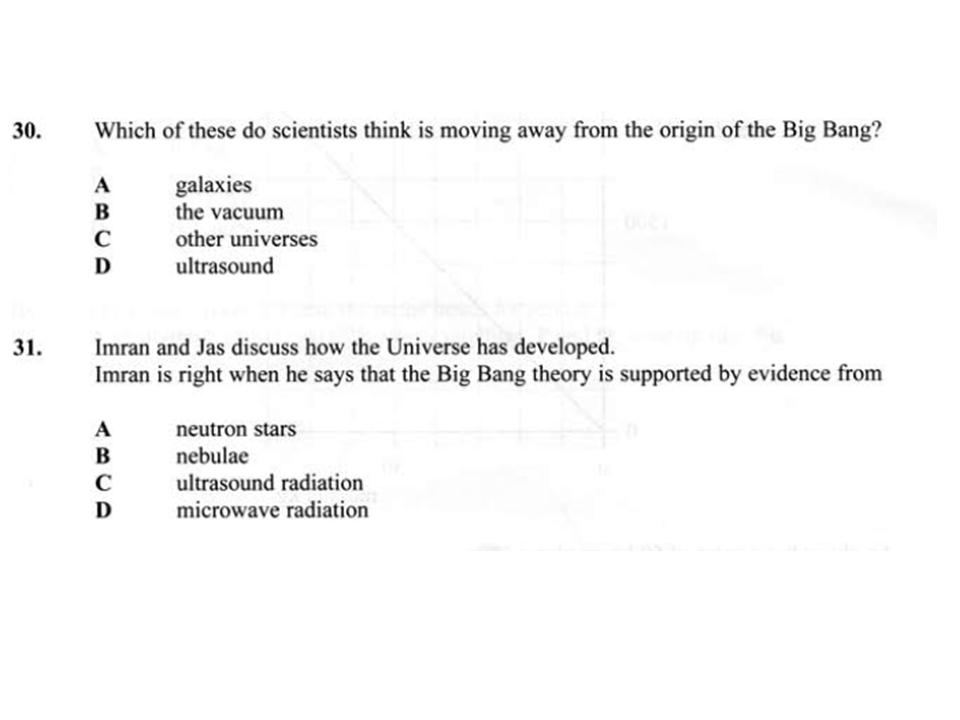
Here’s a couple more, from the “Advanced” section:

The answer to Q30 is, presumably, A. But do any scientists really think that galaxies are “moving away from the origin of the Big Bang”?  I’m worried that this implies that the Big Bang was located at a specific point. Is that what they’re teaching?

Bearing in mind that only one answer is supposed to be right, the answer to Q31 is presumably D. But is there really no evidence from “nebulae” that supports the Big Bang theory? The expansion of the Universe was discovered by observing things Hubble called “nebulae”..

I’m all in favour of school students being introduced to fundamental things such as cosmology and particle physics, but my deep worry is that this is being done at the expense of learning any real physics at all and is in any case done in a garbled and nonsensical way.

Lest I be accused of an astronomy-related bias, anyone care to try finding a correct answer to this question?

The more of this kind of stuff I see, the more admiration I have for the students coming to study physics and astronomy at University. How they managed to learn anything at all given the dire state of science education in the UK is really quite remarkable.

Announcement of Opportunities

Posted in Education, The Universe and Stuff with tags , , , , on June 16, 2010 by telescoper

I mentioned this a while ago, but I thought it wouldn’t do any harm to repeat the official advertisement here. Cardiff is going large (or at least larger) in experimental physics, and the first deadline is approaching..

..so get cracking with your applications now!

Chair in Experimental Physics

Reader/Senior Lecturer/Lecturer in Experimental Physics

School of Physics and Astronomy

As the first stage of a major initiative to broaden its research activity the School of Physics and Astronomy at Cardiff University has some immediate vacancies for permanent faculty positions at either full Professor/Reader/Senior Lecturer/Lecturer level in any area of Experimental Physics, other than Astrophysics.

Applications are welcome in fields new to the School as well as those complementary to the existing strengths. Candidates working in interdisciplinary areas with a firm Physics base are also welcomed. You will be expected to have demonstrated an established programme of research, and will also be expected to teach Physics at undergraduate and postgraduate level.

The School of Physics and Astronomy at Cardiff University has strong research groups in Photons & Matter (theory and experimental), Gravitational Physics and Nanophysics, as well as a large Astrophysics programme.

You should have a PhD in Physics, Mathematics or closely-related subject.

Salary:
A point on the Cardiff Professorial Salary Scale (Chair)
£45155 – £55535 per annum (Reader)
£37839 – £43840 per annum (Senior Lecturer)
£29853 – £35646 per annum (Lecturer)

Further information about the School may be found at http://www.astro.cardiff.ac.uk/

Informal enquiries regarding these positions may be made to Professor Walter Gear, Head of School, email Walter.Gear@astro.cardiff.ac.uk

To work for an employer that values and promotes equality of opportunity, visit www.cardiff.ac.uk/jobs telephone + 44 (0) 29 2087 4017 or email vacancies@cardiff.ac.uk for an application form quoting vacancy number 186 for the Chair position and 188 for the Reader/Senior Lecturer/Lecturer position.

Closing date: Friday, 23 July 2010.

Please note vacancies are for one Chair and three Senior Lecturer/Lecturer positions.

www.cardiff.ac.uk/jobs