Archive for Pieter Bruegel the Elder

The Hunters in the Snow – Pieter Bruegel the Elder

Posted in Art, Poetry with tags , , on December 17, 2024 by telescoper

by Pieter Bruegel the Elder (1565, oil on panel, 117×162 cm, Kunsthistorisches Museum, Vienna).

This very famous painting is the subject of this ekphrastic poem, written in 1962, by William Carlos Williams:

The over-all picture is winter
icy mountains
in the background the return

from the hunt it is toward evening
from the left
sturdy hunters lead in

their pack the inn-sign
hanging from a
broken hinge is a stag a crucifix

between his antlers the cold
inn yard is
deserted but for a huge bonfire

that flares wind-driven tended by
women who cluster
about it to the right beyond

the hill is a pattern of skaters
Brueghel the painter
concerned with it all has chosen

a winter-struck bush for his
foreground to
complete the picture


It seems strange to me that the poem misses what I think is the most important feature of the painting: that the hunters are returning empty-handed. It’s that that makes the image so bleak.
Everyman

Posted in Art, Crosswords with tags , , on December 16, 2018 by telescoper

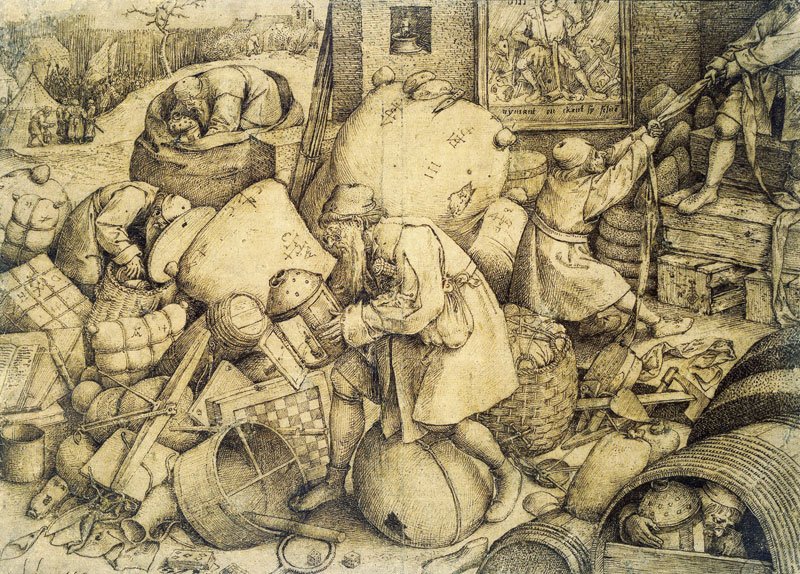
Having finished the Everyman crossword in this morning’s Observer, I was reading a review of some books about Pieter Bruegel in the Times Literary Supplement where I found mention of a piece by that artist also called Everyman.

Here is the work, an ink drawing on paper, of dimensions 20.9cm by 29.2 cm made in Antwerp in 1558 and currently in the British Museum.

According to the catalogue, the work is called Elck in Dutch, which means ‘each’ or ‘everyone’, but is usually known in English as ‘Everyman’.

The scenes in the drawing illustrate proverbs or sayings. The central proverb concerns Elck who vainly seeks himself in the objects of this world as he stands over a broken globe. With a lantern he searches through a pile of barrels and bales, a game board, cards and objects which signify the distractions of life.

To the right, two more Elck figures play tug of war with a rope, illustrating the saying, ‘each tugs for the longest end’.

In the background on a wall hangs a picture which continues the moral theme. It shows a fool sitting among a pile of broken household objects gazing at himself in a mirror. He is Nemo or Nobody, as the inscription below him informs us: ‘Nobody knows himself.

To me it seems that Elck is searching (no doubt in vain) for something worth keeping in the junkyard of human existence. Perhaps he should perhaps have a go at a crossword to cheer himself up?