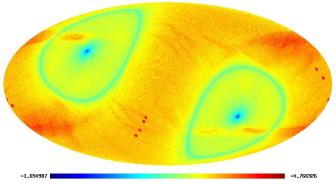
Archive for Planck

Planck’s Progress

Posted in The Universe and Stuff with tags , , on November 10, 2009 by telescoper

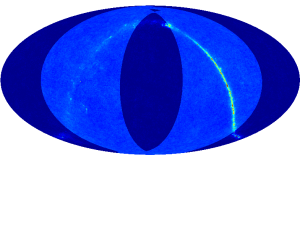
Only time for a very quick post today, so I thought I’d just pass on some news I got via Chris North about how Planck is doing. As it happens, the satellite has recently reached  the point where it has observed about half the sky. It spins on its axis in rather stately fashion (at about one revolution per minute) and, as it moves in its orbit, that sweeps the telescope across the celestial sphere. Each scan is almost a great circle, but  these gradually creep around over about a six month period to cover the whole sky.

The nice picture below, in ecliptic coordinates, shows how far it has got. You can also see the Galactic plane, arching across the sky and showing up clearly at the frequencies Planck is sensitive to.

Planck3NovSkyCoverage

The Planck Consortium had an official meeting last week in Bologna at which they drank lots of wine and ate lots of food, but other than that nobody who was there has told me anything.

It’s all very hush hush don’t you know.

Another take on cosmic anisotropy

Posted in Cosmic Anomalies, The Universe and Stuff with tags , , , on October 22, 2009 by telescoper

Yesterday we had a nice seminar here by Antony Lewis who is currently at Cambridge, but will be on his way to Sussex in the New Year to take up a lectureship there. I thought I’d put a brief post up here so I can add it to my collection of items concerning cosmic anomalies. I admit that I had missed the paper he talked about (by himself and Duncan Hanson) when it came out on the ArXiv last month, so I’m very glad his visit drew this to my attention.

What Hanson & Lewis did was to think of a number of simple models in which the pattern of fluctuations in the temperature of the cosmic microwave background radiation across the sky might have a preferred direction. They then construct optimal estimators for the parameters in these models (assuming the underlying fluctuations are Gaussian) and then apply these estimators to the data from the Wilkinson Microwave Anisotropy Probe (WMAP). Their subsequent analysis attempts to answer the question whether the data prefer these anisotropic models to the bog-standard cosmology which is statistically isotropic.

I strongly suggest you read their paper in detail because it contains a lot of interesting things, but I wanted to pick out one result for special mention. One of their models involves a primordial power spectrum that is intrinsically anisotropic. The model is of the form

P(\vec{ k})=P(k) [1+a(k)g(\vec{k})]

compared to the standard P(k), which does not depend on the direction of the wavevector. They find that the WMAP measurements strongly prefer this model to the standard one. Great! A departure from the standard cosmological model! New Physics! Re-write your textbooks!

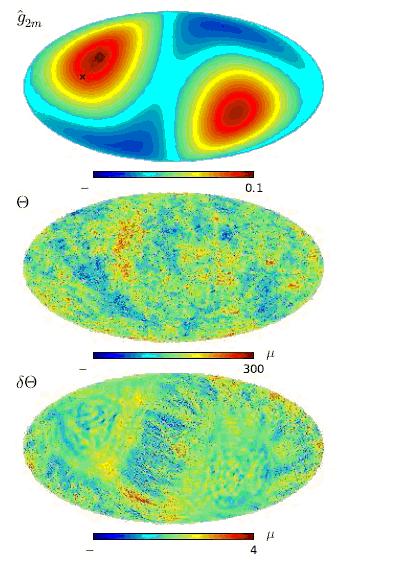
Well, not really. The direction revealed by the best-choice parameter fit to the data is shown in the smoothed picture  (top). Underneath it are simulations of the sky predicted by their  model decomposed into an isoptropic part (in the middle) and an anisotropic part (at the bottom).

lewis2

You can see immediately that the asymmetry axis is extremely close to the scan axis of the WMAP satellite, i.e. at right angles to the Ecliptic plane.

This immediately suggests that it might not be a primordial effect at all but either (a) a signal that is aligned with the Ecliptic plane (i.e. something emanating from the Solar System) or (b) something arising from the WMAP scanning strategy. Antony went on to give strong evidence that it wasn’t primordial and it wasn’t from the Solar System. The WMAP satellite has a number of independent differencing assemblies. Anything external to the satellite should produce the same signal in all of them, but the observed signal varies markedly from one to another. The conclusion, then, is that this particular anomaly is largely generated by an instrumental systematic.

The best candidate for such an effect is that it is an artefact of a asymmetry in the beams of the two telescopes on the satellite. Since the scan pattern has a preferred direction, the beam profile may introduce a direction-dependent signal into the data. No attempt has been made to correct for this effect in the published maps so far, and it seems to me to be very likely that this is the root of this particular anomaly.

We will have to see the extent to which beam systematics will limit the ability of Planck to shed further light on this issue.

First Light from Planck!

Posted in The Universe and Stuff with tags , , , on September 17, 2009 by telescoper

Credit to Andrew Jaffe for alerting me to the fact that ESA’s first press release concerning Planck has now been, well, released…

I last blogged about Planck when it had reached its orbit around L2 and cooled down to its working temperature of 100 milliKelvin. Over the ensuing weeks it has been tested and calibrated, prodded and poked (electronically of course) and generally tuned up. More recently it has completed a “mini-survey” to check that it’s all working as planned.

The way Planck scans means that it takes about six months to cover the whole sky, which is much longer than the two-week period allowed for the mini-survey. This explains the fact that a relatively narrow slice of the celestial sphere has been mapped. However, you can see the foreground emission from the Galactic plane quite clearly. Here is the region shown in the box split into the nine separate frequency channels that Planck observes:

The High Frequency Instrument (HFI) is more sensitive to dust, while the Low Frequency Instrument (LFI) detects more radio emission. It all seems to be working as expected!

And finally here’s a blow up of the smaller square above the Galactic plane shown as seen by  LFI and HFI:

This region is much less prone to foreground emission. The fact that similar structures are seen in the two completely independent receivers shows that the structure is not just instrument noise. In other words, Planck is seeing the cosmic microwave background!

Now Planck will carry out its full survey, scanning the sky for another year or so. There will then be an intense period of data analysis for about another year after which the key science results will be published. Exciting times.

News from L2

Posted in The Universe and Stuff with tags , on July 6, 2009 by telescoper

Just a quick update with a couple of bits of news about Planck.

First, the satellite has completed its final  manoeuvre and is now in its orbit around the second lagrange point. The  orbit is, in fact, slightly smaller than was originally planned owing to the fact that the extreme accuracy of the post-launch trajectory left a bit of extra fuel. Anyway, it’s now about 1.5 million kilometres from home, circling L2 which is what it will be doing for about a year.

The second bit of news has been the cause of particular celebration here at Cardiff. The High Frequency Instrument (HFI) has been cooling down since launch and has now reached its operating temperature of 0.1K (100 milliKelvin). The environment it is sitting in is about 60-70K so it’s no easy job to get it down to such a low level. Anyway, it’s now definitely the coolest thing in space…

The Cardiff HFI team celebrated on Friday, with beer that was no doubt suitably chilled.

Planck spins at about 1 revolution per minute and has been sending back scans of the sky for test purposes.  The HFI scans show that it is working well, detecting dust emission from the Galactic Plane well before it got down to sufficiently low temperatures to see the cosmic microwave background.

What happens next is the Calibration and Performance Verification phase during which the instruments will be checked out in great detail before the real science gets started in August.

Space Camp

Posted in Uncategorized with tags , , , , , on July 4, 2009 by telescoper

The other day I was looking through my copy of the Men’s Disciplinary Rubberwear Gazette (which I buy for the Spot-the-Ball competition). Turning to the advertisements, I discovered that the Science & Technology Facilities Council is conducting a review of its space facilities and operations. Always eager to push back the frontiers of science, I hurried down to their address in Swindon to find out what was going on.

ME: Hello. Is there anyone there?

JULIAN: Oh hello. My name’s Julian, and this is my friend Sandy.

SANDY: Oooh hello! What can we do for you?

ME: Hello to you both. Is this Polaris House?

JULIAN: Not quite. Since we took over we changed the name…

ME: To?

SANDY: It’s now called Polari House…

JULIAN: On account of that’s the only language spoken around here.

ME: So you’re in charge of the British Space Programme then?

JULIAN:  Yes, owing to the budget, the national handbag isn’t as full as it used to be so now it’s just me and her.

SANDY: But never fear we’re both dab hands with thrusters.

JULIAN: Our motto is “You can vada about in any band, with a satellite run  by Jules and…

SANDY: …Sand.

ME: I heard that you’re looking for some input.

SANDY: Ooooh. He’s bold, in’e?

ME: I mean for your consultation exercise…

JULIAN: Oh yes. I forgot about that. Well I’m sure we’d welcome your contribution any time, ducky.

ME: Well I was wondering what you could tell me about Moonlite?

SANDY: You’ve come to the right place. She had an experience by Moonlight, didn’t you Jules?

JULIAN: Yes. Up the Acropolis…

ME: I mean the Space Mission “Moonlite”

SANDY: Oh, of course. Well, it’s only small but it’s very stimulating.

JULIAN: Hmmm.

SANDY: Yes. It gets blasted off into space and whooshes off to the Moon…

JULIAN: …the backside thereof…

SANDY: ..and when it gets there it shoves these probes in to see what happens.

ME: Why?

SANDY: Why not?

ME: Seems a bit pointless to me.

JULIAN: There’s no pleasing some people is there?

ME: Haven’t you got anything more impressive?

SANDY: Like what?

ME:  Maybe something that goes a bit further out? Mars, perhaps?

JULIAN: Well the French have this plan to send some great butch omi to troll around on Mars but we haven’t got the metzas so we have to satisfy ourselves with something a bit more bijou…

SANDY: Hmm…You can say that again.

JULIAN: You don’t have to be big to be bona.

SANDY: Anyway, we had our shot at Mars and it went willets up.

ME: Oh yes, I remember that thing named after a dog.

JULIAN: That’s right. Poodle.

ME: Do you think a man will ever get as far as Uranus?

JULIAN&SANDY: Oooh! Bold!

SANDY: Well I’ll tell you what. I’ll show you something that can vada out to the very edge of the Universe!

ME: That sounds exciting.

JULIAN: I’ll try to get it up right now.

ME: Well…er…

JULIAN: I mean on the computer

ME: I say, that’s an impressive piece of equipment

JULIAN: Thank you

SANDY: Oh don’t encourage her…

ME: I meant the computer.

JULIAN: Yes, it’s a 14″ console.

SANDY:  And, believe me, 14 inches will console anyone!

JULIAN; There you are. Look at that.

ME: It looks very impressive. What is it?

SANDY: This is an experiment designed to charper for the heat of the Big Bang.

JULIAN. Ooer.

SANDY: The Americans launched WMAP and the Europeans had PLANCK. We’ve merged the two ideas and have called it ….PLMAP.

ME: Wouldn’t it have been better if you’d made the name the other way around? On second thoughts maybe not..

JULIAN: It’s a little down-market but we have high hopes.

SANDY: Yes, Planck had two instruments called HFI and LFI. We couldn’t afford two so we made do with one.

JULIAN: It’s called MFI. That’s why it’s a bit naff.

ME: I see. What are these two round things either side?

SANDY: They’re the bolometers…

ME: What is this this long thing in between pointing up? And why is it leaning to one side?

SANDY: Well that’s not unusual in my experience …

JULIAN:  Shush. It’s an off-axis Gregorian telescope if you must know.

ME: And what about this round the back?

SANDY: That’s your actual dish. It’s very receptive, if you know what I mean.

ME: So what does it all do?

JULIAN: It’s designed to make a map of what George Smoot called “The Eek of God”. It’s fabulosa…

SANDY: Or it would be if someone hadn’t neglected to read the small print.

ME: Why? Is there are problem?

JULIAN: Well, frankly, yes. We ran out of money.

SANDY: It was only when we got it out the box we realised.

ME: What?

JULIAN & SANDY: Batteries Not Included!

(With thanks to cosmic variance for the inspiration, and apologies to Barry Took and Marty Feldman, who wrote the original Julian and Sandy sketches for the radio show Round the Horne.)
Hot in Town

Posted in Science Politics, The Universe and Stuff with tags , , on July 2, 2009 by telescoper

After a fun but frantic few days in the big city I’ve now escaped back to the relative cool of Cardiff. The Royal Society Summer Science Exhibition appears to be going very well, but my part in it has come to an end. The rest of the team will have the joy of continuing for the rest of the week and then dismantling the exhibit and returning with it at the weekend.

The exhibition proper started on Tuesday and our stand was drawing a lot of visitors right from the word go. That’s partly because we had a very good spot, right near the entrance, but we also had a bit of  coverage on the BBC News which might have helped. Inside the building we attracted quite a lot of people to our stand because we were showing infrared images on a large flatscreen monitor of people as they walked past. That seemed to draw people in large numbers to the other parts of the exhibit which was, after all, the purpose of it.

People look quite strange in the infra-red. Here’s an example:

photo_2

That’s me. The calibration scale to the right is in Celsius: hot is white (37) or yellow and cold is blue or black (26). Red is in the middle, around 30 Celsius. Different people seem to have different hot spots and cold spots: most  appear to have cooler ears and lips compared to the rest of their faces, but noses vary considerably in temperature.

There was only one potentially embarrassing moment, when a group of teenage lads wandered in front of the camera. Apparently, a certain type of mens’ underwear has very high emissivity around 10 microns. I just happened to glance up at the monitor and noticed a prominent hotspot just in time to tilt the camera up before anyone else noticed. Thereafter we kept it focussed above waist level just in case…

After my shift on Tuesday I had to nip back on the tube to my temporary lodgings, shower, change into my dinner jacket and black tie, and then return to the Royal Society for the much-anticipated Soirée. Taking the tube turned out to be a mistake. The heatwave currently gripping London has turned the underground system into something resembling the inside of an oven, so I decided to walk back rather than melt again when I’d got changed. I drew a few strange looks walking through Soho in my glad rags, but at least it was cooler at street level than on the Underground.

The evening occasion  turned out to be very busy too. To my surprise, it wasn’t just champagne and posh nibbles: a substantial meal was on offer in a marquee at the back of the Royal Society building. However, there were large crowds moving through the exhibition and we only had six people on the exhibit. We therefore staggered our trips to the grub tent making sure there was always someone at the exhibit to deal with the invited guests. By the time my turn came round it was 9.30 and the whole thing closed at 10.00. I still had time for a good nosh-up and a couple of glasses of wine, though, so all was well.

At the exhibit there was a steady supply of champagne and VIP guests. Lots of Lords and Ladies and other bigwigs,  but I hadn’t the faintest idea who most of them were. These are all the kind of people who assume that everyone on the planet (a) knows who they are and (b) is impressed to have the opportunity to meet them. Being surrounded by such a sea of effortless superiority is quite intimidating but, fortunately, there were also some familiar faces who stopped by and appeared interested. The noted biologist Steve Jones dropped by, and had his picture taken in the infrared, as did John Polkinghorne. I had met Polkinghorne before not long ago, but he clearly didn’t remember me at all.

“Medals may be worn” was one of the instructions, but I had neglected to bring  my cycling proficiency badge.

Summer Science

Posted in The Universe and Stuff with tags , , on June 29, 2009 by telescoper

Just time for a very quick post today, owing to the hectic nature of the past (and future) few days.

Yesterday (Sunday) morning, I clambered on board a large van full of expensive and bulky gear and we lumbered away from Cardiff, down the M4 and all the way to London. The reason is the Royal Society Summer Science Exhibition, which involves various research groups setting up exhibits and demonstrating their wares to the general public in the splendid environs of the Royal Society building in Carlton House Terrace, just off Pall Mall.

Yesterday and today we’ve been setting up our exhibit, which is about Herschel and Planck  (both of which are still working perfectly, in case you wanted to ask). Unloading the van in the sweltering heat yesterday wasn’t that much fun but everyone was very helpful and we got through it.  We had temporary flooring to put down, lots of rigging and large flat monitors needed to be hoisted on to gantries. I felt a bit like a sort of up-market roadie. Most of the heavy work was done yesterday, though, and we spent today putting the computers and other electronic exhibits together and generally making it all work. I chipped in as best I could, despite my legendary incompetence with practical things. They didn’t really let me near anything really valuable anyway.

By about 2pm today we had finished, and I have to say it looks very impressive. Credit to Chris North, and the others who spent ages designing it and organizing the logistics of what is a very complicated exhibit. There are scale models of Planck and Herschel, and a full-size model of the instrument SPIRE which is on Herschel and which was designed and built by the Cardiff team. The complexity of the optical system is quite amazing. Incidentally, I heard a rumour that some test images from SPIRE are going to be released soon.. I hear they’re stunning. Watch this space.

As well as these other bits there’s an infrared camera attached to a monitor to show your hot bits, and another monitor with a wii attachment so you can see anywhere on the sky at any wavelength you wish. There are also two touch-screen displays that can take visitors through the science and technology behind these two wonderful  satellites.  It’s all very interactive, and I think it’s going to be a hit for the hands-on visitors.

To back this all up, we’ve also got mountains of leaflets, mugs, pens and other assorted memorabilia. I think they’ve overestimated how much of this stuff we can dispense in a week, but I’m sure it will come in handy in the future anyway.

An extensive rota has been organized to set the exhibit up and  keep it staffed. I had an all-day shift yesterday and was signed up for 8-3 today. Since we actually got everything done a bit early, however, I was given permission to leave. At 3pm today there was a “press preview” of the exhibition which I could’t stay for, so I figured I might as well leave before the reptiles started to arrive.

I’ll be on the stand tomorrow, trying to be nice to the public, and back again on Wednesday doing the same. The shifts are only 4 hours at a go, which is good because it’s quite tiring keeping up the enthusiasm. It’s also forecast to be extremely hot on the weather front which is another reason to keep the shifts short. I was longing for a beer by the time I finished yesterday.

I’ve also been invited to a “soirée” on Wednesday evening, which is a swanky black tie function at which sundry VIPs view the exhibits and chat with the exhibitors over champagne and canapés. ‘m quite looking forward to the chance to indulge myself and hang out with the big nobs, but I can’t say I’m looking forward to wearing the penguin suit when it’s 30C. Still, as long as the champagne is chilled I’m sure I’ll survive.

Toodle pip.

Notes from the North

Posted in Biographical, The Universe and Stuff with tags , , on June 8, 2009 by telescoper

Just time for a quick post today. I’m in Copenhagen for a short meeting entitled “Cosmology and Astroparticle Physics from the LHC to Planck“. The meeting only lasts today and tomorrow morning, but it’s been a lot of fun so far and has offered me the chance to chat with a lot of people I don’t often get the chance to talk to.

I suppose the only thing from the meeting I really want to mention in this short post is the  current status of Planck, which is currently about a million km from Earth. Both instruments (the High Frequency Instrument HFI and Low Frequency Instrument LFI) are still performing fine and the satellite,  having now been injected into its rather large orbit around L2, is  cooling down to its operating temperature. So far so good. There will be more tests at the beginning of July, after which it will start its real business of scanning the sky to make maps of the primordial temperature  fluctuations.

Today I gave my (usual) talk about cosmic anomalies (which I’ve blogged about before), but there were also interesting talks about possible interpretation of the positron excess observed in the direction of the Galactic Centre,  on a model of anisotropic dark energy  and a wacky contribution by Igor Novikov about semi-traversible wormholes.

Meanwhile, over lunch and dinner the various European participants of the meeting mulled over the results from the elections to the European parliament which completed yesterday.

The results generally showed a move to the right across Europe. In the United Kingdom this also happened, as the Labour Party’s share of the vote collapsed to just under 16%. I’m not going to shed any tears for them, but I am shamed to admit that my country will now be represented in the European Parliament by two members of the British National Party – a bunch of neo-Nazi thugs who are doing the best they can for their own ends to exploit peoples’ discontent with the mainstream parties. Fortunately their share of the vote (about 6%, on a very low turnout) remained relatively small and was, in fact, less than that of the Green Party. Nevertheless with the 65th anniversary of D-Day only a few days ago, it is depressing that so many people have forgotten the sacrifices that previous generations made to save this country from exactly that  kind of fascist. I hope this disaster is not repeated at the next general election. This kind of monstrosity makes the arcane world of cosmology suddenly seem so irrelevant.

Catching Up

Posted in Biographical with tags , , , on May 25, 2009 by telescoper

I’ve been away for a few days leading up to the Whitsuntide bank holiday so I thought I’d just throw together a quick post catching up on two or three things.

First, we’re all  indebted to Ed and Haley for putting together this video of the Herschel-Planck launch party a couple of weeks ago. I think it’s very nicely done, despite the fact that I’m in it. In fact, some trick of the lens makes me appear slightly drunk. I don’t know how that can have happened.

I’d also like to take this opportunity to thank the fine folks at the University of Sussex Astronomy Centre for inviting me to give a seminar there on Friday and also laying on such fine hospitality, in the form of an excellent curry afterwards. They also put me up in the splendid Cavalaire hotel (run by Derek and Garry) which is comfortable, friendly and, well, just very Brighton

I did my graduate studies at Sussex, getting my DPhil there about 20 years ago and stayed thereafter for another couple of years as a postdoc before moving up to London. Having the excuse to go back was rather wonderful because wandering around the city brought back lots of very happy memories of the place.

Some things have changed, of course. I was shocked to discover that the Zap Club under the arches on the seafront has closed down (or at least changed its name).  Superficially, things have come and gone but the overall feel of the town hasn’t changed much, though, as far as I can tell. I was quite surprised that the same bus route (number 25) runs from the town to the Campus in Falmer, although the one I got was stuck in traffic for ages on the way. On a glorious sunny weekend, though, there’s no better place to be than Brighton. I wish I could have stayed a bit longer.

And finally, as I predicted, the last day of the Premiership season did indeed see the relegation of Newcastle United. I wasn’t surprised at the outcome, but it’s typical of this season that they went out with such a whimper. Basically they needed to get something out of their game away Aston Villa and hope that either Sunderland or Hull City would lose. In fact the other two teams played their part by both losing. Unfortunately, however, Newcastle also lost 1-0 (to an own goal) so they go down. I’ve been reconciled to this for quite a long time, however, and it didn’t depress me too much. It probably helped that the substantial bet I made on this eventuality has already paid out and I’ve got a nice bit of dosh to compensate me. It probably also means I’m a cynical bastard. Quite a few folks at Sussex expressed disapproval of my gambling philosophy – always bet on the outcome that you don’t want to happen, as a kind of insurance policy – but I stand by it. I’m looking forward to seeing the team play in Cardiff City next season and, who knows, maybe they’ll be playing Brighton the following year!

Incidentally, the Whit week holiday (which celebrates the feast of Pentecost) was always called “Race Week” when I was a kid on Tyneside, because it is when the Northumberland Plate has been run at Newcastle racecourse (since 1833). The associated festivities regularly got out of hand and degenerated into drunken chaos until, in 1882, the local Temperance Society set up a Temperance Fair on the Town Moor. Over the years this grew into the largest travelling fun fair in Europe and became called “The Hoppings“. It was the highlight of the half-term holiday at School to be taken to The Hoppings – usually in the pouring rain – to come home with a goldfish in a plastic bag and a toffee apple.

Race week isn’t to be confused with the famous “Blaydon Races” which take place on 9th June and which are commemorated in Geordie Ridley‘s music hall song, which mentions the date of 1862. The race referred to in this case is an athletics race which was originally run on Stella Haugh, which is now the site of  a power station. The runners now race from Newcastle to Blaydon following the route described in the song. If you’re confused by the lyrics then you probably weren’t aware that Paradise is a place in Newcastle. The Blaydon Races is typically sung by supporters of Newcastle United, though I suspect those renditions will be rather subdued for a while.

Anyway, back to work tomorrow. In a day or two I’ll be locked away marking examinations. Hey ho.

Divided Loyalties

Posted in Biographical, Science Politics with tags , , , , on May 16, 2009 by telescoper

It’s easy to tell that summer is on the way. England are playing the West Indies at Cricket. It’s the penultimate weekend of the Premiership football season. The undergraduates are taking their exams. I’m sitting with a pile of projects to mark. And it’s raining.

I suppose I have to mention the football. My team, Newcastle United, gave themselves a chance of avoiding relegation on Monday night by beating local rivals, Middlesborough 3-1. A win today at home against Fulham would pretty much have guaranteed safety. They lost 1-0. It now looks inevitable that they will be relegated after 16 years in the top flight.

It’s a thankless task being a Newcastle supporter. I’ve followed them all my life and they have managed to avoid winning any competition of any significance since the Fairs cup in 1968 (now called the UEFA cup). They have loyal fans and a wonderful stadium, but somehow seem completely unable to convert that into success on the field. This season they were doomed as soon as the manager Kevin Keegan quit over the owner Mike Ashley’s refusal to allow him to be involved in signing any players. After a period without a manager, during which they lost game after game, the club appointed veteran relegation specialist Joe Kinnear, who did OK for a while then at Christmas had to go into hospital with heart problems. Another run of poor results followed until, in desperation, the club appointed the iconic former player Alan Shearer to his first managerial position. His lack of experience showed, though, and he’s only managed to win one game. In short, the season has been a shambles.

When my father died (about 18 months ago), I thought that my interest in Newcastle United would wane. Football and music were the only two things we had in common after my parents split when I was about 12 and I went to live with my mother. I saw him only rarely in later years,and much of the time we spent together involved talking about football. However, I still find myself getting nervous on match days and looking anxiously for the scores whenever they’ve been playing. It’s like there is an umbilical cord that still connects me to my home town and I can’t get rid of it.

That feeling was reinforced yesterday when, following a conversation at the RAS Club last week, Robert Smith sent me a booklet that he had received when he attended a conference in Newcastle in 1965. The Official Guide to Newcastle upon Tyne (priced 2/6) filled me with a mixture of nostalgia and amusement. Ironically, given the football team’s inadequacies the motto of the city is FORTITER DEFENDIT TRIUMPHANS, which was also the motto of my old school, the Royal Grammar School (also mentioned in the booklet).

The little picture on the left shows the armorial bearings of the City of Newcastle upon Tyne. The official blazon is: Arms:- Gules three Castles triple towered Argent. Crest on a Wreath of the Colours. A Castle as in the arms issuant therefrom from a demi Lion guardant supporting a Flagstaff Or, flying therefrom a forked Pennon of the Arms of Saint George.

Supporters: – on either side a Sea Horse proper crined and finned Or.

Obviously supporters don’t guarantee success, even if they’re proper crined and finned.

Of course, I shall be disappointed if and when Newcastle get relegated next week, but I don’t go along with all the guff in the newspapers about how it will have dire consequences for the city. They’ve been relegated twice before in my lifetime, and the world didn’t end then nor will it now. In any case, I’d reckon the Football Club has taken much more out of the economy of Newcastle in recent years than it has put back into it. Hard-earned cash from supporters has gone straight into the pockets of overpaid players and inept management staff. Maybe relegation will shake the Club up, which will be good in the long run.

Anyway, every cloud has at least one silver lining and this one has two. At the start of the season, I was prescient enough to place a large bet on Newcastle to get relegated at quite long odds. I expect to be handsomely compensated by Mr William Hill when they do go down. The other thing is that they will have to play Cardiff City in the Championship next year, which will give me the chance to see them play in Cardiff’s brand new stadium.

Incidentally, Cardiff City blew their promotion hopes in spectacular fashion. Needing only to avoid losing to Preston North End by 5 goals in order to secure a place in the play-offs, they lost 6-0.

Meanwhile we’ve been coming down slowly from the high that was Thursday’s launch of Herschel and Planck. I was surprised to see Matt Griffin in the department yesterday afternoon because he was actually at the launch in Kourou. He had left after the launch and flown directly back to Cardiff (via Paris). Our other representatives will return over this weekend, and things will start to get back to normal.

Matt told me that he was so impressed with the professionalism of Arianespace, that he wasn’t at all nervous about the launch. Matt’s instrument, SPIRE, will switch on during 22 May and testing will start. I’m sure that Matt and his team will be more than a little nervous about that!

Assuming both Planck and Herschel work satisfactorily, the next problem we will have to face is the deluge of data that will shortly be upon us. The astronomers at Cardiff University have submitted an application for rolling grant support from STFC (not Swindon Town Football Club) to enable us to extract scientific results from new data especially from Herschel. Unfortunately, though, the coffers are pretty bare and it seems very unlikely that we will get the substantial uplift in funding we need to carry out the work on a reasonable timescale.

A rolling grant is intended to support an ongoing research programme. Typically the grants cover 5 years’ funding, enabling the group to offer longer term contracts to staff than is allowed by the 3-year standard grant format. After 3 years of the rolling period, the group has to bid again for another 5 year period but the timing means there is always two years’ grace, meaning that if renewal is not recommended the group still has two years’ funding so the plug isn’t pulled immediately. If an extension is offered but at a reduced level of funding, a group might decide to refuse the new grant and carry on with its existing two years, perhaps to apply in the following round.

The problem with the current financial situation is that STFC barely has the funds needed to continue its existing rolling grants. In other words if all the groups applying for rolling support declined their new contracts and rolled on their existing grants, STFC would only just be able to pay them. In such a situation there would be no new grants or any kind of increase in existing rollers. The implications for successful exploitation of Herschel and Planck appear to be grim and there could well be a lot of difficult decisions within the department to be made if we have to operate within a much reduced budget.

It would be ridiculous if a billion-dollar mission like Herschel ends up stymied because of the relatively small sums needed to exploit the data, but that doesn’t mean it won’t happen. Football teams aren’t the only organizations to suffer from bad management.