Archive for Polarization

Launch!

Posted in The Universe and Stuff with tags , , , on January 3, 2015 by telescoper

Meanwhile, in Antarctica, the search for signatures of primordial gravitational waves in the polarization of the cosmic microwave background goes on. Here’s a fascinating blog by a member of the SPIDER team, whose balloon-borne experiment was recently launched and is currently circling the South Pole taking data. Here’s hoping it works out as planned!

annegambrel22's avatarSPIDER on the Ice

This is surreal.

I have been working on SPIDER for three and a half years, and much of the rest of the collaboration has been working for many years beyond that. We have all gone through intense times of stress and disappointment, victories and defeats. The personal sacrifice on the part of every individual on the team to get SPIDER to the point of flight readiness has been a weight on all of our shoulders as we prepared to launch our hopes and dreams on a balloon.

Ballooning is incredibly risky. Everything can work flawlessly on the ground, and then one thing can break during launch, or freeze or overheat at float altitude, and no amount of commanding from afar can bring it back to life. This happens so often in ballooning, and all you can do is obsess over every aspect of the experiment, have redundancy where possible, and…

View original post 760 more words

BICEP2 bites the dust.. or does it?

Posted in Bad Statistics, Open Access, Science Politics, The Universe and Stuff with tags , , , , , , , , on September 22, 2014 by telescoper

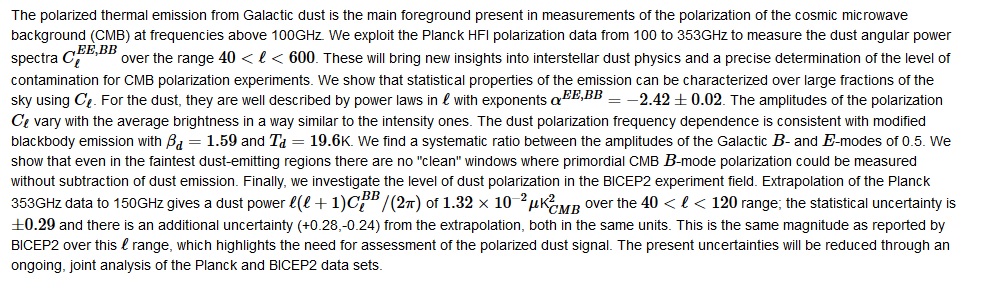
Well, it’s come about three weeks later than I suggested – you should know that you can never trust anything you read in a blog – but the long-awaited Planck analysis of polarized dust emission from our Galaxy has now hit the arXiv. Here is the abstract, which you can click on to make it larger:

PlanckvBICEP2

My twitter feed was already alive with reactions to the paper when I woke up at 6am, so I’m already a bit late on the story, but I couldn’t resist a quick comment or two.

The bottom line is of course that the polarized emission from Galactic dust is much larger in the BICEP2 field than had been anticipated in the BICEP2 analysis of their data (now published  in Physical Review Letters after being refereed). Indeed, as the abstract states, the actual dust contamination in the BICEP2 field is subject to considerable statistical and systematic uncertainties, but seems to be around the same level as BICEP2’s claimed detection. In other words the Planck analysis shows that the BICEP2 result is completely consistent with what is now known about polarized dust emission.  To put it bluntly, the Planck analysis shows that the claim that primordial gravitational waves had been detected was premature, to say the least. I remind you that the original  BICEP2 result was spun as a ‘7σ’ detection of a primordial polarization signal associated with gravitational waves. This level of confidence is now known to have been false.  I’m going to resist (for the time being) another rant about p-values

Although it is consistent with being entirely dust, the Planck analysis does not entirely kill off the idea that there might be a primordial contribution to the BICEP2 measurement, which could be of similar amplitude to the dust signal. However, identifying and extracting that signal will require the much more sophisticated joint analysis alluded to in the final sentence of the abstract above. Planck and BICEP2 have differing strengths and weaknesses and a joint analysis will benefit from considerable complementarity. Planck has wider spectral coverage, and has mapped the entire sky; BICEP2 is more sensitive, but works at only one frequency and covers only a relatively small field of view. Between them they may be able to identify an excess source of polarization over and above the foreground, so it is not impossible that there may a gravitational wave component may be isolated. That will be a tough job, however, and there’s by no means any guarantee that it will work. We will just have to wait and see.

In the mean time let’s see how big an effect this paper has on my poll:


Note also that the abstract states:

We show that even in the faintest dust-emitting regions there are no “clean” windows where primordial CMB B-mode polarization could be measured without subtraction of dust emission.

It is as I always thought. Our Galaxy is a rather grubby place to live. Even the windows are filthy. It’s far too dusty for fussy cosmologists, who need to have everything just so, but probably fine for astrophysicists who generally like mucking about and getting their hands dirty…

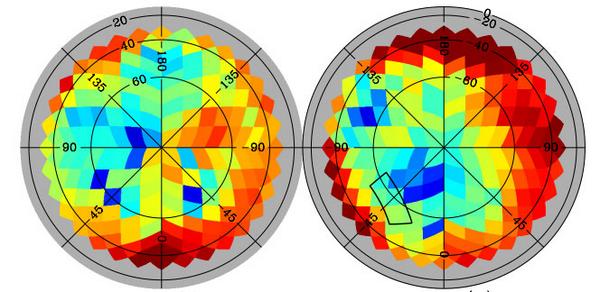
This discussion suggests that a confident detection of B-modes from primordial gravitational waves (if there is one to detect) may have to wait for a sensitive all-sky experiment, which would have to be done in space. On the other hand, Planck has identified some regions which appear to be significantly less contaminated than the BICEP2 field (which is outlined in black):

Quieter dust

Could it be possible to direct some of the ongoing ground- or balloon-based CMB polarization experiments towards the cleaner (dark blue area in the right-hand panel) just south of the BICEP2 field?

From a theorist’s perspective, I think this result means that all the models of the early Universe that we thought were dead because they couldn’t produce the high level of primordial gravitational waves detected by BICEP2 have no come back to life, and those that came to life to explain the BICEP2 result may soon be read the last rites if the signal turns out to be predominantly dust.

Another important thing that remains to be seen is the extent to which the extraordinary media hype surrounding the announcement back in March will affect the credibility of the BICEP2 team itself and indeed the cosmological community as a whole. On the one hand, there’s nothing wrong with what has happened from a scientific point of view: results get scrutinized, tested, and sometimes refuted.  To that extent all this episode demonstrates is that science works.  On the other hand most of this stuff usually goes on behind the scenes as far as the public are concerned. The BICEP2 team decided to announce their results by press conference before they had been subjected to proper peer review. I’m sure they made that decision because they were confident in their results, but it now looks like it may have backfired rather badly. I think the public needs to understand more about how science functions as a process, often very messily, but how much of this mess should be out in the open?


UPDATE: Here’s a piece by Jonathan Amos on the BBC Website about the story.

ANOTHER UPDATE: Here’s the Physics World take on the story.

ANOTHER OTHER UPDATE: A National Geographic story

Stokes V – The Lost Parameter

Posted in The Universe and Stuff with tags , , , , , , on August 27, 2014 by telescoper

Some years ago I went to a seminar on the design of an experiment to measure the polarization of the cosmic microwave background. At the end of the talk I asked what seemed to me to be an innocent question. The point of my question was the speaker had focussed entirely on measuring the intensity of the radiation (I) and the two Stokes Parameters that measure linear polarization of the radiation (usually called Q and U). How difficult, I asked, would it be to measure the remaining Stokes parameter V (which quantifies circular polarization)?

There was a sharp intake of breath among the audience and the speaker responded with a curt “the cosmic microwave background is not circularly polarized”. It is true that in the standard cosmological theory the microwave background is produced by Thomson scattering in the early Universe which produces partial linear polarization, so that Q and U are non-zero, but not circular polarization so V=0. However, I had really asked my question because I had an idea that it might be worth measuring V (or at least putting an upper limit on it) in order to assess the level of instrumental systematics (which are a serious issue with polarization measurements).

I was reminded of this episode when I saw a paper on the arXiv today by Asantha Cooray, Alessandro Melchiorri and Joe Silk which points out that the CMB may well have some level of circular polarization. When light travels through a region containing plasma and a magnetic field, circular polarization can be generated from linear polarization via a process called Faraday conversion. For this to happen, the polarization vector of the incident radiation (defined by the direction of its E-field) must have non-zero component along the local magnetic field, i.e. the B-field. Charged particles are free to move only along B, so the component of E parallel to B is absorbed and re-emitted by these charges, thus leading to phase difference between it and the component of E orthogonal to B and hence to the circular polarization. This is related to the perhaps more familiar process of Faraday rotation, which causes the plane of linear polarization to rotate when polarized radiation travels through a region containing a magnetic field.

Anyway, here is the abstract of the paper

The primordial anisotropies of the cosmic microwave background (CMB) are linearly polarized via Compton-scattering. The Faraday conversion process during the propagation of polarized CMB photons through regions of the large-scale structure containing magnetized relativistic plasma, such as galaxy clusters, will lead to a circularly polarized contribution. Though the resulting Stokes-V parameter is of order 10-9 at frequencies of 10 GHz, the contribution can potentially reach the total Stokes-U at low frequencies due to the cubic dependence on the wavelength. In future, the detection of circular polarization of CMB can be used as a potential probe of the physical properties associated with relativistic particle populations in large-scale structures.

It’s an interesting idea, but it’s hard for me to judge the feasibility of measuring a value of Stokes V as low as 10-9. Clearly it would only work at frequencies much lower than those probed by current CMB experiments such as BICEP2 (which operates at 150 GHz). Perhaps if the speaker had answered my question all those years ago I’d be in a better position to decide!

Published BICEP2 paper admits “Unquantifiable Uncertainty”..

Posted in Bad Statistics, The Universe and Stuff with tags , , , , , , on June 20, 2014 by telescoper

Just a quick post to pass on the news that the BICEP2 results that excited so much press coverage earlier this year have now been published in Physical Review Letters. A free PDF version of the piece can be found here.  The published version incorporates a couple of important caveats that have arisen since the original release of the results prior to peer review. In particular, in the abstract (discussing models of the dust foreground emission:

However, these models are not sufficiently constrained by external public data to exclude the possibility of dust emission bright enough to explain the entire excess signal. Cross correlating BICEP2 against 100 GHz maps from the BICEP1 experiment, the excess signal is confirmed with 3σ significance and its spectral index is found to be consistent with that of the CMB, disfavoring dust at 1.7 σ.

Since the primary question-mark over the original result was whether the signal was due to dust or CMB, this corresponds to an admission that the detection is really at very low significance. I’ll set aside my objection to the frequentist language used in this statement!

There is an interesting comment in the footnotes too:

In the preprint version of this paper an additional DDM2 model was included based on information taken from Planck conference talks. We noted the large uncertainties on this and the other dust models presented. In the Planck dust polarization paper [96] which has since appeared the maps have been masked to include only regions “where the systematic uncertainties are small, and where the dust signal dominates total emission.” This mask excludes our field. We have concluded the information used for the DDM2 model has unquantifiable uncertainty. We look forward to performing a cross-correlation analysis against the Planck 353 GHz polarized maps in a future publication.

The emphasis is mine. The phrase made me think of this:

hazards

The paper concludes:

More data are clearly required to resolve the situation. We note that cross-correlation of our maps with the Planck 353 GHz maps will be more powerful than use of those maps alone in our field. Additional data are also expected from many other experiments, including Keck Array observations at 100 GHz in the 2014 season.

In other words, what I’ve been saying from the outset.


Has BICEP2 bitten the dust?

Posted in The Universe and Stuff with tags , , , , , , , , , , on June 5, 2014 by telescoper

Time for yet another update on twists and turns of the ongoing saga of  BICEP2 and in particular the growing suspicion that the measurements could be accounted for by Galactic dust rather than primordial gravitational waves; see various posts on this blog.

First there is a Nature News and Views article by Paul Steinhardt with the title Big Bang blunder bursts the multiverse bubble. As the title suggests, this piece is pretty scathing about the whole affair, for two main reasons. The first is to do with the manner of the release of the result via a press conference before the results had been subjected to peer review. Steinhardt argues that future announcements of “discoveries” in this area

should be made after submission to journals and vetting by expert referees. If there must be a press conference, hopefully the scientific community and the media will demand that it is accompanied by a complete set of documents, including details of the systematic analysis and sufficient data to enable objective verification.

I also have reservations about the way the communication of this result was handled but I wouldn’t go as far as Steinhardt did. I think it’s quite clear that the BICEP2 team have detected something and that they published their findings in good faith. The fact that the media pushed the result as being a definitive detection of primordial gravitational waves wasn’t entirely their fault; most of the hype was probably down to other cosmologists (especially theorists) who got a bit over-excited.

It is true that if it turns out that the BICEP2 signal is due to dust rather than primordial gravitational waves then the cosmology community will have a certain amount of egg on its face. On the other hand, this is actually what happens in science all the time. If we scientists want the general public to understand better how science actually works we should not pretend that it is about absolute certainties but that it is a process, and because it is a process operated by human beings it is sometimes rather messy. The lesson to be learned is not about hiding the mess from the public but about communicating the uncertainties more accurately and more honestly.

Steinhardt’s other main point is one with which I disagree very strongly. Here is the core of his argument about inflation:

The common view is that it is a highly predictive theory. If that was the case and the detection of gravitational waves was the ‘smoking gun’ proof of inflation, one would think that non-detection means that the theory fails. Such is the nature of normal science. Yet some proponents of inflation who celebrated the BICEP2 announcement already insist that the theory is equally valid whether or not gravitational waves are detected. How is this possible?

The answer given by proponents is alarming: the inflationary paradigm is so flexible that it is immune to experimental and observational tests.

This is extremely disingenuous. There’s a real difference between a theory that is “immune to experimental and observational tests” and one which is just very difficult to test in that way. For a start, the failure of a given experiment to detect gravitational waves  does not prove that gravitational waves don’t exist at some level; a more sensitive experiment might be needed. More generally, the inflationary paradigm is not completely specified as a theory; it is a complex entity which contains a number of free parameters that can be adjusted in the light of empirical data. The same is also true, for example, of the standard model of particle physics. The presence of these adjustable degrees of freedom makes it much harder to test the hypothesis than would be the case if there were no such wiggle room. Normal science often proceeds via the progressive tightening of the theoretical slack until there is no more room for manoeuvre. This process can take some time.

Inflation will probably be very difficult to test, but then there’s no reason why we should expect a definitive theoretical understanding of the very early Universe to come easily to us. Indeed, there is almost certainly a limit to the extent that we can understand the Universe with “normal science” but I don’t think we’ve reached it yet. We need to be more patient. So what if we can’t test inflation with our current technology? That doesn’t mean that the idea is unscientific. It just means that the Universe is playing hard to get.

Steinhardt continues with an argument about the multiverse. He states that inflation

almost inevitably leads to a multiverse with an infinite number of bubbles, in which the cosmic and physical properties vary from bubble to bubble. The part of the multiverse that we observe corresponds to a piece of just one such bubble. Scanning over all possible bubbles in the multi­verse, every­thing that can physically happen does happen an infinite number of times. No experiment can rule out a theory that allows for all possible outcomes. Hence, the paradigm of inflation is unfalsifiable.

This may seem confusing given the hundreds of theoretical papers on the predictions of this or that inflationary model. What these papers typically fail to acknowledge is that they ignore the multiverse and that, even with this unjustified choice, there exists a spectrum of other models which produce all manner of diverse cosmological outcomes. Taking this into account, it is clear that the inflationary paradigm is fundamentally untestable, and hence scientifically meaningless.

I don’t accept the argument that “inflation almost inevitably leads to a multiverse” but even if you do the rest of the argument is false. Infinitely many outcomes may be possible, but are they equally probable? There is a well-defined Bayesian framework within which one could answer this question, with sufficient understanding of the underlying physics. I don’t think we know how to do this yet but that doesn’t mean that it can’t be done in principle.

For similar discussion of this issue see Ted Bunn’s Blog.

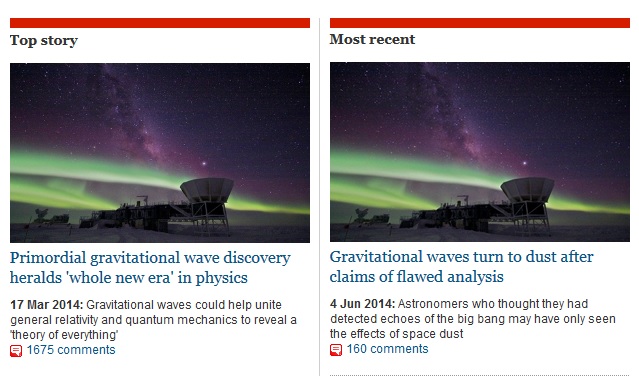
Steinhardt’s diatribe was accompanied  yesterday by a sceptical news piece in the Grauniad entitled Gravitational waves turn to dust after claims of flawed analysis. This piece is basically a rehash of the argument that the BICEP2 results may be accounted for by dust rather than primordial gravitational waves, which definitely a possibility, and that the BICEP2 analysis involved a fairly dubious analysis of the foregrounds. In my opinion it’s an unnecessarily aggressive piece, but mentioning it here gives me the excuse to post the following screen grab from the science section of today’s Guardian website:

BICEP_thenandnow

Aficionados of Private Eye will probably think of the Just Fancy That section!

Where do I stand? I can hear you all asking that question so I’ll make it clear that my view hasn’t really changed at all since March. I wouldn’t offer any more than even money on a bet that BICEP2 has detected primordial gravitational waves at all and I’d offer good odds that, if the detection does stand, the value of the tensor-to-scalar ratio is significantly lower than the value of 0.2 claimed by BICEP2.  In other words, I don’t know. Sometimes that’s the only really accurate statement a scientist can make.

BICEP2: The Dust Thickens…

Posted in The Universe and Stuff with tags , , , , , , on May 29, 2014 by telescoper

Off to a day-long staff training event today so just time to post a quick update on the BICEP2 saga (see various posts on this blog). There’s a new paper on the arXiv today by Flauger, Hill and Spergel. The first part of its rather lengthy abstract reads:

BICEP2 has reported the detection of a degree-scale B-mode polarization pattern in the Cosmic Microwave Background (CMB) and has interpreted the measurement as evidence for primordial gravitational waves. Motivated by the profound importance of the discovery of gravitational waves from the early Universe, we examine to what extent a combination of Galactic foregrounds and lensed E-modes could be responsible for the signal. We reanalyze the BICEP2 results and show that the 100×150 GHz and 150×150 GHz data are consistent with a cosmology with r=0.2 and negligible foregrounds, but also with a cosmology with r=0 and a significant dust polarization signal. We give independent estimates of the dust polarization signal in the BICEP2 region using four different approaches. While these approaches are consistent with each other, the expected amplitude of the dust polarization power spectrum remains uncertain by about a factor of three. The lower end of the prediction leaves room for a primordial contribution, but at the higher end the dust in combination with the standard CMB lensing signal could account for the BICEP2 observations, without requiring the existence of primordial gravitational waves. By measuring the cross-correlations between the pre-Planck templates used in the BICEP2 analysis and between different versions of a data-based template, we emphasize that cross-correlations between models are very sensitive to noise in the polarization angles and that measured cross-correlations are likely underestimates of the contribution of foregrounds to the map. These results suggest that BICEP1 and BICEP2 data alone cannot distinguish between foregrounds and a primordial gravitational wave signal, and that future Keck Array observations at 100 GHz and Planck observations at higher frequencies will be crucial to determine whether the signal is of primordial origin. (abridged)

The foreground analysis done in this paper seems to me to be much more convincing that that presented in the original BICEP2 paper and it confirms that the data as presented can not discriminate between B-modes arising from a polarized foreground component and from the presence of primordial gravitational waves. As I’ve said before (several times now), the press hype surrounding this discovery was a bit premature and we have to wait for observations at other frequencies before a clearer picture emerges through the dust.

UPDATE: A new Nature News and Views Article contains a strong statement by David Spergel to the effect that BICEP2 provides no evidence either for or against the existence of primordial gravitational waves.

The Cold Spot

Posted in Cosmic Anomalies, The Universe and Stuff with tags , , , , on August 16, 2009 by telescoper

Musing yesterday about the rapidly approaching restart of the academic year reminded me that I really ought to get on and finish the bunch of papers sitting on my desk and on various computers. I’ve also got a book to finish before October so I’d better get cracking with that too.

More importantly, however, it reminded me to congratulate my PhD student Rockhee Sung who has just had her first paper published (in the journal Classical and Quantum Gravity). The paper is available online here and it’s free to download for a month even if you don’t have a personal or institutional subscription to the journal.

The idea of this paper came a while ago but it has taken us a long time to get everything in place to start writing it up. In the meantime other papers have been written on the subject, but Rockhee and I have done this our own way – or rather she has, as she put most of the hard work into actually doing the calculations.

About four years ago, during the course of careful statistical analysis of data from the Wilkinson Microwave Anisotropy Probe (WMAP), a group based in Santander (Spain) published a paper drawing attention to the existence of an anomalous “Cold Spot” in the data. This phenomenon has now acquired its own Wikipedia entry (here), so I won’t repeat all the details except to say that it is about 5° across and that it is colder than one would expect if the temperature fluctuations are Gaussian, as is predicted in the simplest models of the early Universe involving cosmological inflation. The spot is to the bottom right, and is marked with an arrow on the picture below.

It’s worth digressing a little here to explain that a fluctuating field of course contains both hot spots and cold spots. Because there CMB temperature fluctuations comprise a wide range of wavelengths there are also spots on different scales. Assessing the statistical significance of a single isolated feature like the cold spot is not particularly easy. Based on the brute force method of simulating skies according to the Gaussian hypothesis and then repeating the approach that led to the original discovery, the result is that around 1% of Gaussian CMB skies have a cold spot as cold as that observed in the real data. Before the non-Bayesians among you get too excited, I’ll remind you that this means that the probability of a Cold spot given the standard model is about 1%, i.e. P(Cold Spot | Standard Model)=0.01. This is NOT the same as saying that the probability of the standard model being correct is 0.01…

A probability of 1% is an in-between kind of level: not too small to be decisive, and not too large to be instantly dismissed as just being a chance fluctuation. My personal opinion is that the Cold Spot is an interesting feature that deserves to be investigated further, but is not something that in itself should cause anyone to doubt the standard model. I include it among the list of cosmological anomalies that I’ve blogged about before (for example, here, here and here). I find them interesting but don’t lose sleep worrying that the standard model is about to fall to pieces. Not yet, anyway.

Not all theorists are as level-headed as me, however, and within weeks of the discovery of the cold spot suggestions were already being put forward as to how it could be “explained” theoretically. Some of these are described in the Wikipedia entry, so I won’t rehash the list. However, one suggestion not included there was the idea that the anomalous cold spot might be there because the Universe were not isotropic, i.e. if the Cosmological Principle were violated.

Way back when I was a lad doing my own PhD, my supervisor John Barrow had been interested in globally anisotropic (but nevertheless homogeneous) cosmologies. These are models in which any observer sees different things in different directions, but the pattern seen by observers in different places is always the same. I never worked on these at the time – they seemed a bit too esoteric even for me – but I remembered bits and pieces about them from conversations.

A complete classification of all the space-times  possessing this property was completed over a hundred years ago (before General Relativity was invented) by the Italian mathematician Luigi Bianchi, and cosmological models based on them are called the Bianchi models.

This isn’t the place to go into detail about the Bianchi models: the classification is based on the mathematical properties of Lie groups, which would take me ages to explain. However, it is worth pointing out that only five Bianchi types actually contain the cosmologically principled Friedmann-Lemaître-Robertson-Walker universe as a special case: I, V, VII0 ,VIIh and IX. If you really want to know what the classes are you’ll have to look them up! Since we know our Universe is very close to being homogeneous and isotropic, it seems reasonable to look at those models capable of describing small departures from that case so the above list provides a useful subset of the models to explore.

Rockhee’s PhD project was to explore  the patterns of cosmic microwave background  fluctuations that can arise in that set of Bianchi cosmologies, not just in the temperature (which had been done before) but also in polarization (which hadn’t). I’ve already posted some of the temperature patterns Rockhee computed here.

The reason for extending wanting to extend this work to include polarization was the following. The microwave background radiation is partly linearly polarized because of the way radiation is scattered by electrons. If an electron is immersed in a radiation bath which is isotropic there is no net polarization, but if the radiation field is anisotrpic – in particular if it varies on an angular scale of 90º (i.e. a quadrupole) – then the scattered radiation will be partly polarized. In the standard cosmology the variations in the radiation field are random fluctuations so each electron “sees” a different quadupole. The net polarization field is therefore produced incoherently, by adding stochastic contributions. In  a  Bianchi model the situation is different. Each electron in this case sees the same quadupole. The polarization pattern produced is therefore coherent. Not only do anisotropic universes produce characteristic radiation patterns, they also produce a corresponding pattern in polarization.

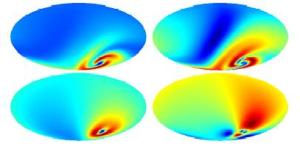
So what does this all have to do with the Cold Spot? Well, in anisotropic spaces that are also curved, it is possible for light rays to get focussed in such a way that the entire pattern of flucuations present at least-scattering winds up concentrated in a small patch of the sky as seen by a late-time observer. for this to happen the space has to be negatively curved. Only two of the Bianchi types can do this, as there are only two that are both near-FLRW and negatively curved: V and VIIh. Both of these models could, in principle, therefore produce a cold spot by geometrical, rather than stochastic means. In the little figure below, taken from our paper, you can see examples of Bianchi VIIh (top) and Bianchi V (bottom) showing the temperature (left) and polarization (right) in each case. We’ve oriented the model to put the cold spot in approximately the right location as the observed one.
 

cold


The point is that there is a pretty heavy price to be paid for producing the cold spot in this way: an enormous, coherent signal in the polarized radiation field.

As often happens in such situations, somebody else had the idea to investigate these models and we were scooped to a large extent by Andrew Pontzen and Anthony Challinor from Cambridge, who recently published a paper showing that the polarization produced in these models is already excluded by experimental upper limits. They concentrated on the Bianchi VIIh case, as this appears to have a more general structure than V and it was the model first advocated as an explanation of the cold spot. In this model the combined effect of vorticity and shear introduces a swirly pattern into the radiation field that you can see clearly in the top two panels of the figure as well as focussing it into a small patch. Bianchi V doesn’t produce the same kind of pattern either in temperature or polarization: it looks more like a simple quadrupole squeezed into a small part of the sky. A particularly interesting aspect of this is that the Bianchi VIIh case clearly has a definite “handedness” while the Bianchi V one doesn’t.

The moral of all this is that the polarization of the cosmic microwave background provides key additional information that could prove decisive in eliminating (or perhaps even confirming) models of the Universe more exotic than the standard one. That’s one of the areas in which  we expect Planck to produce the goods!

In the meantime Rockhee and I will be submitting a couple of much larger papers in due course, one containing a wider discussion of the possible pattern morphologies that can be produced in these models, and another about their detailed statistical properties.