Archive for Politics

Science Is Vital, So Don’t Let It Be Strangled.

Posted in Politics, Science Politics with tags , , on March 15, 2015 by telescoper

The General Election looming on the horizon could prove to be a watershed for scientific research in the United Kingdom. In the period immediately following the 2010 Election there was a great deal of nervousness about the possibility of huge cuts to spending on research. One of the most effective campaigns to persuade the new government against slashing funding for science on the grounds that scientific research was likely to be the principal fuel for any economic recovery was led by Science is Vital. I have written a few posts about this organisation.

The scientific community breathed a collective sigh of relief in autumn 2010 when the UK Government announced that research funding would be “ring-fenced” and maintained in cash terms for the duration of the Parliament. Things could have been far worse, as they have been in other parts of the public sector, but over the years the effect of inflation has been that this “flat cash” settlement involves a slow strangulation as opposed to a quick fall of the axe.

A recent piece in the Guardian includes this picture, which speaks for itself:

Science_spendingThe United Kingdom now spends less than 0.5% of its GDP on research, and this fraction is falling rapidly. We are now ranked last in the G8 by this criterion, way behind the USA and Germany. Why are we in this country so unbelievably miserly abou funding research? Other countries seem to recognize its important, so why can’t our politicians see it? We should be increasing our investment in science, not letting it wither away like this.

It seems to me that much more of this squeeze and we’ll be needing to close down major facilities and start withdrawing from important international collaborations. The Science and Technology Facilities Council (STFC) is particularly vulnerable, as such a large fraction of its budget is committed to long-term projects. It’s already trimmed funding for other activities to the bone, with research grants under particularly intense pressure. Will the ongoing Nurse Review of the Research Councils spell doom for STFC, as many of my colleagues think? Will be research funding  be transferred rom universities into research institutes?

Anyway, it seems an appropriate time to advertise the latest campaign from Science is Vital, which involves writing to candidates (including incumbent MPs) in your constituency to Tell Them That Science Is Vital. You might consider including some of the following, or others suggested by the website. If you’re a scientist, describe why your research is important. Here are some suggestions. If there is a local research institute in your constituency, explain how important it is to your local economy (how many people it employs, for example). If you’re a patient, or someone who cares for a patient, say how important you think research into that disease. Ask your candidate or MP to endorse the Science is Vital campaign to increase public funding of science to 0.8% of GDP. And if you do write, remember that the economic argument for investing research isn’t the only one…

Je Suis Charlatan

Posted in Politics with tags , , on January 21, 2015 by telescoper

This week’s Private Eye cover is spot-on about the hypocrisy of certain political leaders whose professed support free speech in France differs markedly from what goes on in their own country…

charlatan

Je Suis Charlie

Posted in Charlie Hebdo, Paris with tags on January 8, 2015 by telescoper

image

Wind versus Nuclear: The real story in pictures

Posted in Science Politics, The Universe and Stuff with tags , , , on November 5, 2014 by telescoper

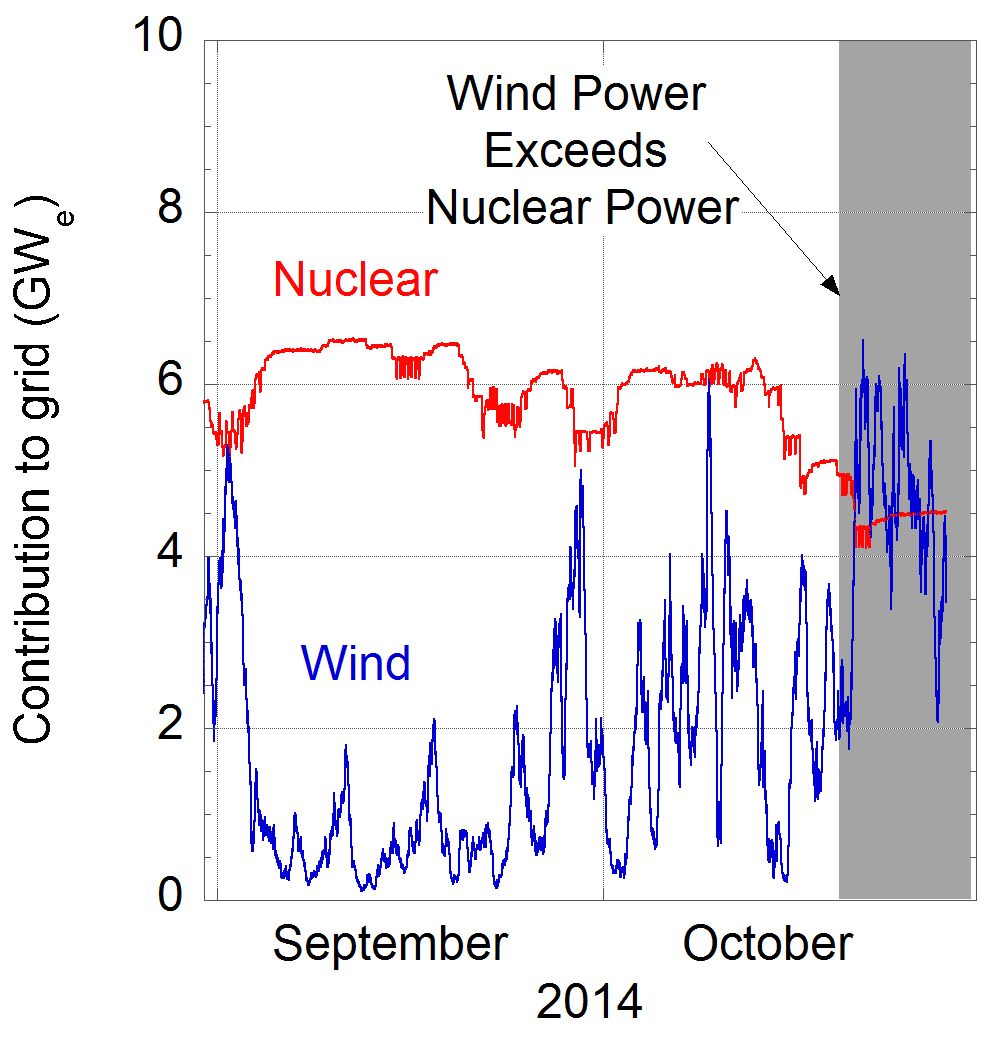
Here’s an interesting, balanced analysis of the statistics of wind power versus nuclear power in the UK over the past couple of months. There’s obviously room for more growth in renewable energy generation, but I still think we’ll need to increase nuclear capacity to provide a counter to the intermittent variability of wind power if we are to reduce our dependency on fossil fuels, which still produce most of the UK’s energy…

Michael de Podesta's avatarProtons for Breakfast

Graph showing the electricity generated by nuclear and wind power (in gigawatts) every 5 minutes for the months of September and October 2014. The grey area shows the period when wind power exceeded nuclear power. Graph showing the electricity generated by nuclear and wind power (in gigawatts) every 5 minutes for the months of September and October 2014. The grey area shows the period when wind power exceeded nuclear power. (Click Graph to enlarge)

For a few days in October 2014,  wind energy consistently generated more electricity in the UK than nuclear power. Wow!

You may have become aware of this through several news outlets. The event was reported on the BBC, but curiously the Daily Mail seems not to have noticed .

Alternatively, you may like me, have been watching live on Gridwatch – a web site that finally makes the data on electricity generation easily accessible.

I was curious about the context of this achievement and so I downloaded the historically archived data on electricity generation derived from coal, gas, nuclear and wind generation in the UK for the last three years. (Download Page)

And graphing the…

View original post 548 more words

The Athenian Option Revisited

Posted in Politics with tags , , , , on September 19, 2014 by telescoper

I have to admit that I didn’t stay up to watch the results come in from the referendum on Scottish independence, primarily because I knew I had a very busy morning ahead of me and needed an early night. Not eligible to vote myself I did toy with the option of having a bet on the outcome, but the odds on the “no” outcome I thought more likely were 9-1 on so hardly worth a flutter at all. The opinion polls may have had difficulty getting this one right, but I generally trust the bookies’ assessment.

Anyway, to summarize the outcome:

  • “No” obtained a mark of 55%, which corresponds to a solid II.2 with no need for resits.
  • “Yes” obtained a mark of 45%, which is a Third Class result, but may claim extenuating circumstances or request another attempt.

Sorry about that. I guess I’ve been doing too many examination boards these days…

On balance, I’m glad that Scotland voted “no” but I don’t think it would have been that much of a big deal in the long run had they decided otherwise. There might have been some short-term difficulties but we’d all have survived. In the end what matters is that this whole exercise was run democratically and the issue was settled by voting rather than fighting, which is what would have happened in the not-too-distant past.

The aftermath of the vote against Scottish secession has been dominated by talk of greater devolution of powers not only to Scotland but also to Wales and even the English regions. One striking thing about the referendum was the high turnout (by British standards) of around 85 per cent that contrasts strongly with the dismal rate of participation in, e.g.. the recent European elections. In the light of all this I thought I’d resurrect an idea I’ve blogged about before.

Some time ago I read a very interesting an provocative little book called The Athenian Option, which offers a radical vision of how to renew Britain’s democracy.

The context within which this book was written was the need to reform Britain’s unelected second chamber, the House of Lords. The authors of the book, Anthony Barnett and Peter Carty, were proposing a way to do this even before Tony Blair’s New Labour party came to power in 1997, promising to reform  the House of Lords in its manifesto. Despite being well into it’s third Parliament, New Labour hasn’t done much about it yet, and has even failed to offer any real proposals. Although it has removed voting rights from the hereditary peers, the result of this is that the House of Lords is still stuffed full of people appointed by the government.

The need for reform is now greater than ever. In reason times, we have seen dramatically increasing disillusionment with the political establishment, which has handed  out billions of pounds of tax payers’ money to the profligate banking sector causing a ballooning public debt, followed by savage cuts in public spending with consequent reductions in jobs and services.

Meanwhile, starting under New Labour, the culture of cronyism led to the creation of a myriad pointless quangos doing their best to strangle the entire country with red tape. Although Gordon Brown stated in 2004 that he was going to reduce  bureaucracy, the number of civil servants in the UK grew by about 12% (from 465,7000 to 522,930) between 2004 and 2009. If the amount of bureaucracy within the British university system is anything to go by, the burden of the constant processes of evaluation, assessment and justification is out of all proportion to what useful stuff actually gets done. This started in the Thatcher era with  Conservative governments who viewed the public services as a kind of enemy within, to be suspected, regulated and subdued. However, there’s no denying that it has got worse in recent years.

There is an even more sinister side to all this, in the steady erosion of civil liberties through increased clandestine surveillance, detention without trial and the rest of the paraphernalia of paranoid government. Big Brother isn’t as far off as we’d all like to think.

The furore over MP’s expenses led to further disgust with the behaviour of our elected representatives, many of whom seem to be more interested in lining their own pockets than in carrying out their duties as our elected representatives.

The fact is that the political establishment has become so remote from its original goal of serving the people that it is now regarded with near-total contempt by a large fraction of the population. Politics now primarily serves itself and, of course, big business. It needs to be forced to become more accountable to ordinary people. This is why I think the suggestion of radical reform along the lines suggested by Barnett and Carty is not only interesting, but something like it is absolutely essential if we are to survive as a democracy.

What they propose is to abolish the House of Lords as the Second Chamber, and replace it with a kind of jury selected by lottery from the population in much the same way that juries are selected for the crown courts except that they would be much larger, of order a thousand people or so.  This is called the Athenian Option because in ancient Athens all citizens could vote (although I should add that in ancient Athens there were about 5000 citizens and about 100,000 slaves, and women couldn’t vote even if they weren’t slaves, so the name isn’t at all that appropriate).

Selection of representatives from the electoral roll would be quite straightforward to achieve.  Service should be mandatory, but the composition of the Second Chamber could be refreshed sufficiently frequently that participation should not be too onerous for any individual. It may even be possible for the jury not to have to attend a physical `house’ anyway. They could vote by telephone or internet, although safeguards would be needed to prevent fraud or coercion. It would indeed probably be better if each member of the panel voted independently and in secret anyway.

The central body of government would continue to be a representative Parliament similar to the current House of Commons. The role of the jury would be  limited to voting on legislation sent to it by the House of Commons, which would continue to be elected by a General Election as it is at present. Laws passed by the Commons could not become law unless approved by the juries.

Turnout at British general elections has been falling steadily over the past two decades. Apathy has increased  because the parliamentary machine has become detached from its roots. If nothing is done to bring it back under popular control, extremist parties like the British National Party will thrive and the threat to our democracy will grow further.

The creation of regional assemblies in Wales, Scotland and Northern Ireland has not been as successful as it might have been because it has resulted not in more democracy, but in more politicians. The Welsh Assembly, for example, has little real power, but has fancy offices and big salaries for its members and we have it as well as Westminster and the local Councils.

We also have a European Parliament, again with very little real power but with its own stock of overpaid and self-important politicians elected by the tiny fraction of the electorate that bothers to vote.

My solution to this mess would be to disband the regional assemblies and create regional juries in their place. No legislation would be enacted in Wales unless passed by the Welsh jury, likewise elsewhere.

To be consistent, the replacement House of Lords should be an English jury, although perhaps there could be regional structures within England too. We would therefore have one representative house, The House of Commons, and regional juries for Wales, Scotland, England (possibly more than one) and Northern Ireland. This would create a much more symmetrical structure for the governance of the United Kingdom, putting an end to such idiocies as the West Lothian Question.

Of course many details would need to be worked out, but it seems to me that this proposal makes a lot of sense. It retains the political party system in the House of Commons where legislation would be debated and amended before being sent to the popular juries. The new system would, however, be vastly cheaper than our current system. It would be much fairer and more democratic. It would make the system of government more accountable, and it would give citizens a greater sense of participation in and responsibility for the United Kingdom’s political culture. Politics is too important to be left to politicians.

On the other hand, in order to set it up we would need entire sections of the current political structure to vote themselves out of existence. Since they’re doing very nicely out of the current arrangements, I think change is unlikely to be forthcoming through the usual channels. Turkeys won’t vote for Christmas.

Anyone care for a revolution?


Scotland Should Decide…

Posted in Bad Statistics, Politics, Science Politics with tags , , , , , , , , , on September 9, 2014 by telescoper

There being less than two weeks to go before the forthcoming referendum on Scottish independence, a subject on which I have so far refrained from commenting, I thought I would write something on it from the point of view of an English academic. I was finally persuaded to take the plunge because of incoming traffic to this blog from  pro-independence pieces here and here and a piece in Nature News on similar matters.

I’ll say at the outset that this is an issue for the Scots themselves to decide. I’m a believer in democracy and think that the wishes of the Scottish people as expressed through a referendum should be respected. I’m not qualified to express an opinion on the wider financial and political implications so I’ll just comment on the implications for science research, which is directly relevant to at least some of the readers of this blog. What would happen to UK research if Scotland were to vote yes?

Before going on I’ll just point out that the latest opinion poll by Yougov puts the “Yes” (i.e. pro-independence) vote ahead of “No” at 51%-49%. As the sample size for this survey was only just over a thousand, it has a margin of error of ±3%. On that basis I’d call the race neck-and-neck to within the resolution of the survey statistics. It does annoy me that pollsters never bother to state their margin of error in press released. Nevertheless, the current picture is a lot closer than it looked just a month ago, which is interesting in itself, as it is not clear to me as an outsider why it has changed so dramatically and so quickly.

Anyway, according to a Guardian piece not long ago.

Scientists and academics in Scotland would lose access to billions of pounds in grants and the UK’s world-leading research programmes if it became independent, the Westminster government has warned.

David Willetts, the UK science minister, said Scottish universities were “thriving” because of the UK’s generous and highly integrated system for funding scientific research, winning far more funding per head than the UK average.

Unveiling a new UK government paper on the impact of independence on scientific research, Willetts said that despite its size the UK was second only to the United States for the quality of its research.

“We do great things as a single, integrated system and a single integrated brings with it great strengths,” he said.

Overall spending on scientific research and development in Scottish universities from government, charitable and industry sources was more than £950m in 2011, giving a per capita spend of £180 compared to just £112 per head across the UK as a whole.

It is indeed notable that Scottish universities outperform those in the rest of the United Kingdom when it comes to research, but it always struck me that using this as an argument against independence is difficult to sustain. In fact it’s rather similar to the argument that the UK does well out of European funding schemes so that is a good argument for remaining in the European Union. The point is that, whether or not a given country benefits from the funding system, it still has to do so by following an agenda that isn’t necessarily its own. Scotland benefits from UK Research Council funding, but their priorities are set by the Westminster government, just as the European Research Council sets (sometimes rather bizarre) policies for its schemes. Who’s to say that Scotland wouldn’t do even better than it does currently by taking control of its own research funding rather than forcing its institutions to pander to Whitehall?

It’s also interesting to look at the flipside of this argument. If Scotland were to become independent, would the “billions” of research funding it would lose (according to the statement by Willetts, who is no longer the Minister in charge) benefit science in what’s left of the United Kingdom? There are many in England and Wales who think the existing research budget is already spread far too thinly and who would welcome an increase south of the border. If this did happen you could argue that, from a very narrow perspective, Scottish independence would be good for science in the rest of what is now the United Kingdom, but that depends on how much the Westminster government sets the science budget.

This all depends on how research funding would be redistributed if and when Scotland secedes from the Union, which could be done in various ways. The simplest would be for Scotland to withdraw from RCUK entirely. Because of the greater effectiveness of Scottish universities at winning funding compared to the rest of the UK, Scotland would have to spend more per capita to maintain its current level of resource, which is why many Scottish academics will be voting “no”. On the other hand, it has been suggested (by the “yes” campaign) that Scotland could buy back from its own revenue into RCUK at the current effective per capita rate  and thus maintain its present infrastructure and research expenditure at no extra cost. This, to me, sounds like wanting to have your cake and eat it,  and it’s by no means obvious that Westminster could or should agree to such a deal. All the soundings I have taken suggest that an independent Scotland should expect no such generosity, and will get actually zilch from the RCUK.

If full separation is the way head, science in Scotland would be heading into uncharted waters. Among the questions that would need to be answered are:

  •  what will happen to RCUK funded facilities and staff currently situated in Scotland, such as those at the UKATC?
  •  would Scottish researchers lose access to facilities located in England, Wales or Northern Ireland?
  •  would Scotland have to pay its own subscriptions to CERN, ESA and ESO?

These are complicated issues to resolve and there’s no question that a lengthy process of negotiation would be needed to resolved them. In the meantime, why should RCUK risk investing further funds in programmes and facilities that may end up outside the UK (or what remains of it)? This is a recipe for planning blight on an enormous scale.

And then there’s the issue of EU membership. Would Scotland be allowed to join the EU immediately on independence? If not, what would happen to EU funded research?

I’m not saying these things will necessarily work out badly in the long run for Scotland, but they are certainly questions I’d want to have answered before I were convinced to vote “yes”. I don’t have a vote so my opinion shouldn’t count for very much, but I wonder if there are any readers of this blog from across the Border who feel like expressing an opinion?


NATO Cardiff: is this what democracy looks like?

Posted in Politics with tags , , , , on August 29, 2014 by telescoper

I’m off to Cardiff this evening, and hope at some point over the weekend to take some pictures of the monstrous barrier described in this post by Keith Flett that has been put up all around town. One of the most important points about this month-long fiasco is that there was no consultation whatsoever with the people of Cardiff before the decision was taken to waste such a vast amount of money. No doubt that’s because if there had been a consultation the response would have been overwhelmingly negative. Who will be held to account? My guess is “nobody”…

kmflett's avatarKmflett's Blog

Nato Cardiff: is this what democracy looks like?
I live in North London and central Cardiff something that seems to surprise some of my social media followers but is explained by the nature of my job as a union officer and the fact that my partner happens to live in Cardiff…

Next week on 4/5th September there is a Nato Summit meeting, not in Cardiff but at the Celtic Manor hotel outside Newport on the M4.

I’m no fan of Nato. It contains the word ‘treaty’ in its name and history suggests that treaties are an excellent way of starting wars. In addition it appears to be run largely by people who have more than a passing similarity to Dr Strangelove. Of course its opponents are mostly unlovely as well.

Anyway if you are going to have a Nato summit and lots of, at the least, self styled statesmen [&…

View original post 371 more words

What Nigel Farage did not say on beards

Posted in Beards, Politics with tags , , , on May 26, 2014 by telescoper

In the aftermath of yesterday’s European election results, the great political question of the day is where precisely does UKIP stand on facial hair?

kmflett's avatarKmflett's Blog

What Nigel Farage did not say on beards

UKIP leader Nigel Farage who is perpetually clean shaven is very probably a pogonophobe although as the equally perpetually hirsute Michael Rosen has pointed out to me, UKIP has some supporters with beards.

Accuracy on matters UKIP is not easy to achieve. The party itself is an unreliable guide and the BBC guided by the follicly challenged Nick Robinson isn’t much better.

However at the end of the week which saw a supposed quote from Farage about Muslims and beards to the effect that either the beard went or the wearer did and that beards should be no more than two inches in length achieve wide currency, a small attempt at accuracy can surely do no harm.

There is no absolute proof that Farage did not make these remarks. He has not denied them despite opportunities to do so

It is however…

View original post 198 more words

The Royal Observatory Bomb and the Rise of Unreason

Posted in History, Literature, Politics, Science Politics with tags , , , , , , , , , , on February 16, 2014 by telescoper

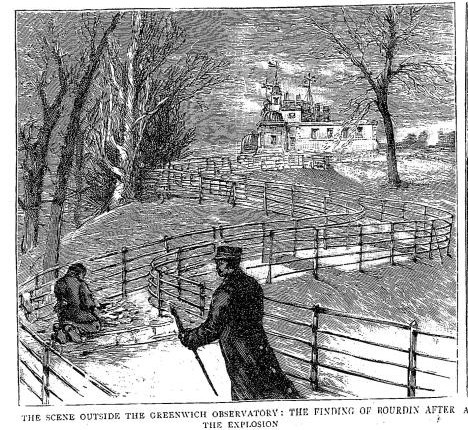
I missed the anniversary by a day but I thought I’d pass on a fascinating but very sad little bit of history. One hundred and twenty years ago yesterday, on February 15th 1894, a 26-year old Frenchman by the name of Martial Bourdin blew himself up near the Royal Observatory in Greenwich. His death seems to have been an accident caused by the bomb he was carrying going off prematurely. It is not really known either whether the bomb was meant for the Royal Observatory or somewhere else. Anarchist attacks involving bombs were not uncommon in the 1890s and the range of targets was very wide.

Greenwich_Observatory_Bomb

Bourdin was found alive, though very seriously injured, by people who heard the blast. Though able to speak he did not offer any explanation for what had happened. He died about half an hour later.

This sad and perplexing story inspired Joseph Conrad‘s famous novel The Secret Agent. Conrad added an “Author’s Note” to the manuscript of his book:

The attempt to blow up the Greenwich Observatory: a blood-stained inanity of so fatuous a kind that is is impossible to fathom its origin by any reasonable or even unreasonable process of thought. For perverse unreason has its own logical processes. But that outrage could not be laid hold of mentally in any sort of way, so that one remained faced by the fact of a man blown to pieces for nothing even most remotely resembling an idea, anarchistic or other. As to the outer wall of the Observatory, it did not show as much as the faintest crack.

We’ll never know what Bourdin’s motivations were; perhaps he didn’t really know himself. He is usually described as an “anarchist” although that term describes such a wide spectrum of political beliefs that it doesn’t really explain Bourdin’s actions; not all anarchists embrace violence and aggression, for example, although some – such as the members of Class War – clearly do. At one end of the anarchist spectrum there are the violent thugs who are nothing more than the mirror image of fascism and at the other there are reasonable intelligent people who simply don’t believe in hierarchical structures.

Brighton has its share of anarchists and the thing that’s most noticeable about them to an outsider like me is their conformity; the dress code is apparently very strictly enforced. The obvious irony aside, this suggests to me that much of the attraction of being an anarchist is not really the existence of a compelling political philosophy, but simply to fulfill the need to belong to something.

The main thing that occurred to me yesterday while I was reading about the Greenwich Observatory bomb plot concerns the implications of the location. If the Royal Observatory was the intended target then why was it so? The simple answer is that a core belief for most varieties of anarchist is their opposition to “the State”. A powerful symbol of the British state in 1894 was the Royal Navy; it was Britain’s maritime traditions that led to the founding of the Royal Observatory in the first place and most of the work carried out there involved accurate positional measurements designed to help with navigation. Or maybe it was to do with the role of the Observatory in defining the time? Insofar as acts like this make any sense at all, these seem reasonable interpretations. 

I’m tempted to suggest that the adoption of Greenwich as the Prime Meridian in 1884 may have given a young Frenchman additional grounds for resentment..

A different answer from the suggestion that it was an anti-establishment gesture stems from  the conflict between anarchism and the nature of scientific knowledge. Anarchists usually express their beliefs in terms of the desire to make society more “equal” and “democratic”, so that decisions should be made collectively for the common good. I’m happy with that line of argument, and agree that we should all enjoy equal rights versus the government and other institutions, and in relation to one another. However, having equal rights does not mean having equal knowledge and it doesn’t mean that any person’s opinion about anything is as good as anyone else’s. What I mean is that there are scientific experts, and the knowledge they possess has demonstrable value.

The approach of some to this challenge is simply to deny the value of scientific knowledge, and assert instead that it’s just a social construct like anything else. I am aware of a number of so-called social scientists at the University of Sussex and elsewhere who hold this view; my usual response is to ask them whether they regard witchcraft or crystal healing as equal to orthodox medicine.

CLARIFICATION: Please note I do not mean to imply that all social scientists hold the opinions described above. I’m fully aware that they are fringe views. The phrase “so-called social scientists” does not refer to all social scientists, just the fringe in much the same way I’d use “so-called geographers” to describe the Flat Earth Society.

I’m not trying to suggest that members of the Department of Sociology are plotting to blow up the Astronomy Centre! What I do think that while we should always strive to be as democratic as possible there are always limits, not just because of what is practically possible but also what is socially desirable. Any organization in which everyone votes about every decision that has to be made would struggle to function at all. We have to find ways of working that make best use of the different skills and knowledge we all possess.

A constructive approach is to argue that if we are to build  a more democratic society it is first necessary to greatly increase the level of scientific literacy in the population, so that more people can make informed decisions about the big issues facing the future, such as how we fulfill our energy requirements for the next 30 years and how we cope with global warming. That will not be an easy thing to do given the dearth of scientists in Parliament and in the media, but that’s not an argument for not trying.

Symptomatic of the widespread rejection of science among the politically disaffected is the lamentable state of Green politics in the United Kingdom. In my opinion there is huge potential for a scientifically-informed political movement focussed on environmental issues. Unfortunately the current Green Party is anti-science to the core, which would doom it to perpetual marginalization even without the loss of credibility stemming from the childish antics of the only Green MP, Caroline Lucas. I know that many will argue with me about whether the Green Party should be included in “The Left”, but since both Labour and Conservative parties now belong to the Centre-Right it seems a sensible classification to me.

It hasn’t always been like this. As Alice Rose Bell pointed out in a Guardian piece some time ago, there have been examples of constructive engagement between science and left-wing politics. This seems to me to have largely evaporated. I don’t think that’s so much because scientists have rejected the left. It’s more that the left has rejected science.

Would Scottish Independence be Good for English Science?

Posted in Politics, Science Politics with tags , , , , on November 13, 2013 by telescoper

On Monday the Minister for Universities and Science, David Willetts, visited Edinburgh where he took in, among other things, the UK Astronomy Technology Centre and was treated to an explanation of how adaptive optics work. There being less than a year to go before the forthcoming referendum on Scottish independence, the visit was always likely to generate political discussion and this turned out to be the case.

According to a Guardian piece

Scientists and academics in Scotland would lose access to billions of pounds in grants and the UK’s world-leading research programmes if it became independent, the Westminster government has warned.

David Willetts, the UK science minister, said Scottish universities were “thriving” because of the UK’s generous and highly integrated system for funding scientific research, winning far more funding per head than the UK average.

Unveiling a new UK government paper on the impact of independence on scientific research, Willetts said that despite its size the UK was second only to the United States for the quality of its research.

“We do great things as a single, integrated system and a single integrated brings with it great strengths,” he said.

Overall spending on scientific research and development in Scottish universities from government, charitable and industry sources was more than £950m in 2011, giving a per capita spend of £180 compared to just £112 per head across the UK as a whole.

It is indeed notable that Scottish universities outperform those in the rest of the United Kingdom when it comes to research, but it always struck me that using this as an argument against independence is difficult to sustain. In fact it’s rather similar to the argument that the UK does well out of European funding schemes so that is a good argument for remaining in the European Union. The point is that, whether or not a given country benefits from the funding system, it still has to do so by following an agenda that isn’t necessarily its own. Scotland benefits from UK Research Council funding, but their priorities are set by the Westminster government, just as the European Research Council sets (sometimes rather bizarre) policies for its schemes. Who’s to say that Scotland wouldn’t do even better than it does currently by taking control of its own research funding rather than forcing its institutions to pander to Whitehall?

It’s also interesting to look at the flipside of this argument. If Scotland were to become independent, would the “billions” of research funding it would lose (according to Willetts) benefit science in what’s left of the United Kingdom? There are many in England and Wales who think the existing research budget is already spread far too thinly and who would welcome an increase south of the border. If this did happen you could argue that, from a very narrow perspective, Scottish independence would be good for English science.

For what it’s worth, I am a complete agnostic about Scottish independence – I really think its for the Scots to decide – but I don’t think it would benefit the rest of the UK from the point of view of science funding. I think it’s much more likely that if Scotland were to leave the United Kingdom then the part of the science budget it currently receives would be cancelled rather than redistributed, which would leave us no better off at all.