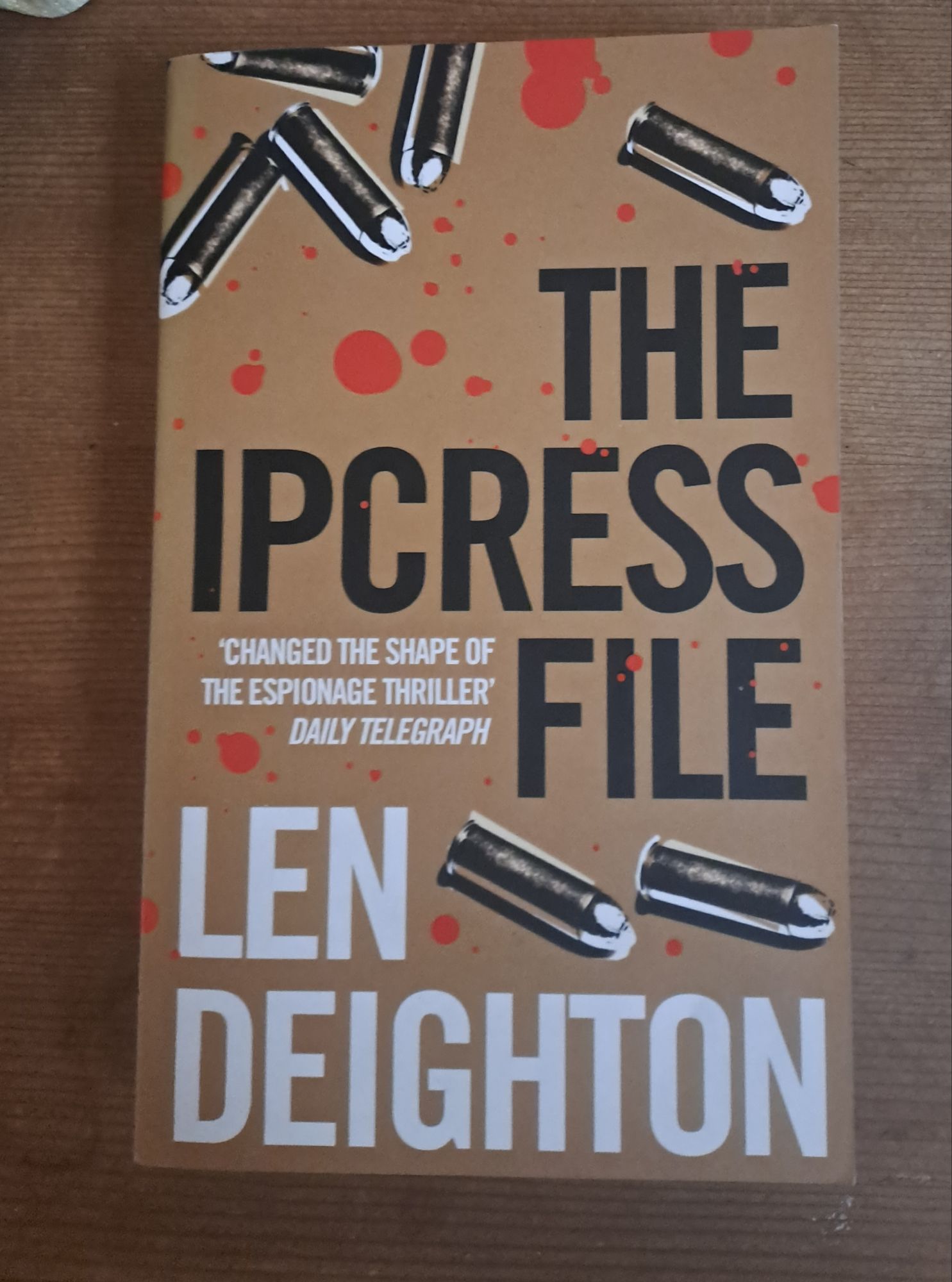
With all the excitement yesterday I missed the news that novelist Len Deighton had passed away (at the age of 97). I learnt from his obituary that he began his career as an illustrator and cartoonist, but he is far more famous as an excellent writer, especially of spy stories. The IPCRESS File (left) is one of my favourite novels in this genre.
It’s superbly written in a very down-to-earth fashion, and as a result far more credible than the more famous James Bond stories of Ian Fleming. In my opinion Deighton was a far better writer than Fleming. The IPCRESS File was in fact, Deighton’s first espionage novel, written in 1962, and the first appearance of Harry Palmer. Deighton was roughly contemporary with John le Carré though the characters of Harry Palmer and George Smiley could hardly be more different!
I found the copy shown above on my shelves and must read it again. Funeral in Berlin is another cracker, but I can’t find my copy. I probably lent it to someone and never got it back…
I am very late passing this sad news on, but I only just heard of the death (on 28th December 2024, at the age of 90) of Sverre Aarseth, who spent almost all of his research career at the Institute of Astronomy in Cambridge. Sverre was a pioneer in the use of N-body numerical techniques for solving gravitational problems and whose work had enormous impact across many aspects of astrophysics and cosmology, not least because he made his codes available as “open source”. I suspect many of us have used an “Aarseth code” at some point in our careers! I only met him a few times, but he struck me as a friendly and self-effacing man. He was certainly never someone who tried to hog the limelight but he was held in a very high regard across the research community.
It is my sad duty to pass on the news that Professor Peter Clegg, formerly of Queen Mary University of London, passed away last Friday, 22nd March 2024.
Peter Clegg was an expert in observational and instrumental aspects of infrared astronomy. He was in the School of Physics at Queen Mary when I was in the School of Mathematical Sciences and I got to know him through the MSc in Astronomy that the two Schools delivered jointly, and latterly through the RAS Club. He was well known to colleagues in the Astronomy Instrumentation Group at Cardiff, many of whom worked for some time at Queen Mary.
I understand that Peter had been ill for some months, and that he passed away peacefully in his sleep. The funeral is to be on 12th April. Please contact me privately for details if you knew Peter and would like to attend.
I just read the terrible news of the death at the age of 79 of yet another icon of Welsh Rugby Union, the legendary standoff Barry John.
Five years ago I posted an item about Barry John inspired by this clip
The opening part of this clip had caught my attention because it was filmed near the bus stop just outside The Halfway, a pub on Cathedral Road just a few yards from the house in Cardiff in which I lived for many years; in the background you can see Llandaff Fields.
I had often wondered what became of Barry John. He was 74 when I wrote about him and no longer the slim young prodigy who was undoubtedly the best rugby player I ever saw. Since he played in a great era for Welsh rugby that included Gareth Edwards, J.P.R. Williams, Gerald Davies et al, that really says something. As the Guardian obituary aptly puts it, he “played Rugby from another world”.
As a sort of rugby equivalent of George Best, Barry John was incredibly famous during his career. Budding rugby players – even those not born in Wales – all wanted to play like Barry John. But suddenly, at the age of just 27, after playing just 25 internationals, he turned his back on all the publicity and adulation and retired from rugby. He found the pressure of being such a star in the amateur era too difficult to cope with.
So was Barry John really that good? Absolutely yes, he was. Slight of build but with superb balance, he had an extraordinary, almost magical, ability to find his way through a crowd of potential tacklers as if they weren’t there at all. In the memorable words of that great commentator Bill McLaren “he flits like a little phantom”. But you don’t need to take my word for it. Just look at him – and some other giants of the time – in these highlights of the classic Scotland-Wales tie in the Five Nations of 1971. Watch about 30 seconds in, where he wrong-foots half the Scottish three-quarter line before ghosting through three more and releasing the ball to his forwards. Will there ever be another Barry John? I doubt it..
I’m sure there are many of us who remember the excitement of watching Barry John play and feel enriched by what he gave us.
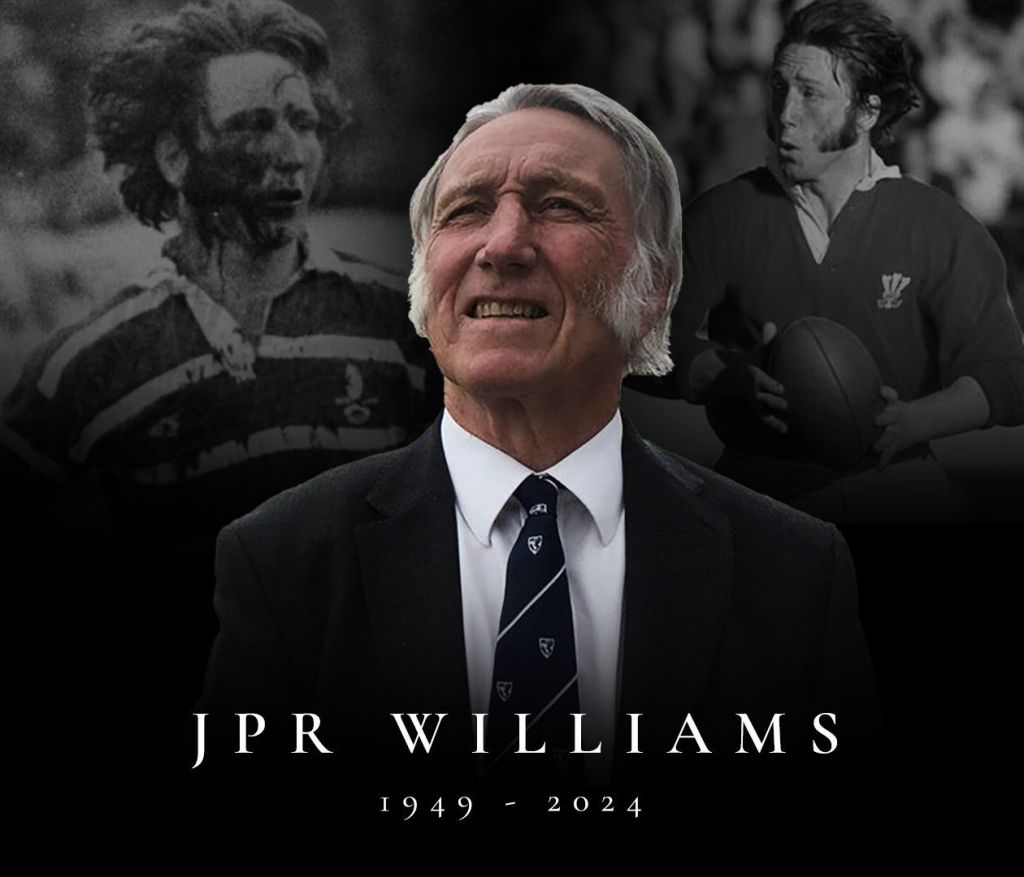
A cold and miserable day in Cardiff yesterday got even sadder when news came out of the death of Welsh rugby legend John Peter Rhys Williams known universally as “JPR” after the winger John James Williams (another great player), joined the national team and became “JJ”. JPR was one of the superb players who dominated Welsh rugby in the 1970s; he stood out even in such exalted company. In my opinion JPR is was the greatest full-back ever.
JPR was instantly recognizable on the field: tall and craggy, with characteristic long hair, prominent sideburns, socks always rolled down around his ankles, he was an imposing figure whether patrolling the defensive lines or stepping up to join the attack. In the famous 1973 match in Cardiff between The Barbarians and New Zealand he was described by commentator Cliff Morgan as “a man who never shirks his responsibility”. Just watch the memorable opening try where you’ll see JPR in the thick of the action, twice shrugging off dangerous tackles around his neck, the second time receiving the ball from Phil Bennett to start the passing move from deep inside his own half.
Many people forget that the man himself scored a great try in that game too:
As a full-back, JPR was often the last line of defence. Sometimes, tidying up after a kick from the opposition, he would clear his lines by kicking. More often, though, he would spot a weakness and go charging forward, ball in hand, not afraid to run straight at the opposition. He was quick to spot gaps in his own defence too, rushing to provide cover, often with last-ditch try-saving tackles.
As good as he was at turning defence into attack, he was even better when his side were already in control. Here are two tries he scored for Wales against England in 1976 that demonstrate his superb positional sense in attack as well as his sheer physical strength.
(Wales achieved a Grand Slam in 1976; England got the Wooden Spoon.)
JPR was a tough, aggressive and uncompromising man on the field – players certainly knew when he’d tackled them! – but a gentleman off it, and held in a very high regard throughout the rugby world and beyond. His loss is immeasurable. One by one the legends are leaving us. The world is poorer without them.
Rest in peace, J.P.R. Williams (1949-2024)
P.S. When living in Cardiff years ago I had the pleasure of meeting and talking with two Welsh rugby legends, Gerald Davies and Phil Bennett (the former at a function, the latter at a book-signing). Both were charmingly modest men. I never really met JPR properly but I remember vividly stepping out of my house in Pontcanna on a Six Nations match day and finding myself face-to-face with him in the street. He must have been around 60 then and was still the same imposing figure he was in the 1970s. I recognized him immediately. I wanted to say something and perhaps even shake his hand, but I was too star-struck.
P.P.S. JPR was a fully-qualified orthopaedic surgeon and a Fellow of the Royal College of Surgeons. This is a reminder that back in the 1970s, Rugby Union was still an amateur game.
The views presented here are personal and not necessarily those of my employer (or anyone else for that matter).
Feel free to comment on any of the posts on this blog but comments may be moderated; anonymous comments and any considered by me to be vexatious and/or abusive and/or defamatory will not be accepted. I do not necessarily endorse, support, sanction, encourage, verify or agree with the opinions or statements of any information or other content in the comments on this site and do not in any way guarantee their accuracy or reliability.


 In the Dark