I saw an interesting news item this morning reporting that at one point last Sunday about 87% of Germany’s energy needs were supplied by renewable sources. The circumstances that led to this were relatively short-lived, but it is interesting nevertheless. I keep an eye on the UK’s national grid statistics from time to time and it rarely exceeds 20% in the form of renewables.
Anyway, all that reminded me of this, which appeared in the Guardian a couple of weeks weeks ago. It’s the last interview recorded by David Mackay before his untimely death from cancer in April. He’s characteristically direct in pointing out that the idea that the UK could be powered entirely by renewable energy is not at all practicable.
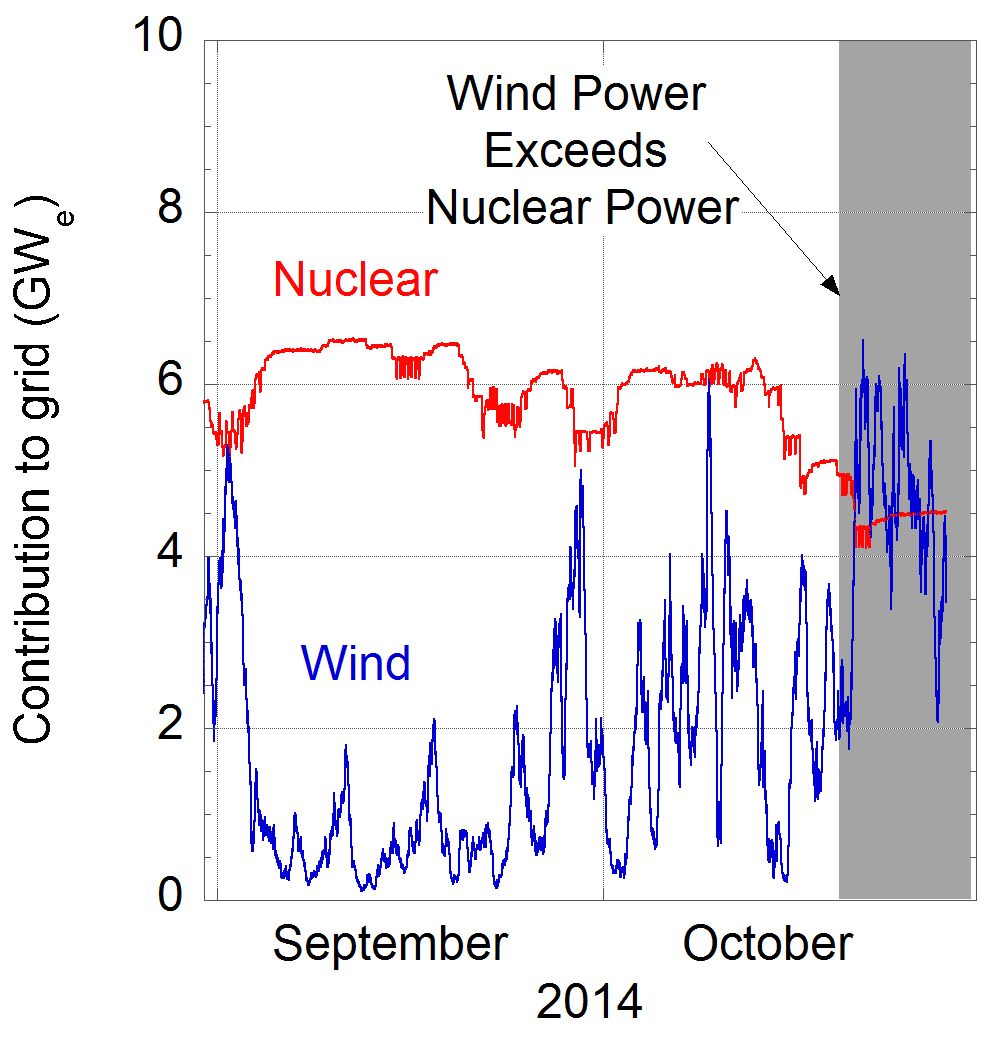
Here’s an interesting, balanced analysis of the statistics of wind power versus nuclear power in the UK over the past couple of months. There’s obviously room for more growth in renewable energy generation, but I still think we’ll need to increase nuclear capacity to provide a counter to the intermittent variability of wind power if we are to reduce our dependency on fossil fuels, which still produce most of the UK’s energy…
Graph showing the electricity generated by nuclear and wind power (in gigawatts) every 5 minutes for the months of September and October 2014. The grey area shows the period when wind power exceeded nuclear power. (Click Graph to enlarge)
For a few days in October 2014, wind energy consistently generated more electricity in the UK than nuclear power. Wow!
Alternatively, you may like me, have been watching live on Gridwatch – a web site that finally makes the data on electricity generation easily accessible.
I was curious about the context of this achievement and so I downloaded the historically archived data on electricity generation derived from coal, gas, nuclear and wind generation in the UK for the last three years. (Download Page)
Since it’s a Bank Holiday – and a fine and sunny one at that – I’ll restrict myself to a brief post today so I can return to the outside part of the Universe and get a bit of sun while it lasts.
I saw an article in the Observer yesterday about the proposed High Speed 2 rail link (`HS2′) between London and the Midlands. The budget for this project has risen to a whopping £42.6 billion pounds. Another article in today’s Grauniad argues that HS2 is `certainly not for northerners’ benefit’, which is clearly the case because according to current plans it only goes as far as Leeds, which as everyone knows, is in the Midlands. But the real point is that I find it extraordinary that we are even considering investing such a staggering sum in a new railway with few obvious benefits to anyone other than the lucky company that gets the contract to build it. In the mean time our existing railways will continue to be poorly maintained, shockingly unreliable and of course excruciatingly expensive.
Thinking about the cost of HS2, which had earlier been estimated at a mere £30 billion, reminded me of an old post about renewable energy, and specifically the proposed Severn Barrage, which has an estimated cost somewhere between £10 billion and £35 billlion, but which could generate 2GW average power from tidal energy extracted from plain old H2O, which is about 6% of the UK’s average demand. Of course there are important environmental issues to be dealt with – no form of electricity generation is free from such concerns – and the power generated by a Severn Barrage would be variable, with peaks not necessarily coinciding with peak demand. At least the variation is predictable, though, which is more than can be said for wind power…
Anyway, let’s suppose for the sake of argument that the price tags on these two projects are both £30 billion. I’d be interested in knowing how many people think, as I do, that £30 billion invested in tidal energy generation would be a far better use of funds than a fast train from London to nowhere interesting.
The views presented here are personal and not necessarily those of my employer (or anyone else for that matter).
Feel free to comment on any of the posts on this blog but comments may be moderated; anonymous comments and any considered by me to be vexatious and/or abusive and/or defamatory will not be accepted. I do not necessarily endorse, support, sanction, encourage, verify or agree with the opinions or statements of any information or other content in the comments on this site and do not in any way guarantee their accuracy or reliability.


 In the Dark