Today provides me with an occasion for a short post in a very irregular series marking the momentous events that unfolded seventy years ago.
At 1000 hours on 24th March 1945, nine battalions of the 6th British Airborne Division together with six from 17th US Airborne Division began landing on the German (east) side of the River Rhine, near Wesel. This was the last mass parachute and glider assault of the Second World War, and was designed to pierce the final great physical barrier to a ground advance into Nazi Germany. It was codenamed Operation Varsity.
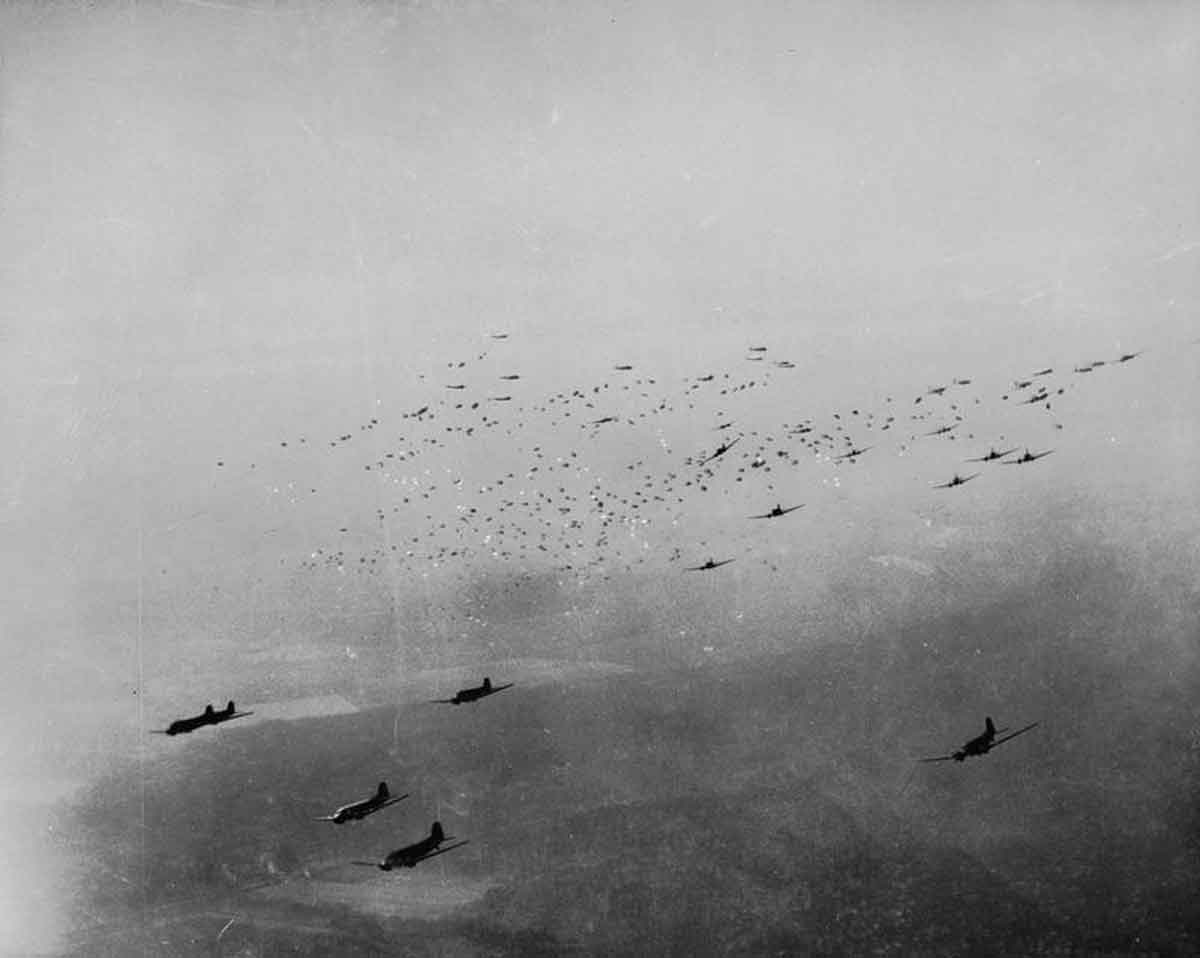
The airborne troops were given the task of seizing and holding high ground overlooking a stretch of the Rhine which was to be crossed by elements of the British 21st Army Group, which included the British Second Army. The airborneassault involved 540 aircraft towing 1300 gliders into heavy anti-aircraft fire, so casualties during the first phase of the operation were heavy. However, within six hours of the commencement of the operation, all objectives were taken and the airborne troops subsequently linked up with ground forces who had crossed the river in assault boats in what was known as Operation Plunder.
This was all a part of a coordinated series of airborne and amphibious attacks by British, Canadian and American forces that began overnight on 23rd March 1945 and went on during the morning of 24th March 1945. The Applied troops, crossing the River Rhine in large numbers and beginning a rapid advance into Germany. By 27 March, they had established a bridgehead 35 miles (56 km) wide and 20 miles (32 km) deep.
Following the link-up with the ground troops, the 6th Airborne led a 300 mile advance through Germany, marching approximately 11 miles per day until they managed to capture enough enemy transport. Second Army reached the Weser on 4 April, the Elbe on 19 April, the shore of the Baltic Sea at Lübeck on 2 May. On 3 May, Hamburg capitulated. By 7 May the Soviet Army had met up with the British forces at the Baltic port of Wismar.
I mention this because one of the troops that crossed the Rhine the British Second Army that day was a new recruit, a young man by the name of Richard Shaw, my mother’s brother. He took part in the subsequent advance through Germany and spent most of the year after the end of the Second World War stationed in Hamburg. He died just a few years ago, after a fall in his home, at the age of 85.
Lest we forget.
Follow @telescoper
 In the Dark