Archive for Richard Ellis

Galaxies and Black Holes in the First Billion Years

Posted in Biographical, The Universe and Stuff with tags , , , , , on September 1, 2025 by telescoper

Trying to catch up on recent developments in galaxy formation? I can heartily recommend an excellent review article on the subject by Richard Ellis which you can find on the arXiv here. The abstract reads:

 I present written notes from three lectures given at the 54th Saas-Fee Advanced Course of the Swiss Society of Astrophysics and Astronomy in January 2025 entitled “Galaxies and Black Holes in the First Billion Years as seen by the JWST”. I focused my lectures on progress in studies of cosmic reionisation, the properties of galaxies in the reionisation era, topics related to the redshift frontier and the search for Population III stars. The lectures were given to graduate students in astrophysics and cover both pedagogical material as well as observational results from the first two and half years of JWST science operations. The pace of discovery with JWST is, of course, rapid and so my lectures discuss long-term goals, analysis methods and their assumptions and limitations in the hope that the underlying material will retain value in the near future. In this written version, the visual material is that presented at Saas-Fee in January 2025 but I have provided updates on progress from the literature up to August 2025. The material is aimed at early career researchers and should not be considered as a scholarly review of the entire JWST literature on high redshift galaxies.

It’s quite a long article (65 pages) but nicely written and well worth reading, as it is full of information about recent advances as well as historical insights. Talking of which, there’s a picture on page 41 taken at a meeting in Durham in 1988 called The Epoch of Galaxy Formation that I attended while I was still a graduate student:

Richard Ellis himself is in the front row, left of centre with light-coloured trousers, checked shirt and hands in pockets. I’m in the picture too, but I’ll leave it up to you to find me!

A poll was held among the delegates at that meeting about various questions to do with galaxy formation. The majority opinions revealed by these votes nearly all turned out to be utterly wrong! That’s progress, I guess…
The Gruber Prize for Cosmology 2023: Richard Ellis

Posted in Biographical, The Universe and Stuff with tags , , on April 13, 2023 by telescoper
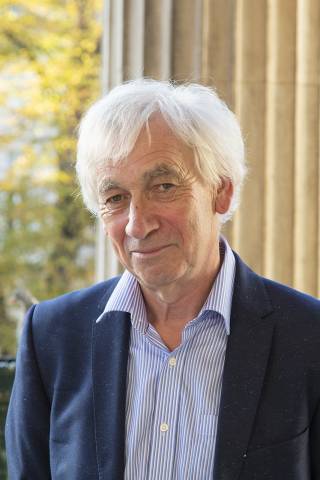
Professor Richard Ellis

I’m delighted to be able to convey the news that the 2023 Gruber Prize for Cosmology has been awarded to Richard Ellis. Heartiest congratulations to him! The official announcement reads:

Over the past five decades Richard Ellis’s innovations have reimagined cosmology in fundamental ways. His observations have pushed the cosmic horizon—how far across the universe we can see—to a period close to the development of the first galaxies. Meanwhile the instruments he conceived, then shepherded through development and execution, have transformed myriad astronomical methodologies.

The full citation is here:

The Gruber Foundation is pleased to present the 2023 Cosmology Prize to Richard Ellis for his numerous contributions in the fields of galaxy evolution, the onset of cosmic dawn and reionization in the high redshift universe, and the detection of the earliest galaxies via the Hubble Ultra Deep Field study. 

Richard Ellis has also driven several frontier instrumental developments in optical astronomy, especially the use of multi-object spectroscopy to study many galaxies in the same field of view.  These included the “autofib” instrument, the “2dF” facility on the Anglo-Australian Telescope, which led to the discovery of baryon acoustic oscillations, the “LDSS” on the Herschel Telescope, which studied the redshifts of faint galaxies, and the “PFS” currently under commissioning on the Subaru Telescope to study dark matter and dark energy.

There’s a lot more information and biographical material in the full press release here.

If I can add just a couple of personal comments. Way back in 1985, when I was about to start my PhD DPhil, I attended an SERC summer school for new research students held in Durham. The lectures on Observational Cosmology at that school were delivered by Richard Ellis. I still have the notes, in fact. In many ways, this was my first encounter with modern cosmology. Quite few things have changed since then of course, but it was a formative experience. One thing I particularly remember is his discussion of the Hubble constant controversy:

 You will see that there were two main estimates, one low and one high, both about three sigma away from the currently-favoured value of around 70. Plus ça change, plus c’est la même chose…

The second comment is that Richard was the external member on the panel that awarded me my first Chair position way back in 1998. Gosh. Was that really 25 years ago? Still, it goes to show that even an eminent scientist such as Richard can sometimes make an error of judgement!

Hubble Tension in Perspective

Posted in The Universe and Stuff with tags , , , on May 18, 2020 by telescoper

In my office today for the first time in a couple of months I stumbled across a folder containing the notes from the summer school for new Astronomy PhD students I attended in Durham in 1985. Yes, that’s thirty five years ago..

Among the lectures was a set given by Richard Ellis on Observational Cosmology from which I’ve taken this little snippet about the Hubble Constant:

It’s not only a trip down memory lane but also up the cosmological distance ladder! You will see that there were two main estimates, one low and one high. Both turned out to be about three sigma away from the currently-favoured value of around 70.

Plus ça change, plus c’est la même chose…

Does this change your mind about today’s tension between another pair of “low” (67) and “high” (73) values?

Astronomy Look-alikes, No. 16

Posted in Astronomy Lookalikes with tags , on February 15, 2010 by telescoper

I read with great interest a recent story that Geoff Hoon MP is planning to stand down at the next election. No doubt he took this decision in order to avoid the embarassment of losing his seat by popular vote. Perhaps he took his lead from his double, astronomer Richard Ellis, who also recently jumped ship from his Chair at Oxford in order to return to Caltech?

Richard Ellis

Geoff Hoon