Archive for Royal Astronomical Society

Astrostatistics at NAM

Posted in The Universe and Stuff with tags , , , on March 22, 2011 by telescoper

I’m using the opportunity of my enforced layoff to remind astronomers that this year’s forthcoming Royal Astronomical Society National Astronomy Meeting, incorporating the MIST and UKSP meetings, will be taking place at the splendid Venue Cymru conference centre, Llandudno, North Wales, from Sunday 17 April to Thursday 21 April.

The period for egistration has been extended , and you can now also submit abstracts of either oral or poster presentations to be considered for inclusion in the various sessions described in the science programme.

I’m organising a session on Recent Developments in Astro-statistics. I haven’t exactly been overwhelmed with offers to speak and there are still one or two slots available, so if you’d like to give a talk in that session please register and upload an abstract to the website. You can’t do the latter until you have done the former. Astro-statistics will be interpreted widely, so I hope to have a varied programme including as many applications of statistics to astronomy and astrophysics as I can get!

NAM is a particularly good opportunity for younger researchers – PhD students and postdocs – to present their work to a big audience so I particularly encourage such persons to submit abstracts. Would more senior readers please pass this message on to anyone they think might want to give a talk?

If you have any questions please feel free to use the comments box (or contact me privately).

Oh, and I should have mentioned that Andrew Jaffe is also touting for trade for the cosmology sessions he’s organising…


Share/Bookmark

NAM 2011

Posted in The Universe and Stuff with tags , , , , on January 20, 2011 by telescoper

Just a quick post to plug this year’s forthcoming Royal Astronomical Society National Astronomy Meeting, incorporating the MIST and UKSP meetings, which will be taking place at the splendid Venue Cymru conference centre, Llandudno, North Wales, from Sunday 17 April to Thursday 21 April.

Registration is now open, and you can now also submit abstracts of either oral or poster presentations to be considered for inclusion in the various sessions described in the science programme.

I’ve been asked to organise a small part of this meeting, namely a session on Recent Developments in Astro-statistics, so if you’d like to give a talk in that session please register and upload an abstract to the website. You can’t do the latter until you have done the former. Astro-statistics will be interpreted widely, so I hope to have a varied programme including as many applications of statistics to astronomy and astrophysics as I can get!

NAM is a particularly good opportunity for younger researchers – PhD students and postdocs – to present their work to a big audience so I particularly encourage such persons to submit abstracts. Would more senior readers please pass this message on to anyone they think might want to give a talk?

If you have any questions please feel free to use the comments box (or contact me privately).


Share/Bookmark

The Travellers and the Rest

Posted in Biographical with tags , , , , , , , , , , on January 15, 2011 by telescoper

Yesterday’s journey to the Big Smoke wasn’t as bad as it might have been, although it was a bit frustrating at times. The train was diverted through Bath to avoid flooding near Bristol, which added about 20 minutes to the journey time. That was expected, so didn’t cause any major anxiety. After the rather scenic detour we found ourselves back in familiar territory on the Cardiff-London line, Swindon. I never thought I’d see the day when I was pleased to arrive at Swindon! However, my pleasure soon evaporated when we sat on the platform at Swindon without moving, and with no announcements or information or explanation, for another 15 minutes. Obviously 25 minutes late just wasn’t late enough for First Great Western, so they had to hold the train to enhance further their record of unpunctuality. In the end we arrived at Paddington 40 minutes late. Not good.

I still got to the meeting in time for a quick cup of tea before the afternoon’s proceedings. Straight away there was some great news. The President of the RAS, Prof. Roger Davies, announced the recipients of this year’s medals and awards and among them was Cardiff’s own Matt Griffin, who receives the Jackson-Gwilt Medal.  According to the RAS website

The Jackson-Gwilt Medal is available for award annually for the invention, improvement or development of astronomical instrumentation or techniques; for achievement in observational astronomy; or for achievement in research in the history of astronomy.

Matt Griffin’s citation reads as follows:

This year’s winner is Professor Matt Griffin of the University of Cardiff, for his work on instrumentation for astronomy in the submillimetre waveband, the region of the electromagnetic spectrum between the far-infrared and microwave wavebands.

Matt Griffin is one of a select group of scientists that helped establish a UK lead in the technical development of instrumentation for submillimetre astronomy. He has been involved in most submillimetre instrument projects over the last three decades, including the Spectral and Photometric Imaging Receiver (SPIRE) camera on Herschel. Matt led a diverse international team to bring this project to fruition, encompassing 18 institutions on three different continents.

SPIRE represents a step change in capability. With the ground-based SCUBA camera, 20 nights of observing led to the detection of 5 galaxies at submillimetre wavelengths. With SPIRE, 6000 galaxies can be detected in 8 hours.

Matt Griffin thus receives the Jackson-Gwilt Medal for in particular his outstandingly successful work on SPIRE, an instrument that is transforming submillimetre astronomy.

Heartiest congratulations to Matt and, of course, to the rest of this year’s awardees!

After the RAS meeting it was time for dinner. Owing to a muddle with bookings The Athenaeum wasn’t available for this month’s RAS Club dinner so we dined instead in the unfamiliar surroundings of The Travellers Club, which is actually next door at 106 Pall Mall.Given the trials and tribulations of travelling with First Great Western, perhaps I should apply for honorary membership?

The room we had was smaller than usual, but cosy, and the staff were very friendly. The dinner wasn’t marvellous but as always there was no shortage of interesting conversation, some of it even relating to astronomy! I got grilled by a few people about what’s going on with STFC new consolidated grants system. I told everyone who asked everything I know about it, which didn’t break any confidentiality because I don’t know anything at all.

The table service was a bit slower than at the Athenaeum so it was quite late by the time we got onto the club business. The January dinner is the “Parish” dinner at which new members and, if necessary, new officers are elected by an amusingly arcane process. A few members had to leave  to catch trains before the business was completed but I stayed to the end at about 10.00pm,  placing (perhaps unjustified) confidence in  the 10.45 train from Paddington actually existing and getting there in time to get it.

I did get to Paddington in good time, and the train hadn’t been cancelled, but it was a bit late leaving.  It then apparently developed an unspecified “mechanical fault” which made for slow running. I got into Cardiff about 25 minutes late. No diversions on the way back – presumably the floods had subsided. Perhaps there’s an excuse for the chaos ensuing from the floods, but poor maintenance is surely entirely the fault of the train company.  Not a good day for First Great Western, especially when they’ve raised their already exorbitant fares for the new year..

Oh, and one other thing that’s not at all connected with anything else. As I walked back through Sophia Gardens from the station to my house in Pontcanna about quarter to two in the morning, I saw a fox hurtling across the path in front of me then vanishing into the trees. When I lived in Beeston (a suburb of Nottingham) I saw foxes very regularly, often in my own garden. Likewise even when I lived in Bethnal Green, in the East End of London. I was  quite surprised when I moved to my house in Cardiff, right next to Pontcanna Fields and Bute Park, that no foxes were to be seen despite the apparently more promising surroundings. I’ve now lived here for two and a half years and this is the first one I’ve ever spotted. I wonder why there are so few foxes in this area?


Share/Bookmark

Flooding into London

Posted in Biographical with tags , , , , , , on January 14, 2011 by telescoper

A brave bunch of hardy Cardiff  University astronomers are heading into London today for a meeting of the Royal Astronimical Society in London which celebrates the first year of science from the Herschel Space Observatory. This wouldn’t normally constitute too arduous a trip, but it turns out after the last couple of days torrential rain in Wales and the South-West of England, there is flooding on the line at Sodding Chipbury Chipping Sodbury which has sent the railway network into one of its regular episodes of chaos. Half the trains from Cardiff to London are cancelled, and the other half diverted all round the houses so they will take at least an extra half-hour to reach their destination at Paddington.

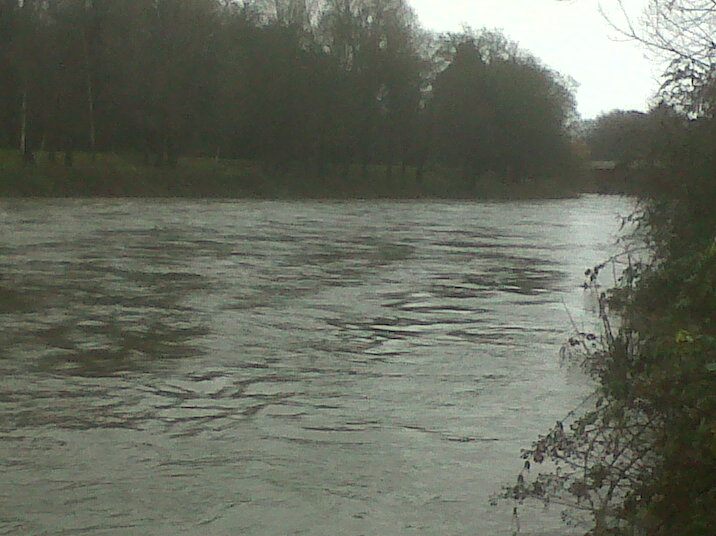
There isn’t any flooding actually in Cardiff, but the River Taff, which hibernated peacefully through the recent snowy period, has now sprung back into life and seems to be in an angry mood. I took these snaps yesterday as I walked into work, so you can see the water level is high enough to submerge some of the riverside shrubs and trees, but not high enough (yet) to threaten the embankments.

At times like this the Taff is more than a little scary, not so much because of the way it looks but because of the sound of it growling along down to Cardiff Bay, carrying the occasional car tyre and traffic cone with it.

I suppose this is small potatoes compared to the terrible floods in Australia, Brazil and elsewhere in the world, but it is quite exasperating, especially since it happens so regularly yet still catches the train companies completely unawares.

Anyway, I don’t know if the first wave of Cardiff folk managed to get to London in time for the start of the meeting. I had a couple of things to do this morning so decided to go later, even though that meant missing some of the talks that are closer to my own interests. I did think about cancelling my trip entirely, but decided in the end to give it a go. I hope I make it there at least in time for dinner at the RAS Club.

But then there’s the question of what time I’ll get  home tonight…


Share/Bookmark

Astronomy Look-alikes, No. 24

Posted in Astronomy Lookalikes with tags , , , on May 19, 2010 by telescoper

In view of the recent installation of Professor Roger Davies as the new President of the Royal Astronomical Society, I feel obliged to do him the honour of adding to my collection of look-alikes. How about Mr Mackey from South Park?

Ash Thursday

Posted in Science Politics with tags , , on April 15, 2010 by telescoper

I couldn’t resist putting up a quick post about the bizarre circumstances that have seen all airports closed and planes grounded all around Britain,  and the  skies emptied of aircraft.  The eruption of a volcano in a part of Iceland called Eyjafjallajoekull – there will be a pronunciation test at the end – has led to considerable plume of ash being thrown up into the atmosphere. Prevailing winds being roughly south-easterly in direction, part of this cloud has been heading towards mainland Britain.

You can see the cloud as the dark brown and black region on the following satellite image taken early this morning.

Apparently the ash contained in this cloud poses a significant danger to aircraft engines, so the UK Air Traffic Control system decided during the course of today to close UK airspace to all incoming and outgoing flights. Cue travel chaos.

It is anticipated that the ash will affect all of Britain by about 1800 GMT (i.e. 1900 British Summer Time) . It will dissipate as it spreads but of course as long as the eruption continues more ash will be pumped into the air.

One of the events disrupted by this display of vulcanism is the UK National Astronomy Meeting currently taking place in Glasgow. Many UK participants travelled to this meeting by plane and some of them are stuck there now because their return flights are not flying. NAM usually tends to be the sort of thing that senior academics tend to attend for only a day or two because the specialist sessions are quite brief and there are so many other things to do.

Today (Thursday) there was meant to be a Panel meeting organized by the Royal Astronomical Society at which members of the Science and Technology Facilities Council Executive, among others, were supposed to face questions from the assembled throng of astronomers. UK Astronomy has been under a dark threatening cloud for quite a while already, even before the Icelandic volcano did its thing.

However, the panel discussion was drastically curtailed by some not being able to make it to Glasgow and others having to leave early in order to get the train because their planes had been cancelled. In fact, according to what I’ve gleaned from the extensive Twitter traffic (from #NAM2010), John Womersley (Director of Science Programmes at STFC) was basically holding the fort in the absence of the other pundits. He seems to have come in for quite a lot of flak from younger scientists, particularly those whose careers have been wrecked by decisions made by the STFC Executive. I suspect those unable to make it are probably not ungrateful at being presented with an excuse for their absence.

Fellow blogger Andrew Jaffe was commendably prescient in deciding well in advance to return to London from Glasgow by train rather than plane. That’s the kind of  decision many people live to regret given the legendary unreliability of our train network, but this time it certainly paid off.

Not so many Cardiff astronomers went to NAM this year – the reason being that we are back to teaching while most other UK universities are still in their Easter break. However, those Cardiff staff and students who have gone there face more than a few problems getting back!

The meeting is scheduled to end tomorrow but it’s very unclear whether the skies will be open by then. We might have a few cancelled lectures if the situation doesn’t improve quickly…

In the Bleak Midwinter

Posted in Biographical, Cricket, Poetry, Science Politics with tags , , , , , , on January 9, 2010 by telescoper

Apologies for my posts being a bit thin lately. It turned out to be quite a strange week, as I’ll explain in due course, but I thought I’d take the opportunity now to catch up a little bit. I apologize in advance for the rambling nature of this contribution, but if you read this blog regularly you’ll be used to that.

We’re all now back at work after the Christmas break, but this was always going to be an unusual week because it’s the last one before the mid-year examinations start. During this time there are revision lectures, but the timetable isn’t as full as in term-time proper, so  it’s more like a half-way house than a genuine return to full-time work. Although I’m always glad not to be thrown into full-time teaching or examination marking straight away after the break, I always find this hiatus slightly disorienting.

This year things are even stranger than usual because, after largely escaping the bad weather that has affected the rest of the country since before Christmas, snow and ice finally arrived with a vengeance in Cardiff on Tuesday night. It wasn’t too bad where I live, quite near the city centre, but a lot of snow fell up in rural areas, especially up in the valleys, with the result that quite a few members of staff couldn’t make it into work.

Talking of the weather gives me the excuse to include this absolutely beautiful picture of snow-bound Britain taken by NASA’s Earth Observatory satellite:

The problem wasn’t so much the snow itself, but the fact that the temperature dropped steeply soon after it fell leaving roads and pavements coated with sheets of ice. My regular refuse collection, scheduled for Wednesday, didn’t happen because the trucks couldn’t make it through the treacherous conditions, and buses and trains were severely disrupted. I think there’s been a similar picture across most of the United Kingdom.

Incidentally, the well-known Christmas carol from which I took the title of this post began life as a poem by Christina Rossetti, the first verse of which goes

In the bleak mid-winter
Frosty wind made moan,
Earth stood hard as iron,
Water like a stone;
Snow had fallen, snow on snow,
Snow on snow,
In the bleak mid-winter
Long ago.

I don’t know why but, as the snow was falling heavily in the early hours of Wednesday morning, I woke up with terrible stomach pains, so bad that they kept me awake all night. I assume that this was some sort of belated reaction to yuletide over- indulgence rather than anything more serious because the discomfort eventually died away and I was left with mere exhaustion after losing a whole night’s sleep. Rather than risk walking in through the snow, I retreated to bed and slept most of Wednesday although I didn’t eat or drink anything the whole day.

Columbo kept me good company during this unpleasant episode. Usually if we’re in the house at the same time he sometimes stays by my side, but he’s at other times quite happy to potter around, or sleep on his own in  a place of his choosing.  I think he knew something wasn’t right, because he never left me alone all day which is quite unusual. Alternatively, he may just have found it warmer being next to me than elsewhere. Who knows?

My guts apparently having recovered, I went into the department on Thursday for a busy day of project interviews. These are held half-way through the third year in order to assess the students progress on their projects. In between the interviews I was trying to keep up with progress on the last day of the test match between South Africa and England taking place in Cape Town, where the weather was somewhat different to Cardiff. The match had been coming to the boil, eventually ending in a draw as England’s last pair once again staved off what looked likely to be a defeat. Shades of Monty last summer! Although it was clearly a gripping finale, I’m glad in a way that I didn’t get to follow it more closely. I always get an uneasy churning feeling in my stomach during tense passages of play, and after what had happened the day before I think that was best avoided.

Yesterday (Friday) was the date of the January meeting of the Royal Astronomical Society in London, and I decided to show my faith in the public transport system by making the round trip to London.  No-one can accuse me of having lost my spirit of adventure! Some trains had been cancelled, but those still running seemed to be on time and I thought the odds weren’t too bad.

The specialist Discussion Meeting featured a programme dedicated to the legacy of XMM, a highly successful X-ray satellite that has just had its funding axed by STFC. Later on, during the Ordinary Meeting there was an interesting talk by Alan Fitzsimmons about the impact of a small asteroid with the Earth that took place in October 2008,  and Matt Griffin presented some of the stunning new results from Herschel. RAS Discussion meetings are always held on the 2nd Friday of the month. Astronomical historian Alan Chapman reminded the Society that the corresponding meeting 80 years ago, on 10th January 1930,  was an important event in the development of the theory of the expanding universe.

Fully recovered from my tummy problems, I rounded the week off with a trip to the RAS Club for a nice dinner at the Athenaeum. Turnout was a bit lower than usual, presumably because of the inclement weather. This was the so-called Parish Meeting, at which various items of Club business are carried out, including the election of new members and Club officers. Professor Donald Lynden-Bell recently announced his retirement from the position of President and this was his last occasion in the Chair; the resulting Presidential Election was a close-run affair won by Professor Dame Carole Jordan. The election of new members is an archaic and slightly dotty process which always leaves me wondering how I managed to get elected myself. At one point during these proceedings the Club finds itself to be “without Officers”,  whereupon the most junior member (by length of membership rather than age) suddenly becomes important. On this occasion, this turned out to be me but since I didn’t know what I was supposed to do, I fluffed it. If I’d known I might have seized the opportunity to stage a coup d’etat. Other than this, it seemed to go off without any major hitches and eventually we dispersed into the freezing night to make our ways home.

As usual on Club nights I took the 10.45pm train from Paddington to Cardiff. In the prevailing meteorological circumstances I was a bit nervous about getting home, but my fears were groundless. The train was warm and, with Ipod, Guardian and Private Eye crosswords, and the last 100 pages of a novel to occupy me, the journey was remarkably pleasant. We got to Cardiff 4 minutes ahead of schedule.

Chinese Puzzles

Posted in Uncategorized with tags , , on February 17, 2009 by telescoper

On Friday 13th February I made one of my sporadic trips to London to go to the Royal Astronomical Society monthly meeting, catch up with friends, and dine at the Athenaeum with the RAS Club. That also gave me the excuse to stay in London over Valentine’s day and go with an old friend to the Opera followed by dinner in Chinatown on Saturday night.

As it happens, the RAS meeting also had a taste of the Orient about it because there were two absolutely fascinating talks about the Dunhuang Star Chart. This is a paper scroll found amongst many thousand similar objects squirrelled away by Buddhist monks in a tomb which was then subsequently bricked up and painted over. It lay undisturbed for a thousand years until rediscovered and basically plundered by treasure hunters, adventurers and archaeologists and its contents dispersed around the globe.

The Dunhuang Star Chart thus found its way to the British Library in London where it has recently been the subject of a special study involving both historians and astronomers. You can see this huge and very ancient sky map in full online here.

I had read about this sky map before in some book about the history of astronomy, but I hadn’t realised that its date had recently been re-evaluated to put it not in the 10th century (as I had previously believed), but in the middle of the 7th centur,  possibly as early as 640 AD. Moreover, recent quite convincing mathematical analysis has shown that the chart is not just made of freehand sketches but was produced with some mathematical precision using a form of cylindrical projection. Once again, we find the Chinese were well in advance of their western counterparts in terms of scientific knowledge.

So why were these scrolls hidden away? There are two theories. One is that the monks were concerned about imminent invasion from the west and they simply wanted to safeguard their knowledge until it could be reclaimed. Unfortunately it never was. The other theory is based on the fact that astronomical knowledge was highly classified in this period of Chinese imperial rule, the Tang Dynasty. The astrological clues contained in star charts could be used to cast doubt on the Emperor if they fell into the wrong hands, so were  forbidden to all but the inner court. Astronomy was Top Secret. The monks at Dunhuang may have hidden their papers because they shouldn’t have had them in the first place, and feared the wrath of the Emperor if they  were discovered by the Imperial heavies.

I find mysterious artefacts like this absolutely fascinating and they also strengthen my conviction that astronomy and archaeology have much in common. Both are observational rather than experimental sciences, and both rely on making inferences based on indirect and sometimes scanty clues. Perhaps its this that makes both disciplines prone to a few flights of fancy every now and again as well as posing puzzles which perhaps will never be solved.

Anyway, topping the bill at the RAS was the President, Andy Fabian, whose Presidential Address was entitled Black Holes at Work. Unfortunately,  the thing that didn’t work was the data projector so we had an embarassing delay while people rushed around trying to fix it. One of the charms of the RAS is that it never seems to be quite at the forefront of  technology. Anyway, once he got going the talk was very interesting. He was short of time at the end, though, so I didn’t have time to ask the  obligatory question about magnetic fields.

Then it was down to the Atheneaum and a nice dinner and rather a lot to drink.

The following evening after the Opera we went for dinner in Chinatown in Soho. The chilly West End streets were crowded, with what I originally assumed to be Valentine dates but which appeared instead to be mainly standard tourists taking advantage of the weak pound. Many restaurants were completely full, but eventually we found a table in a good place and all was well.

Coming back to Cardiff the following day I bought the Observer so I could do the crosswords on the train, and was reminded of the Azed competition crossword a couple of weeks ago which involved a quotation from a poem about St Valentine’s day by Coventry Padmore. It was quite a strange puzzle of a type called “Letters Latent” in which the cryptic part referred to the answer minus one or more letters.  The quote concerned was

Well dost thou, Love, thy solemn Feast to hold
In vestal February;

the poem is trying to make the point that wintry February is  a good time for St Valentine’s day as during spring and summer nobody needs to be reminded about the birds and the bees.

The task for competition entrants was to clue the word “vestal” in such a way that the definition referred to the whole word but the cryptic part omitted the s. My attempt was

Volatile components make this oil extra virgin

(The components of volatile give oil+vetal; virgin is the definition for vestal.)

Since I’ve now meandered far off the original subject, I think I’d better finish there!

Lost in the City

Posted in Biographical, Poetry with tags , , on November 17, 2008 by telescoper

The second Friday of the month is the day of the regular “open” meeting of the Royal Astronomical Society (at 4pm) preceded by parallel discussion meetings on topics that vary from month to month. This month one of the sessions was organized in memory of Bernard Pagel, who died last year and whom I knew a little, so I decided to go to that.

I met Bernard Pagel when I started my DPhil at Sussex University in 1985. He taught one of the courses on the MSc Astronomy and we research students were required to attend his lectures. I have to say he wasn’t the best lecturer I’ve ever had; he always seemed unable to look at the class, which is a trait I find quite disconcerting. But he did reveal a wonderfully wicked sense of humour. When a visiting seminar speaker arrived late and after the seminar explained he had dozed off on the train and missed his stop, Bernard suggested that he must have been reading through his transparencies.

I left Sussex to move to London around about the time Bernard retired from his position at Sussex but he immediately took up a chair at NORDITA in Copenhagen where age restrictions were somewhat looser. I had been working for a while with Bernard Jones in Copenhagen so I next ran into Bernard Pagel when I visited there. I still found him a strange and rather distant man, but as often happens the ice was broken when a group of staff, students and visitors went to a nice concert in the Tivoli Concert Hall. If I remember correctly it was a Mozart violin concerto. Afterwards, Bernard let his guard down and talked in a much more relaxed way than I had known before and we became quite friendly thereafter. He was in fact a man with very wide interests outside his own sphere of eminence in astrophysical spectroscopy.

After the meeting was over, I went once more to the Athenaeum for dinner with the RAS Club. I was quite surprised when, after the meal, it was announced that I had written on my blog about my previous dinner there. I’m not convinced that everyone there knew what a blog actually is but maybe some of them have found their way here…

Although I got back home to Cardiff in good time on the last occasion I dined at the Club, I had already decided to go to the opera on Saturday night so didn’t have to rush off to make the last train. Walking back to Bloomsbury where I was staying on Friday and Saturday I suddenly realized that it as almost exactly ten years since I moved out of London to Nottingham. In fact I bought my house in Beeston on 13th November 1998 and commuted back to London for about a month, as my position in Nottingham didn’t start until 1st January 1999.

On Saturday morning I decided to behave like a tourist so I first went to the British Museum. I intended to see the new Babylon exhibition, but by the time I got there after a leisurely breakfast it had sold out for the day so I had to content myself with the permanent exhibits. I don’t think I ever went to the British Museum in all the time I lived in London, so it was interesting although I got completely lost.

I did get to see the Elgin Marbles but I still don’t know how to play. I also ended up in a room full of mummies, which is something I find quite distasteful. Although the mortal remains are incredibly old, they are still human bodies and I don’t like the way they are stuck in cases for people to gawp at. Call me sentimental but I think these should be returned to Egypt and laid to rest with some sort of dignity. I also think the Elgin Marbles should go back to Greece, but for different reasons. If we hand them back, we might actually get some votes in the Eurovision song contest for a change.

The rest of the day I wandered around a few of the dozens of bookshops that clutter the area between Charing Cross Road and Covent Garden, feeling all the time like a complete stranger to the city. So much has changed that it’s nearly impossible for me to believe that I ever actually lived there at all. In one shop I picked up a (very expensive) old book of poems by Shelley and found the following lines (written about Naples rather than London):

I stood within the city disinterred;
And heard the autumnal leaves like footfalls
Of spirits passing through the streets
;

I didn’t buy the book. My mood wasn’t helped by the gloomy light. Although it was quite warm for November, there was a curious purple tinge to the late afternoon which I found a bit unsettling.

On my way back I revisited an old tradition of mine of peering in through the window of one of the electrical goods shops on Tottenham Court Road to check the football results. When I was living in London I was usually out most of the day on weekends somewhere in the West End, so that was the only way to keep apprised of developments. Nowadays I don’t go out as much as I used to, so I find quieter ways of filling the gap between the end of Final Score and the start of Match of the Day that seems to me to symbolize middle age.

Then it was time to get to the Coliseum for the opera followed by supper with Joao and Kim at Belgo‘s where our table, ironically, was next to that of a dozen very raucous girls from Cardiff in town for a birthday celebration.

In the Club

Posted in Biographical with tags , on October 13, 2008 by telescoper

Earlier this year I was elected a member of the Royal Astronomical Society Club. This organization shouldn’t be confused with the Royal Astronomical Society (RAS) itself. I’ve been a Fellow of that for ages. The RAS Club is basically a dining club whose members are all Fellows of the Royal Astronomical Society. All you have to do to join the Royal Astronomical Society is to pay some money and sign your name in a book. To get into the RAS Club you have to be elected by the existing membership. I was elected at the January meeting this year, but this was the first time I’ve been able to dine owing to the long drawn-out affair of my move from Nottingham to Cardiff.

Curiously the RAS Club is actually older than the RAS itself, as the first dinner was held in 1820, before the RAS was actually formed. Nowadays, the RAS Club usually meets at the Athenaeum in Pall Mall, shortly after the end of the monthly “Ordinary” meetings of the RAS at Burlington House (referred to as “another place”) which happen on the second friday of each month. That is except when the RAS meeting is the annual National Astronomy Meeting (NAM) which is held at a different location each year, usually in April. On these occasions the club also meets, but at an appropriate alternative venue near the NAM location.

Although I knew several people already in the club I didn’t really know what it would be like, but my first time there turned out to be very pleasant. The food and wine were good and the conversation was extremely enjoyable. At the end of the dinner my health was drunk – as indeed was I – and I had to reply, which I did by telling the story of my encounter with the Kansas police. It seemed to go down quite well. After other speeches the dinner was declared “informal” which is just as well because by then I was as informal as a newt.

The club’s various little rituals are a bit bizarre, such as calling Burlington House (“another place”), but quaintly amusing in their own way and the proceedings are remarkably lacking in pomposity. I’m now actually looking forward to the “Naming of Names” next month.

I think the RAS Club (and even the RAS itself) is viewed with suspicion and perhaps even hostility by some astronomers, who seem to think the club is a kind of sinister secret society whose existence is intrinsically detrimental to the health of astronomy in the UK. Actually it’s just an excuse for a good nosh-up and some daft jokes, although I was initially disappointed to find out that there wasn’t after all a covert plan for world domination. Or if there is, nobody told me about it.

The other common complaint is that the club’s membership is just a bunch of old dinosaurs. Now it is true that your typical member of the RAS Club isn’t exactly in the first flush of youth, but age has its effect on all of us eventually and there is something very distasteful, if not offensive, about the widespread ageism with which some astronomers tend to regard the older generation. The recent Wakeham review of physics rightly pointed out that UK astronomy is in a very strong international position, second only to the United States. This strength hasn’t appeared overnight. It is founded just as much on the past achievements of older astronomers as it is sustained by the energy and creativity of the young.

So let’s have a bit more respect.

As for me, the age thing isn’t a great concern. I feel I’ve been on the fast track to fogeydom for some time anyway. I like to play Bridge and go to the Opera too. Although it wouldn’t be to everyone’s taste, I’m not at all ashamed to admit that I actually felt quite at home at the RAS club.

While a private dining club can have whatever image its members feel comfortable with, fogeyish or not, the image of a professional organization is much more crucial and it is important that the former doesn’t impact negatively on the latter. The “real” Royal Astronomical Society definitely has to find a way forward that is a bit more up-to-date and relevant than it is now. If the stuffy air puts off younger astronomers from joining then that can have a very bad effect on the future. Although UK astronomy is very strong, it does need to have better representation in the corridors of power. The Institute of Physics is a professional organization which can deliver much more effective campaigning on behalf of mainstream physics than the RAS is able to do for astronomy, at least at present. Part of the reason is the poor take-up of RAS fellowship by younger astronomers, no doubt at least partly because of its fogeyish image, which in turns prevents it from modernizing. The RAS understands this and is trying to recruit more younger members, but with only limited success.

It’s a difficult balancing act to weigh up the considerable political value of established tradition against the critical need to encourage innovation and change. I know some astronomers think a new professional organization is needed for UK astronomy, and that the RAS should be left to turn into a kind of museum. I think that would be a shame and that it would be better for more astronomers to abandon their antipathy, join the Society and put some effort into making it fit to face the challenges of the 21st Century.