Archive for Samuel Sakker

Das Lied von der Erde

Posted in Biographical, Music with tags , , , , , , , on February 22, 2025 by telescoper

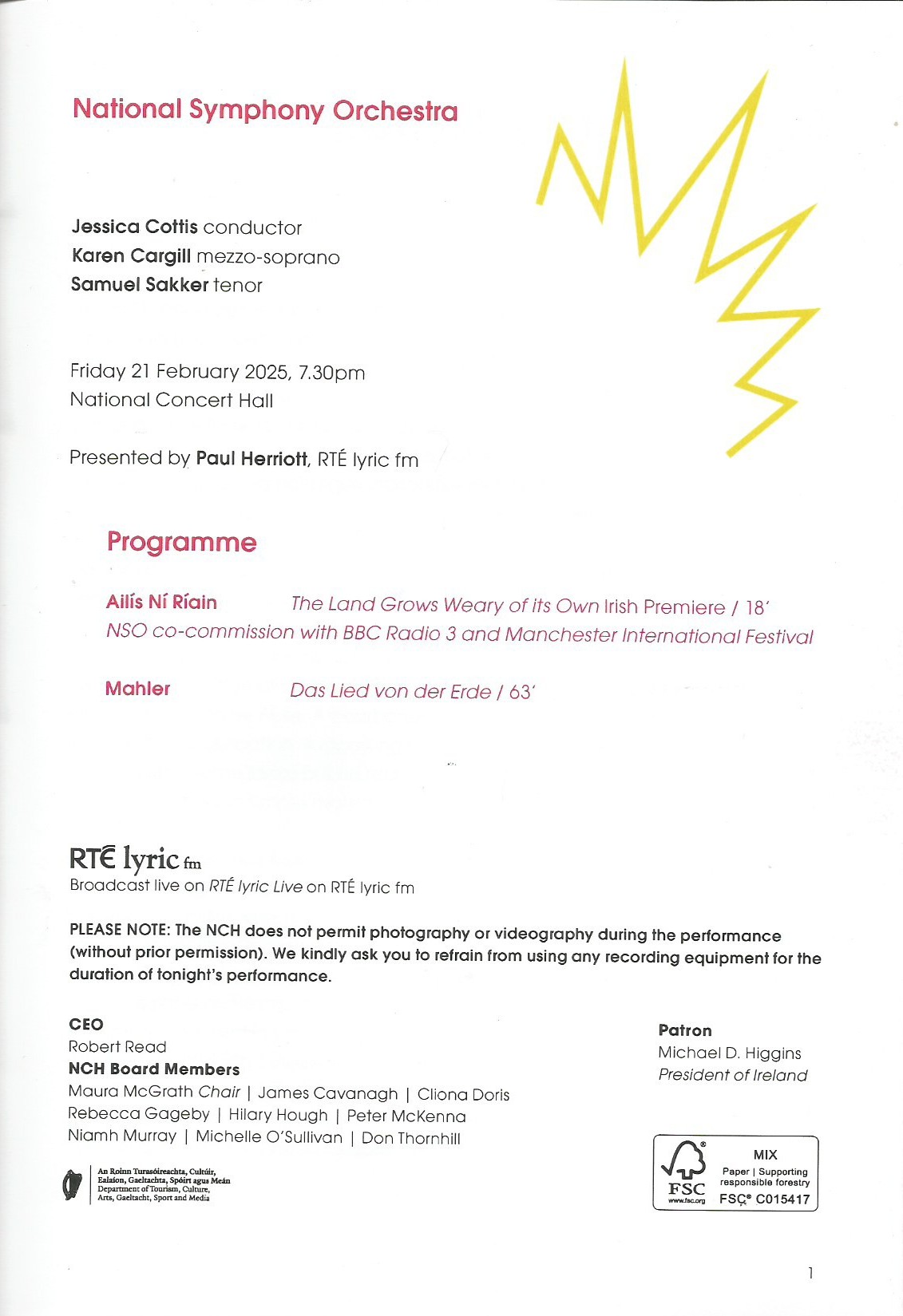
And it came to pass that yesterday evening I travelled into Dublin for another concert at the National Concert Hall. The main item on the menu was Das Lied von der Erde (“The Song of the Earth”), an orchestral work for two voices and orchestra by Gustav Mahler. Sometimes described as a song cycle this piece is a symphony in all but name (and number). Mahler was suspicious about counting this work as his 9th Symphony because of the Curse of the Ninth. He did go on to composer another (numbered) Symphony but did not live to hear it performed. He didn’t live to hear Das Lied von der Erde performed either.

Das Lied von der Erde (“The Song of the Earth”) is a long work – performance time is just over an hour – and it is spread over six movements, thematically linked by translations of classical Chinese poems translated into German by Has Bethge. The final movement, by far the longest, incorporates two texts whereas the others include one each.

This is one of my favourite works but I’ve only ever heard it on the radio or on a recording so I was delighted to see it was coming up at the National Concert Hall. I enjoyed last night’s performance enormously. The National Symphony Orchestra was conducted by Jennifer Cottis with soloists Samuel Sakker (tenor) and Karen Cargill (mezzo-soprano). The start of this piece is difficult for the tenor who has to come in at full volume. At first I thought he was going to struggle, but he hit his straps very quickly and delivered a strong performance. Karen Cargill was superb throughout, her voice very well matched to the demands of the music. I have heard her sing Mahler before, incidentally, in Cardiff, and she was great then too. The whole orchestra played beautifully, but I would pick out the woodwind section for special mention.

That wasn’t the entire concert. There was also the Irish premier of a new work work by Ailís Ní Ríain called The Land Grows Weary of its Own, which is a meditation on the effects on bird populations and migration thereof caused by Earth’s changing climate. It’s an interesting piece, with some fascinatingly complex passages, especially for the percussion. The composer was the audience, but unforunately the auditorium was only about half full for the performance. It only lasts about 20 minutes so the interval came quite quickly. Returning after my glass of wine I could see a much fuller Concert Hall so some people obviously skipped the first piece, which is a shame.

Yesterday was a very rainy and blustery day and on the way home I thought about the number of times I’ve walked from Connolly Station to the NCH yet never been rained on. Last night was no different.

Fidelio in Dublin

Posted in Opera with tags , , , , , , on February 23, 2020 by telescoper

Yesterday evening found me once again at the National Concert Hall in Dublin for a performance of Beethoven’s only Opera, Fidelio, performed by Lyric Opera Ireland together with the young musicians of Sinfonua conducted by Tony Purser. The event was, of course, part of the Beethoven 250 celebrations that will be taking place all this year in concert halls around the world. The National Concert Hall isn’t really designed for opera, so the orchestra had to squeeze into the space between the front row of the stalls and the stage. I was a few rows back, but I could still read the scores on the desks!

A synopsis of the Opera is as follows.

Leonore (Sínead Campbell-Wallace) has disguised herself as a man, Fidelio, and has gained employment as assistant to the chief gaole, Rocco (Mikhail Svetlov), of the state prison in the hope of finding and freeing her imprisoned husband Florestan (Samuel Sakker). To complicate matters, Rocco’s daughter, Marzelline (Rachel Croash), has fallen in love with Fidelio, which annoys her suitor Jaquino (Patrick Hyland) even though he doesn’t know Fidelio is actually a woman. Leonore persuades Rocco to let her help him in the underground cells where the political prisoners are held in inhuman conditions. The prison governor, the villainous Don Pizarro (Gyula Nagy), learns of an impending inspection by the minister and decides that Florestan – who has been particularly cruelly treated – must be killed to hide the evidence of his abuse. Leonore hears of the plan to murder her husband and, as the prisoners are briefly allowed out into the sunlight, she searches in vain for Florestan among them. He is still in chains below ground. Eventually Leonore and Rocco descend into the darkness of the dungeon and find Florestan, near death, having a vision of an angel that has come to rescue him. Leonore looks on as Pizarro arrives and tries to kill her husband, but she stops him and reveals her true identity. In the nick of time (geddit?), the Minister, Don Fernando (Felix Kemp), arrives and, appalled by what he sees, commands that all the prisoners be released. Leonore sets her husband free.

Much of Beethoven’s music from his “middle period” – Fidelio was first performed in 1805 – is about the struggle for political liberty and social justice that was taking place throughout Europe at the time so it’s not difficult to see why he was attracted to this story. Although originally written in three acts, it is now performed in a version with only two. This gives the opera a fascinating structure. The music in Act I is clearly a nod back in the direction of Mozart, while Act II is dramatically different, specifically with a much wider range of orchestral colour, and is clearly a look forward towards Romanticism. There are no less than four published versions of the overture. Last night we heard the standard one often called Leonore No. 3, but more often simply known as Fidelio.

Fidelio is really a singspiel (a form of opera in which the recitative is spoken or declaimed rather than sung). In this performance the spoken dialogue was in English while the sung part was in the original German. There were surtitles too, so the plot was easy to follow. Given the constraints of the National Concert Hall the set was simple but nonetheless effective, and the a mixture of 19th century and modern dress. Part of the chorus performed from the choir stalls behind the stage. In the first act they were dressed as prisoners but during the interval they changed into ordinary everday clothes, a device I found very effective. A story of wrongful imprisonment is as relevant today as it was in Beethoven’s time. This point was emphasized near the end of Act I when the prisoners are briefly allowed out from their cells: children in modern dress mingled with them, holding photographs of people of all races and generations who have been unjustly taken away.

I thought the principals were outstanding. Sínead Campbell-Wallace (soprano) was a superb Leonore, both vocally and dramatically, Samuel Sakker (tenor) impressed, Mikhail Svetlov (bass) was in fine voice throughout, and (perhaps the pick of them all) Hungarian baritone Gyula Nagy was a wonderfully sinister Don Pizarro.

So far so good, but there were some less than ideal things about this production, chiefly the intonation. For many people the highlight of this Opera is the wonderful Prisoners’ Chorus (“O welche Lust….”) when the inmates of the gaol are temporally released to get some fresh air. They staggered onto the stage, eyes blinking at the light, but their incarceration had obviously robbed some of  them of a sense of pitch and the started horrifically out of tune. From time to time the orchestra – especially the brass – also struggled to find the correct pitch, producing some painfully jarring moments.

It’s hard to believe that it has been the best part of a decade since I first saw Fidelio, in a production by Welsh National Opera. Both that one and this one offered much to enjoy, but I still have to see a production that really does this work justice.