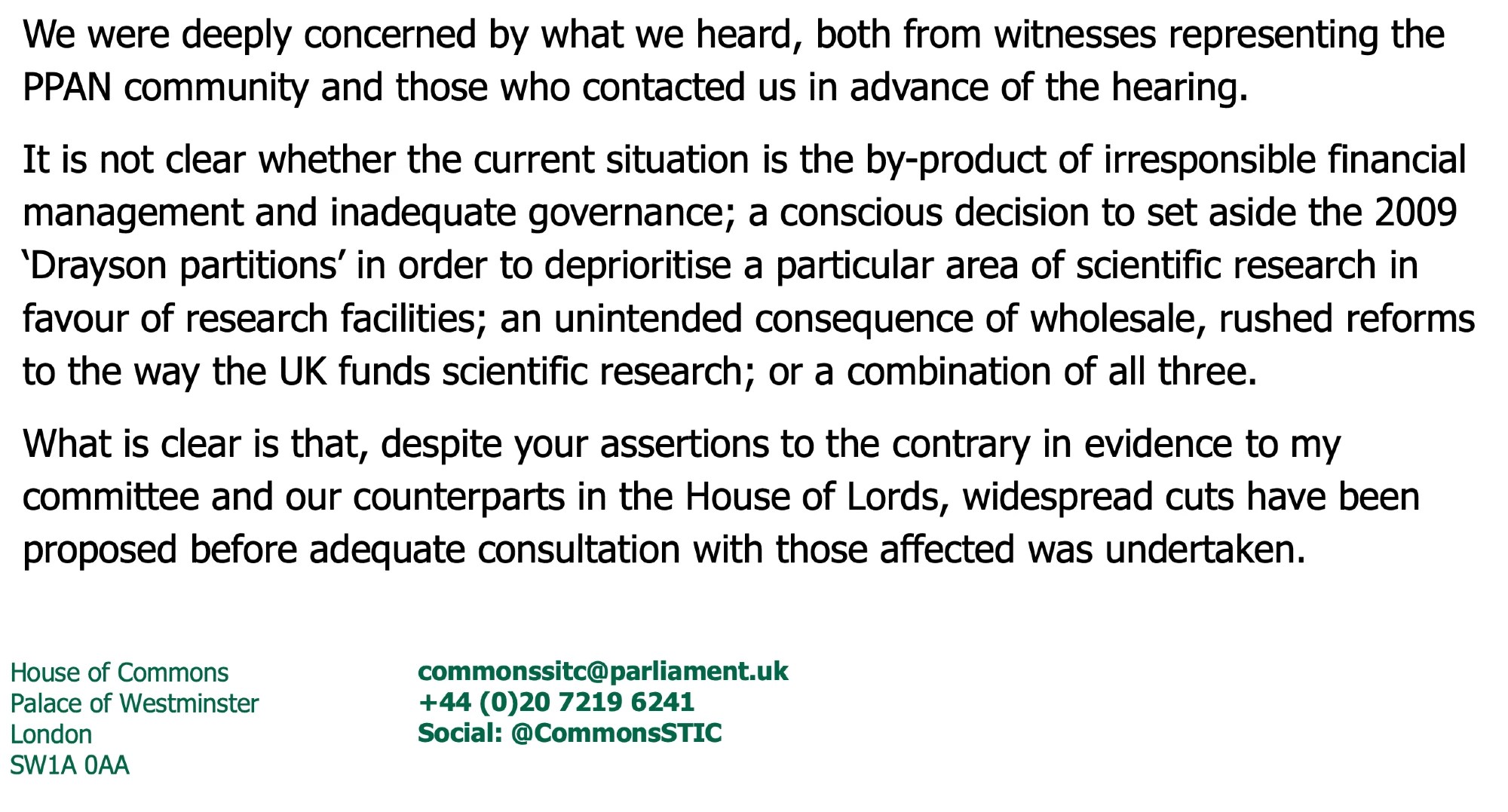
I’ve just got time this evening to pass on news that the Chair of the Parliamentary Select Committee looking at he current STFC debacle (see this account), Chi Onwurah, has responded to the events in extremely frank terms. Here is an excerpt:
The full response – which is definitely well worth reading because it doesn’t pull any punches – can be found here:
This isn’t by any means the end of the story of this fiasco, but it is certainly a positive sign that it is being taken very seriously in political circles. Credit is due not only to all those who attended and gave evidence to the Committee – Catherine Heymans, Jon Butterworth et al – but also to those who lobbied behind the scenes.
I am remiss in having forgotten until now to circulate an open letter that has been set up to express support for the high energy physics theory and particle theory communities in the United Kingdom. I signed the letter a few days ago but neglected to circulate it for further signature.
The letter reads:
We the undersigned wish to raise serious concerns about the current cuts to UK high energy particle physics theory grants by signing up to the letter below. The open letter and list of signatories are printed on this page. Individuals who wish to support this initiative may add their name as a signatory by completing the form below. This letter will be sent to Lord Patrick Vallance (Minister of State for Science, Innovation, Research and Nuclear), Liz Kendall (Secretary of State for Science, Innovation and Technology), Chi Onwurah MP (Chair of the UK House of Commons Science, Innovation and Technology Select Committee), and Prof. Sir Ian Chapman (CEO of UKRI).
We are signing this letter to raise serious concerns about the proposed cuts to high energy physics theory and particle theory in the United Kingdom. The UK is a world leader in this area: its historical activity led to the development of the Standard Model of particle physics and the ongoing development of string theory. UK theoretical physicists provide essential input to major international experiments, including the Large Hadron Collider at CERN and next-generation programmes in neutrino physics, gravitational waves, and cosmology, enabling rigorous interpretation of data and the extraction of fundamental insight. The strength of the UK community lies in its intellectual breadth and integration: researchers operate across phenomenology, formal theory, and their interface, and sustained dialogue between these areas underpins the UK’s leading role in global collaborations and internationally recognised research groups. In parallel, UK theorists advance the theoretical foundations of fundamental physics.
These groups and scientists can only operate thanks to critical funding by UK research council funding.
The current apparent scale of the cuts to the Particle Physics, Astronomy and Nuclear Physics area (30% to the overall budget) will result, when rising costs are taken into account, in a much greater than 50% cut in the number of postdoctoral researchers active in these areas in the UK. This will have a devastating effect on the ability of the UK to maintain its leading role in the subject.
Such funding decisions will affect the famously excellent reputation of the UK university sector. It will risk the health of UK physics departments and will therefore damage economic growth in the UK. Many scientists trained in this sector subsequently move into senior positions in technical industries such as machine learning and finance. Theorists at universities play a crucial role in the training and development of the inventors and disruptors of the future.
We urge UK politicians and leaders in the UK funding organisations to carefully consider the implications of the current direction of funding decisions before it is too late and irreparable damage is done to the UK theory community.
You can sign the letter and see a list of existing signatories here.
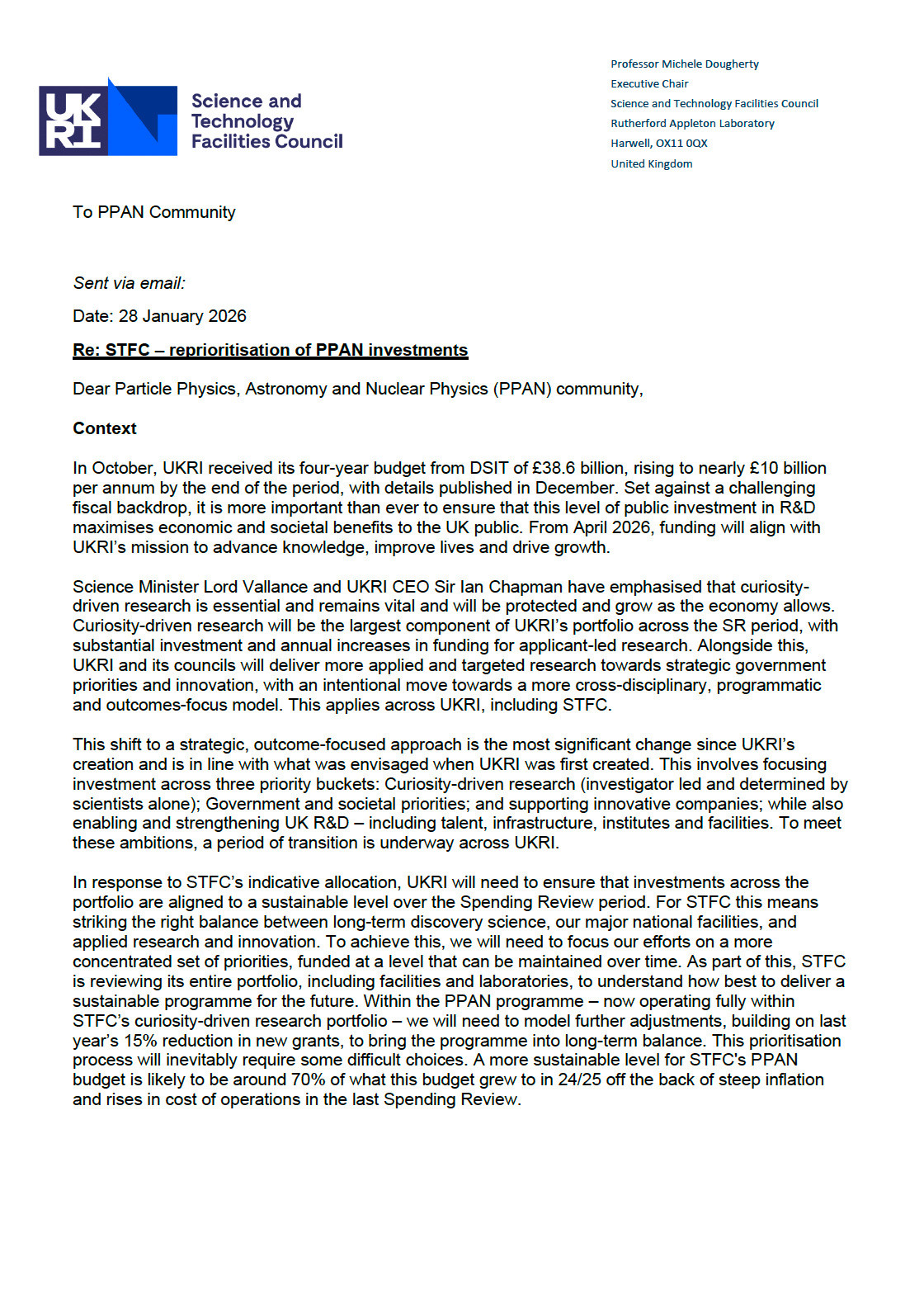
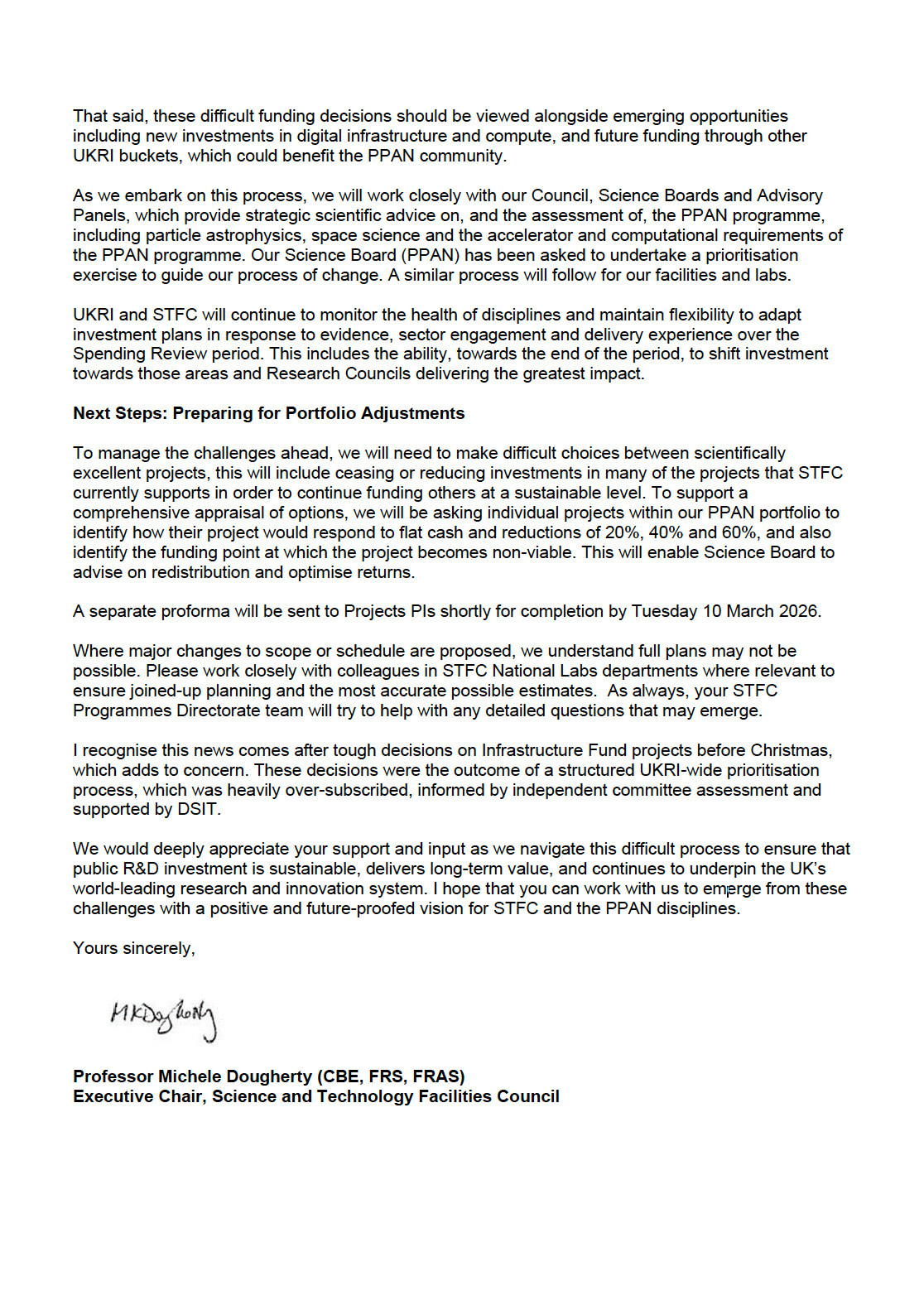
The following guest post by George Efstathiou is a response to the current STFC funding crisis I blogged about here, and specifically to a letter by the Executive Chair of STFC, Professor Michele Dougherty. I include the letter here for completeness:
George’s post follows:
–o–
I am glad that Michele Dougherty has finally communicated the position of STFC to the community. There is a glaring inconsistency between paragraphs 2 and 4 of her letter.
I have just finished a 5 year term on the STFC Science Board and now that the problems are in the public domain I am able to speak freely. In brief, the financial problems at STFC have arisen because of high inflation and high costs of energy against the backdrop of long term flat cash settlements. The national labs/facilities are particularly vulnerable to both. In addition, the labs invested heavily in ambitious upgrades that are now acknowldeged to be unsustainable. However, it is difficult to downsize programmes at the facilities quickly because it takes time to cut staff levels. In fact, money needs to be spent up front to achieve long term reductions in staff levels. From my time on Science Board, I can see no solution given the SR settlement other than for PPAN to take a big cut. Asking for more money from UKRI will likely fall on deaf ears, since the STFC problems are (to a large extent) of their own making.
The problem, as I see it, is whether it is possible for STFC to construct a recovery programme for PPAN science. The impression given in the Dougherty letter is that the ‘bucket’ allocation formula constrains STFC and so they are forced to reduce PPAN expenditure (Bucket 1) at the expense of ‘outcome driven’ growth related expenditure (Bucket 2) which goes mostly to the government labs/facilities. Science board was told that the new allocation formula was to blame for the huge cuts in the PPAN programme. Furthermore, the STFC plan to shift towards ‘growth related’ priorities is envisaged by STFC to lead to a long term cut in PPAN science. This situation was described to Science Board as the ‘new normal’. This is clearly inconsistent with paragraph 2 in Dougherty’s letter, which states that ‘curiosity-driven research will be the largest component of UKRI’s portfolio across the SR period, with substantial investment and annual increases in funding for applicant-led research’.
I discussed this contradiction with Paul Nurse, who told me that Patric Vallance had assured him that funding for basic research would not be cut under the new funding model. This prompted me to write to Michele Dougherty and Grahame Blair asking for clarification on the interpretation of the new funding model by STFC. I did not receive a reply.
This is what I think is going on. I believe that it is the STFC Executive Board that has decided to prioritise the facilities ahead of the PPAN programme. This is their decision and is not forced on them by the new allocation formula. I also believe that the their priorities are a reflection of conflicts of interest in the governance structure of STFC. Decisions at STFC are made by the Executive Board (EB) which is composed mostly of lab/facility directors and senior programme managers. The Council and Science Boards are advisory. The EB is therefore heavily biased in favour of the facilities component of the STFC portfolio. This bias has afflicted STFC since it was first created. I wrote to Michele Dougherty last July concerning the governance structure at STFC. I did not get a reply.
The situation for PPAN science is very serious and I objected to Science Board being used to conduct a ‘prioritisation’ exercise. At these high levels of cuts, decisions depend on many programmatic factors that Science Board cannot judge. Large cuts to key PPAN projects will surely raise questions of whether the UK should continue to pay international subscriptions. In addition, the UK Space Agency is being absorbed into DSIT and there is uncertainty concerning the relationship between UKSA and STFC. We also have the absurd spectacle of deep cuts to PPAN projects running alongside a call for white papers on future space missions.
I would urge the community to ask questions of STFC. It is important, in particular, to extract an answer from Michele Dougherty to the question of ‘how much freedom does STFC have to distribute funds between the three buckets?’. This is pertinent to the issue of whether STFC can construct a recovery plan for PPAN science. I also think that it is worth pursuing questions on the governance of STFC, which are at the heart of the problems.
George Efstathiou FRS Emeritus Professor of Astrophysics (1909) Kavli Institute for Cosmology Madingley Road Cambridge
I started doing this blog back in 2008 and over the subsequent couple of years wrote many posts about a funding crisis affecting the Science and Technology Facilities Council, the UK funding agency that covers particle physics and astronomy research that had been created in 2007. I particularly remember the cancellation of the experiment Clover back in 2009 which had devastating and demoralising consequences for staff at Cardiff (where I was working at the time). It looks like a return to the Bad Old Days.
I moved from the UK eight years ago and haven’t really kept up with news related to the science funding situation there so I was very disturbed last night to see a message from the Royal Astronomical Society containing the following:
In a letter from its Executive Chair, Professor Michele Dougherty, the research council indicates that the budget for particle physics, astronomy and nuclear physics together will drop by around 30%. The letter also asks project teams to plan for scenarios where their funding is reduced by 20%, 40% and 60%.
All this is on top of a recent squeeze that has led to grants being delayed to make savings of around 15%. The full letter is here:
Exclusive: Science and Technology Facilities Council seeks £162m cost savings, with existing projects facing axe
The article goes on to point out the dangers of cuts of this scale to physics departments in the UK, many of which have a significant fraction of their activity in astronomy and particle physics.
The additional reduction and prospect of cuts to ongoing projects is likely to be felt as a hammer blow by physics departments in UK universities, of which a quarter are already at risk of closure.
Grim times indeed. It looks to me like the people running UKRI, the umbrella organization for all the UK research councils which has an annual budget of £8bn, have decided to throw STFC under the bus to chase shorter-term economically driven projects and to hell with the long-term funding of basic research. In Ireland we’re familiar with the consequences of that approach.
Still, at least the UK has the Astronomer Royal as an independent voice to speak up against these cuts. The current Astronomer Royal is… checks notes… oh… Michelle Dougherty, Executive Chair of STFC.
Apparently I still have a few readers in the UK, so I thought I’d share a bit of news aimed at them.
It seems the Science, Innovation and Technology Committee of the House of Commons has initiated an inquiry into ” how well placed the UK astronomy sector is to showcase the UK as a science superpower and maximise its leadership in international programmes”. Apparently this will examine the status of the UK’s astronomical research base and assets, UK access to international astronomical facilities and contribution to international programmes. It will also explore astronomy’s potential contribution to the UK economy and what considerations should inform the Science and Technology Facilities Council’s next Strategic Delivery Plan, due in 2026.
I don’t know why STFC doesn’t just use ChatGPT to write its strategic plan like everyone else, but there you go.
Anyway, the Committee welcomes submissions addressing any or all of the following:
The strengths and weaknesses of UK astronomy and how these compare to other nations
The opportunities and challenges facing UK astronomy and whether it is receiving sufficient support
What the aims and focus of UK astronomy should be
The extent to which UK astronomy contributes to the UK’s status as a science superpower
Whether the UK is maximising the contribution that astronomy can make to the wider UK economy
What role astronomy is playing in encouraging greater diversity and inclusion in STEM and public interest in science
To find out more information and/or submit a submission go here. The deadline is 27th October.
I stumbled by accident yesterday on a bit of news relating to UK Astronomy Grant funding via the Science and Technology Facilities Council (STFC). I am of course completely out of that system, and have been for years, but I am nevertheless quite nosy so was interested to find out about the changes. Thanks to Alan Heavens and Paul Crowther for enlightening me.
Way back in 2010 I wrote in somewhat critical terms about the new-style Consolidated Grants that STFC was planning to introduce. This system replaced a dual approach of so-called “Standard Grants” – which were typically rather small, usually funding one postdoctoral researcher and bits and bobs – and “Rolling Grants” – which were usually larger, covering all the activities of a department or institution – with a single system of “Consolidated Grants”. The Standard Grants were “responsive”, in that investigators could put in an application whenever they wanted, whereas Rolling Grants were on a fixed timetable. After the change, the responsive mode went out the window and Departments were forced to apply collectively, once every three years.
Much of the reason for the change was the administrative cost of the system. There were huge numbers of standard grant applications. Back in the mists of time there were two application deadlines per year so it was a heavy burden on the panels and the Swindon office, especially since so little funding was available in the first place. Standard grants were also the first to get squeezed when there was a funding shortfall, whereas Rolling grants generally carried on rolling.
Well, the news is that the current Astronomy grant round, with applications in 2022 and grants starting in 2023, will see the last of these Consolidated Grants. From this year on, there will be a new system of – wait for it – “Small” and “Large” grants, thought these are officially called Type 1 and Type 2. The Small Awards scheme is described here and it looks very much like the old Standard Grant system. Details of the Large grants scheme are not yet available, but I believe they will start next year. You can find more details here (PDF).
So now it seems something very like the old system is returning, and there are no doubt the same worries that Large grants will eat up most of the money, leaving very little for the Small grants. Déjà vu.
DIRAC is a high-performance computing facility designed to serve the research community supported in the UK by the Science and Technology Facilities Council (STFC). Recently DIRAC ran a competition to select the best images produced using results obtained by this facility, and I was honoured to be asked to be one of the judges. Entries were divided into two Themes: Theme 1 (Particle and Nuclear Physics) and Theme 2 (Astronomy, Cosmology and Solar & Planetary Science) and scores were allocated by the judges based on visual impact and scientific interest. There were 41 entries altogether, all of a very high standard.
So, without further ado, I shall now show you the winning entries!
The winning image in Theme 1 was submitted by Ed Bennett and Biagio Lucini of Swansea University and called Let it (Wilson) flow. The description supplied by the creators reads:
A space-time slice of the topological charge density distribution of a 128 times 643 lattice field configuration (with periodic boundaries) from an ensemble of the SU(2) gauge theory with two flavours of Dirac fermion in the adjoint representation (also known as Minimal Walking Technicolor). Moving along the time direction from left to right, successive time-slices are also iterated using the gradient flow of the Wilson action, which removes the ultraviolet noise that would otherwise prevent computation of the configuration’s topological charge. This noise is clearly visible on the left, with the actual instantons (orange) and anti-instantons (blue) becoming visible at longer flow times to the right.
Here is the winning image for Theme 1:
Theme 1 winner: Let it (Wilson) flow by Ed Bennett and Biagio Lucini.
The winning entry of Theme 2 is entitled Immediate origin of the Moon as a post-impact satellite and was submitted by Jacob Kegerreis of Durham University who supplied the following description:
The Moon is thought to have formed following a giant impact, but the details are still hotly debated. New high-resolution simulations, like the one shown here, reveal that a Moon-like satellite can be immediately placed into a wide orbit around the Earth, in contrast with the traditional idea of later accretion from a debris disk. This opens up new possibilities for the Moon’s initial orbit and interior, which could help to solve mysteries like its tilted orbit, thin crust, and Earth-like isotopes. The 3D smoothed particle hydrodynamics (SPH) simulations were run using the SWIFT code on the DiRAC COSMA8 system with over 100 times higher resolution than the current standard. The SPH data from this mid-impact snapshot are rendered using Houdini and Redshift, with the colour, opacity, and emission controlled by the particle material, density, and internal energy.
Here is the winning image of Theme 2:
Theme 2 Winner: Immediate origin of the Moon as a post-impact satellite by Jacob Kegerreis
Congratulations to the winners!
It was a lot of fun being one of the judges for this competition and I learnt a lot about the science from the clever way in which many of the entries displayed their results. The field was very strong, and many more images were worthy of recognition, but we were only allowed to pick one winner from each Theme. I am however given to understand that it is planned to include the best of the rest alongside the winners in a 2023 calendar which will be distributed to the DIRAC user community.
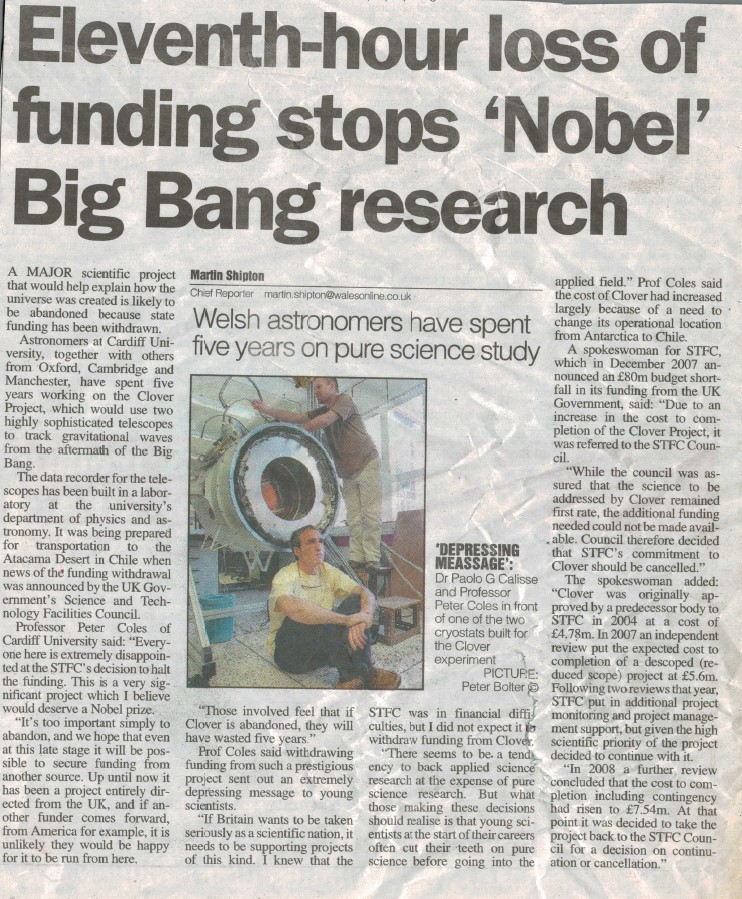
I was tidying up some papers in my desk yesterday and came across a clipping dated April 9th 2009, i.e. exactly nine years ago to the day. Amazed by this coincidence, I resolved to post it on here but was unable to work out how to use the new-fangled scanner in the Data Innovation Institute office so had to wait until I could get expert assistance this morning:
Sorry it’s a bit crumpled, but I guess that demonstrates the authenticity of its provenance.
The full story, as it appeared in the print edition of the Western Mail, can also be found online here. By the way it’s me on the stepladder, pretending to know something about astronomical instrumentation.
I wrote at some length about the background to the cancellation of the Clover experiment here. In a nutshell, however, Clover involved the Universities of Cardiff, Oxford, Cambridge and Manchester and was designed to detect the primordial B-mode signal from its vantage point in Chile. The chance to get involved in a high-profile cosmological experiment was one of the reasons I moved to Cardiff from Nottingham almost a decade ago, and I was looking forward to seeing the data arriving for analysis. Although I’m primarily a theorist, I have some experience in advanced statistical methods that might have been useful in analysing the output. It would have been fun blogging about it too.
Unfortunately, however, none of that happened. Because of its budget crisis, and despite the fact that it had already spent a large amount (£4.5M) on Clover, the Science and Technology Facilities Council (STFC) decided to withdraw the funding needed to complete it (£2.5M) and cancel the experiment. I was very disappointed, but that’s nothing compared to Paolo (shown in the picture) who lost his job as a result of the decision and took his considerable skills and knowledge abroad.
We will never know for sure, but if Clover had gone ahead it might well have detected the same signal found five years later by BICEP2, which was announced in 2014. Working at three different frequencies (95, 150 and 225GHz) Clover would have had a better capability than BICEP2 in distinguishing the primordial signal from contamination from Galactic dust emission (which, as we now know, is the dominant contribution to the BICEP2 result; see thread here), although that still wouldn’t have been easy because of sensitivity issues. As it turned out, the BICEP2 signal turned out to be a false alarm so, looking on the bright side, perhaps at least the members of the Clover team avoided making fools of themselves on TV!
P.S. Note also that I moved to Cardiff in mid-2007, so I had not spent 5 years working on the Clover project by the time it was cancelled as discussed in the newspaper article, but many of my Cardiff colleagues had.
It’s been a very busy week here in Cardiff, as we have been hosting a National Event to launch the Science and Technology Facilities Council (STFC)’s new Centres for Doctoral Training in Data-Intensive Science. There are eight new CDTs involving 19 institutions across the country (including the local one that involved the Universities of Cardiff, Bristol and Swansea). We were delighted to be chosen to host this event, which has had a tremendous buzz about it, as 120 new PhD students met with academics from all the CDTs, STFC staff, and representatives of industry partners, for a mixture of training and networking activities. I took part in a panel discussion this morning about careers, which was very interesting.
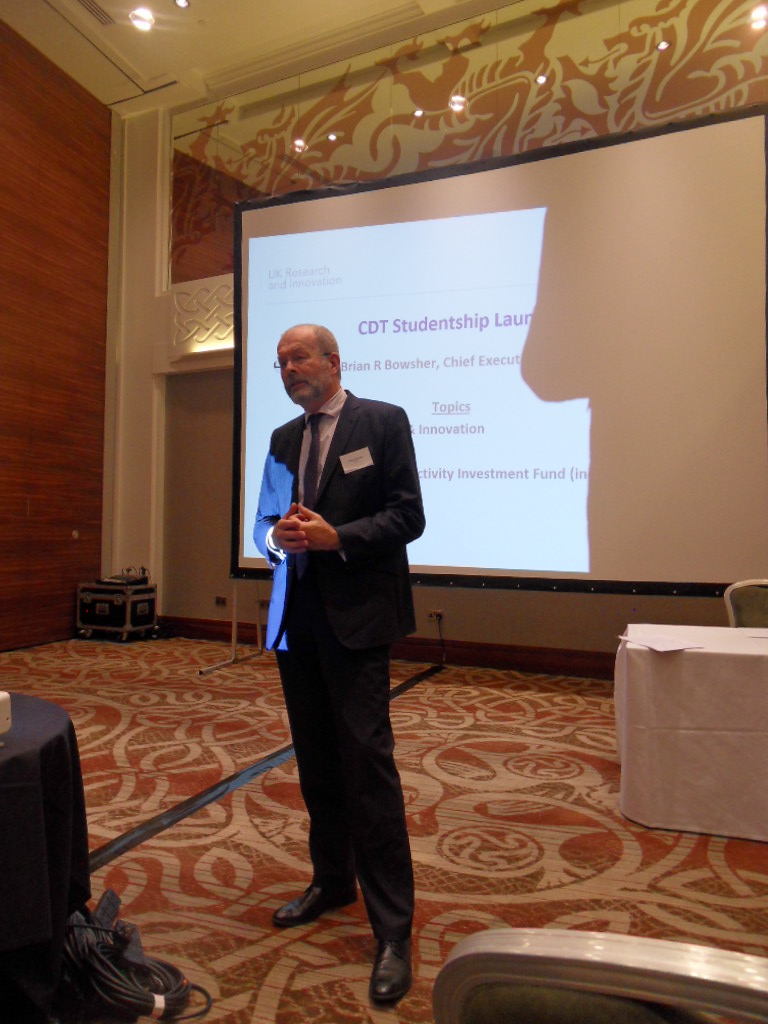
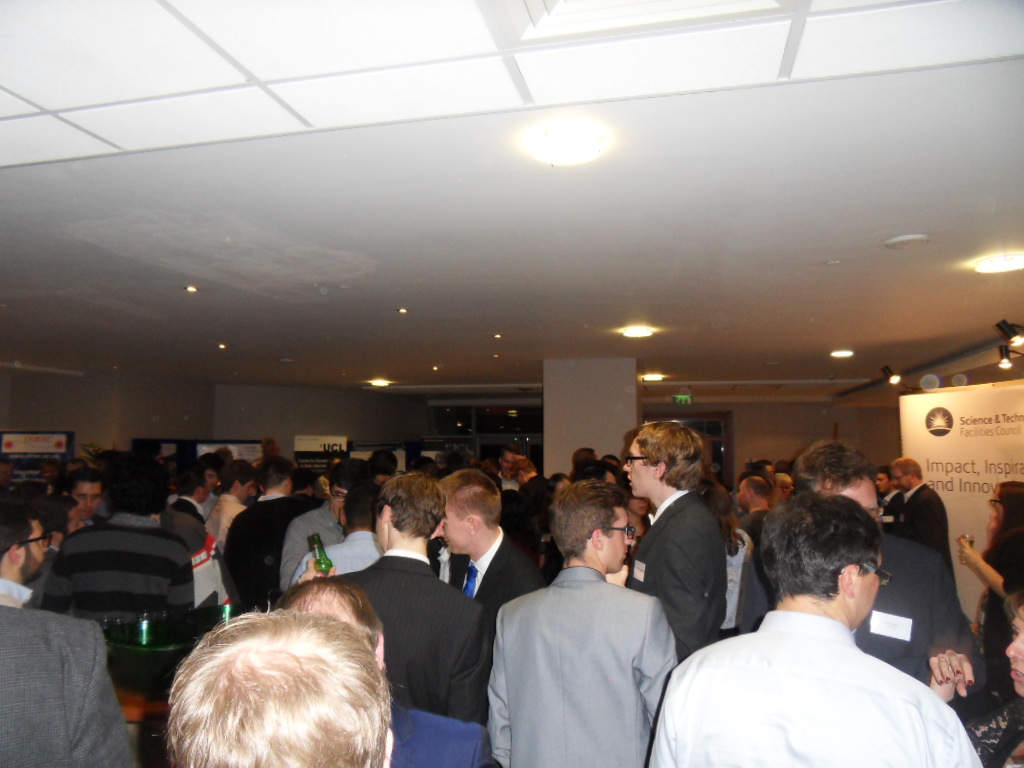
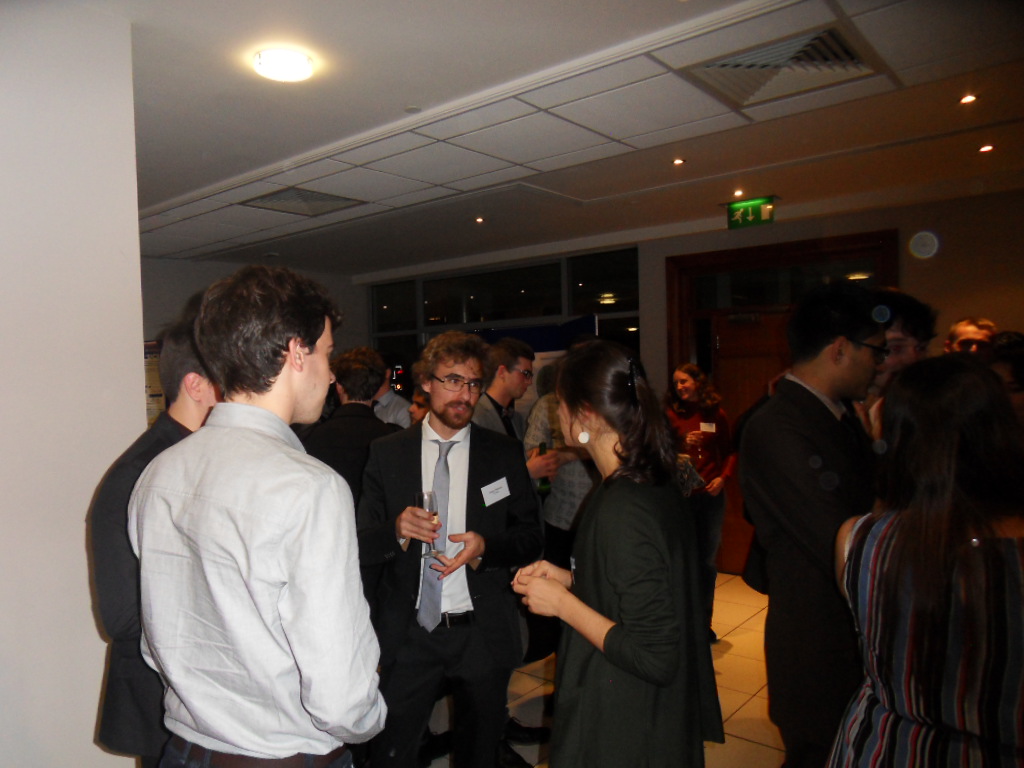
Last night we had a dinner at the Mercure Hotel in Cardiff (where the Real Madrid team stayed just before this summer’s UEFA Champions League Final in Cardiff). The dinner was preceded by a welcome from Professor Karen Holford (Deputy Vice-Chancellor of Cardiff University), a talk by Brian Bowsher (Chief Executive of STFC) and Prof. Patrick Sutton of the Gravitional Physics group at Cardiff who gave an outstanding talk about the latest developments in gravitational waves. There was then a `showcase’ event to allow students and staff to talk about their work over a few drinks.
Here are some pictures of yesterday’s activities.
Prof. Karen Holford giving her welcome speech.
Dr Bian Bowsher, STFC Chief Executive
I noticed in Dr Bowsher’s talk that STFC has apparently moved the Boulby Mine from North Yorkshire (near Whitby) to Northumberland:
STFC sites (some of them in the correct geographical location).
Professor Mark Walport was unable to attend the event in person but did at least appear on a slide about the new UK Research and Innovation entity, which formally comes into existence in April 2018!
Professor Sir Mark Walport
Patrick Sutton doing his gravitational waves talk…
The Showcase Event
Showcase Event
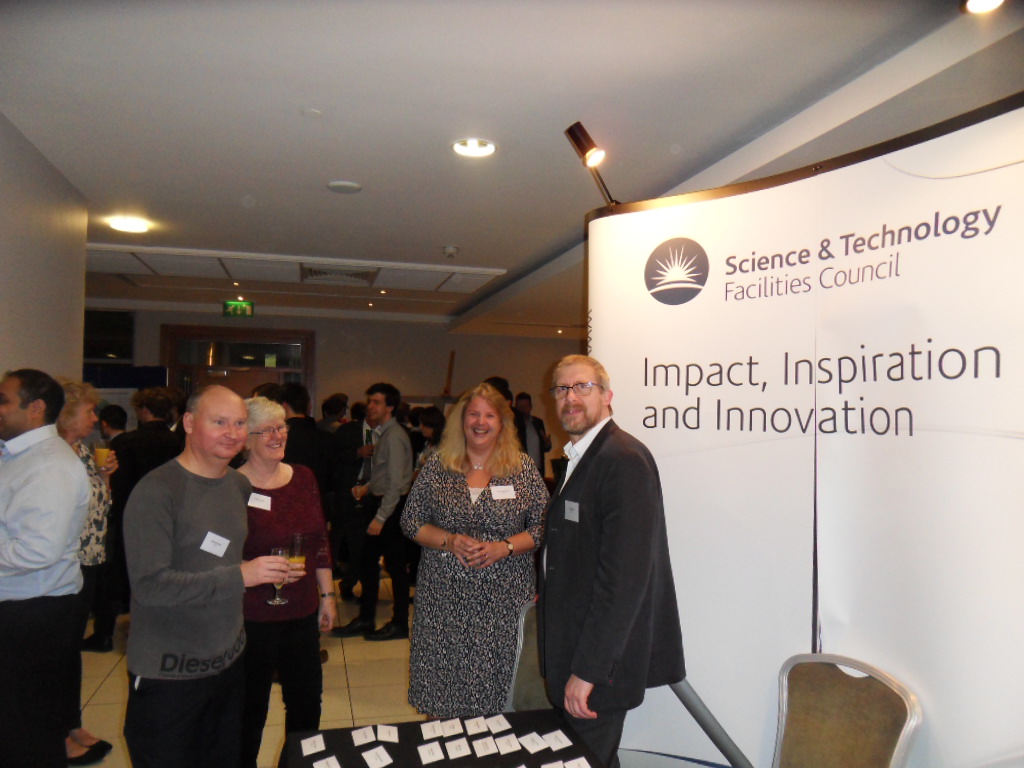
And here are some of the members of the team from STFC who did most of the organization for this very successful and enjoyable event.
Some members of the STFC team!
The event finishes this afternoon, after which I think I’ll have a lie down!
Update: there’s a Cardiff University News item about this here.
The other day I was surprised to see this tweet announcing the impending formation of a new council under the umbrella of the new organisation UK Research & Innovation (UKRI):
Welcome to the official Twitter account of Research England – a new council within @UKRI_news. Launching in April 2018!
These changes are consequences of the Higher Education and Research Act (2017) which was passed at the end of the last Parliament before the Prime Minister decided to reduce the Government’s majority by calling a General Election.
It seems to me that it’s very strange indeed to have a new council called Research England sitting inside an organisation that purports to be a UK-wide outfit without having a corresponding Research Wales, Research Scotland and Research Northern Ireland. The seven existing research councils which will henceforth sit alongside Research England within UKRI are all UK-wide.
This anomaly stems from the fact that Higher Education policy is ostensibly a devolved matter, meaning that England, Wales, Scotland and Northern Ireland each have separate bodies to oversee their universities. Included in the functions of these bodies is the so-called QR funding which is allocated on the basis of the Research Excellence Framework. This used to be administered by the Higher Education Funding Council for England (HEFCE), but each devolved council distributed its own funds in its own way. The new Higher Education and Research Act however abolishes HEFCE and replaces some of its functions into an organisation called the Office for Students, but not those connected with research. Hence the creation of the new `Research England’. This will not only distribute QR funding among English universities but also administer a number of interdisciplinary research programmes.
The dual support system of government funding consists of block grants of QR funding allocated as above alongside targeted at specific projects by the Research Councils (such as the Science and Technology Facilities Council, which is responsible for astronomy, particle physics and nuclear physics research). There is nervousness in England that the new structure will put both elements of the dual support system inside the same organisation, but my greatest concern is that by exlcuding Wales, Scotland and Northern Ireland, English universities will be given an unfair advantage when it comes to interdisciplinary research. Surely there should be representation within UKRI for Wales, Scotland and Northern Ireland too?
Incidentally, the Science and Technology Facilities Council (STFC) has started the process of recruiting a new Executive Chair. If you’re interested in this position you can find the advertisement here. Ominously, the only thing mentioned under `Skills Required’ is `Change Management’.
The views presented here are personal and not necessarily those of my employer (or anyone else for that matter).
Feel free to comment on any of the posts on this blog but comments may be moderated; anonymous comments and any considered by me to be vexatious and/or abusive and/or defamatory will not be accepted. I do not necessarily endorse, support, sanction, encourage, verify or agree with the opinions or statements of any information or other content in the comments on this site and do not in any way guarantee their accuracy or reliability.






 In the Dark