Archive for Science

Particle Physics – The Opera

Posted in Opera, The Universe and Stuff with tags , , , , on January 8, 2009 by telescoper

A new season is about to start at English National Opera and I’ve been spending a lot of time and money recently getting tickets for some of the operas, as well as organizing the logistics of getting to and from London. Among the forthcoming productions is a revival of Nicholas Hytner’s production of Mozart’s The Magic Flute (Die Zauberflöte, K. 620).

I can’t remember how many times I have seen this opera performed nor in how many different productions. It’s a wonderful creation because it manages to combine being utterly daft with being somehow immensely profound. The plot makes no sense at all, the settings are ridiculous (e.g. “rocks with water and a cavern of fire”), and the whole thing appears to be little more than a pantomime. Since it’s Mozart, though, there is one ingredient you can’t quibble with: a seemingly unending sequence of gorgeous music.

When I first saw The Magic Flute I thought it was just a silly but sublime piece of entertainment not worth digging into too deeply. I wondered why so many pompous people seemed to take it so terribly seriously. Real life doesn’t really make much sense, so why would anyone demand that an opera be any less ridiculous? Nevertheless, there is a vast industry devoted to unravelling the supposed “mystery” of this opera, with all its references to magic and freemasonry.

But now I can unveil the true solution of problem contained within the riddle encoded in the conundrum that surrounds the enigma that has puzzled so many Opera fans for so long. I have definitive proof that this opera is not about freemasons or magic or revolutionary politics.

Actually it is about particle physics.

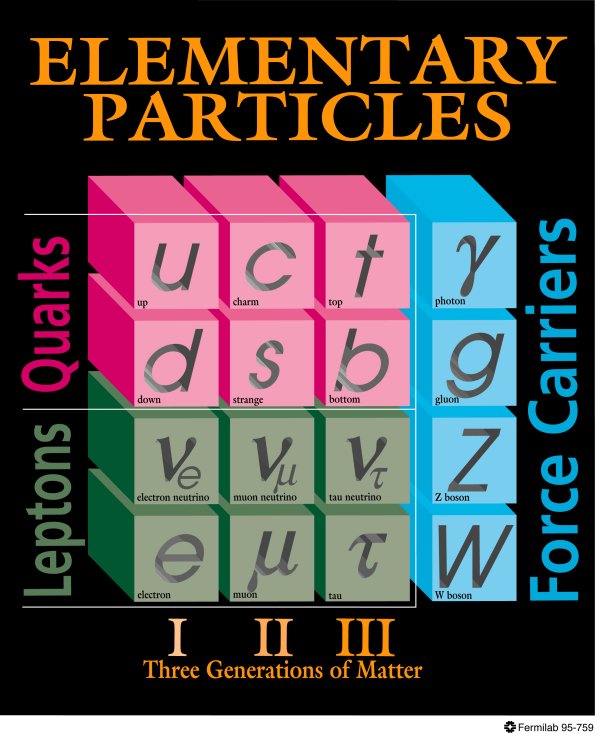
To see how I arrived at this conclusion note the following figure which shows the principal elementary particles contained within the standard model of particle physics:

To the left of this picture are the fermions, divided into two sets of particles labelled “quarks” and “leptons”. Each of these consists of three pairs (“isospin doublets”), each pair defining a “generation”. This structure of twos and threes is perfectly represented in The Magic Flute.

Let’s consider the leptons first. These can be clearly identified with the three ladies who lust after the hero Tamino in Act 1. This emotional charge is clearly analogous to the electromagnetic charge carried by the massive leptons (the electron, muon and tauon, lying along the bottom of the diagram). The other components in the leptonic sector must be the three boys who pop up every now and again to help Papageno with useful advice about when to jangle his magic bells. These must therefore be the neutrinos, which are less massive than the ladies, and are also neutral (although I hesitate to suggest that this means they should be castrati). They don’t play a very big part in the show because they participate only in weak interactions.

Next we have the quarks, also arrayed in three generations of pairs. These interact more strongly than the leptons and are also more colourful. The first generation is easy to identify, from the phenomenology of the Opera, as consisting of the hero Tamino (d for down) and his beloved Pamina (u for up); her voice is higher than his, hence the identification. The second generation must comprise the crazy birdcatcher Papageno (s for strange) and his alluring madchen who is called Papagena (c for charmed). That just leaves the final pairing which clearly is the basso profundo and fount of all wisdom Sarastro (b for bass bottom) and my favourite character and role model the Queen of the Night (t for top).

To provide corroboration of the identification of the Queen of the Night with the “top” quark, here is a clip from Youtube of a bevy of famous operatic sopranos having a go at the immensely different coloratura passage from the Act 1 aria “O Zittre Nicht, mein leiber Sohn” culminating in a spectacular top F that lies beyond the range of most particle accelerators, never mind singers.

There’s some splendid frocks in there too.

The Queen of the Night isn’t actually in the Opera very much. After this aria in Act 1 she disappears until the middle of Act 2, probably because she needs to have a lie down. When she comes back on she sings another glass-shattering aria (Der Hölle Rache kocht in meinem Herzen), which I like to listen to when I’m writing referee reports. The first line translates as “The rage of hell is boiling in my heart”.

The remaining members of the cast – The Speaker and Monostatos, as well as sundry priests, slaves, enchanted animals and the chorus – must make up the so-called Force carriers at the left of the table, which are bosons, but I haven’t had time to go through the identifications in detail. They’re just the supporting cast anyway. And there is one particle missing from the picture, the Higgs boson. This accounts for the masses of other particles by exerting a kind of drag on them so it clearly must be the Dragon from Act 1.

Professor Who?

Posted in Biographical, Music, Television, The Universe and Stuff with tags , , , , , on January 7, 2009 by telescoper

As a Professor of Astrophysics I am often asked “Why on Earth did you take up such a crazy subject?”

I guess many astronomers, physicists and other scientists have to answer this sort of question. For many of them there is probably a romantic reason, such as seeing the rings of Saturn or the majesty of the Milky Way on a dark night. Others will probably have been inspired by TV documentary series such as The Sky at Night, Carl Sagan’s Cosmos or even Horizon which, believe it or not, actually used to be quite good but which is nowadays uniformly dire. Or it could have been something a bit more mundane but no less stimulating such as a very good science teacher at school.

When I’m asked this question I’d love to be able to put my hand on my heart and give an answer of that sort but the truth is really quite a long way from those possibilities. The thing that probably did more than anything else to get me interested in science was a Science Fiction TV series or rather not exactly the series but the opening titles.

The first episode of Doctor Who was broadcast in the year of my birth, so I don’t remember it at all, but I do remember the astonishing effect the credits had on my imagination when I saw later episodes as a small child. Here are some tests for the sequence as it appeared in the very first series featuring William Hartnell as the first Doctor.

To a younger audience it probably all seems quite tame, but I think there’s a haunting, unearthly beauty to the shapes conjured up by Bernard Lodge. Having virtually no budget for graphics, he experimented in a darkened studio with an old-fashioned TV camera and a piece of black card with Doctor Who written on it in white. He created the spooky kaleidoscopic patterns you see by simply pointing the camera so it could see into its own monitor, thus producing a sort of electronic hall of mirrors.

What is so fascinating to me is how a relatively simple underlying concept could produce a rich assortment of patterns, particularly how they seem to take on an almost organic aspect as they merge and transform. I’ve continued to be struck by the idea that complexity could be produced by relatively simple natural laws which is one of the essential features of astrophysics and cosmology. As a practical demonstration of the universality of physics this sequence takes some beating.

As well as these strange and wonderful images, the titles also featured a pioneering piece of electronic music. Officially the composer was Ron Grainer, but he wasn’t very interested in the commission and simply scribbled the theme down and left it to the BBC to turn it into something useable. In stepped the wonderful Delia Derbyshire, unsung heroine of the BBC Radiophonic Workshop who, with only the crudest electronic equipment available, turned it into a little masterpiece. Ethereal yet propulsive, the original theme from Doctor Who is definitely one of my absolute favourite pieces of music and I’m glad to see that Delia Derbyshire is now receiving the acclaim she deserves from serious music critics.

It’s ironic that I’ve now moved to Cardiff where new programmes of Doctor Who and its spin-off, the anagrammatic Torchwood, are made. One of the great things about the early episodes of Doctor Who was that the technology simply didn’t exist to do very good special effects. The scripts were consequently very careful to let the viewers’ imagination do all the work. That’s what made it so good. I’m pleased that the more recent incarnations of this show also don’t go overboard on the visuals. Perhaps thats a conscious attempt to appeal to people who saw the old ones as well as those too young to have done so. It’s just a pity the modern opening title music is so bad…

Anyway, I still love Doctor Who after all these years. It must sound daft to say that it inspired me to take up astrophysics, but it’s truer than any other explanation I can think of. Of course the career path is slightly different from a Timelord, but only slightly.

At any rate I think The Doctor is overdue for promotion. How about Professor Who?

Gamma Plus

Posted in The Universe and Stuff with tags , on November 26, 2008 by telescoper

I’m a bit slow to blog about this but better late than never. The topic is the satellite formerly known as GLAST (which was an acronym: Gamma-ray Large Area Space Telescope) and which is now called Fermi (which isn’t an acronym, but a late and great physicist). I’ve got nothing against the change of name but I rather enjoyed seeing GLAST in titles of papers and conference talks, particularly in combination with the complementary ground-based facility HESS (another acronym: High Energy Stereoscopic System, situated in Namibia). “Astronomy with Hess and Glast” always sounded to me it should be like Astronomy with Sturm und Drang, or something like that. Astronomy with Hess and Fermi just doesn’t sound as exciting.

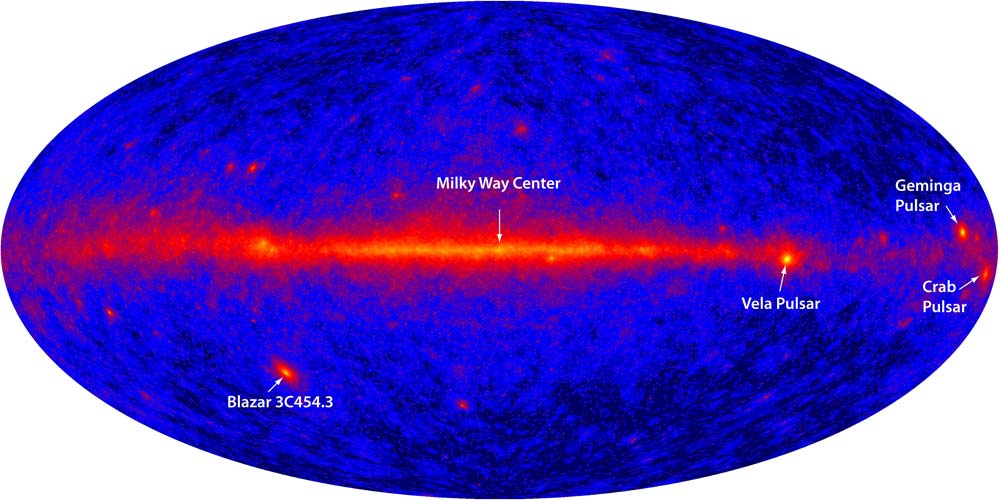
Anyway, Fermi was launched in June 2008 and by August had completed a quick scan of the whole sky in gamma rays with energies from 20 MeV up to 300 GeV. The main result of this quick look is that the telescope seems to work and that most of things you would expect are actually there in the gamma-ray sky, as you can see in this picture (courtesy of NASA/Fermi):

fermi0827081

As expected, the Galactic Plane shows up quite brightly in gamma rays because of the collisions between dust particles and high-energy cosmic rays. There are also a couple of supernova remnants nearby and one nearby active galaxy 3C454.3 outside our galaxy. It’s too early to say how many other sources Fermi will identify but it’s certainly a very promising start.

Actually things are looking up elsewhere in the high-energy astrophysics world too, as reported on cosmic variance recently, with a number of tantalising indications of immense potential interest discussed there. One of the exciting possibilities is that gamma ray observations might offer the chance to detect the annihilation of dark matter particles through collisions in our own Galaxy. Such collisions could chuck out gamma rays energies relating to the (unknown) mass of the dark matter particles.

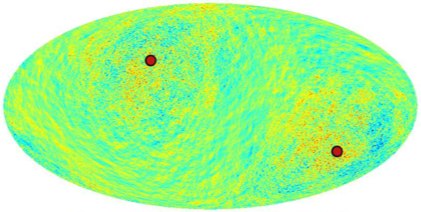
For myself, I wonder if there might be any hint that the low-level fuzz in the Fermi map might give us about the apparent lopsidedness and other anomalies in the Cosmic Microwave background?

elongated

Hmm. Watch this space

PS. I hope my remarks about the name won’t set Enrico Fermi spinning in his grave. Or perhaps only half-spinning. (Geddit?)

Popularisation or Propaganda?

Posted in Science Politics, The Universe and Stuff with tags , , , on November 25, 2008 by telescoper

I was just reading a piece by Jim Al-Khalili in today’s Guardian online science section. Jim is Professor of Physics and of Public Engagement in Science at the University of Surrey. His piece seems to have been inspired by the new appointment of Marcus du Sautoy to a similar position at Oxford University recently vacated by Richard Dawkins. His message is essentially that scientists should not only be more active in popularising science but also do more to “defend our rational, secular society against the rising tide of irrationalism”.

The legitimate interface between science and society has many levels to it. One aspect is the simple need to explain what science tells us about the world in order that people can play an informed part in our increasingly technological society. Another is that there needs to be encouragement for (especially young) people to study science seriously and to make it their career in order to maintain the supply of scientists for the future. And then there is the issue of the wider cultural implications of science, its impact on other belief-systems (such as religions) other forms of endeavour (such as art and literature) and even for government.

I think virtually all scientists would agree with the need for engagement in at least the first two of these. In fact, I’m sure most scientists would love to have the chance to explain their work to a lay audience, but not all subjects are as accessible or inspirational as, say, astronomy. Unfortunately also, not all scientists are very good at this sort of thing. Some might even be counterproductive if inflicted on the public in this way. So it seems relatively natural that some people have had more success than others, and have thus become identified as “science communicators”. Although some scientists are a bit snobby about those who write popular books and give popular talks, most of us agree that this kind of work is vital.

Vital, yes, but there are dangers. The number of scientists involved in this sort of work is probably more limited than it should be owing to the laziness of the popular media, who generally can’t be bothered to look outside London and the South-East for friendly scientists. The broadsheet newspapers employ very few qualified specialists among their staff even on the science pages so it’s a battle to get meaningful scientific content into print in the mass media. Much that does appear is slavishly regurgitated from one of the press agencies who are kept well fed by the public relations experts employed by research laboratories and other science institutes.

These factors mean that what comes out in the media can be a distorted representation of the real scientific process. Head of research groups and laboratories are engaged in the increasingly difficult business of securing enough money to continue their work in these uncertain financial times. Producing lots of glossy press releases seems to be one way of raising the profile and gaining the attention of funding bodies. Most scientists do this with care, but sometimes the results are ludicrously exaggerated or simply wrong. Some of the claims circulating around the time the Large Hadron Collider was switched on definitely fell into one or more of those categories. I realise that there’s a difficult balance to be struck between simplicity and accuracy, and that errors can result from overenthusiasm rather than anything more sinister, but even so we should tread carefully if we want the public to engage with what science really is.

Most worryingly is the perceived need to demonstrate black-and-white certainty over issues which are considerably more complicated than that. This is another situation where science popularisation becomes science propaganda. I’m not sure whether the public actually wants its scientists to make pronouncements as if they were infallible oracles, but the media definitely do. Scientists sometimes become cast in the role of priests, which is dangerous, especially when a result is later shown to be false. Then the public don’t just lose faith with one particular scientist, but with the whole of science.

Science is not about certainty. What it is a method for dealing rationally with uncertainty. It is a pragmatic system primarily intended for making testable inferences about the world using measurable, quantitative data. Scientists look their most arrogant and dogmatic when they try to push science beyond the (relatively limited) boundaries of its applicability and to ride roughshod over alternative ways of dealing with wider issues including, yes, religion.

I don’t have any religious beliefs that anyone other than me would recognize as such. I am also a scientist. But I don’t see any reason why being a scientist or not being a scientist should have any implications for my (lack of) religious faith. God (whatever that means) is, by construction, orthogonal to science. I’m not at all opposed to scientists talking about their religion or their atheism in the public domain, but I don’t see why their opinions are of any more interest than anyone else’s in these matters.

This brings us to the third of Jim’s suggestions: that more scientists should follow Richard Dawkins’ lead and be champions of atheism in the public domain. As a matter of fact, I agree with some of Dawkins’ agenda, such as his argument for the separation of church and state, although I don’t feel his heavy-handed use of the vitriol in The God Delusion achieved anything particularly positive (except for his bank balance, perhaps). But I don’t think it’s right to assume that all scientists should follow his example. Their beliefs are their business. I don’t think we will be much better off if we simply replace one set of priests with another.

So there you have my plea for scientists to accept that science will never have all the answers. There will always be “aspects of human experience that, even in an age of astonishing scientific advance, remain beyond the reach of scientific explanation”.

Can I have the Templeton Prize now please?

Is there an Elephant in the Room?

Posted in Cosmic Anomalies, The Universe and Stuff with tags , on September 26, 2008 by telescoper

A couple of weeks ago I was in Cambridge giving a talk at a nice cosmology meeting housed in the splendid Centre for Mathematical Sciences. How the other half lives. The building is not only palatial, it is also very well designed for informal interactions and discussions. When I was a student at Cambridge this building didn’t exist and the Department of Applied Mathematics and Theoretical Physics was housed in rather ramshackle but characterful buildings in Silver Street, right in the city centre. I don’t know what department is there now.

I gave a talk with the title “Fishing for Elephants in the CMB”. I always think it’s a good idea not to give too much away in the title, although perhaps in this case I went a bit too far. Quite apart from the mixed metaphor, it doesn’t really give any clue at all as to what I was talking about. Mind you, I’m not sure at the end of the talk the audience was any the wiser either.

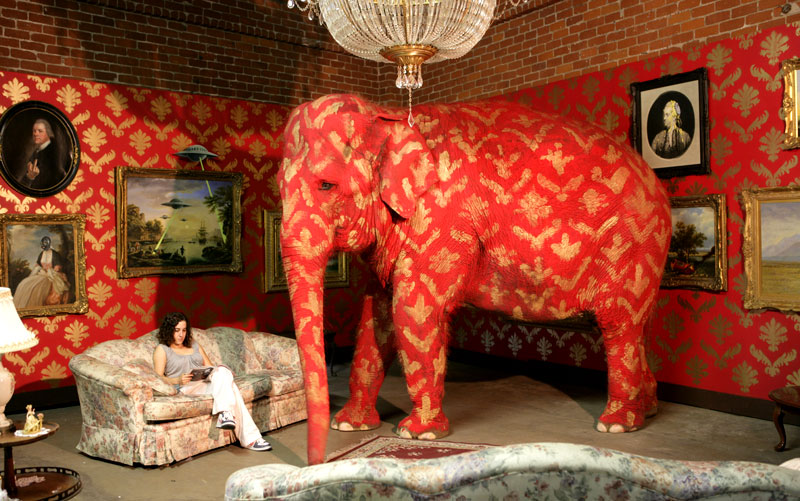
The idea for the title came from the phrase “There’s an Elephant in the Room”, a curious expression that even has its own wikipedia entry, as well as being the title of the picture shown here made by the artist Banksy. It refers to something that is large and obvious, but is being ignored for some reason, usually because it is considered impolite to draw attention to it. My talk of course wasn’t about real elephants but the possibility that there may be a metaphorical one in the field of cosmology, something that is consciously ignored by most of the community.

In yesterday’s post, I referred to the importance of the cosmic microwave background in establishing the so-called “concordance model” of cosmology. But as well as providing compelling evidence in support of this theory, the CMB has also thrown up a few bits of evidence that are quite difficult to reconcile with the standard description of the Universe.

Perhaps the most famous of these anomalies is the so-called “Axis of Evil“, which is an unexplained alignment of features in the pattern of temperature fluctuations observed across the sky by the Wilkinson Microwave Anisotropy Probe (WMAP) satellite. In the concordance picture, the fluctuations are basically random so there shouldn’t be coherent alignments like this.

But the Axle of Elvis isn’t the only curiosity in the cosmology shop. There is also a significant asymmetry between North and South on the sky (with respect to the ecliptic plane) when the two celestial hemispheres should be statistically indistinguishable if the standard model is correct.

There also exists a peculiar cold spot. Of course a fluctuating temperature pattern must contain places colder than average and places hotter than average. However, the standard model assumes these are drawn from a Gaussian (or “normal“) distribution, in which large fluctuations are extremely rare. The cold spot we see in the WMAP is colder than the coldest cold spot expected if the standard model is right, with odds of greater than 1000:1 against.

And there’s more. Statistical measures of the fluctuation pattern, such as the correlation function, pixel variance and quadupole moment, all give results for the real sky that are discordant with theory, although admittedly some are more significant than others. There are others too but I have no time to go into them, except to say that they may be related to the ones I’ve already mentioned, or at least share a common cause.

So what’s going on? The most conservative view is that there is nothing in the data that can’t be explained by the standard model and what we are seeing is a consequence of over-interpreting one or two chance coincidences. In the words of Fred Menger

If tortured sufficiently, data will confess to anything.

There may indeed be some truth to this, but serious attempts have been made to assess the statistical significance of the various results and my personal reaction is that, while coincidences do happen, it is unwise to dismiss 1000:1 results as mere flukes. On the other hand, these assessments are difficult and the significance may have been miscalculated.

More likely is the presence of some slight unidentified systematic artefact in the data. Not being an experimentalist it’s unfair to cast doubts on the brilliant work of the WMAP team, but one should keep an open mind about this possibility.

But as a theorist I have to admit that the most exciting possibility is that, lurking out there somewhere, are clues to a radical departure from orthodox theory. Many suggestions have been made, and no doubt most of them will be shown to be wrong. But the most dramatic thing that can happen in science is when the only game in town is “none of the above” and we are forced to think outside the box altogether.

I’m certainly not going to argue that we need to ditch the standard model or that cosmologists should all become obsessed with these tantalising conundrums. But in focussing exclusively on questions related to the standard model and its parameters, we may be throwing away a great deal of potentially exciting information. Every now and again, it’s worth checking your waste basket in case there’s something in it that you really shouldn’t have binned.

I realise that there are probably too many mixed metaphors in this piece. They’re a habit of mine and when you get to my age it’s difficult to change. After all, you can’t teach an old leopard to change its spots in midstream.


Mesmeric Universes

Posted in The Universe and Stuff with tags , , on September 25, 2008 by telescoper

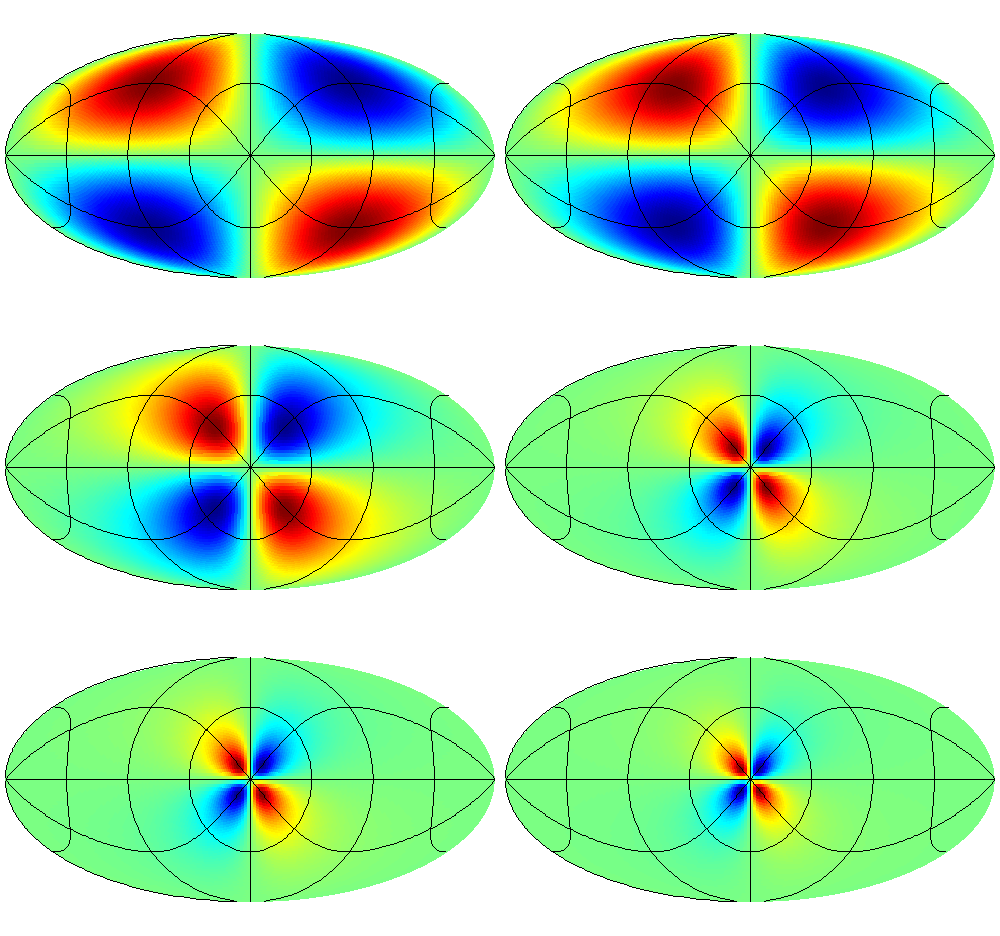
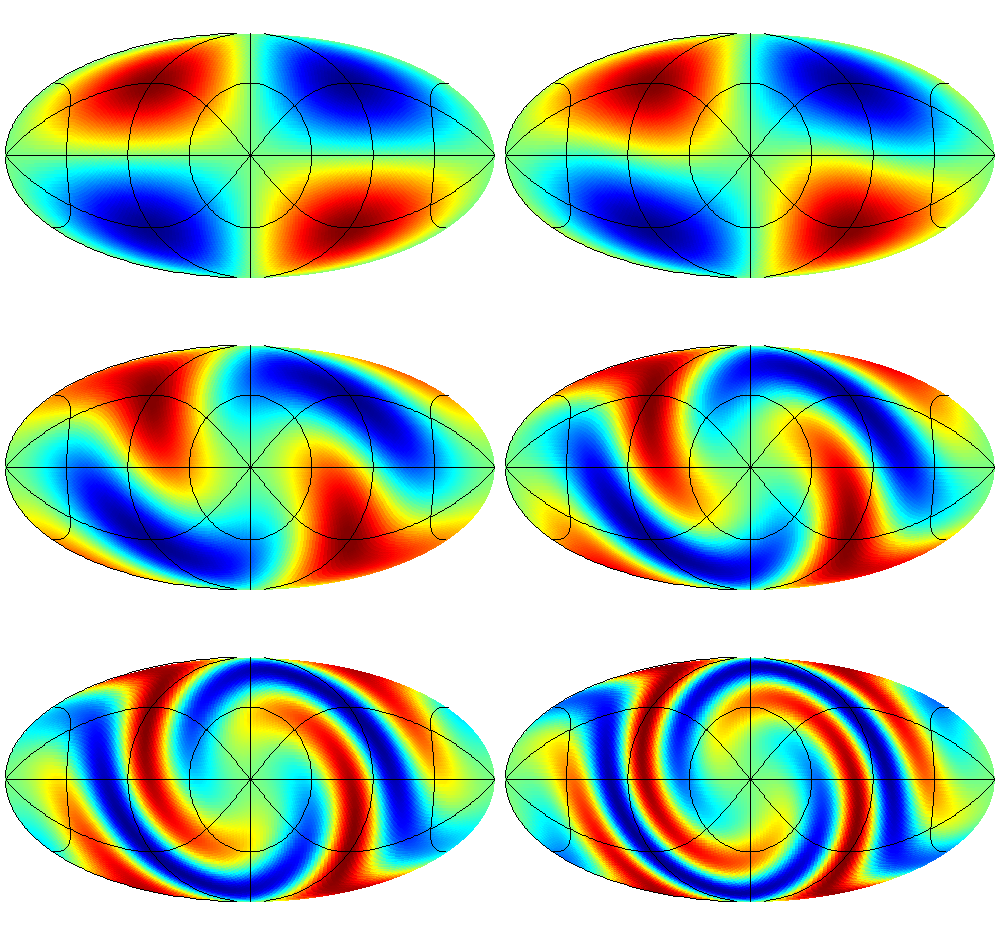
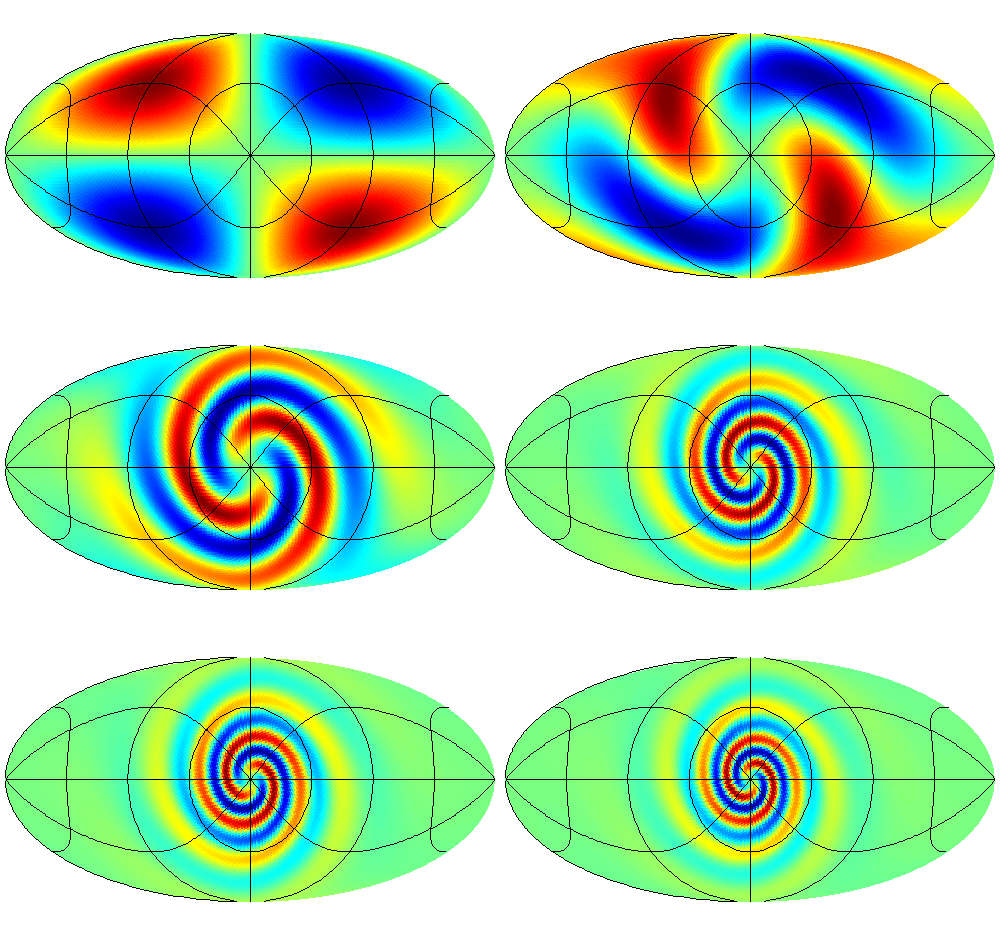
It’s probably going to be difficult to describe what these images really are without going into enormous amounts of technical detail, but I think they are fun so I thought I’d put the pictures up with only a brief description. The remind me a little bit of the sort of hypnotic swirl sometimes used to put people under, although there’s a bit more to them than that.

According to our the standard “Big Bang” model, our Universe satisfies the Cosmological Principle which is that it is both homogeneous and isotropic, i.e. that it is the same in every location and looks the same in all directions. Of course we know our Universe isn’t exactly like that because it contains lumps of stuff called galaxies that correspond to variations in its density, but if look at sufficiently large scales it begins to look smooth. Sand is lumpy if you look close at it, but if you look at it from a long way away it looks smooth. The universe is supposed to be similarly smooth if you take a coarse-grained view.

The primary reason for incorporating the Cosmological Principle into models of the Universe is to make the mathematics simple. Einstein’s General Theory of Relativity is such a difficult theory that there are very few situations where the equations can actually be solved. One case where exact solution is relatively easy to achieve is that of homogeneous and isotropic space, which is such a symmetric state of affairs that much of the complexity of the Einstein equations disappears. Cosmological models based on this solution are generally called the Friedman models, after Alexander Friedman who first derived the solutions in the 1920s.

Despite their simplicity, the Friedman models turned out to be surprisingly accurate at describing our actual Universe which we now know to be very close to homogeneous and isotropic. Evidence for this comes from the Cosmic Microwave Background (CMB) which is astonishingly smooth across the sky. Variations in the sky temperature of the CMB are about one part in a hundred thousand of the mean temperature, which is smoother than the surface of a billiard ball.

However, it remains possible that our Universe may be slightly asymmetric and it is interesting to know what the CMB would look like if this were the case. Unfortunately there is no general cosmological solution available, so we have to tread slowly. One approach is to look at Universes which are homogeneous (the same in every place) but not isotropic (they look different in different directions). This might be describe the situation if the Universe were expanding more quickly in one direction that the others, or if it were rotating.

Actually the theory of homogeneous anisotropic universe models is quite well established and there is a full classification of all the possibilities, into the nine so-called Bianchi types. This is mathematically very complicated, so I won’t give details. However, my PhD student Rockhee has been calculating what the CMB pattern would look like in these models and the results are very pretty so I’ve included a few examples here. The little animated gifs show what the sky looks like as the Universe evolves in such cases. In all cases it starts as a pure quadrupole, i.e. a 90 degree variation across the sky. You might have to click on the image to see the animation.

The first one is Bianchi Type V. This is an example of a model in which the space is curved, so that as time goes on the initial quadrupole is focussed by gravitational effects into a smaller and smaller region of the sky. The preferred direction in this (and the other models) is picked to be in the centre of the image and the projection shows the whole sky. Hot spots are blue and cold spots are red, which is the way a physicist should plot temperature.

The next example is Bianchi Type VII_0 which is a flat Universe with rotation. What happens is that the initial quadrupole in this case gets twisted by the rotating space-time into a sort of spiral pattern. Late on in the evolution of such a Universe, an observer would see an interesting swirly structure in the cosmic microwave background.

The final example is my favourite, Bianchi Type VII_h. This one is a sort of combination of the two above examples. It has both rotation and curvature, so there is a swirly pattern which also gets focussed into a small bit of the sky. An observer living in such a Universe would see a prominent spot on the sky lying in the direction of the axis, which in this case is chosen to be in the centre of the diagram.

We’ve also been working out what the sky would look like in polarized light for these, but that’s even more complicated. If you’re really interested, I’ll post a link to the paper when it’s done…

Death and Conkers

Posted in Uncategorized with tags , , on September 24, 2008 by telescoper

Strange connections. No sooner do I post a meandering item about the autumn weather bringing about flashbacks when I get two – quite different echoes – from today’s Guardian.

The first came from the obituary pages, where I read of the death on September 21st 2008 of Professor Sir Brian Pippard, aged 88.

I never knew him personally. In fact he retired from his post as Cavendish Professor of Physics in 1982, which was the year I started my undergraduate degree at Cambridge, so I was never taught by him. His research was predominantly in the area of superconductivity, which is far from my own speciality, so I never knew him through that route either.  But I did develop a kind of respect for him through a little book he compiled, called Cavendish Problems in Classical Physics.

This was on the list of required textbooks I got before I started my time as a student and I still have it today. As its name suggests, this contains all manner of problems about very mainstream topics in physics: electricity, magnetism, mechanics, and so on. Some of them are short, some long, but all have interesting little twists in them and each is instructive in its own way. 

I tried some of these problems on first year physics students at Cardiff last academic year and they turned out to be excessively challenging. In other words, the students couldn’t do them. I don’t want to go into a rant about declining standards of school science teaching, but it is a fact that A-level physics nowadays provides absolutely no preparation for tackling the likes of the  Cavendish Problems because it does not cultivate the kind of lateral thinking needed even to formulate these problems. Instead the students tend to be taken through standard exercises that they learn by rote and regurgitate in examinations. Anything different to what they’ve been led through completely throws them. I’m generalizing horribly, I know, but there’s a lot of truth in there.

It’s not so much that students can’t complete the Cavendish problems, but that they don’t even know how to start. It’s a shame that the art of genuine problem solving is so badly neglected in today’s schools, especially because its the bit that’s the most fun .  The brain can be so much more than a memory device, if only we could free up future generations of young minds by abandoning the obsession with modularised, factoid based teaching.

I think Brian Pippard would have agreed.

The other of today’s autumnal flashbacks was triggered by a short piece about the humble horse chestnut tree.  At this time of year the ground underneath these trees is covered with conkers which are collected by schoolboys and used in the game of the same name.  Or at least that’s what used to happen.

Apparently, for several years now horse chestnut trees have been struggling with adverse weather and attacks from moths. Now they have an even tougher enemy, a virulent disease called bleeding canker. This causes a sticky ooze to emanate from the trunk and branches of the trees, the leaves to die much earlier than usual and, worst of all,  the conkers to be very small or even non-existent. The bacterium that causes this disease  now infects about half the horse chestnut trees in the United Kingdom, and there is no known cure.

The death of high school physics is bad enough, but how can we ever cope without conkers?

The MacGuffin Factor

Posted in Science Politics, The Universe and Stuff with tags , , , on September 22, 2008 by telescoper

Unpick the plot of any thriller or suspense movie and the chances are that somewhere within it you will find lurking at least one MacGuffin. This might be a tangible thing, such the eponymous sculpture of a Falcon in the archetypal noir classic The Maltese Falcon or it may be rather nebulous, like the “top secret plans” in Hitchcock’s The Thirty Nine Steps. Its true character may be never fully revealed, such as in the case of the glowing contents of the briefcase in Pulp Fiction , which is a classic example of the “undisclosed object” type of MacGuffin. Or it may be scarily obvious, like a doomsday machine or some other “Big Dumb Object” you might find in a science fiction thriller. It may even not be a real thing at all. It could be an event or an idea or even something that doesn’t exist in any real sense at all, such the fictitious decoy character George Kaplan in North by Northwest.

Whatever it is or is not, the MacGuffin is responsible for kick-starting the plot. It makes the characters embark upon the course of action they take as the tale begins to unfold. This plot device was particularly beloved by Alfred Hitchcock (who was responsible for introducing the word to the film industry). Hitchcock was however always at pains to ensure that the MacGuffin never played as an important a role in the mind of the audience as it did for the protagonists. As the plot twists and turns – as it usually does in such films – and its own momentum carries the story forward, the importance of the MacGuffin tends to fade, and by the end we have often forgotten all about it. Hitchcock’s movies rarely bother to explain their MacGuffin(s) in much detail and they often confuse the issue even further by mixing genuine MacGuffins with mere red herrings.

North by North West is a fine example of a multi-MacGuffin movie. The centre of its convoluted plot involves espionage and the smuggling of what is only cursorily described as “government secrets”. But although this is behind the whole story, it is the emerging romance, accidental betrayal and frantic rescue involving the lead characters played by Cary Grant and Eve Marie Saint that really engages the characters and the audience as the film gathers pace. The MacGuffin is a trigger, but it soon fades into the background as other factors take over.

There’s nothing particular new about the idea of a MacGuffin. I suppose the ultimate example is the Holy Grail in the tales of King Arthur and the Knights of the Round Table and, much more recently, the Da Vinci Code. The original Grail itself is basically a peg on which to hang a series of otherwise disconnected stories. It is barely mentioned once each individual story has started and, of course, is never found.

Physicists are fond of describing things as “The Holy Grail” of their subject, such as the Higgs Boson or gravitational waves. This always seemed to me to be an unfortunate description, as the Grail quest consumed a huge amount of resources in a predictably fruitless hunt for something whose significance could be seen to be dubious at the outset.The MacGuffin Effect nevertheless continues to reveal itself in science, although in different forms to those found in Hollywood.

The Large Hadron Collider (LHC), switched on to the accompaniment of great fanfares last week, provides a nice example of how the MacGuffin actually works pretty much backwards in the world of Big Science. To the public, the LHC was built to detect the Higgs Boson, a hypothetical beastie introduced to account for the masses of other particles. If it exists the high-energy collisions engineered by LHC should reveal its presence. The Higgs Boson is thus the LHC’s own MacGuffin. Or at least it would be if it were really the reason why LHC has been built. In fact there are dozens of experiments at CERN and many of them have very different motivations from the quest for the Higgs.

Particle physicists are not daft, however, and they have realised that the public and, perhaps more importantly government funding agencies, need to have a really big hook to hang such a big bag of money on. Hence the emergence of the Higgs as a sort of master MacGuffin, concocted specifically for public consumption, which is much more effective politically than the plethora of mini-MacGuffins which, to be honest, would be a fairer description of the real state of affairs.

Even this MacGuffin has its problems, though. The Higgs mechanism is notoriously difficult to explain to the public, so some have resorted to a less specific but more misleading version: “The Big Bang”. As I’ve already griped, the LHC will never generate energies anything like the Big Bang did, so I don’t have any time for the language of the “Big Bang Machine”, even as a MacGuffin.

While particle physicists might pretend to be doing cosmology, we astrophysicists have to contend with MacGuffins of our own. One of the most important discoveries we have made about the Universe in the last decade is that its expansion seems to be accelerating. Since gravity usually tugs on things and makes them slow down, the only explanation that we’ve thought of for this perverse situation is that there is something out there in empty space that pushes rather than pulls. This has various possible names, but Dark Energy is probably the most popular, adding an appropriately noirish edge to this particular MacGuffin. It has even taken over in prominence from its much older relative, Dark Matter, although that one is still very much around.

We have very little idea what Dark Energy is, where it comes from, or how it relates to other forms of energy we are more familiar with, so observational astronomers have jumped in with various grandiose strategies to find out more about it. This has spawned a booming industry in survey of the distant Universe (such as the Dark Energy Survey) all aimed ostensibly at unravelling the mystery of the Dark Energy. It seems that to get any funding at all for cosmology these days you have to sprinkle the phrase “Dark Energy” liberally throughout your grant applications.

The old-fashioned “observational” way of doing astronomy – by looking at things hard enough until something exciting appears (which it does with surprising regularity) – has been replaced by a more “experimental” approach, more like that of the LHC. We can no longer do deep surveys of galaxies to find out what’s out there. We have to do it “to constrain models of Dark Energy”. This is just one example of the not necessarily positive influence that particle physics has had on astronomy in recent times and it has been criticised very forcefully by Simon White.

Whatever the motivation for doing these projects now, they will undoubtedly lead to new discoveries. But my own view is that there will never be a solution of the Dark Energy problem until it is understood much better at a conceptual level, and that will probably mean major revisions of our theories of both gravity and matter. I venture to speculate that in twenty years or so people will look back on the obsession with Dark Energy with some amusement, as our theoretical language will have moved on sufficiently to make it seem irrelevant.

But that’s how it goes with MacGuffins. Even the Maltese Falcon turned out to be a fake in the end.

p.s. I heard on Saturday that the LHC is having some problems with its magnets and will actually be off-line for a few months. Last week I heard a particle physicist describing the great switch-on as like “Christmas”. This turns out to have been truer than he can have imagined. Only a week has passed and his most expensive toy is already broken…

Nice work if you can get it..

Posted in Books, Talks and Reviews with tags , , , on September 19, 2008 by telescoper

I’ve just discovered that my review of Steven Weinberg’s new book “Cosmology” has been published today in the American journal Science. ( I think the link will only work if you or your institution has a subscription to the magazine.) It’s quite a nice job getting to review books like this, not because you get paid a lot (in fact, usually you don’t get paid at all), but because you get a free copy of the book and there is a clear incentive to read it. Reviews themselves are quite easy to do, as they’re usually only around a thousand words so don’t take more than an hour or so to rattle off.

The case of this particular book is quite unusual, thought, because Science usually only includes reviews of popular-level books, and this one is very technical. However, because Weinberg is such an eminent and well known physicist and this work is a long-awaited update of his classic Gravitation and Cosmology (published in 1972), it makes an interest subject for a review even if it is probably impossible for a non-specialist to actually read and understand all of it. It’s definitely not for the mathematically faint-hearted. In the review I stayed off the mathematical details and tried to explain how this book exemplifies the changes that have taken place in cosmology over the past thirty or forty years. Anyway, as you will see if you read the review, I liked the updated book a lot but I think it’s definitely for connoisseurs rather than absolute beginners.

The Curious Case of the Inexpert Witness

Posted in Bad Statistics with tags , , , on September 17, 2008 by telescoper

Although I am a cosmologist by trade, I am also interested in the fields of statistics and probability theory. I guess this derives from the fact that a lot of research in cosmology depends on inferences drawn from large data sets. By its very nature this process is limited by the fact that the information obtained in such studies is never complete. The analysis of systems based on noisy or incomplete data is exactly what probability is about.

Of course, statistics has much wider applications than in pure science and there are times when it is at the heart of controversies that explode into the public domain, particularly when involved in medicine or jurisprudence. One of the reasons why I wrote my book From Cosmos to Chaos was a sense of exasperation at how poorly probability theory is understood even by people who really should know better. Although statistical reasoning is at the heart of a great deal of research in physics and astronomy, there are many prominent practioners who don’t really know what they are talking about when they discuss probability. As I soon discovered when I started thinking about writing the book, the situation is even worse in other fields. I thought it might be fun to post a few examples of bad statistics from time to time, so I’ll start with this, which is accompanied by a powerpoint file of a lunchtime talk I gave at Cardiff.

I don’t have time to relate the entire story of Sally Clark and the monstrous miscarriage of justice she endured after the deaths of her two children. The wikipedia article I have linked to is pretty accurate, so I’ll refer you there for the details. In a nutshell, in 1999 she was convicted of the murder of her two children on the basis of some dubious forensic evidence and the expert testimony of a prominent paediatrician, Sir Roy Meadow. After appeal her convinction was quashed in 2003, but she died in 2007 from alcohol poisoning having apparently taken to the bottle after three years of wrongful imprisonment.

Professor Meadow had a distinguished (if somewhat controversial) career, becoming famous for a paper on Munchausen’s Syndrome by Proxy which appeared in the Lancet in 1977. He subsequently appeared as an expert witness in many trials of parents accused of murdering their children. In the Sally Clark case he was called as a witness for the prosecution, where his testimony included an entirely bogus and now infamous argument about the probability of two sudden infant deaths happening accidentally in the same family.

The argument is basically the following. The observed ratio of live births to cot deaths in affluent non-smoking families (like Sally Clark’s) is about 8,500:1. This means that about 1 in 8,500 children born to such families die in such a way. He then argued that the probability that two such tragedies happen in the same family is this number squared, i.e. about 73,000,000:1. In the mind of the jury this became the odds against the death of Mrs Clark’s children being accidental and therefore presumably the odds against her being innocent. The jury found her guilty.

For reasons why this argument is completely bogus, and more technical details, look in the following powerpoint file (which involves a bit of maths):

the-inexpert-witness

It is difficult to assess how important Roy Meadow’s testimony was in the collective mind of the Jury, but it was certainly erroneous and misleading. The General Medical Council decided that he should be struck off the medical register in July 2005 on the grounds of “serious professional misconduct”. He appealed, and the decision was partly overturned in 2006, the latest judgement basically being about what level of professional misconduct should be termed “serious”.

My reaction to all this is a mixture of anger and frustration. First of all, the argument presented by Meadow is so clearly wrong that any competent statistician could have been called as a witness to rebut it. The defence were remiss in not doing so. Second, the disciplinary action taken by the GMC seemed to take no account of the consequences his testimony had for Sally Clark. He was never even at risk of prosecution or financial penalty. Sally Clark spent three years of her life in prison, on top of having lost her children, and now is herself dead. Finally, expert testimony is clearly important in many trials, but experts should testify only on those matters that they are experts about! Meadow even admitted later that he didn’t really understand statistics. So why did he include this argument in his testimony? I quote from a press release produced by the Royal Statistical Society in the aftermath of this case:

Although many scientists have some familiarity with statistical methods, statistics remains a specialised area. The Society urges the Courts to ensure that statistical evidence is presented only by appropriately qualified statistical experts, as would be the case for any other form of expert evidence.

As far as I know, the criminal justice system has yet to implement such safeguards.

How many more cases like this need to happen before the Courts recognise the dangers of bad statistics?