Archive for Science

Among the Literati

Posted in Books, Talks and Reviews with tags , , on September 16, 2008 by telescoper
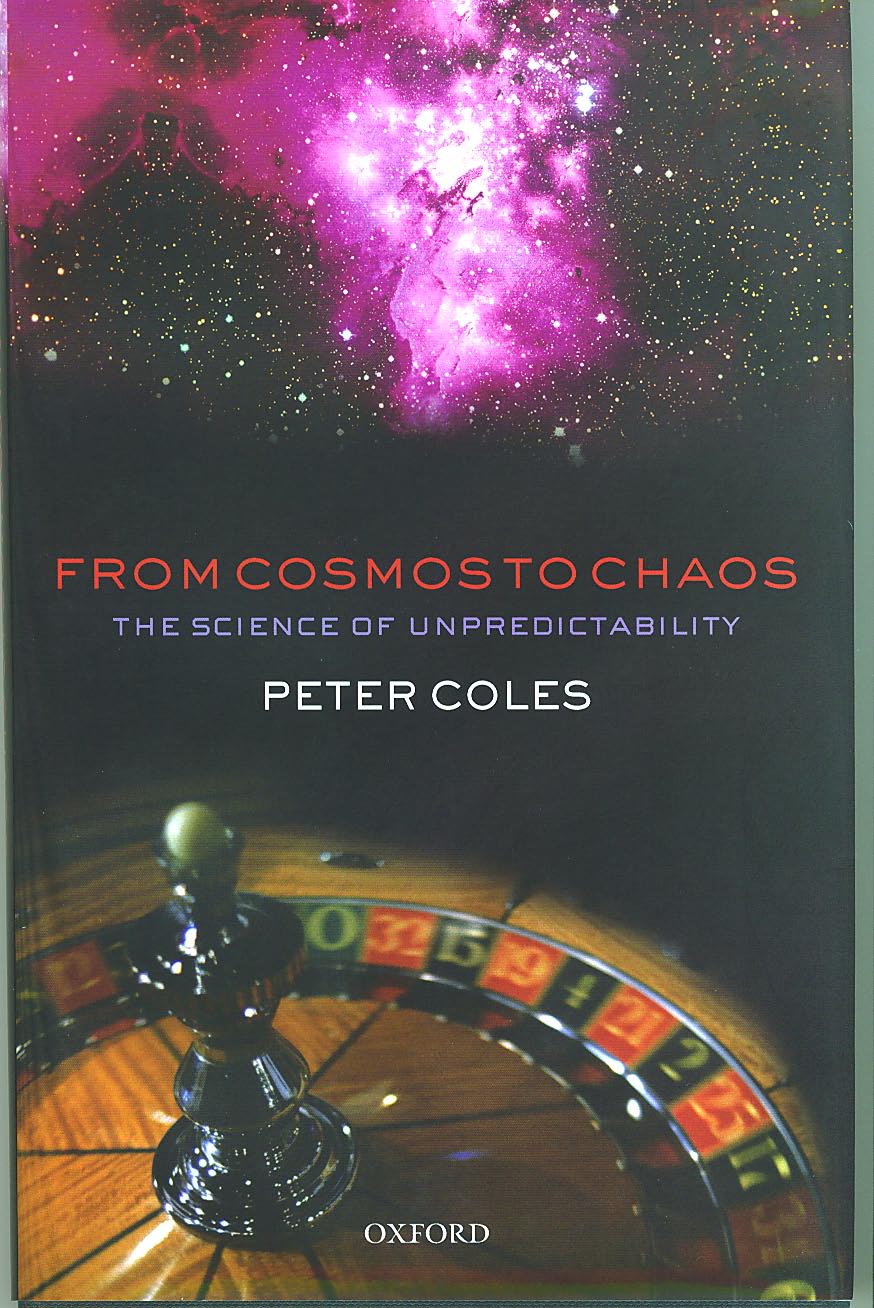
Front Cover

Front Cover

I couldn’t resist including the following which is taken from the Times Literary Supplement (March 28, 2008, No. 5478). I get the TLS mainly for the crossword, and was chuffed when they actually published a review of my book From Cosmos to Chaos, published by Oxford University Press in 2006, and which was also reviewed in Nature and Physics World.

Between you and me the book developed out of a number of bits and pieces about probability theory I had written over quite a long time but never published. I cobbled them together in a rush and the book is a bit of a mess, really. Had I had more time it might have been more coherent. Perhaps. And it didn’t help that OUP didn’t allow me to correct the proofs, so there are lots of typographical errors. Anyway, reviewers have been very generous, particular Jim Bennett (Director of the Museum of the History of Science at Oxford) who wrote the review from which I have taken the following excerpt. And in case you think I edited out the bad bits, that’s not true. He actually reviewed four books in one article and I’ve just taken the bit about mine.

We can turn from inclusiveness and caution to the refreshingly opinionated writing of Peter Coles in From Cosmos to Chaos. This is really a book about probability theory and its application to different branches of science, but Coles is a Professor of Astrophysics, and cosmology is one of the most evident strengths of his book. Here again we learn much besides about our author: he supports Newcastle United, follows cricket and is keen on gambling. His is the only book of these four that has any formal mathematics to speak of, and we are encouraged not to give up at the first hurdle. He also uses illustrations from card games and seems oblivious to the fact that his fascination with contract bridge is just as likely as his affection for mathematical formulae to put readers off.

Coles’s preferred methodology in probability theory is Bayesian, based on an assignment of probabilities, understood as degrees of reasonable belief, to possible outcomes, rather than deriving them from frequency-based statistics.

This preference is carried throughout From Cosmos to Chaos and its epistemological implications are readily embraced. The “standard model” in particle physics, for example, is not absolutely right, but is currently the best bet among the alternatives. The Big Bang is not certain but the best available model given the present array of observational data. A “Theory of Everything” will not, pace Stephen Hawking, reveal the Mind of God – that is “silly” – it will be the most economical description of the universe and a good way of saving paper. The concept of entropy has a “subjective” aspect, not in the sense that anyone can use it as they choose, but because it arises from “the way we manage our knowledge about nature rather than (being) about nature itself’. Here there is a genuine engagement between the scientist, the historian and the philosopher of science.

Is it his approach based on the assignment of reasonable belief that has liberated Coles to express such clear preferences and opinions on all manner of theories? He is good on the difficulties and inadequacies in quantum mechanics, and charming in telling us that, having been warned beforehand that the subject would be confusing, he studied it for three years before realizing “what was the correct way to be confused about it”. He is amazed that the Copenhagen interpretation (where an act of measurement compels a realization of one or other physical states that existed previously only within a distribution of probabilities) could have been embraced seriously by so many highly intelligent people; but he has even less time for the multiverse, and contends that “in the gap left by the failure to find a sensible way to understand quantum reality there has grown a pathological industry of pseudo scientific gobbledegook”.

Coles suggests that the probabilistic descriptions given by quantum mechanics may simply arise from its incompleteness and he sees potential in a Bayesian approach, where quantum states are understood as states of knowledge rather than states of reality. He is pessimistic about the value of string theory: its apparent unconcern for predictable outcomes sets it outside scientific practice, while its plethora of possible accounts of our universe, known as the “string landscape”, would be better called the “string scrap-yard”.

Coles’s mathematics is not always easy to follow, but it seems to occupy its proper place, with the voice of the physicist helping us to position and appreciate it even without full understanding. In the chapter on the Big Bang, for example, the general reader may not understand all of the technical accounts, but she will get a real sense of what cosmology is and the kinds of claims it makes. These are not dogmatic but offered with a kind of realistic integrity and concluded by a series of “open questions” – fundamental but not yet answered. In the last chapter, probabilistic reasoning is applied to questions closer to everyday life, such as medical statistics and expert witnessing, and in a final – seemingly incongruous but enjoyable – addendum Coles addresses the breakdown of trust between scientists and the public. This does not arise from his subject and seems to be there just because the author – characteristically, one feels – had things he wanted to say. While bemoaning decline in the distribution of science understanding, he also berates the baleful effect of the scientific zealot, insisting that the scientific approach is pragmatic rather than idealistic. Coles urges scientists to engage honestly with the public and educationalists not to dumb down the school curriculum.

Science and Religion

Posted in Books, Talks and Reviews with tags , , on September 16, 2008 by telescoper

This is a write-up of a talk I gave at the University of Derby earlier this year. Although I’m not religious myself, I don’t agree with the likes of Richard Dawkins and am quite happy to engage in dialogue on such things, as I think science and religion ask different questions and get different answers. But there can be no dialogue if there is dogma, whether it be of theist or atheist flavour.

Does the Big Bang Theory Explode Religion?

The Big Bang theory has been around for many years, and provides an amazingly accurate description of how elements were formed in the early Universe, so does this mean we have removed the need for a creator God?

When eminent cosmologist Professor Peter Coles talked to a group of people of many faiths (and of no faith) at the Multi-Faith Centre in the University of Derby on 14 February 2008, he gave a very clear andsuccinct description of the theory, using wit and wisdom to engage the audience in an evening of information and discussion.

Peter appears regularly in the media. His expertise includes the Big Bang theory, the expansion of the universe and whether it will continue to expand or ultimately collapse. He is based in theSchool of Physics and Astronomy, Cardiff University. He entertained the audience with his wit and humour. He gave a brief history of cosmology, explaining the evidence for our current understanding of the Universe and worked his way back to discuss its creation.

The conclusion of the event was that cosmology tries to explain HOW the Universe came about but cannot tell us WHY. “If I was creating the Universe I wouldn’t have done it this way,” Peter joked. “I would have had something simpler, not all messed up like this. But it wasn’t my decision.”

For a fuller report on the event see

http://www.emsec.org.uk/index.php/Creation_of_the_Universe

The Last Experiment

Posted in Science Politics, The Universe and Stuff with tags , , , on September 16, 2008 by telescoper

I’ve launched myself into the blogosphere just a bit too late for the feeding frenzy surrounding the switching on of the Large Hadron Collider at CERN last week. Obviously the event itself was a bit of a non-event as it will take years for anything interesting to come out the other end of its multi-billion-dollar tunnel. There are a couple of things worth saying in retrospect, though, now that the dust has settled.

The first is about all this nonsense concerning the creation of black holes that could destroy the Earth. If it were possible to create black holes in the LHC then they would be very puny ones, not capable of destroying anything very much at all. The phrase “black hole” conjures up Hollywood-style images of dead stars rampaging through the Galaxy devouring planets and costing a fortune in special effects. But not all black holes are massive enough to be stars in movies. If the LHC could make black holes it would only make very titchy ones. Since the gravitational effect of a black hole depends on its mass – and these little ones have very little of that – any that did pop out of an event in the LHC would be more of a pin-prick than a hole…

Moreover, energetic particles in the form of cosmic rays are constantly raining down on the Earth’s atmosphere, colliding with hadrons as they do so. The most extreme cosmic rays have energies far in excess of the limit that can be reached by the LHC. If an energetic hadron collision were going to produce a black hole that could destroy the planet, it would have happened a very long time ago and we wouldn’t be around to discuss the possibility.

So how did this daft idea come to dominate the news coverage surrounding the switch-on of the LHC? The press are never reluctant to peddle the doomsday scenario whenever they can as it appears to sell newspapers. But there is probably a bit more to it than that. I think part of it is a side-effect of the exaggerated language used by particle physicists in their attempt to use the LHC to capture the public imagination. “The Big Bang Machine” is just one example. If the experiment were really attempting to recreate the Big Bang, then there would indeed be much to be scared about. But the fact of the matter is that the LHC doesn’t reach energies anything like those reached in the Big Bang (nor even in the many smaller bangs that our Universe indulges in from time to time, such as supernova explosions).

The maximum energy reached by the LHC is going to be about 7 TeV (roughly equivalent to the energy of a bumble bee in flight). Although the very earliest stages of the Big Bang itself are not well understood, we are pretty sure that the primordial fireball started off with energies at least a million million (i.e. 1,000,000,000,000) times larger than this. It is doubtful (to say the least) that we’ll ever be able to build a device capable of reaching such energies, so the only “Big Bang Machine” there will ever be is the one we happen to be living in.

This is perhaps the reason why particle physicists are so desperate to glean maximum publicity for the LHC. It’s cost – though not extreme when compared to, for example, military spending – far exceeds that of any other scientific experiment. When it is over, will it be possible to build an even bigger experiment to probe even deeper into the subatomic world? Funding of such experiments generally comes from the public purse and it seems more than likely that the taxpayer will draw the line very soon. Although it won’t destroy the world, perhaps the LHC is nevertheless the end of the line for experimental physics of that kind.

So by all means let’s celebrate the LHC. It’s a wonderful demonstration of what international cooperation can achieve. It is also a response to the need all humans have to ask questions about our Universe. But let us not forget that our ability to probe the inner space of particles with experiments will always be limited, while the outer space beyond the stars offers much wider horizons.

PS. I can’t resist adding this link, as the best example of the worst of the hysteria about the LHC.

PPS. And this one, which explains why the LHC really is safe.