Archive for Science

The Moral Activity which Disentangles

Posted in Literature, The Universe and Stuff with tags , , , , , , , on May 22, 2013 by telescoper

I came across this last night and thought I would share it with you. It’s the preamble to Edgar Allan Poe‘s famous short story The Murders in the Rue Morgue, which is arguably the first-ever work in the genre of detective fiction. The piece is a bit dated (especially by the reference to the (now) discredited pseudoscience of phrenology, but Poe nevertheless says some very interesting things about a topic that I have returned to a number of times on this blog: the interplay between analysis and synthesis (and between deductive and inductive reasoning) involved not only in detective stories but also in card games and – I would contend – in the scientific method generally. I  agree with Poe when he says that the most fascinating part of such endeavours is the poorly understood yet vital element of intuition, that creative spark of ingenuity that sets apart a true genius, but am not sure about his contention that it is closely related to the analytic aspect. Anyway, see what you think…

–o–

IT is not improbable that a few farther steps in phrenological science will lead to a belief in the existence, if not to the actual discovery and location, of an organ of analysis. If this power (which may be described, although not defined, as the capacity for resolving thought into its elements) is not, in fact, an essential portion of what late philosophers term ideality, then there are, indeed, many good reasons for supposing it a primitive faculty. That it may be a constituent of ideality is here suggested in opposition to the vulgar dictum (founded, however, upon the assumptions of grave authority) that the calculating and discriminating powers (causality and comparison) are at variance with the imaginative — that the three, in short, can hardly co-exist. But, although thus opposed to received opinion, the idea will not appear ill-founded when we observe that the processes of invention or creation are strictly akin with the processes of resolution — the former being nearly, if not absolutely, the latter conversed.

It cannot be doubted that the mental features discoursed of as the analytical, are, in themselves, but little susceptible of analysis. We appreciate them only in their effects. We know of them, among other things, that they are always to their possessor, when inordinately possessed, a source of the liveliest enjoyment. As the strong man exults in his physical ability, delighting in such exercises as call his muscles into action, so glories the analyst in that moral activity which disentangles.  He derives pleasure from even the most trivial occupations bringing his talent into play. He is fond of enigmas, of conundrums, of hieroglyphics; exhibiting in his solutions of each a degree of acumen which appears to the ordinary apprehension præternatural. His results, brought about by the very soul ­and essence of method, have, in truth, the whole air of intuition.

The faculty in question is possibly much invigorated by mathematical study, and especially by that highest branch of it which, unjustly, and merely on account of its retrograde operations, has been called, as if par excellence, analysis.  Yet to calculate is not in itself to analyse. A chess-player, for example, does the one without effort at the other.  It follows that the game of chess, in its effects upon mental character, is greatly misunderstood. I am not now writing a treatise, but simply prefacing a somewhat peculiar narrative by observations very much at random; I will, therefore, take occasion to assert that the higher powers of the reflective intellect are more decidedly and more usefully tasked by the unostentatious game of draughts than by all the elaborate frivolity of chess. In this latter, where the pieces have different and bizarre motions, with various and variable values, that which is only complex is mistaken (a not unusual error) for that which is profound. The attention is here called powerfully into play. If it flag for an instant, an oversight is committed, resulting in injury or defeat. The possible moves being not only manifold but involute, the chances of such oversights are multiplied; and in nine cases out of ten it is the more concentrative rather than the more acute player who conquers. In draughts, on the contrary, where the moves are unique and have but little variation, the probabilities of inadvertence are diminished, and the mere attention being left comparatively unemployed, what advantages are obtained by either party are obtained by superior acumen. To be less abstract — Let us suppose a game of draughts, where the pieces are reduced to four kings, and where, of course, no oversight is to be expected. It is obvious that here the victory can be decided (the players being at all equal) only by some recherché movement, the result of some strong exertion of the intellect. Deprived of ordinary resources, the analyst throws himself into the spirit of his opponent, identifies himself therewith, and not unfrequently sees thus, at a glance, the sole methods (sometimes indeed absurdly simple ones) by which he may seduce into miscalculation or hurry into error.

Whist has long been noted for its influence upon what is termed the calculating power; and men of the highest order of intellect have been known to take an apparently unaccountable delight in it, while eschewing chess as frivolous. Beyond doubt there is nothing of a similar nature so greatly tasking the faculty of analysis. The best chess-player in Christendom may be little more than the best player of chess; but proficiency ­ in whist implies capacity for success in all those more important undertakings where mind struggles with mind. When I say proficiency, I mean that perfection in the game which includes a comprehension of all the sources (whatever be their character) whence legitimate advantage may be derived. These are not only manifold but multiform, and lie frequently among recesses of thought altogether inaccessible to the ordinary understanding. To observe attentively is to remember distinctly; and, so far, the concentrative chess-player will do very well at whist; while the rules of Hoyle (themselves based upon the mere mechanism of the game) are sufficiently and generally comprehensible. Thus to have a retentive memory, and to proceed by “the book,” are points commonly regarded as the sum total of good playing. But it is in matters beyond the limits of mere rule that the skill of the analyst is evinced. He makes, in silence, a host of observations and inferences. So, perhaps, do his companions; and the difference in the extent of the information obtained, lies not so much in the falsity of the inference as in the quality of the observation. The necessary knowledge is that of what to observe. Our player confines himself not at all; nor, because the game is the object, does he reject deductions from things external to the game. He examines the countenance of his partner, comparing it carefully with that of each of his opponents. He considers the mode of assorting the cards in each hand; often counting trump by trump, and honor by honor, through the glances bestowed by their holders upon each. He notes every variation of face as the play progresses, gathering a fund of thought from the differences in the expression of certainty, of surprise, of triumph or of chagrin. From the manner of gathering up a trick he judges whether the person taking it can make another in the suit. He recognises what is played through feint, by the air with which it is thrown upon the table. A casual or inadvertent word; the accidental dropping or turning of a card, with the accompanying anxiety or carelessness in regard to its concealment; the counting of the tricks, with the order of their arrangement; embarrassment, hesitation, eagerness or trepidation — all afford, to his apparently intuitive perception, indications of the true state of affairs. The first two or three rounds having been played, he is in full possession of the contents of each hand, and thenceforward puts down his cards with as absolute a precision of purpose as if the rest of the party had turned outward the faces of their own.

The analytical power should not be confounded with simple ingenuity; for while the analyst is necessarily ingenious, the  ingenious man is often remarkably incapable of analysis. I have spoken of this latter faculty as that of resolving thought into its elements, and it is only necessary to glance upon this idea to perceive the necessity of the distinction just mentioned. The constructive or combining power, by which ingenuity is usually manifested, and to which the phrenologists (I believe erroneously) have assigned a separate organ, supposing it a primitive faculty, has been so frequently seen in those whose intellect bordered otherwise upon idiocy, as to have attracted general observation among writers on morals. Between ingenuity and the analytic ability there exists a difference far greater indeed than that between the fancy and the imagination, but of a character very strictly analogous. It will be found, in fact, that the ingenious are always fanciful, and the truly imaginative never otherwise than profoundly analytic.
An Apology: The Royal Institution

Posted in Uncategorized with tags , , , on May 21, 2013 by telescoper

Earlier this year, in common with other media, this blog pledged its support to a campaign to save the Royal Institution from financial oblivion. In doing so I may have given the impression that the Royal Institution is a venerable and  highly esteemed organization dedicated to the task of bring science closer to the public and inspiring future generations with its exciting range of outreach activities, including its famous public lectures.

However, in the light of the Royal Institution’s recent decision to trademark the phrase “Christmas Lectures” , I now realize that this was misleading and in fact the Royal Institution is just another rapaciously self-serving organization, run by small-minded buffoons, which is dedicated to nothing but its own self-aggrandizement. It has further become clear that the RI will do anything it can to maintain its cushy existence in a  fancy property in Mayfair to the detriment of all  outreach activities elsewhere, and  should therefore be shut down immediately as a threat to the future health of UK science.

Moreover, as a protest, this blog calls upon all University science departments in the United Kingdom to organize their own series of  Christmas Lectures Yuletide Discourses  under the title Not the Royal Institution Christmas Lectures, beginning each presentation with a lengthy preamble describing the unpleasant and idiotic actions of the Royal Institution and explaining why its Christmas Lectures® should be boycotted.

I hope this clarifies the situation.

P.S. For more blog outrage, see here, here here…. (cont., p94).

All models are wrong

Posted in The Universe and Stuff with tags , , , , , , , , , on May 17, 2013 by telescoper

I’m back in Cardiff for the day, mainly for the purpose of attending presentations by a group of final-year project students (two of them under my supervision, albeit now remotely).  One of the talks featured a famous quote by the statistician George E.P. Box:

Essentially, all models are wrong, but some are useful.

I agree with this, actually, but only if it’s not interpreted in a way that suggests that there’s no such thing as reality and/or that science is just a game.  We may never achieve a perfect understanding of how the Universe works, but that’s not the same as not knowing anything at all. 

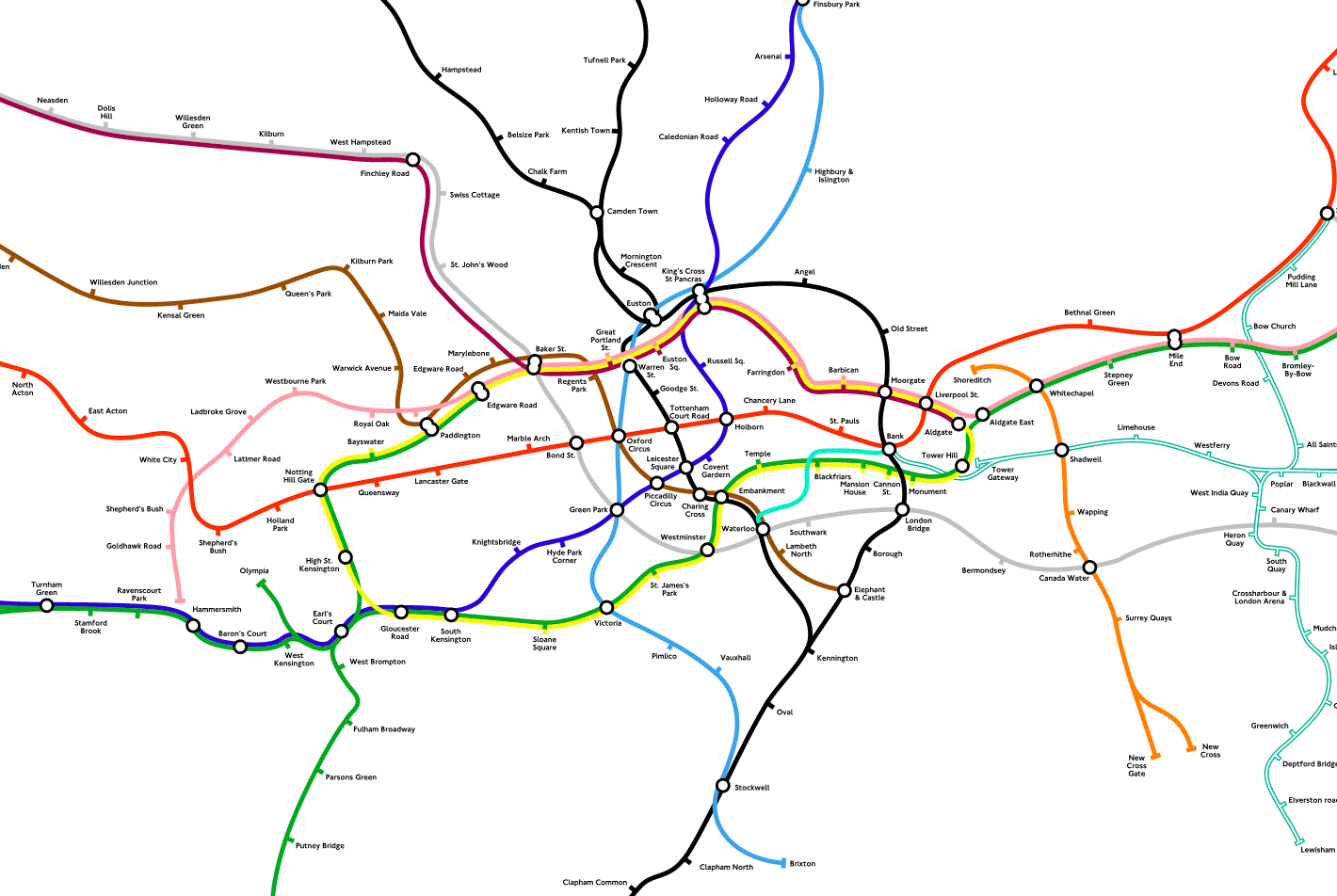
A familiar example that nicely illustrates my point  is the London Underground or Tube map. There is a fascinating website depicting the evolutionary history of this famous piece of graphic design. Early versions simply portrayed the railway lines inset into a normal geographical map which made them rather complicated, as the real layout of the lines is far from regular. A geographically accurate depiction of the modern tube network is shown here which makes the point:

geo_tubemap

A revolution occurred in 1933 when Harry Beck compiled the first “modern” version of the map. His great idea was to simplify the representation of the network around a single unifying feature. To this end he turned the Central Line (in red) into a straight line travelling left to right across the centre of the page, only changing direction at the extremities. All other lines were also distorted to run basically either North-South or East-West and produce a much more regular pattern, abandoning any attempt to represent the “real” geometry of the system but preserving its topology (i.e. its connectivity).  Here is an early version of his beautiful construction:

Note that although this a “modern” map in terms of how it represents the layout, it does look rather dated in terms of other design elements such as the border and typefaces used. We tend not to notice how much we surround the essential things with embellishments that date very quickly.

More modern versions of this map that you can get at tube stations and the like rather spoil the idea by introducing a kink in the central line to accommodate the complexity of the interchange between Bank and Monument stations as well as generally buggering about with the predominantly  rectilinear arrangement of the previous design:

I quite often use this map when I’m giving popular talks about physics. I think it illustrates quite nicely some of the philosophical issues related with theoretical representations of nature. I think of theories or models as being like maps, i.e. as attempts to make a useful representation of some  aspects of external reality. By useful, I mean the things we can use to make tests. However, there is a persistent tendency for some scientists to confuse the theory and the reality it is supposed to describe, especially a tendency to assert there is a one-to-one relationship between all elements of reality and the corresponding elements in the theoretical picture. This confusion was stated most succintly by the Polish scientist Alfred Korzybski in his memorable aphorism :

The map is not the territory.

I see this problem written particularly large with those physicists who persistently identify the landscape of string-theoretical possibilities with a multiverse of physically existing domains in which all these are realised. Of course, the Universe might be like that but it’s by no means clear to me that it has to be. I think we just don’t know what we’re doing well enough to know as much as we like to think we do.

A theory is also surrounded by a penumbra of non-testable elements, including those concepts that we use to translate the mathematical language of physics into everday words. We shouldn’t forget that many equations of physics have survived for a long time, but their interpretation has changed radically over the years.

The inevitable gap that lies between theory and reality does not mean that physics is a useless waste of time, it just means that its scope is limited. The Tube  map is not complete or accurate in all respects, but it’s excellent for what it was made for. Physics goes down the tubes when it loses sight of its key requirement, i.e. to be testable, and in order to be testable it has to be simple enough to calculate things to be compared with observations. In many cases that means a simplified model is perfectly adequete.

Another quote by George Box expands upon this point:

Remember that all models are wrong; the practical question is how wrong do they have to be to not be useful.

In any case, an attempt to make a grand unified theory of the London Underground system would no doubt produce a monstrous thing so unwieldly that it would be useless in practice. I think there’s a lesson there for string theorists too…

Many modern-day physicists are obsessed with the idea of a “Theory of Everything” (or TOE). Such a theory would entail the unification of all physical theories – all laws of Nature, if you like – into a single principle. An equally accurate description would then be available, in a single formula, of phenomena that are currently described by distinct theories with separate sets of parameters. Instead of textbooks on mechanics, quantum theory, gravity, electromagnetism, and so on, physics students would need just one book. But would such a theory somehow be  physical reality, as some physicists assert? I don’t think so. In fact it’s by no means clear to me that it would even be useful..

(Lack of) Diversity in STEM Subjects

Posted in Science Politics with tags , , , , , , on May 10, 2013 by telescoper

Among the things I learnt over the last few days was some interesting information about the diversity (or, rather, lack of diversity) of undergraduates taking undergraduate degrees in STEM subjects in the UK universities. For those of you not up on the lingo, `STEM’ is short for Science, Technology, Engineering and Mathematics. Last year the Institute of Physics produced a report that contains a wealth of statistical information about the demographics of the undergraduate population, from which the following numbers are only a small component.

Physics

Maths

Chemistry

Engineering

Female

21%

41%

44%

12%

BME

11%

24%

20%

30%

Socio-Economic

37%

42%

43%

51%

Non-EU

5%

12%

7%

32%

For completeness I should point out that these numbers refer to first-year undergraduates in 2010-11; I have no particular reason to suppose there has been a qualitative change since then. “BME” stands for “Black and Minority Ethnic”, and “Socio-Economic” refers to students whose with parents not employed in managerial or professional positions.

Overall, the figures here at the University of Sussex are roughly in line with, but slightly better than, these national statistics; the proportion of female students in our Physics intake for 2010/11, for example, was 27%.

There are some interesting (and rather disappointing) things to remark. First is that the proportion of Physics students who are female remains low; Physics scores very badly on ethnic diversity too. Mathematics on the other hand seems a much more attractive subject for female students.  Notice also how Physics and Chemistry attract a very small proportion of overseas students compared to Engineering.

In summary, therefore, we can see that Physics is a subject largely studied by white  middle-class European males. What are we doing wrong?

Despite considerable efforts to promote Physics to a more diverse constituency,  the proportion of, e.g., female physics students seems to have been bumping along at around 20% for ages.  Interestingly, all the anecdotal evidence suggests that those women who do Physics at University do disproportionately well, in the sense that female students constitute a  much larger fraction of First-class graduates than 20%. This strongly suggests that the problem lies at school level; some additional IOP information and discussion on this can be found here.

I’m just passing these figures on for information, as I’m quite often asked about them during, e.g., admissions-related activities. I don’t have any really compelling suggestions, but I would like to invite the blogosphere to comment and/or make suggestions as to promote diversity in STEM disciplines.

Should the passive voice be avoided?

Posted in Education with tags , , , , , on May 1, 2013 by telescoper

It’s another very busy day (as well as another lovely one) so I thought instead of sitting indoors this lunchtime writing a typically verbose blog item I’d just pick something out of my back catalogue and give it another airing because it deals with something that’s come up a couple of times recently.

This is the time of year when final-year students are drafting their project reports. Yesterday I was back in Cardiff giving feedback on two such articles.  I usually quite enjoy reading these things, in fact. They’re not too long and I’m usually pretty impressed with how the students have set about the (sometimes quite tricky) things I’ve asked them to do for their project work. I think the project report is quite a challenge for UK physics students because they generally haven’t had much practice in putting together a lengthy piece of writing before or during their university course, so haven’t developed a style that they feel comfortable with and are often unfamiliar with various conventions (such as reference style, punctuation of equations, etc). Some of these are explained in quite a lot of detail in the instructions the students are given, of course, but we all know that only girls read instructions….

The thing that strikes me most forcibly about the strange way students write project reports is that they are nearly always phrased entirely in the passive voice, e.g.

The experiment was calibrated using a phlogiston normalisation widget….

I accept that people disagree about whether the passive voice is good style or not. Some journals actively encourage the passive voice while others go the opposite way entirely . I’m not completely opposed to it, in fact, but I think it’s only useful either when the recipient of the action described in the sentence is more important than the agent, or when the agent is unknown or irrelevant. There’s nothing wrong with “My car has been stolen” (passive voice) since you would not be expected to know who stole it. On the other hand “My Hamster has been eaten by Freddy Starr” would not make a very good headline.

The point is that the construction of a statement in the passive voice in English is essentially periphrastic, in that it almost inevitably involves some form of circumlocution – either using more words than necessary to express the meaning or being deliberately evasive by introducing ambiguity. Both of these failings should be avoided in scientific writing.

Apparently, laboratory instructors generally tell students to write their reports in the passive voice as a matter of course. I think this is just wrong. In a laboratory report the student should describe what he or she did. Saying what “was done” often leaves the statement open to the interpretation that somebody else did it. The whole point of a laboratory report is surely for the students to describe their own actions. “We calibrated the experiment..”  or “I calibrated the experiment…” are definitely to be preferred to the form I gave above.

That brings me to the choice of pronoun in the active voice. One danger is that it can appear very bombastic, but that’s not necessarily the case. I don’t find anything particularly wrong in saying, e.g.

We improve upon the technique of Jones et al. (1848) by introducing a variable doofer in the MacGuffin control, thereby removing gremlins from the thingummy process.

But the main issue is whether to use the singular or plural form. It can be irritating to keep encountering “I did this..” and “I did that..” all the way through a journal paper, and I certainly  would feel uncomfortable writing a piece like that in the first person singular. I think it feels less egotistical to use “we”, even if there is only one author (which is increasingly rare in any case). If it’s good enough for the Queen it’s good enough for me! However, I just looked “we” up in Chambers dictionary and found

..used when speaking patronizingly, esp to children, to mean `you’.

which wasn’t at all what I had in mind!

However in the case of a student project that I’m assessing I actually want to know what the particular student  writing the report did, not what was done by person or persons unspecified or by a group of uncertain composition. So I encourage my students to put, e.g.,

I wrote a computer program in 6502 Assembly Language to solve the Humdinger equation using the Dingbat-Schnitzelgruber algorithm.

I also (sometimes) like “we” when there’s, e.g., a complicated mathematical derivation.  Going  line by line through a lengthy piece or difficult technical argument seems friendlier if you imagine that the reader is trying to do the calculation along with you as you write it:

if we differentiate the right hand side of equation (8), use the expression for x obtained in equation (97), expand y in a power-series and take away the number we first thought of we find…

The “we” isn’t necessarily an  author with delusions of grandeur (or schizophrenia), but instead denotes a joint operation between author and reader.

Anyway, to resume the thread, it seems to me that sometimes it is appropriate to use the passive voice because it is the correct grammatical construction in the circumstances. Sometimes also the text just seems to work better that way too. But having to read an entire document written in the passive voice drives me to distraction. It’s clumsy and dull.

In scientific papers, things are a little bit different but I still think using the active voice makes them easier to read and less likely to be ambiguous. In the introduction to a journal paper it’s quite acceptable to discuss the background to your work in the passive voice, e.g. “it is now generally accepted that…” but when describing what you and your co-authors have done it’s much better to use the active voice. “We observed ABC1234 using the Unfeasibly Large Telescope..” is, to my mind, much better than “Observations of ABC1234 were made using..”.

Reading back over this post I notice that I have jumped fairly freely between active and passive voice, thus demonstrating that I don’t have a dogmatic objection to its use. What I’m arguing is that it shouldn’t be the default, that’s all.

My guess is that a majority of experimental scientists won’t agree with this opinion, but a majority of astronomers and theoreticians will.

This guess will now be tested by reactivating an old poll..

Your PhD Questions Answered (?)

Posted in Education, The Universe and Stuff with tags , , , , , , on March 10, 2013 by telescoper

As I mentioned last week, one of the main items on the agenda at the moment is recruitment of new PhD students. As usual, this finds me having to operate on both sides of the fence,  playing a role in selecting students whilst also trying to advise students on how to target their applications, prepare for interview, and choose between offers (for those who manage to get a place).

In my field (astrophysics), the primary route for funding a PhD comes through the Science and Technology Facilities Council (STFC) which operates a national deadline (31st March) before which candidates can not be required to make a decision. This deadline sets the timescale for departments to decide too, as we clearly want to make sure all our first choice applicants get their offers before the cutoff date.

The national deadline prevents students from being pressured into making decisions before they have heard back from all the institutions to which they have applied, so in that sense it’s a good idea. On the other hand, it does mean that there’s often frantic activity on deadline day as offers are accepted or declined. Reserves have to be contacted quickly when a favoured candidate withdraws to go somewhere else and not all of them may still be available. A student who has been waiting anxiously without a first-choice offer may suddenly receive a lifeline on deadline day.

Getting offers is one thing, but deciding between them is quite another. There are many things to take into account, and the criteria are by no means clear. I’m not the only person to have been thinking about this. There are personal matters, of course. Is it a nice place? Are the people friendly? Do you think you can get on with your potential supervisor? That sort of thing. But there’s also the actual research. Is the project really what you want to do? Is is likely to open up a future career in research, or just be a dead end? Is the mixture of theory and experiment (or observation) what you would like?

One of the issues that often arises when I discuss research with potential PhD students is how structured the project  is. Some projects are  mapped out by the supervisor in great detail, with specific things to be done in a specific order with well-defined milestones against which progress can be measured. Others, especially but not exclusively theoretical ones, are much more of the nature of “here’s an interesting idea – let’s study it and see where it leads”. Most PhDs are somewhere between these two extremes, but it’s probably true that experimental PhDs are more like the former, whereas theoretical ones are more like the latter. Mine, in theoretical astrophysics, ended up evolving quite considerably from its starting point.

I’ve always been grateful to my supervisor for allowing me the freedom to follow my own curiosity. But I think it was essential to be given an initial focus, in the form of a specific project to cut my teeth on. Getting a calculation finished, written up and published gave me the confidence to start out on my own, but I did need a lot of guidance during that initial phase. We a;ll need to learn how to walk before we can run.

Another aspect of this is what the final thesis should look like. Should it be a monolithic work, focussed on one very specific topic, or can it be an anthology of contributions across a wider area?  Again, it’s a question of balance. I think that a PhD thesis should be seen as a kind of brochure advertising the skills and knowledge of the student that produced it. Versatility is a good quality, so if you can do lots of different things then your thesis should represent that. On the other hand, you also need to demonstrate the ability to carry out a sustained and coherent piece of research. Someone who flits around knocking out lots of cutesy “ideas papers” may get a reputation for being a bit of a dabbler who is unable or unwilling to tackle problems in depth. The opposite extreme would be a person who is incapable of generating new ideas, but excellent once pointed in a specific direction. The best scientists, in my opinion, have creative imagination as well as technical skill and stamina.  It’s a matter of balance, and some scientists are more balanced than others. There are some (scary) individuals who are brilliant at everything, of course., but us mere mortals have to make the most of our limited potential.

The postdoc market that lies beyond your PhD is extremely tough. To survive you need to maximize the chances of getting a job, and that means being able to demonstrate a suitability for as many opportunities as possible that come up. So if you want to do theory, make sure that you know at least something about observations and data analysis. Even if you prefer analytic work, don’t be too proud to use a computer occasionally. Research problems often require  you to learn new things before you can tackle them. Get into the habit of doing that while you’re a student, and you’re set to continue for the rest of your career. But you have to do all this without spreading yourself too thin, so don’t shy away from the chunky calculations that keep you at your desk for days on end. It’s the hard yards that win you the match.

When it comes to choosing supervisors, my advice would be to look for one who has a reputation for supporting their students, but avoid those who want to exert excessive control. I think it’s a supervisor’s duty to ensure that PhD student becomes as independent as possible as quickly as possible, but to be there with help and advice if things go wrong. Sadly there are some who treat PhD students simply as assistants, and give little thought to their career development.

But if all this sounds a bit scary, I’ll add just one thing. A PhD offers a unique challenge. It’s hard work, but stimulating and highly rewarding. If you find a project that appeals to you, go for it. You won’t regret it.

Emotion and the Scientific Method

Posted in Biographical, Music, The Universe and Stuff with tags , , , , on February 10, 2013 by telescoper

There was an article in today’s Observer in which four scientists from different disciplines talk about how in various ways they all get a bit emotional about their science. The aim appears to correct “the mistaken view that scientists are unemotional people”. It’s quite an interesting piece to read, but I do think the “mistaken view” is very much a straw man. I think most people realize that scientists are humans rather than Vulcans and that as such they have just as many and as complex emotions as other people do. In fact it seems to me that the “mistaken view” may only be as prevalent as it is because so many people keep trying to refute it.

I think anyone who has worked in scientific research will recognize elements of the stories discussed in the Observer piece. On the positive side, cracking a challenging research problem can lead to a wonderful sense of euphoria. Even much smaller technical successes lead to a kind of inner contentment which is most agreeable. On the other hand, failure can lead to frustration and even anger. I’ve certainly shouted in rage at inanimate objects, but have never actually put my first through a monitor but I’ve been close to it when my code wouldn’t do what it’s supposed to. There are times in that sort of state when working relationships get a bit strained too. I don’t think I’ve ever really exploded in front of a close collaborator of mine, but have to admit that one one memorable occasion I completely lost it during a seminar….

So, yes. Scientists are people. They can be emotional. I’ve even known some who are quite frequently also tired. But there’s nothing wrong with that not only in private life but also in their work. In fact, I think it’s vital.

It seems to me that the most important element of scientific research is the part that we understand worst, namely the imaginative part. This encompasses all sorts of amazing things, from the creation of entirely new theories, to the clever design of an experiment, to some neat way of dealing with an unforeseen systematic error. Instances of pure creativity like this are essential to scientific progress, but we understand very little about how the human brain accomplishes them. Accordingly we also find it very difficult to teach creativity to science students.

Most science education focuses on the other, complementary, aspect of research, which is the purely rational part: working out the detailed ramifications of given theoretical ideas, performing measurements, testing and refining the theories, and so on. We call this “scientific method” (although that phrase is open to many interpretations). We concentrate on that aspect because we at have some sort of conception at least of what the scientific method is and how it works in practice. It involves the brain’s rational functions, and promotes the view of a scientist as intellectually detached, analytic, and (perhaps) emotionally cold.

But what we usually call the scientific method would be useless without the creative part. I’m by no means an expert on cognitive science, but I’d be willing to bet that there’s a strong connection between the “emotional” part of the brain’s activities and the existence of this creative spark. We’re used to that idea in the context of art, and I’m sure it’s also there in science.

That brings me to something else I’ve pondered over for a while. Regular readers of this blog will know that I post about music from time to time. I know my musical tastes aren’t everyone’s cup of tea, but bear with me for a moment. Some of the music (e.g. modern Jazz)  I like isn’t exactly easy listening – its technical complexity places a considerable burden on the listener to, well, listen. I’ve had comments on my musical offerings to the effect that it’s music of the head rather than of the heart. Well, I think music isn’t an either/or in this respect. I think the best music offers both intellectual and emotional experiences. Not always in equal degree, of course, but the head and the heart aren’t mutually exclusive. If we didn’t have both we’d have neither art nor science.

In fact we wouldn’t be human.

Science Propaganda

Posted in Science Politics, The Universe and Stuff with tags , , on January 2, 2013 by telescoper

I thought I’d do a quick rehash of an old post which is vaguely relevant to the still simmering controversy generated by the Cox-Ince editorial I blogged about before Christmas.

The legitimate interface between science and society has many levels to it. One aspect is the simple need to explain what science tells us about the world in order that people can play an informed part in our increasingly technological society. Another is that there needs to be encouragement for (especially young) people to study science seriously and to make it their career in order to maintain the supply of scientists for the future. And then there is the issue of the wider cultural implications of science, its impact on other belief-systems (such as religions) other forms of endeavour (such as art and literature) and even for government.

I think virtually all scientists would agree with the need for engagement in at least the first two of these. In fact, I’m sure most scientists would love to have the chance to explain their work to a lay audience, but not all subjects are as accessible or inspirational as, say, astronomy. Unfortunately also, not all scientists are very good at this sort of thing. Some might even be counter-productive if inflicted on the public in this way. So it seems relatively natural that some people have had more success at this activity than others, and have thus become identified as “science communicators”. Although some scientists are a bit snobby about those who write popular books and give popular talks, most of us agree that this kind of work is vital for both science and society.

Vital, yes, but there are dangers. The number of scientists involved in this sort of work is probably more limited than it should be owing to the laziness of the popular media, who generally can’t be bothered to look outside London and the South-East for friendly scientists. The broadsheet newspapers employ very few qualified specialists among their staff even on the science pages so it’s a battle to get meaningful scientific content into print in the mass media. Much that does appear is slavishly regurgitated from one of the press agencies who are kept well fed by the public relations experts employed by research laboratories and other science institutes.

These factors mean that what comes out in the media can be a distorted representation of the real scientific process. Heads of research groups and laboratories are engaged in the increasingly difficult business of securing enough money to continue their work in these uncertain financial times. Producing lots of glossy press releases seems to be one way of raising the profile and gaining the attention of funding bodies. Most scientists do this with care, but sometimes the results are ludicrously exaggerated or simply wrong. Some of the claims circulating around the time the Large Hadron Collider was switched on definitely fell into one or more of those categories. I realise that there’s a difficult balance to be struck between simplicity and accuracy, and that errors can result from over-enthusiasm rather than anything more sinister, but even so we should tread carefully if we want the public to engage with what science really is.

The Cox-Ince editorial is refreshingly clear about the limitations of science:

Science is a framework with only one absolute: all opinions, theories and “laws” are open to revision in the face of evidence. It should not be seen or presented, therefore, as a body of inviolate knowledge against which policy should be judged; the effect of this would be to replace one priesthood with another. Rather, science is a process, a series of structures that allow us, in as unbiased a way as possible, to test our assertions against Nature.

However, there is still far too much science reporting that portrays as facts  ideas and theories which have little or no evidence to support them. This isn’t science communication, it’s science propaganda and I think too many scientists go along with it. There’s a difficult balance to be struck, between engaging the public with inspirational but superficial TV programmes and explaining the intellectual struggles that science really involves.  Give the public the latter without any of the former and they’ll surely switch off!

Most worryingly is the perceived need to demonstrate black-and-white certainty over issues which are considerably more complicated than that. This is another situation where science popularisation becomes science propaganda. I’m not sure whether the public actually wants its scientists to make pronouncements as if they were infallible oracles, but the media definitely do. Scientists sometimes become cast in the role of priests, which is dangerous, especially when a result is later shown to be false. Then the public don’t just lose faith with one particular scientist, but with the whole of science.

Science is not about certainty. What it is a method for dealing rationally with uncertainty. It is a pragmatic system primarily intended for making testable inferences about the world using measurable, quantitative data. Scientists look their most arrogant and dogmatic when they try to push science beyond the (relatively limited) boundaries of its applicability and to ride roughshod over alternative ways of dealing with wider issues including, yes, religion.

I don’t have any religious beliefs that anyone other than me would recognize as such. I am also a scientist. But I don’t see any reason why being a scientist or not being a scientist should have any implications for my (lack of) religious faith. God (whatever that means) is, by construction, orthogonal to science. I’m not at all opposed to scientists talking about their religion or their atheism in the public domain. I don’t see why their opinions are of any more interest than anyone else’s in these matters, but I’m quite happy to hear them voiced.

This brings us to the question, often raised by hardline atheists, as to whether more scientists  should follow Richard Dawkins’ lead and be champions of atheism in the public domain. As a matter of fact, I agree with some of Dawkins’ agenda, such as his argument for the separation of church and state, although I don’t feel his heavy-handed use of the vitriol in The God Delusion achieved anything particularly positive (except for his bank balance, perhaps). But I don’t think it’s right to assume that all scientists should follow his example. Their beliefs are their business. I don’t think we will be much better off if we simply replace one set of priests with another. In this respect I wholeheartedly agree with Peter Higgs who has recently described Dawkins as “embarrassing”.

So there you have my plea for both public and scientists to accept that science will never have all the answers. There will always be “aspects of human experience that, even in an age of astonishing scientific advance, remain beyond the reach of scientific explanation”.

Can I have the Templeton Prize now please?

Taking Notes…

Posted in Education with tags , , , , on November 6, 2012 by telescoper

As if this week wasn’t busy enough, I’ve just received back the student questionnaires for my second-year module The Physics of Fields and Flows (which includes some theoretical physics techniques, such as vector calculus and Fourier methods, together with applications to fluid flow, electromagnetism and a few other things). I’ve only just taken up this module this year and was planning to prepare it over the summer, but circumstances rather intervened and I’ve had to put together more-or-less on the fly. I was, therefore, not inconsiderably apprehensive about the reaction I’d get from the students.

Fortunately most of the comments were fairly positive, although there were some very useful constructive criticisms, which I’ll definitely take into account for the rest of the term.

However, one recurring comment was that I write too fast on the whiteboard. In fact I go far more slowly than the lecturers I had at University. That brings me back to an old post I did some time ago about  lecture notes.

I won’t repeat the entire content of my earlier discussion, but one of the main points I made in that was about how inefficient many students are at taking notes during lectures, so much so that the effort of copying things onto paper must surely prevent them absorbing the intellectual content of the lecture.

I dealt with this problem when I was an undergraduate by learning to write very quickly without looking at the paper as I did so. That way I didn’t waste time moving my head to and fro between paper and screen or blackboard. Of course, the notes I produced using this method weren’t exactly aesthetically pleasing, but my handwriting is awful at the best of times so that didn’t make much difference to me. I always wrote my notes up more neatly after the lecture anyway. But the great advantage was that I could write down everything in real time without this interfering with my ability to listen to what the lecturer was saying.

An alternative to this approach is to learn shorthand, or invent your own form of abbreviated language. This approach is, however, unlikely to help you take down mathematical equations quickly.

My experience nowadays is that students simply aren’t used to taking notes like this – I suppose because they get given so many powerpoint presentations or other kinds of handout –  so they struggle to cope with the old-fashioned chalk-and-talk style of teaching that some lecturers still prefer. That’s probably because they get much less practice at school than my generation. Most of my school education was done via the blackboard..

Nowadays,  most lecturers use more “modern” methods than this. Many lecturers using powerpoint, and often they give copies of the slides to students. Others give out complete sets of printed notes before, during, or after lectures. That’s all very well, I think, but what are the students supposed to be doing during the lecture if you do that? Listen, of course, but if there is to be a long-term benefit they should take notes too.

Even if I hand out copies of slides or other notes, I always encourage my students to make their own independent set of notes, as complete as possible. I don’t mean copying down what they see on the screen and what they may have on paper already, but trying to write down what I say as I say it. I don’t think many take that advice, which means much of the spoken illustrations and explanations I give don’t find their way into any long term record of the lecture.

And if the lecturer just reads out the printed notes, adding nothing by way of illustration or explanation, then the audience is bound to get bored very quickly.

My argument, then, is that regardless of what technology the lecturer uses, whether he/she gives out printed notes or not, then if the students can’t take notes accurately and efficiently then lecturing is a complete waste of time. In fact for the module I’m doing now I don’t hand out lecture notes at all during the lectures, although I do post lecture summaries and answers to the exercises online after they’ve been done.

I like lecturing, because I like talking about physics and astronomy, but as I’ve got older I’ve become less convinced that lectures play a useful role in actually teaching anything. I think we should use lectures more sparingly, relying more on problem-based learning to instil proper understanding. When we do give lectures, they should focus much more on stimulating interest by being entertaining and thought-provoking. They should not be for the routine transmission of information, which is far too often the default.

I’m not saying we should scrap lectures altogether. At the very least they have the advantage of giving the students a shared experience, which is good for networking and building a group identity. Some students probably get a lot out of lectures anyway, perhaps more than I did when I was their age. But different people benefit from different styles of teaching, so we need to move away from lecturing as the default option.

I don’t think I ever learned very much about physics from lectures, but I’m nevertheless glad I learned out how to take notes the way I did because I find it useful in all kinds of situations. Effective note-taking is definitely a transferable skill, but it’s also a dying art.

The Tremors from L’Aquila

Posted in Bad Statistics, Open Access, Science Politics with tags , , , on October 23, 2012 by telescoper

I can’t resist a comment on news which broke yesterday that an Italian court has found six scientists and a former government official guilty of manslaughter in connection with the L’Aquila Earthquake of 2009. Scientific colleagues of mine are shocked by their conviction and by the severity of the sentences (six years’ imprisonment), the assumption being that they were convicted for having failed to predict the earthquake. However, as Nature News pointed out long before the trial when the scientists were indicted:

The view from L’Aquila, however, is quite different. Prosecutors and the families of victims alike say that the trial has nothing to do with the ability to predict earthquakes, and everything to do with the failure of government-appointed scientists serving on an advisory panel to adequately evaluate, and then communicate, the potential risk to the local population. The charges, detailed in a 224-page document filed by Picuti, allege that members of the National Commission for Forecasting and Predicting Great Risks, who held a special meeting in L’Aquila the week before the earthquake, provided “incomplete, imprecise, and contradictory information” to a public that had been unnerved by months of persistent, low-level tremors. Picuti says that the commission was more interested in pacifying the local population than in giving clear advice about earthquake preparedness.

“I’m not crazy,” Picuti says. “I know they can’t predict earthquakes. The basis of the charges is not that they didn’t predict the earthquake. As functionaries of the state, they had certain duties imposed by law: to evaluate and characterize the risks that were present in L’Aquila.” Part of that risk assessment, he says, should have included the density of the urban population and the known fragility of many ancient buildings in the city centre. “They were obligated to evaluate the degree of risk given all these factors,” he says, “and they did not.”

Many of my colleagues have interpreted the conviction of these scientists as an attack on science, but the above statement actually looks to me more like a demand that the scientists involved should have been more scientific. By that I mean not giving a simple “yes” or “no” answer (which in this case was “no”) but by give a proper scientific analysis of the probabilities involved. This comment goes straight to two issues that I feel very strongly about. One is the vital importance of probabilistic reasoning – in this case in connection with a risk assessment – and the other is the need for openness in science.

I thought I’d take this opportunity to repeat the reasons I think statistics and statistical reasoning are so important. Of course they are important in science. In fact, I think they lie at the very core of the scientific method, although I am still surprised how few practising scientists are comfortable even with statistical language. A more important problem is the popular impression that science is about facts and absolute truths. It isn’t. It’s a process. In order to advance, it has to question itself.

Statistical reasoning also applies outside science to many facets of everyday life, including business, commerce, transport, the media, and politics. It is a feature of everyday life that science and technology are deeply embedded in every aspect of what we do each day. Science has given us greater levels of comfort, better health care, and a plethora of labour-saving devices. It has also given us unprecedented ability to destroy the environment and each other, whether through accident or design. Probability even plays a role in personal relationships, though mostly at a subconscious level.

Civilized societies face severe challenges in this century. We must confront the threat of climate change and forthcoming energy crises. We must find better ways of resolving conflicts peacefully lest nuclear or conventional weapons lead us to global catastrophe. We must stop large-scale pollution or systematic destruction of the biosphere that nurtures us. And we must do all of these things without abandoning the many positive things that science has brought us. Abandoning science and rationality by retreating into religious or political fundamentalism would be a catastrophe for humanity.

Unfortunately, recent decades have seen a wholesale breakdown of trust between scientists and the public at large; the conviction of the scientists in the L’Aquila case is just one example. This breakdown is due partly to the deliberate abuse of science for immoral purposes, and partly to the sheer carelessness with which various agencies have exploited scientific discoveries without proper evaluation of the risks involved. The abuse of statistical arguments have undoubtedly contributed to the suspicion with which many individuals view science.

There is an increasing alienation between scientists and the general public. Many fewer students enrol for courses in physics and chemistry than a a few decades ago. Fewer graduates mean fewer qualified science teachers in schools. This is a vicious cycle that threatens our future. It must be broken.

The danger is that the decreasing level of understanding of science in society means that knowledge (as well as its consequent power) becomes concentrated in the minds of a few individuals. This could have dire consequences for the future of our democracy. Even as things stand now, very few Members of Parliament are scientifically literate. How can we expect to control the application of science when the necessary understanding rests with an unelected “priesthood” that is hardly understood by, or represented in, our democratic institutions?

Very few journalists or television producers know enough about science to report sensibly on the latest discoveries or controversies. As a result, important matters that the public needs to know about do not appear at all in the media, or if they do it is in such a garbled fashion that they do more harm than good.

Years ago I used to listen to radio interviews with scientists on the Today programme on BBC Radio 4. I even did such an interview once. It is a deeply frustrating experience. The scientist usually starts by explaining what the discovery is about in the way a scientist should, with careful statements of what is assumed, how the data is interpreted, and what other possible interpretations might be and the likely sources of error. The interviewer then loses patience and asks for a yes or no answer. The scientist tries to continue, but is badgered. Either the interview ends as a row, or the scientist ends up stating a grossly oversimplified version of the story.

Some scientists offer the oversimplified version at the outset, of course, and these are the ones that contribute to the image of scientists as priests. Such individuals often believe in their theories in exactly the same way that some people believe religiously. Not with the conditional and possibly temporary belief that characterizes the scientific method, but with the unquestioning fervour of an unthinking zealot. This approach may pay off for the individual in the short term, in popular esteem and media recognition – but when it goes wrong it is science as a whole that suffers. When a result that has been proclaimed certain is later shown to be false, the result is widespread disillusionment. And the more secretive the behaviour of the scientific community, the less reason the public has to trust its pronouncements.

I don’t have any easy answers to the question of how to cure this malaise, but do have a few suggestions. It would be easy for a scientist such as myself to blame everything on the media and the education system, but in fact I think the responsibility lies mainly with ourselves. We are usually so obsessed with our own research, and the need to publish specialist papers by the lorry-load in order to advance our own careers that we usually spend very little time explaining what we do to the public or why we do it.

I think every working scientist in the country should be required to spend at least 10% of their time working in schools or with the general media on “outreach”, including writing blogs like this. People in my field – astronomers and cosmologists – do this quite a lot, but these are areas where the public has some empathy with what we do. If only biologists, chemists, nuclear physicists and the rest were viewed in such a friendly light. Doing this sort of thing is not easy, especially when it comes to saying something on the radio that the interviewer does not want to hear. Media training for scientists has been a welcome recent innovation for some branches of science, but most of my colleagues have never had any help at all in this direction.

The second thing that must be done is to improve the dire state of science education in schools. Over the last two decades the national curriculum for British schools has been dumbed down to the point of absurdity. Pupils that leave school at 18 having taken “Advanced Level” physics do so with no useful knowledge of physics at all, even if they have obtained the highest grade. I do not at all blame the students for this; they can only do what they are asked to do. It’s all the fault of the educationalists, who have done the best they can for a long time to convince our young people that science is too hard for them. Science can be difficult, of course, and not everyone will be able to make a career out of it. But that doesn’t mean that it should not be taught properly to those that can take it in. If some students find it is not for them, then so be it. I always wanted to be a musician, but never had the talent for it.

The third thing that has to be done is for scientists to be far more open. Publicly-funded scientists have a duty not only to publish their conclusions in such a way that the public can access them freely, but also to publish their data, their methodology and the intermediate steps. Most members of the public will struggle to make sense of the information, but at least there will be able to see that nothing is being deliberately concealed.

Everyone knows that earthquake prediction is practically impossible to do accurately. The danger of the judgement in the L’Aquila Earthquake trial (apart from discouraging scientists from ever becoming seismologists) is that the alarm will be sounded every time there is the smallest tremor. The potential for panic is enormous. But the science in this field,as in any other, does not actually tell one how to act on evidence of risk, merely to assess it. It’s up to others to decide whether and when to act, when the threshold of danger has been crossed. There is no scientific answer to the question “how risky is too risky?”.

So instead of bland reassurances or needless panic-mongering, the scientific community should refrain from public statements about what will happen and what won’t and instead busy itself with the collection, analysis and interpretation of data and publish its studies as openly as possible. The public will find it very difficult to handle this information overload, but so they should. Difficult questions don’t have simple answers. Scientists aren’t priests.