Archive for Sheherazarde

Boulanger, Shostakovich and Rimsky-Korsakov at the National Concert Hall

Posted in Biographical, Music with tags , , , , , , , , , , , , on January 17, 2026 by telescoper

It was a great pleasure last night to be able to attend my first concert of 2026 at the National Concert Hall. It was a rainy evening in Dublin, but the auditorium was nevertheless packed. The only issue was that so many people were there, mostly with overcoats checked into the cloakroom, that it took a long time to get out at the end!
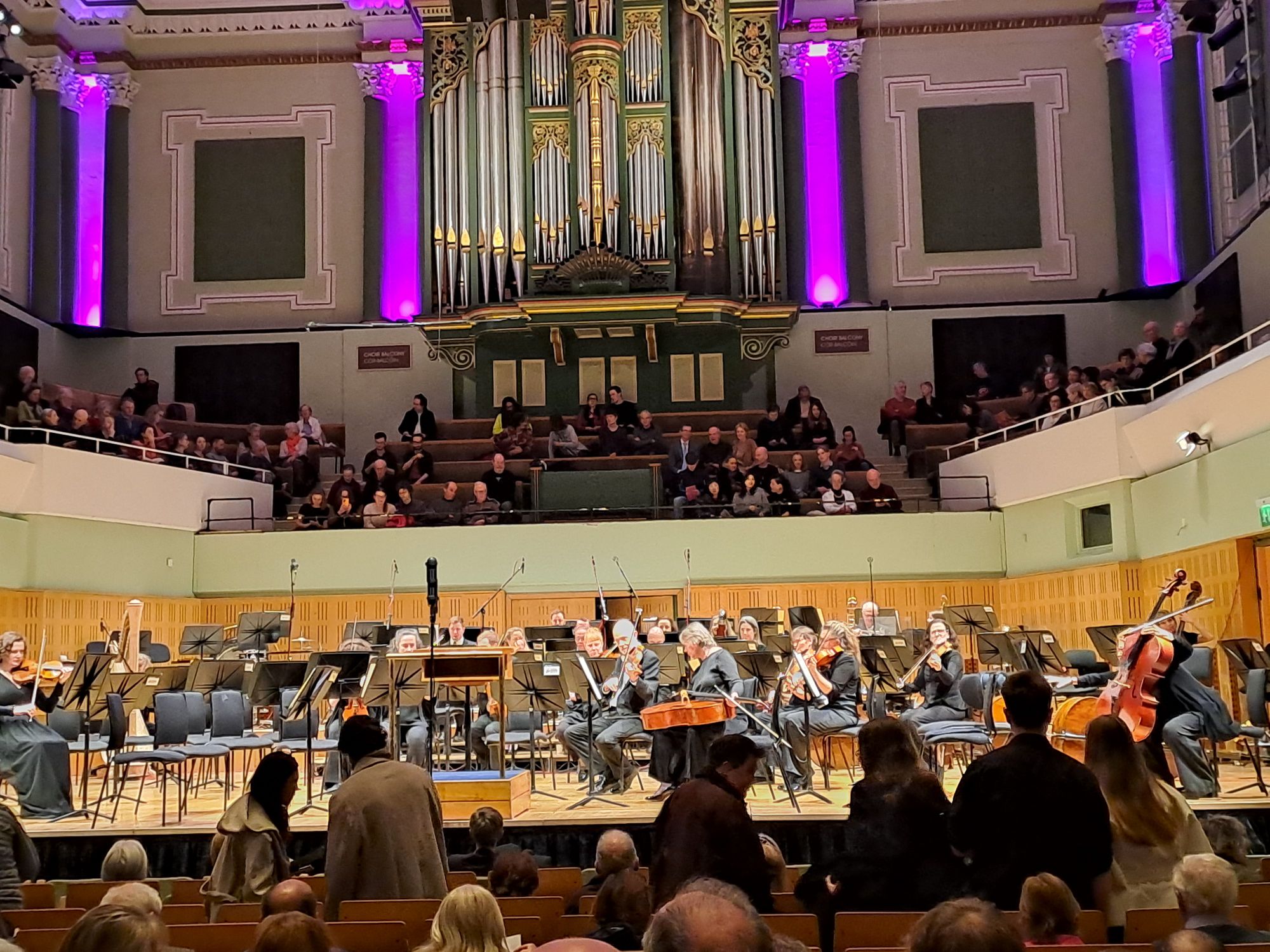
Before the performance

National Symphony Orchestra Ireland was conducted for the evening by guest conductor Anna Sułkowska-Migoń who directed a fine and varied programme of music.

The first piece (D’un Soir Triste; Of a Sand Evening) was by Lili Boulanger. I’ve heard a few pieces by her and found them all excellent, as was this one which is very atmospheric and packs a lot into the 12 minutes or so it takes to perform. The only reason Lili Boulanger is so much less famous than her older syster Nadia is that Lili suffered from ill health nearly all her life, eventually dying from tuberculosis just a few months after this piece was composed at the age of 24. Inevitably the number of compositions by her is very small, but as I said earlier everything I’ve heard by her is very good indeed. Her premature tragic death was a great loss.

After that piece there was considerable reorganization on the stage. The brass, woodwinds and percussion all left and space was made for the Steinway (between the conductor and the audience). Then we were joined by pianist Barry Douglas and trumpeter Darren Moore. The latter brough two trumpets with him, actually, of which more shortly.

The piece we were about to hear was listed in the programme as Concerto for Piano, Trumpet and String Orchestra (which is a more accurate description than the usual name Piano Concerto No. 1) by Dmitri Shostakovich. It’s quite hard to classify really, perhaps you could call it a Triple Concerto, but that doesn’t matter much. Music is much more important than how it is classified.

Although I admire the music of Shostakovich greatly, and look out for performances whenever I can, I had never heard this piece before. I was delighted by it. Written in 1933 when Shostakovich was only 27, it is instantly recognisable in style although I bit lighter and quirkier than one normally expects from that composer. Shostakovich had a wry sense of humour, but he often concealed his jokes to avoid getting into trouble. Not so in this piece, which is overtly playful and mischievous, rather than crypic

The trumpet plays a modest – indeed muted – part early on but, over the four movements, gradually becomes more prominent and at the end it delivers a series of exuberant fanfare-like figures as the key switches from C minor to close in C major. At this point I should given special mention to Darren Moore, Principal Trumpet of the NSOI, who played beautifully. He swtiched trumpets just before the end, where the trumpet is required to be louder and more assertive. I’m going to hazard a guess that he switched to a C trumpet for the closing stages, perhaps from a standard B♭ trumpet used earlier. I’ve heard it said that a C trumpet produces a brighter and cleaner sound, and it certainly did sound different from the other trumpet. If I am right it means that the piece concluded with none of the instruments on stage being transposing instruments.

Now a couple of questions for my readers. I have known some jazz trumpeters over the years and they all played B♭ trumpets. On this basis I always assumed that trumpets in classical orchestras would be B♭ instruments. Now I’m not sure this is true. Do trumpet players in classical orchestras usually use B♭ instruments, or does practice vary? A follow-up question is whether orchestral parts for trumpets and other transposing instruments are scored differently, or are the musicians required to do any transposition themselves? (If I had to bet I’d wager that professionally-trained classical musicians can transpose on sight.) Answers and comments through the comments box please.

Anyway, the hugely enjoyable performance was greeted with cheers and generous applause not only for the excellent soloists Barry Douglas and Darren Moore but for the whole Orchestra.

After the wine break we had a much more familiar work, the orchestral suite Scheherazade by Nikolai Rimsky-Korsakov. Pieces from this suite – especially the first section, The Sea and Sindbad’s Ship – often find their way into collections of popular classics and it is probably Rimsky Korsakov’s greatest hit. It’s inspired by the One Thousand and One Nights although there are only four movements, not 1001! The composer certainly included something for all sections of the orchestra, but there was especially beautiful playing by Elaine Clark (leader). I enjoyed this performance too, mainly as a bit of colourful escapism as did the audience, who have it another standing ovation.

Then it was into the queue to collect my coat and thence on foot to Pearse station for the train back to Maynooth. The rain had stopped by then.

Mozart, Ravel and Danielle de Niese

Posted in Biographical, Music with tags , , , , , , , , on February 4, 2023 by telescoper

After last week’s magnificent concert I couldn’t miss another chance to see and hear Danielle de Niese in at the National Concert Hall in Dublin, again with the National Symphony Orchestra under the direction of Jaime Martin. It was another fascinating (and very full) programme.

For last week’s concert, the National Concert Hall was only about two-thirds full but this time it was packed. I think the glowing reviews of La Voix Humaine contributed to that, as did the round of media interviews Danielle de Niese has done since then contributed to the full house.

Danielle de Niese seems to like singing 20th century French music and the concert opened with Shéhérazade by Maurice Ravel. This is a cycle of three songs which are settings of poems inspired by The Arabian Nights written by the pseudonymous poet Tristan Klingsor: Asie, La flûte enchantée, and L’Indifférent. Ravel was a real master of orchestration, and he creates a succession of exotic textures to complement the vocal lines. It’s not a long piece -altogether the three songs last about 15 minutes – but it covers a vast territory. There’s more than a nod to Debussy in this work too.

After that Danielle de Niese went off stage to change her frock, which was lime green for the Ravel, while the orchestra played the overture to the singspiel Die Entführung aus dem Serail (The Abduction from the Seraglio) by Wolfgang Amadeus Mozart. I’ve actually reviwed the whole Opera (was that really 12 years ago?) and wrote then (about the plot):

It’s admittedly a bit thin, even by the standards of comic opera but, right from the fabulous overture, the music is lovely and there’s a great deal of good-humoured fun, 

The overture is great fun to listen to, and obviously also to play. Jaime Martin was beaming and bouncing up and down on the podium during the performance.

And then Danielle de Niese returned (this time in a lurid red dress) to sing another piece by Mozart. Exsultate, Jubilate is a piece for solo voice and orchestra usually described as a motet but technically really a cantata. There are three movements, marked Allegro, Andante and Allegro. It’s obviously a work,with a religious theme, and the central Andante movement does sound like it is sacred music, but the outer Allegro movements are very operatic, with demanding coloratura passages, especially in the final Hallelujah. I don’t usually associate such vocal acrobatics with religious music, but it’s certainly a very exuberant and joyful piece. Astonishingly, Mozart was just 17 years old when he wrote it.

That piece by Mozart presented very different challenges to the soloist, Danielle de Niese but she showed herself to be a very accomplished performer in this too. With that her two-week residence in Dublin came to an end. She was presented with a huge bouquet of flowers and a standing ovation before we headed off to the bar for the interval.

After the wine break the National Symphony Orchestra was joined by the National Symphony Chorus for complete performance of the music to the ballet Daphnis et Chloé by Maurice Ravel. As is the case with Stravinsky’s Firebird, music from this ballet is often played in the form of a suite or, in the case of this ballet, two suites, but I have to say the whole is much greater than the sum of the suites and this work has become one of my favourite pieces to hear live. It’s a gloriously sensual and dramatic work, again brilliantly orchestrated, full of vibrant colours and lush textures, and even more wonderful when accompanied by the wordless singing of the massed ranks of the National Symphony Chorus. The score lasts a good hour, but that time seemed to flash by in this performance which was extremely well received by a very appreciative audience.

This was a very full programme and I had to leave during the applause to make sure I got back to Pearse station in time to catch the train back to Maynooth. I’m not as quick on my pins as I used to be. I arrived at Pearse with about five minutes to spare only to find that the train was five minutes late so I didn’t have rushed.

I have to congratulate whoever is doing the programming for these NSO concerts at the NCH. The last few have been excellent, and next week’s recipe of Ives, Beethoven and Sibelius looks great too!

The Firebird (and more) at St David’s Hall

Posted in Music with tags , , , , , , on October 18, 2016 by telescoper

Just a quick note to catch up on concert-going activities from last week, as for various reasons I had to skip a few days of blogging…

Last Thursday night (13th October) I was lucky enough to attend a tremendous concert at St David’s Hall in Cardiff featuring the BBC National Orchestra of Wales conducted by Thomas Søndergård at the start of their 2016/7 season. The main item on the bill was the complete score for Igor Stravinsky’s ballet The Firebird. This is a thrillingly piece, involving a huge orchestra, numbering about a hundred musicians, including some positioned away from the rest of the orchestra. In a performance of the ballet the main orchestra would be in the pit, not on the stage, and the musicians offstage in the concert would be onstage with the dancers. If you see what I mean.

The orchestration of The Firebird is a tour de force: intricate but vividly coloured, full of excitement and colour and the BBC National Orchestra of Wales played it with great passion and aplomb. A really brilliant performance.

The Firebird filled the second half of the programme. In the first half we heard three pieces by French composers: Prélude à l’après-midi d’un faune by Claude Debussy; the three songs from Shéhérazade by Maurice Ravel, sung by the inestimable Sarah Connolly; and  the Flute Concerto by Jacques Ibert played by Emily Beynon. The first two pieces are fairly standard in the concert repertoire, but the last one was completely new to me. The last piece is very fine indeed, consisting of two dazzlingly virtuosic faster movements (Allegro and Allegro Scherzando) either side of a lyrical Andante. The orchestra was somewhat pared down for this part of the concert, but it’s nevertheless a piece of substantial weight and harmonic complexity. Hats off to Emily Beynon and the BBC NOW for a wonderful introduction to this work.

What a rich and varied programme for a single concert, all wonderfully played. I’m certainly looking forward to the rest of the season!