Archive for Square Kilometre Array

The SKA Propaganda Machine

Posted in Astrohype, Science Politics, The Universe and Stuff with tags , , , , on February 14, 2012 by telescoper

I’m a big fan of the Square Kilometre Array, a proposed new radio telescope that will revolutionize our understanding of many aspects of astrophysics.

I’m somewhat less keen on the intense lobbying being carried out on behalf of Australian astronomers in advance of the decision whether to site it in Australia or South Africa. The campaign is being orchestrated by a PR organization called Ogilvy and Mather who are making full use of social media to promote the Australian case.

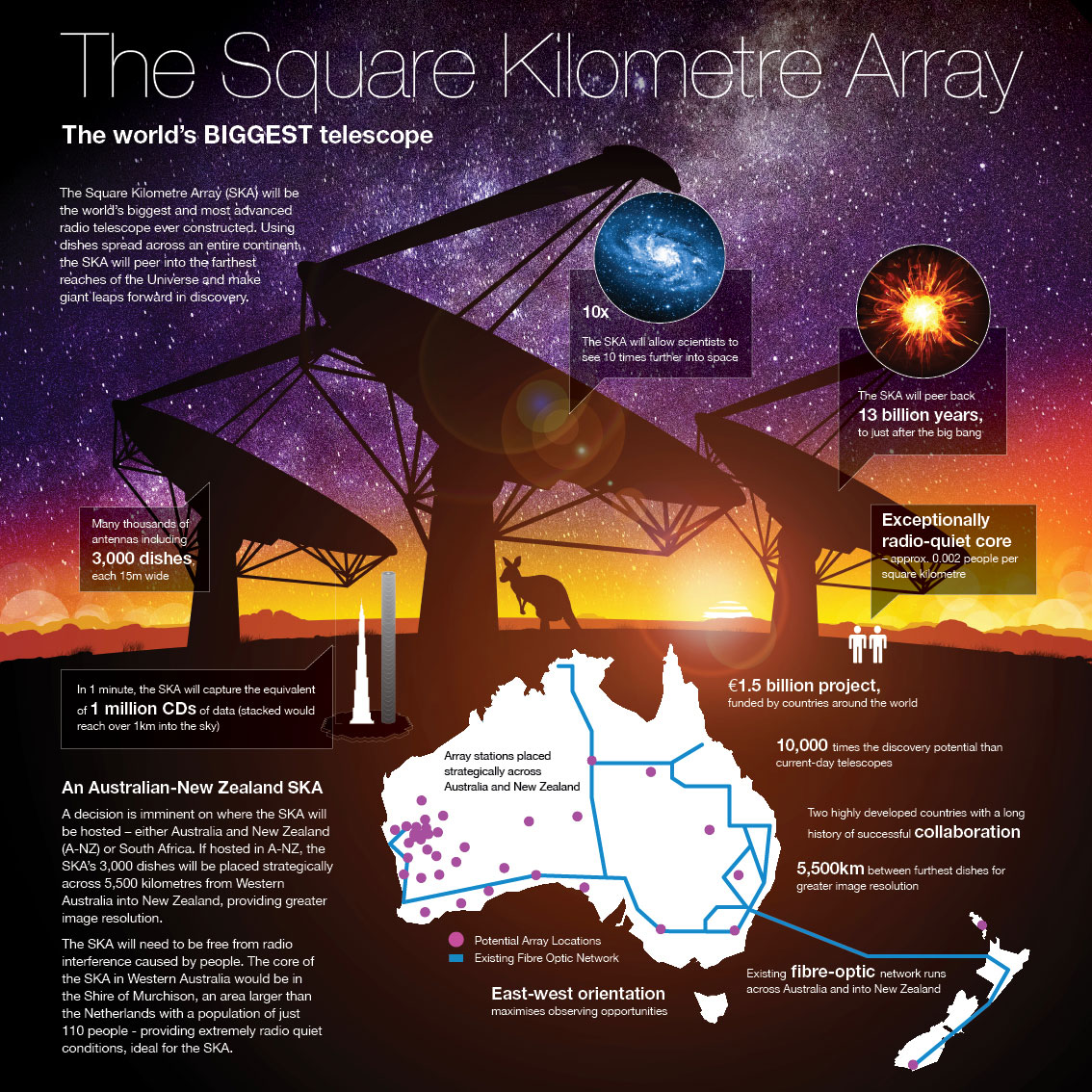
Last week I was invited by email to attend a “webinar” (whatever that is) about the SKA, an invitation that I quietly ignored. Today I got a follow-up email from a person described as a “Digital Analyst” offering me the chance to “interview Dr Brian Boyle or Dr Lisa Harvey Smith”. They also sent me the following “infographic” (i.e. a picture) showing the case for siting the SKA in Australia, which they thought would be of interest to “my blog readers”.

Well, you can call me old-fashioned but I think there’s something a bit distasteful about engaging a glorified ad agency to lobby on behalf of one party in a discussion that should be resolved on purely scientific grounds. I wonder how much it cost, for a start, but I’d also have hoped scientists would be above that sort of thing anyway. Sign of the times, I suppose.

Anyway, even if the digital analysts at Ogilvy will be happy that I’ve shown their infographic, perhaps they might now realize that spin can work in two different ways…

On My Radio (Telescope) …

Posted in Science Politics, The Universe and Stuff with tags , , , , , , on April 7, 2011 by telescoper

A piece of news I should have passed on sooner than this is the announcement that the  Headquarters for the Square Kilometre Array will be based at the Jodrell Bank Observatory which, as you all know, is situated in the English Midlands.

The Square Kilometre Array (known to the astronomical community as SKA) will be, when it’s built, the largest radio telescope, and in fact the largest telescope of any kind, ever constructed.  Building it will be a huge technical challenge, and it involves teams from all around the world. Although it hasn’t yet been decided where the actual kit will be sited – Australia and South Africa are two strong contenders – it’s definitely a coup for the UK to be hosting the Project Office. So congratulations to Jodrell Bank and to John Womersley, Director of Science Programmes at the Science and Technology Facilities Council who will be heading up the operation.

I think  that the SKA is by far the most exciting project in ground-based astronomy on the STFC books: it has a significantly stronger science case than its competitor in the optical part of the spectrum, the European Extremely Large Telescope (E-ELT), although it is admittedly more of a challenge to build it from a technological point of view. Over the last few years I’ve feared on many occasions that STFC would have to pull out of one of these two very expensive projects and that E-ELT would be the one that survived because it is within the remit of the European Southern Observatory (ESO) to which we pay a hefty subscription. Fortunately the clouds seem to have lifted a bit and it looks like we’re going to remain in both, which is excellent news for UK astronomy.

I was thinking of putting up a bit of music to celebrate the good news. Hmmm….Ska….radio. No brainer really. I wonder who was The Selecter for the  location of the SKA Project Office?

P.S. I just looked at the date when On My Radio was in the charts. October 1979, when I was 16.  I have to confess that in those days I had a massive crush on lead singer Pauline Black


Share/Bookmark

Telescope Wars

Posted in Science Politics, The Universe and Stuff with tags , , , on June 13, 2009 by telescoper

Over the last few months the Science and Technology Facilities Council has been setting up a review of its ground-based astronomy programme. The panel conducting the review has produced a consultation document, and is asking for input via an online questionnaire. There will also be a (rather short) public meeting in London on July 9th. The consultation period closes on July 31st.

Reviews of this kind would be necessary in the best of times in order to establish long-term scientific priorities and try to align the provision of facilities with those strategic objectives. Unfortunately, we don’t live in the best of times so the backdrop to the current review is a shrinking pot of money available for “traditional” ground-based astronomy and the consequent need to target planned programmes for the chop.

Andy and Sarah have already blogged about this -and they both know a lot more than me about ground-based astronomy – so I won’t try to cover the same ground as them. I would however, like to make a  couple of points.

The review has to help STFC strike a balance between current facilities and projects for the future. The largest elements of the current ground-based programme include the subscription to ESO (including associated costs for ALMA, which amounts to over £200 Million), the twin 8m telescopes known as Gemini (North and South, about £60 Million), E-Merlin (about £24 Million), UKIRT and JCMT (about £34 Million); figures represent costs over the next 10 years or so. The two biggest projects that the UK would like to get involved in are a European Extremely Large Telescope (E-ELT), an optical telescope currently aimed to be about 42m in diameter, and the Square Kilometre Array, a futuristic radio telescope. Each of these would cost the UK over £100 Million over the next decade.

The consultation document puts it quite succintly:

It would be unrealistic to imagine that in 2020 the UK would have a large stake in large facilities like E-ELT and SKA, and would also retain all its current ground-based facilities. It is always hard to forego a workhorse facility that has supported an active and successful science programme, in order to start construction of some future facility many years hence. But our bid for the capital costs for E-ELT and/or SKA would not be credible if we do not show that we are willing to do this.


I agree that it maintaining the current programme as well as acquiring an interest in both E-ELT and SKA is completely implausible. The more relevant question though is how deep we have to cut the ongoing astronomy programme in order to afford either of these, or whether we can do that at all. It seems quite likely to me that future funding of the ground-based programme is likely to suffer drastically, both because of cuts to the overall STFC grant that appear inevitable in the next comprehensive spending review and also the current STFC leadership’s bias in favour of space technology at the expense of science. On the latter point, it is worth noting that it is specifically the ground-based astronomy programme that is being lined up against the wall here; space-based projects of negligible scientific value, such as Moonlite and BEPI-Columbo are not to going be weighed in the same balance. At the very least, future involvement in a next-generation X-ray telescope  should certainly have been in the mixer with other observatory-type facilities on the ground. I fear that the STFC Executive sees the current UK ground-based programme as significantly too large, and would like to squeeze it all into the box marked ESO. I would like to be able to sound more optimisitic, but I think that the most likely outcome of this review is therefore that the only current facilities that will survive into the medium term will be those provided through ESO  membership. JCMT and UKIRT are nearing the end of their useful life anyway, but the writing is definitely on the wall for both Gemini and E-Merlin. Not that it hasn’t been before now…

If this the way things go, then the remaining issue is whether we can afford to be involved in both E-ELT and  SKA, which seems to me to be most unlikely. If we have to pick one, which should it be? That is clearly going to be the topic of much debate. In the spirit of the drive for rationalisation I touched on above, it may well be that we don’t do anything at all outside the ESO umbrella. In that case the United Kingdom ends up with a ground-based astronomy programme consisting of the ESO facilities plus a share in the E-ELT (itself an ESO proposal). I think this would be a tragedy because  I find the scientific case for SKA much stronger than that for E-ELT; it would have been a closer call if the ELT were still the 100m optical telescope as originally proposed many years ago (and which I used to call the FLT). I’m sure many will disagree for legitimate scientific reasons (rather than the desire to play “mine’s bigger than yours” with the Americans, who are currently developing a 30m telescope).

I’m sure there will also be many astronomers who would rather have neither SKA nor E-ELT if it means losing access to the suite of smaller telescopes that continue to produce many interesting scientific results. If it came to a vote I’m not sure what the result would be, which is why I want to encourage anyone who has any input to fill in the questionnaire!

A final little wrinkle on this question is the following. Suppose STFC decides  not to support future involvement in SKA – I hope this isn’t the way things turn out, but in our dire financial circumstances it might be – does this make continued funding for E-Merlin more likely or less likely? Answers on a postcard (or even via the comments box)..
Not the Square Kilometre Array

Posted in Music with tags , , , , on January 13, 2009 by telescoper

Searching the net for material about one of the world’s leading astronomy projects The Square Kilometre Array, I inadvertently used the well-known abbreviation SKA in Google and was inundated with sites about Ska, the Jamaican music genre that paved the way to Reggae and also fuelled the 2 Tone movement which swept the UK music scene in 1979.

When I was still in School, I was never a big fan of Punk (which immediately preceded Ska in popularity), but absolutely loved bands like The Specials, The Beat and especially Selecter. I adored the music, but also loved their inclusive multi-racial philosophy. Being a bit of an anorak I actually managed to get hold of some of the very rare original Ska recordings, principally by the superb Skatalites who are still going almost 50 years after they were founded. This wonderful band specialised in irreverent and highly eccentric cover versions of movie film tunes from the 1960s including Doctor Zhivago and James Bond, plus the classic Guns of Navarone.

Ska was usually played (at least nominally) in 4-4 time, but each beat was really a cluster of sub-beats forming a triplet. Usually the drummer put a heavy bass accent (and usually a side stick or rim shot on the snare) on the 3rd component of each triplet, and there would be guitar chops, other percussion, and/or brass riffs on the “off” beats. It is said that this structure was inherited, at least in part, from the marching bands that played in Jamaica and it does give a kind of strutting feel to the overall pulse. But wherever it came from the beat gives the music an infectious lilting rythm that gives anyone dancing to it an irresistible urge to jump up and down, especially on up-tempo numbers. The tripletty structure also gives those with no sense of rythm a greater probability of moving in time with at least one relevant beat. Ska also spawned Reggae which inherited its curious rythmic figure, but added a bass accent on the 1st and 3rd beats of the bar (the “on” beats”) and was generally played much slower.

In need of a bit of cheering up I abandoned my quest for astronomical learning and went on yet another trip down memory lane via Youtube, which I enjoyed enormously, so I decided to put up here a piece full of nostalgia for me which I hope at least some of you might enjoy.

Here are The Specials, recorded on British TV in 1979 (a programme which I think I actually watched at the time). They are playing the theme from The Guns of Navarone as a direct tribute to the Skatalites, whose wonderful original version you can also find on Youtube here (although it is really just audio).