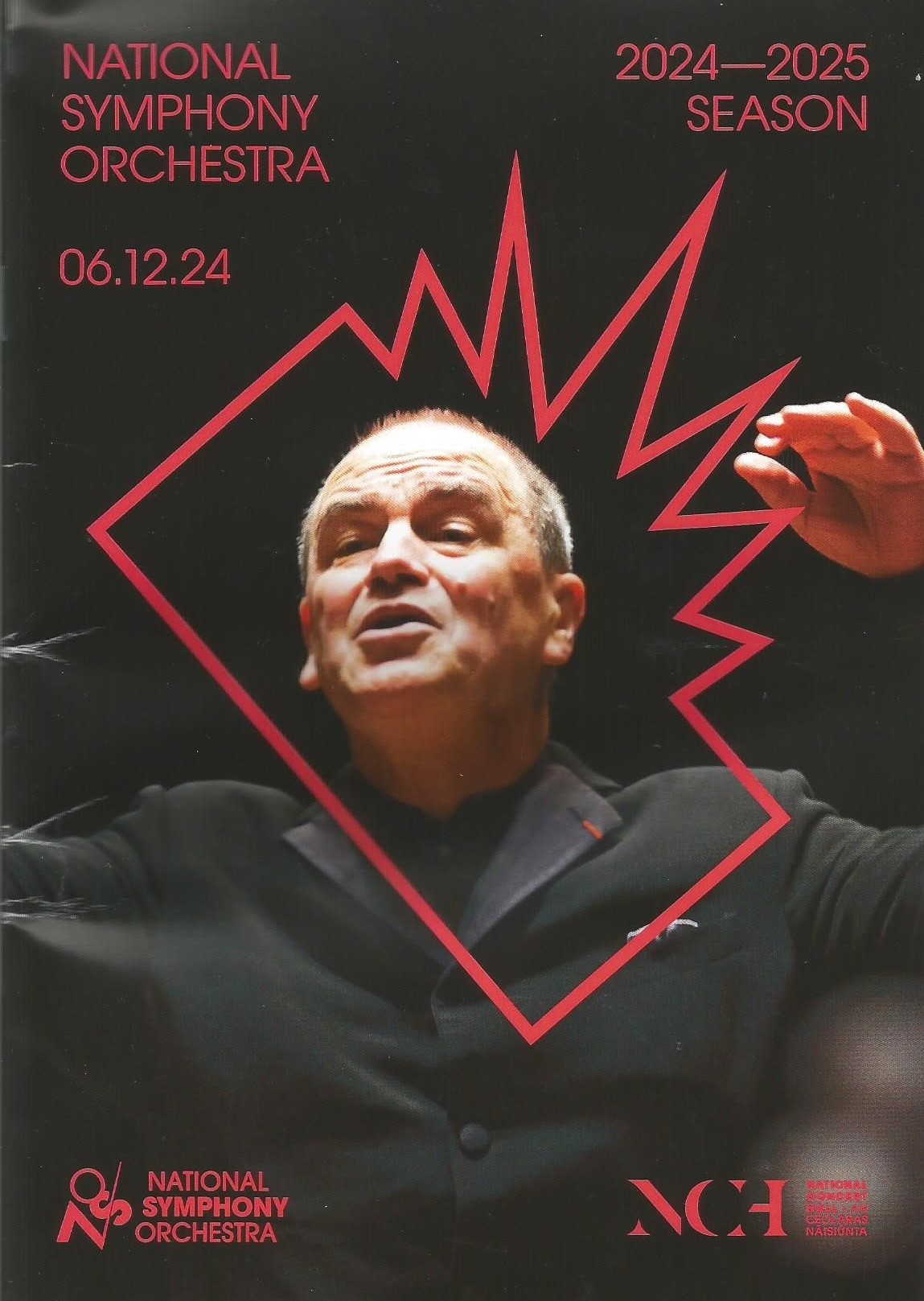

It was a dark and stormy night but I braved the inclement weather to travel to the National Concert Hall in Dublin for what will be my last concert of 2024. It look like being a nearly full house when I booked my ticket, but in the end there were quite a few empty seats perhaps because various groups decided not to make a journey owing to Storm Darragh. My own travels went without a hitch and in fact I even managed to walk from Connolly to the NCH before the performance and back to Pearse after it without getting rained on.
Anyway, there were two items on the menu: Violin Concerto No. 5 in A Major by Wolfgang Amadeus Mozart, with soloist Stefan Jackiw, and the Symphony No. 7 in E Major by Anton Bruckner. The National Symphony Orchestra was conducted by Hans Graf.
Mozart wrote at least five violin concertos, and he was at most 20 when he wrote the last of the five that are known. During last night’s performance I was thinking a lot about all I had failed to achieve by the age of twenty! Influenced by his father Leopold, the violin was Mozart’s first instrument, but he later moved on and preferred to play keyboard instruments. Perhaps he wanted to escape from his father’s domination, which might explain why he didn’t write any more pieces for solo violin in the rest of his (short) life.
The 5th Violin Concerto is sometimes called “The Turkish” though there isn’t much of a Turkish influence in the music. Whatever the name, it is a very enjoyable piece in three movements, played quite beautifully last night by Stefan Jackiw and by the pared-down NSO. The soloist got a very warm ovation and responded with a solo encore in the form of a largo movement from a Bach violin sonata.
After the wine break we returned to find the stage much fuller with a large brass section and extra strings added to the smaller forces required for the Mozart. Bruckner’s Seventh Symphony is a huge and varied work lasting over an hour in performance. The radiant first movement, with its noble melody soaring over shimmering violin tremolos is very reminiscent of Wagner, as is much of the rest of the Symphony (especially in terms of the orchestration). Bruckner famously idolized Wagner and this composition is at least partly a tribute to his musical hero. It is said that Bruckner had a premonition of Wagner’s death in 1883 and the cymbal crash during the second (slow) movement symbolizes the moment that he found out that his premonition had come true. That whole movement (marked Sehr feierlich und sehr langsam; very solemn and very slow) is very moving: sombre though not excessively mournful. The third movement Scherzo is marked Sehr Schnell (very fast) but I found the tempo last night vigorous, but not epecially fast. I was expecting something a bit wilder. The last movement actually sounded to me more like Mahler than Wagner, with a resounding climax.
The Seventh is probably Bruckner’s best known and most performed Symphony. It was certainly a big hit for him when it was first performed in 1884. The composer was born in 1824 and last nigtht’s concert was billed as Bruckner 200. I think the 7th was a good choice to mark the occasion and the performance, with superb playing by the brass section (including the Wagner tuben), and the orchestra very well marshalled by Hans Graf, was a fitting tribute.
My next trip to the NCH won’t be until January, but I’m already looking forward to the Leningrad Symphony after the Christmas break!

 In the Dark