Archive for Stokes parameters

In Search of Stokes V

Posted in The Universe and Stuff with tags , , , , on September 17, 2024 by telescoper

Many moons ago I went to a seminar on the design of an experiment to measure the polarization of the cosmic microwave background. At the end of the talk I asked what seemed to me to be an innocent question. The point of my question was the speaker had focussed entirely on measuring the intensity of the radiation (I) and the two Stokes Parameters that measure linear polarization of the radiation (usually called Q and U). How difficult, I asked, would it be to measure the remaining Stokes parameter V (which quantifies circular polarization)?

There was a sharp intake of breath among the audience and the speaker responded with a curt “the cosmic microwave background is not circularly polarized”. It is true that in the standard cosmological theory the microwave background is produced by Thomson scattering in the early Universe which produces partial linear polarization, so that Q and U are non-zero, but not circular polarization so V=0. I knew that, but had asked my question because I had an idea that it might be worth measuring V (or at least putting an upper limit on it) in order to assess the level of instrumental systematics (which are a serious issue with polarization measurements). It might also help constrain variations from the standard model too.

Well, that thought came back today when I saw a new paper on the arXiv with the abstract:

V-mode polarization of the cosmic microwave background is expected to be vanishingly small in the ΛCDM model and, hence, usually ignored. Nonetheless, several astrophysical effects, as well as beyond standard model physics could produce it at a detectable level. A realistic half-wave plate – an optical element commonly used in CMB experiments to modulate the polarized signal – can provide sensitivity to V modes without significantly spoiling that to linear polarization. We assess this sensitivity for some new-generation CMB experiments, such as the LiteBIRD satellite, the ground-based Simons Observatory and a CMB-S4-like experiment. We forecast the efficiency of these experiments to constrain the phenomenology of certain classes of BSM models inducing mixing of linear polarization states and generation of V modes in the CMB. We find that new-generation experiments can improve current limits by 1-to-3 orders of magnitude, depending on the data combination. The inclusion of V-mode information dramatically boosts the sensitivity to these BSM models.

arXiv:2409.10424

It seems it might be feasible to measure Stokes V after all!

Circular Polarization in the Cosmic Microwave Background?

Posted in The Universe and Stuff with tags , , , , on November 23, 2018 by telescoper

Some years ago I went to a seminar on the design of an experiment to measure the polarization of the cosmic microwave background. At the end of the talk I asked what seemed to me to be an innocent question. The point of my question was the speaker had focussed entirely on measuring the intensity of the radiation (I) and the two Stokes Parameters that measure linear polarization of the radiation (usually called Q and U). How difficult, I asked, would it be to measure the remaining Stokes parameter V (which quantifies circular polarization)?

There was a sharp intake of breath among the audience as if I had uttered an obscenity, and the speaker responded with a glare and a curt `the cosmic microwave background is not circularly polarized’. It is true that in the standard cosmological theory the microwave background is produced by Thomson scattering in the early Universe which produces partial linear polarization, so that Q and U are non-zero, but not circular polarization, so V=0. However, I had really asked my question because I had an idea that it might be worth measuring V (or at least putting an upper limit on it) in order to assess the level of instrumental systematics (which are a serious issue with polarization measurements).

I was reminded of this episode when I saw a paper on the arXiv by Keisuke Inomata and Marc Kamionkowski which points out that the CMB may well have some level of circular polarization. Here is the abstract of the paper:

(You can click on the image to make it more readable.) It’s an interesting calculation, but it’s hard to see how we will ever be able to measure a value of Stokes V as low as 10-14.

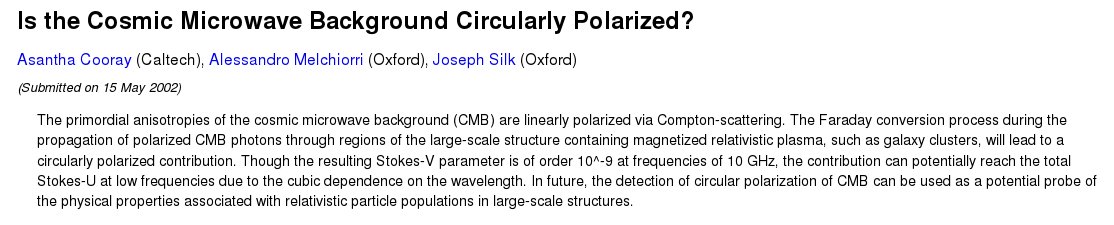
A few years ago there was a paper on the arXiv by Asantha Cooray, Alessandro Melchiorri and Joe Silk which pointed out that the CMB may well have some level of circular polarization. When light travels through a region containing plasma and a magnetic field, circular polarization can be generated from linear polarization via a process called Faraday conversion. For this to happen, the polarization vector of the incident radiation (defined by the direction of its E-field) must have non-zero component along the local magnetic field, i.e. the B-field. Charged particles are free to move only along B, so the component of E parallel to B is absorbed and re-emitted by these charges, thus leading to phase difference between it and the component of E orthogonal to B and hence to the circular polarization. This is related to the perhaps more familiar process of which causes the plane of linear polarization to rotate when polarized radiation travels through a region containing a magnetic field.

Here is the abstract of that paper:

(Also clickable.) This is a somewhat larger effect but differs from the first paper in that it is produced by foreground processes rather than primordial physics. In any case a Stokes V of 10-9 is also unlikely to be measurable at any time in the foreseeable future.

Stokes V – The Lost Parameter

Posted in The Universe and Stuff with tags , , , , , , on August 27, 2014 by telescoper

Some years ago I went to a seminar on the design of an experiment to measure the polarization of the cosmic microwave background. At the end of the talk I asked what seemed to me to be an innocent question. The point of my question was the speaker had focussed entirely on measuring the intensity of the radiation (I) and the two Stokes Parameters that measure linear polarization of the radiation (usually called Q and U). How difficult, I asked, would it be to measure the remaining Stokes parameter V (which quantifies circular polarization)?

There was a sharp intake of breath among the audience and the speaker responded with a curt “the cosmic microwave background is not circularly polarized”. It is true that in the standard cosmological theory the microwave background is produced by Thomson scattering in the early Universe which produces partial linear polarization, so that Q and U are non-zero, but not circular polarization so V=0. However, I had really asked my question because I had an idea that it might be worth measuring V (or at least putting an upper limit on it) in order to assess the level of instrumental systematics (which are a serious issue with polarization measurements).

I was reminded of this episode when I saw a paper on the arXiv today by Asantha Cooray, Alessandro Melchiorri and Joe Silk which points out that the CMB may well have some level of circular polarization. When light travels through a region containing plasma and a magnetic field, circular polarization can be generated from linear polarization via a process called Faraday conversion. For this to happen, the polarization vector of the incident radiation (defined by the direction of its E-field) must have non-zero component along the local magnetic field, i.e. the B-field. Charged particles are free to move only along B, so the component of E parallel to B is absorbed and re-emitted by these charges, thus leading to phase difference between it and the component of E orthogonal to B and hence to the circular polarization. This is related to the perhaps more familiar process of Faraday rotation, which causes the plane of linear polarization to rotate when polarized radiation travels through a region containing a magnetic field.

Anyway, here is the abstract of the paper

The primordial anisotropies of the cosmic microwave background (CMB) are linearly polarized via Compton-scattering. The Faraday conversion process during the propagation of polarized CMB photons through regions of the large-scale structure containing magnetized relativistic plasma, such as galaxy clusters, will lead to a circularly polarized contribution. Though the resulting Stokes-V parameter is of order 10-9 at frequencies of 10 GHz, the contribution can potentially reach the total Stokes-U at low frequencies due to the cubic dependence on the wavelength. In future, the detection of circular polarization of CMB can be used as a potential probe of the physical properties associated with relativistic particle populations in large-scale structures.

It’s an interesting idea, but it’s hard for me to judge the feasibility of measuring a value of Stokes V as low as 10-9. Clearly it would only work at frequencies much lower than those probed by current CMB experiments such as BICEP2 (which operates at 150 GHz). Perhaps if the speaker had answered my question all those years ago I’d be in a better position to decide!