Archive for Students

Back to Teaching

Posted in Education, mathematics, Maynooth with tags , , on September 24, 2024 by telescoper

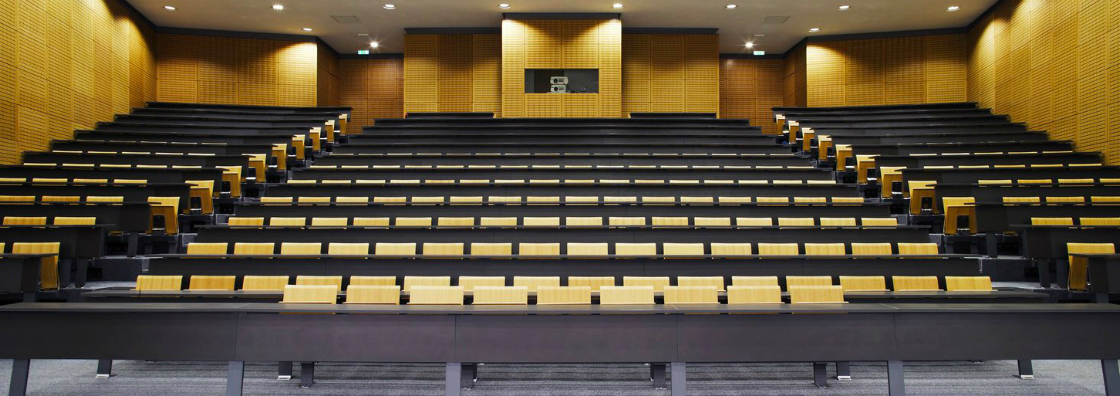
So, after an absence from teaching of over a year, this afternoon I returned to the lecture theatre to give a double session on the module EE206 Differential Equations and Transform Methods. I was a bit apprehensive about having a two-hour slot and it is fair to say that I felt a bit knackered after it, but `then I am getting on a bit. I did have time for a ten-minute break in the middle during which the students could relax and stretch their legs a little. Some of them even came back afterwards.

This module is meant for students on two courses, Electronic Engineering and Robotics and Intelligent Devices, so I will have to think of relevant examples. I’ve got the RLC circuit, of course, but I’ll have to more than that!

If you’re interested you can find an old summary of the module here to see what topics are covered.

The good news from my point of view is that I have a decent room to teach in – complete with chalk boards – and the students seemed pleasant and engaged. I always like to get some interaction going in my classes so it was good to find a reasonable number of people willing to offer answers to questions I asked and indeed willing to ask me questions or request clarification. Overall, I was quite pleased with how it went. You will have to ask the students to see if they agree. At any rate I did manage to get through everything I planned to cover. The class size is about 55, incidentally.

Anyway, today I just warmed up for the module with some revision of basic calculus. I had pessimistically imagined that the students would have forgotten what they did in the first year about this, but in fact quite a few of them remembered quite a lot. I have my second session with this group on Thursday, though that should be a bit easier as it is only one hour instead of two. I will start differential equations proper then.

My remaining teaching sessions this week are all in the Arts Building. I have been quite worried that the rooms I am supposed to use would not be ready in time, but I took a walk around yesterday morning and they are ready (although construction work is going on elsewhere in the block). I was thinking I might have to give these lectures via a remote connection from home as in the old days of the pandemic, but that fortunately is not the case.

The Age Thing

Posted in Biographical, Education with tags , , , , , on January 2, 2024 by telescoper

When I was younger, so much younger than today, I thought I would hate getting old. Now that I’m sixty though I have to say in all honesty that it’s not too bad at all. I could do without the arthritis, of course, but that’s more of an inconvenience than anything else. I am also fortunate to be comfortably off and in a secure job, with the prospect of a decent pension. When I was younger I was frequently under stress, with bouts of insomnia and other issues. Although I am subjected to a bit of aggravation now and then, I seem to have learnt to deal with it better.

I think part of this is that as I’ve got older I’ve become more resistant to peer pressure. Nowadays I go out only when I really want to, and do only what I want to do. Gone are the days when friends used to drag me out to places I didn’t really want to go to. I used to go because I thought people would label me as ‘boring’ if I didn’t. Nowadays, I don’t mind being called boring. I may be boring to you but I am rarely ever bored. I always find plenty to occupy myself.

Another thing that helps is working in a University, which is a good way of being surrounded by interesting young people. So many people of my age seem to resent the young, to the extent of criticizing virtually everything they do. I find the vast majority students friendly, hard-working and engaged, although they have to put up with much more than I had to when I was in their situation.

Teaching physics is interesting because the current generation of undergraduates has to learn a lot of what I had to when I was a student. Every year therefore provides a reminder of the time when I was the age of the new intake, as many of their educational and social experiences are similar. Of course not all. When I was an undergraduate we had no internet or anything like that. There were no social media, either. 

Students these days seem to like using Instagram. I do have an account on Instagram but it is very quiet, probably because I’m not very good at it. Some students follow me there, but I have been told that it would be “inappropriate” to follow them back. That’s probably fair, but I do worry that I appear rude for not following back. It’s not that I’m snobbish or anything. I just feel that I would be intruding, in much the same way as if I wandered into a bar full of students I know. It’s not that I don’t like them, just that I find it awkward (as I’m sure they do). Not having had Instagram when I was young, I suppose I just don’t really understand the etiquette.

One of the things about Instagram is that people do sometimes share quite personal things, and sometimes things that might be quite compromising in a work context, e.g. pictures of themselves in a  state of inebriation. I suppose that’s why it’s a rather contentious issue whether a member of academic staff in a University should or not be “friends” with their undergraduate students on social media. Indeed, this is the official advice given by some institutions to staff. Most wouldn’t have a problem with having social media interactions with their graduate students, though. The nature of the relationship between a PhD student and supervisor is different from that between an undergraduate and a lecturer.

There is a point on social media where professionalism might be compromised just as there is in other social interactions. The trouble is knowing precisely where that boundary lies, which is easy to misjudge. I’ve never felt that it was in any way improper to be friendly to students. Indeed I think that could well improve the students’ experience of education. If the relationship with staff is too distant students may not  feel comfortable asking for help with their work, or advice about wider things. Why should being “professional” mean not treating students as human beings? One can take friendliness too far, however. There have to be some boundaries, and intrusive or demanding behaviour that makes students uncomfortable should be avoided.

I realize I have digressed into social media. Aside from that, though, I’m sure much of student was similar in my day. I’m pretty sure that neither the subject of physics nor students of physics have changed that much over the years. The only difference from my perspective is that every year they look younger! That’s the other side of the coin: the students remind you of your younger self, but not in such a way as to delude you into thinking that you’re still the same person! I think that’s the one thing I’ll miss when I retire, hopefully in the not-too-distant future.

All of this is a roundabout way of saying that I don’t mind getting old. In fact, I feel that my whole life so far has been practice for this.

Teaching + Learning ≠ Lecturing

Posted in Biographical, Education, Maynooth with tags , , , , , on January 13, 2022 by telescoper
Iontas Lecture Theatre, Maynooth University

The main purpose of this post is to encourage you to read a piece written by a second-year student at the blog run by Phil Moriarty of Nottingham University entitled Death of the Lecture: Musings of a second year student as it provides at least some first-hand reflections from a current student about the difficulties being faced by a student. So, go on, or as they say round here, gwan. Read it.

I couldn’t resist making a few tangential comments of my own.

First, on my philosophy of teaching (such as it is) which is largely formed by my own experiences both as a student many years ago and as a lecturer for many years since then. When I was an undergraduate I didn’t get much out of the lectures I attended at Cambridge and my attendance dropped off a bit as my course went on (though I still attended most). This was because the majority of lectures just involved transparency after transparency being put on and taken off the overhead projector, with students frantically writing down as much as they could but with little time to think. I think that’s what people nowadays call a “traditional” lecture. I agree with Phil Moriarty that these are pedagogically useless. If there ever is a return to normality, the New Normal – to use a very hackneyed phrase – should not be based on this as the primary mode of teaching.

I think this form of non-teaching evolved because it is cost-effective, but academics have gone along with it largely because lots of them actually enjoy standing up and talking about their subject; sometimes it’s difficult to get them to stop. As a matter of fact, that applies to me too. I enjoy talking about physics and astrophysics. I like to think that I can at least communicate some enthusiasm for the subjects through lectures, but I do realize that this does not necessarily make me a very effective teacher.

But in many ways I think the “traditional lecture” described above is a straw man. Many lecturers actually use the traditional format (50 minutes with a class in a large room) to do much more than I’ve just described. When we had to switch teaching online I bought a blackboard and did my lectures from home using it. I know a lot of people found it quaint that I adopted this “traditional” approach but I think explaining mathematical concepts through examples works well via a chalkboard and by standing up I could put more energy into the session than I could if sitting at a screen.

The point is that nowadays we provide students with many more resources to back up this kind of activity – besides my sessions the students get tutorials, and besides the live sessions they get printed notes, problem sets to do on their own, various online resources and of course video recordings. Having all that allows the lecturer to free themselves from the task of delivering material and instead try to cultivate understanding. I never lecture verbatim from notes; I prefer to cover the material in a complementary fashion, expanding on the bits I think need most explanation and/or are most important.

When I was a student I found I learned best not by attending lectures but by reading textbooks and doing problems. That’s just me though. Over the years I realized that different students learn in very different ways. The most important thing for teachers to do is to provide as many ways as possible for the students to learn so they can use what works best for them. In some respects I think of higher education as being more like a smorgasbord than a set menu.

But there lies the difficulty. There is now so much extra material available that many students find it hard to know where to start, just as when you arrive at a buffet table: it might look appetizing but you might not even know what’s in many of the dishes. There needs to be some structure, especially in the early years of a degree to help students find their own way to navigate the more independent methods of study required in an undergraduate degree.

The question for me is not whether lectures have a role to play in the New Normal – I think they do – but what is the best way to incorporate them in a blend. More importantly we need to do a lot more to help students develop their study skills and structure their time so they can learn most effectively. There was no time to do this when the pandemic forced us to change and we were given few resources to assist in the task, but it’s going to be necessary in future as we move inevitably to a more flexible future. Timetabled lectures do of course provide a structure, but there’s almost certainly a better way. As one concrete proposal, I’d call for a vastly expanded induction programme for new students focussing on study skills and other aspects of learning to put in place for the benefit of future intakes.

Like most universities, Maynooth University has a “Teaching & Learning Committee”. I sometimes wonder whether there is as strong a connection between these two words as we’d like to believe. At any rate, switching teaching online does not necessarily mean that learning goes with it!

Should Academics be (Facebook) Friends with Students?

Posted in Biographical, Education with tags , , , , on June 30, 2015 by telescoper

I noticed a short article in the Times Higher last week about a small survey that concluded that more than half academics count students among their Facebook friends. It’s actually a very small survey – of 308 academics, all based in America – of whom 54.4% admitted being “friends” with students.

For those of you who don’t use Facebook, a “Facebook friend” isn’t necessarily an actual real-life friend, it’s just someone else on Facebook with whom  you agree to share information, photographs, music and other stuff. Different people have different policies with regard to whether to accept or decline a friend request (or indeed initiate one). I only ever accept requests from people I know in another context, for example, which restricts the number of people who get to see my Facebook scribblings. Others are less selective and have many many more Facebook friends.

One of the things about Facebook is that people do sometimes share quite personal things, and sometimes things that might be quite compromising in a work context, e.g. pictures of themselves ina  state of inebriation. I suppose that’s why it’s a rather  contentious whether a member of academic staff in a University should or not be “friends” with their undergraduate students. I know many of my friends and colleagues  in academia flatly refuse to befriend undergraduate students (in the Facebook sense) and indeed this is the advice given by some institutions to staff. Most wouldn’t have a problem with having social media interactions with their graduate students, though. The nature of the relationship between a PhD student and supervisor is very different from that between an undergraduate and a lecturer.

There is a point on social media where professionalism might be compromised just as there is in other social interactions. The trouble is knowing precisely where that boundary lies, which is easy to misjudge. I’ve never felt that it was in any way improper to be friendly to students. Indeed I think that could well improve the students’ experience of education. If the relationship with staff is too distant students may not  feel comfortable asking for help with their work, or advice about wider things. Why should being “professional” mean not treating students as human beings?

One can take friendliness too far, however. There have to be some boundaries, and intrusive or demanding behaviour that makes students uncomfortable should be avoided.

I’ve thought about this quite a lot since I joined Facebook, which was in 2007. What I decided to do is simple. If a student initiates a friend request, I usually accept it (as long as I actually know who it is). Not many make such requests, but some do. More often, in fact, students send friend requests after they’ve graduated, when they perhaps feel liberated from the student-teacher relationship. On the other hand, I never initiate friend requests with students, for fear that they might feel pressured to accept it. It’s much the same as with other interactions.  For example, I rarely visit the extensive Student Spaces in the School without being invited there for a specific reason. If I did I’d just feel I was intruding. Many universities don’t bother to provide study space for their undergraduates, so this is probably only relevant here in Sussex.

Anyway, that’s my response. I know it’s a sort of compromise, but there you are. I am however interested in how other academics approach this issue. Plus, I haven’t done a poll for a while. So here we go:


What’s Your Lecture Face?

Posted in Biographical, Education with tags , , , on December 19, 2012 by telescoper

I was thinking the other day – it doesn’t happen that often so I try to make the most of it when it does – about what a strange situation it is when someone stands up in front of a bunch of students and lectures at them for an hour. In the course module I’ve just finished teaching I’ve had the best part of a 100 people watching, and occasionally listening to, me drone on about something or other. What’s strange is that all those people see basically the same thing, whereas the lecturer gets to see all those different facial expressions. I wonder if the students are even aware that each one has a characteristic lecture face?

I’m one of those people who finds it very difficult to give a lecture without looking at the audience. It’s partly to try to establish some kind of rapport with them, notably in order to encourage them to answer when I ask a question or to offer questions of their own, but also to try to figure out whether anyone at all is following what I’m saying. Not all students are helpful in this regard, but some have very responsive mannerisms, nodding when they understand and frowning when they don’t. When I’m teaching a class for the first time I usually look around a lot in an attempt to identify those students who are likely to help me gauge how well things are going. Usually,  there are only a few barometers like this but I would be lost without them. Fortunately most students seem to sit in the same place in the theatre for each lecture so you can usually locate the useful ones fairly easily, with a discreet look around before you  start.

Most other students seem to have a default lecture face.  The expressions range from a perpetual scowl to a vacant smile (each of which is in its own way a bit scary). There’s the “wish I wasn’t here” face of pure boredom,  not to mention those who are fast asleep; I don’t mind them as long as they don’t snore. There’s the Bookface of someone who’s not listening but messing around on Facebook, and the inscrutable ones whose faces are masks yielding no clues as to what, if anything, is going on behind. The brightest students often seem to belong to the last group, although I haven’t done a statistical study of this so that must be taken as purely anecdotal.

Anyway, I feel a Christmas Poll coming on. Please participate if you can be bothered. If you don’t know what your own lecture face is, then you could always ask….