Archive for Sussex

The Cuts in UK Higher Education

Posted in Biographical, Cardiff, Education, Maynooth, Politics with tags , , , , on November 28, 2024 by telescoper

Today friend of mine send me a message pointing out that in order to save money the University of Sussex is planning to make about 300 staff redundant; you can see an article about it in the Times Higher here. For the time being it seems the plan to make these savings via a voluntary severance scheme. I don’t know whether academic and administrative staff will be treated equally, either.

This is grim news. I worked at Sussex from 2013 until 2016 when I resigned my post as Head of School of Mathematical and Physical Sciences. I took that decision largely for personal reasons but there were professional reasons too. From 2013 the University had embarked on an ambitious growth plan based on buoyant student numbers and the fee income generated thereby. Staff numbers grew too, to cope with the increased demand for teaching. Unfortunately the management was unable to match this with real improvements in infrastructure, largely due to the disastrous outsourcing of campus estates and services. Many promises made to me as Head of School by Senior Management were broken. I wasn’t the only Head of School to compain of this, either. Although things were still going relatively well when I left in 2016, and I was optimistic for the future of the School then, there were severe risks to its financial stability if student recruitment dived. Sadly, that’s exactly what happened. Falling student numbers – especially from overseas – left the institution very vulnerable, especially since the fee per student did not change. That problem was exacerbated by a burst of inflation. AlthoughIt has clearly been a very difficult time for the University of Sussex, largely due to national and international forces beyond its control, but exacerbated by ineffective, and at times incompetent, institutional management. It should be said also that many University leaders enthusiastically embraced the fees-based system that has led their institutions where they are now, though most of them have now departed and left others to carry the can.

It worries me that Maynooth University is also trying to grow very quickly, without adequate investment in infrastructure especially teaching. It isn’t increasing the number of academic staff much either, preferring to hire more and more managers; yet another such position was advertised this week. I don’t know whether Maynooth’s financial trajectory will follow that of Sussex. The funding environment is very different in Ireland compared to the UK, so it may not. It is clear that the enviroment for education and research here is being steadily degraded by the current leadership.

Anyway, when I saw the announcement about Sussex, I checked other Universities I’ve worked in over the years. There’s a list here. It seems that while there are particular factors at play at Sussex, there are similar difficulties across the Board. Cardiff University has a deficit of £35 million and the VC has refused to rule out compulsory redundancies there. I’m not sure how this is all affecting the School of Physics & Astronomy. Nottingham University, where I worked from 1999 to 2007, has deficit of £30 million, in response to which it has opened a voluntary severance scheme, introduced hiring freezes, cut non-pay budgets, and refused to renew 500 fixed-term contracts.

There certainly are cold winds blowing across the University landscape in the United Kingdom, and there is no sign of any respite. This is just the start.

Teaching in Base 60

Posted in Barcelona, Cardiff, History, mathematics, Maynooth with tags , , , , on October 27, 2023 by telescoper

Some time ago – was it really over a decade? – I wrote a piece about the optimum size of modules in physics teaching. I was still in the United Kingdom then so my ramblings were based on a framework in which undergraduate students would take 120 credits per year, usually divided into two semesters of 60 credits each. In Cardiff, for instance, most modules were (and still are) 10 credits but some core material was delivered in 20 credit modules. In the case of Sussex, to give a contrasting example, the standard “quantum” of teaching was the 15 credit module. I actually preferred the latter because that would allow the lecturer to go into greater depth, students would be only be studying four modules in a semester (instead of six if the curriculum consisted of 10 credit modules), and there would be fewer examinations. In short, the curriculum would be less “bitty”.

In Maynooth the size of modules is reckoned using the European Credit Transfer System (ECTS) which takes a full year of undergraduate teaching to be 60 credits rather than 120 in the UK, but the conversion between the two is a simple factor of two. In Maynooth the “standard” unit of teaching is 5 credits, with some 10 credit modules thrown in (usually extending over two semesters, e.g. projects). This is similar to the Cardiff system. The exception concerns first-year modules, which are 7.5 credits each because students take four modules in their first year so they have to be 30/4=7.5 credits each. The first year is therefore like the Sussex system. It changes to a five-credit quantum from Year 2 onwards because students do three subjects at that stage.

I find it interesting to compare this with the arrangements here in Barcelona (and elsewhere in Spain). Here the ECTS credit size is used, but the standard module is six credits, not five, and year-long projects here are 12 credits rather than 10. The effect of this is that students generally study five modules at a time (or four plus a project). To add to the fun there are also some 9 credit modules, so a semester could be made up of combinations of 6-credit and 9-credit chunks as long as the total adds up to 30.

Anyway, the main point of all this is to illustrate the joy of the sexagesimal system which derives from the fact that 60, being a superior composite number, has so many integer divisors: 2, 3, 4, 5, 6, 12, 15, 20, and 30. The Babylonians knew a thing or two!

It’s a Sin

Posted in Biographical, History, LGBTQ+, Television with tags , , , , , on January 23, 2021 by telescoper

My Twitter feed was on fire last night with reactions to the first episode of the new Channel 4 drama series It’s a Sin. The title is taken from the 1987 hit of the same name by the Pet Shop Boys.

I didn’t watch it. I told a friend that I would find it impossible to watch. He asked “Why, would the memories be uncomfortable?”. I said “No. I can’t get Channel 4 on my television”.

I only have the minimum Saorview you see.

Now I’ve been informed that it is possible to stream Channel 4 for free in Ireland I will definitely watch it, so consider this a prelude to the inevitable commentary when I’ve actually seen it.

The reason why my friend thought I’d find it uncomfortable is that the story of the first episode is set in 1981 and revolves around five characters who were eighteen years old at that time. As it happens I was also 18 in 1981. On the other hand the story involves the protagonists all moving to London in 1981, which I didn’t. I was living in Newcastle in 1981, doing my A-levels and then taking the entrance exam for Cambridge where I went the following year (1982).

Before going on I’ll just mention that 1981 was – yikes – 40 years ago and – double yikes – is closer in time to the end of World War 2 than to today.

Anyway, a major theme running through the 5-part series is the AIDS epidemic that was only just starting to appear on the horizon in 1981. I recall reading an article in a magazine about GRIDS (Gay Related Immune Deficiency Syndrome), which it was what AIDS was called in the very early days. I remember it only vaguely though and didn’t think much about AIDS during the time I was an undergraduate student, although became terrifyingly relevant when I moved to Sussex in 1985 to start my graduate studies.

Although I had been (secretly) sexually active at school and definitely knew I was gay when I was an undergraduate at Cambridge, I wasn’t very open about it except to my closest friends. I also didn’t do much about it either, apart from developing a number of crushes that were doomed to be unrequited.

In my final year at Cambridge I decided that I would try to get a place to do a PhD (or, as it turned out, a DPhil). I applied to a few places around the country, and was very happy to get an offer from Sussex and started my postgraduate studies there in 1985. The reputation of Brighton as being a very `gay’ place to live was definitely part of the decision to go there.

Having been very repressed at Cambridge and mostly unhappy as a consequence I decided that I couldn’t continue to live that way. One of the first things I did during `Freshers Week’ at Sussex was join the GaySoc (as it was called) and I gradually became more involved in it as time went on. To begin with I found it helped to pluck up the nerve to go into gay bars and clubs, which I was a bit scared to do on my own having never really experienced anything like them in Newcastle or Cambridge.

It didn’t take me long to acquire an exciting sex life, picking up guys here and there and having (mostly unprotected) sex with strangers several times a week (or more). I then met an undergraduate student through the GaySoc. Although younger than me he was more experienced and more confident about sex. The relationship I had with him was a real awakening for me. We had a lot of sex. I would often sneak off form my office to his room on campus during the day for a quickie. We never even talked about wearing condoms or avoiding ‘risky’ behaviour. This was in 1986. The infamous government advertising campaign began in 1987.

Then one evening we went together to a GaySoc meeting about AIDS during which a health expert explained what was dangerous and what wasn’t, and exactly how serious AIDS really was. Most of us students were disinclined to follow instructions from the Thatcher government but gradually came round to the idea that it wasn’t the attempt at social control that we suspected but a genuine health crisis. That day my partner and I exchanged sheepish glances all the way through the talk. Afterwards we discussed it and decided that it was probably a good idea for us both to get tested for HIV, though obviously if one of us had it then both of us would.

Having been told what the riskiest sexual practices were, and knowing that I had been engaging very frequently precisely in those behaviours, I just assumed that I would be found HIV+. When I did eventually have a test I was quite shocked to find I was negative, so much so that I had another test to make sure. It was negative again. We were both negative, in fact, so we carried on as before.

It was in the next few years that people I knew started to get HIV, and then AIDS, from which many died. I imagine, therefore, that It’s a Sin will have a considerable personal resonance for me. Even without watching it (yet) a question that often troubles me returned once again to my mind: why am I still alive, when so many people I knew back then are not?

The Rise of Jofra Archer

Posted in Biographical, Cricket with tags , , , on August 23, 2019 by telescoper

With all the news yesterday I got a bit nostalgic and yesterday’s play in the 3rd Ashes Test at Headingley added another element to that. Three years ago this summer I left my post at Sussex University and moved back to Cardiff. I took a break from work of a month before taking up a part-time position at the Data Innovation Research Institute. During the break I took in some cricket, including (part of) the County Championship match between Glamorgan and Sussex at Sophia Gardens, which I watched with a friend who lives in Cardiff. In the Sussex team for that match was a young fast bowler called Jofra Archer.

It struck me then that although he was young and a bit inexperienced he was a natural fast bowler, tall and with a good high action that allowed him to take full advantage of his height and generate a lot of pace and bounce. He was a little wayward at times and a bit expensive but took four wickets in the Glamorgan first innings.

While I was watching the game I noticed a guy sitting in the same stand who seemed a bit nervous. Sometimes changing his seat at the end of each over, at one point sitting near us. During a break in the play we had a chat and it turned out that the nervous spectator was Jofra’s father. He said that he went to watch his son play whenever he could. Then we were lucky enough to chat to the man himself in between deliveries when he was fielding on the third man boundary.

Fast forward three years and the young man has come on tremendously is now a star Test bowler. He’s worked hard to add control to his natural pace and, bowling at speeds of up to 96 mph, he’s able to trouble the world’s best batsmen (including Steve Smith). Yesterday he took 6-45 against Australia and now looks set to be a regular in the England Test team for the foreseeable future (as long as he stays fit). I hope Mr Archer Senior was in the crowd. I bet he’s very proud!

Australia were all out yesterday for 179, which has raised England’s hopes of levelling the series. I think I’ll reserve judgement until I see how England bat on the Headingley pitch against Australia’s quicks. I have a feeling they’re going to struggle…

UPDATE: I don’t like to say I told you so but at lunch on Day 2 England are 54 for 6…
..and soon after lunch all out for 67 off 27 overs and 5 balls. Grim.

Natwest T20 Blast: Glamorgan v Sussex

Posted in Cricket with tags , , , on July 22, 2017 by telescoper

Last night’s Twenty20 match in Cardiff was planned as a staff social outing for members of the School of Physics & Astronomy at Cardiff University. I had to do some things at home before the 6.30 start so didn’t join the group that went to a pub first but went straight to the ground.

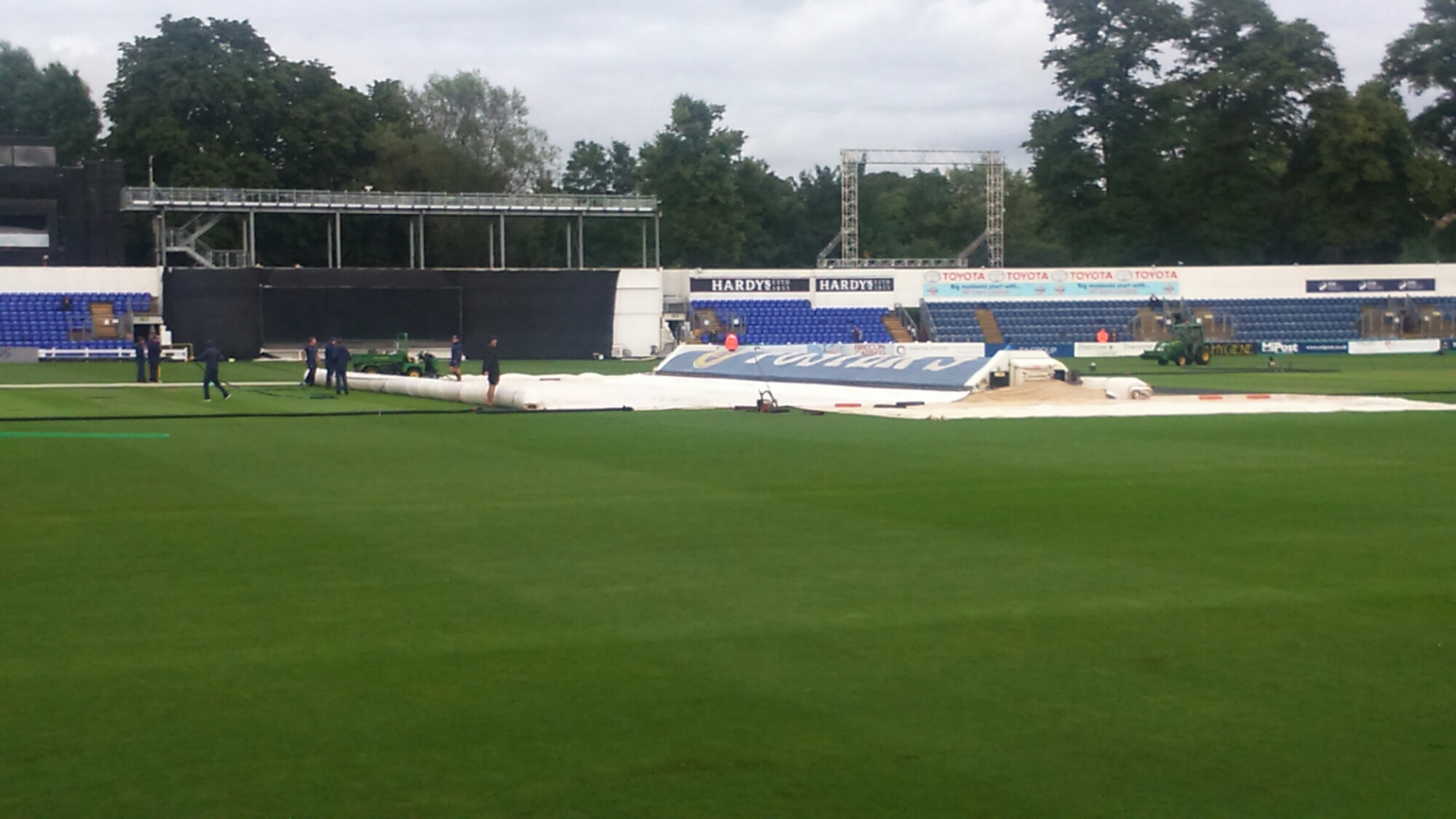
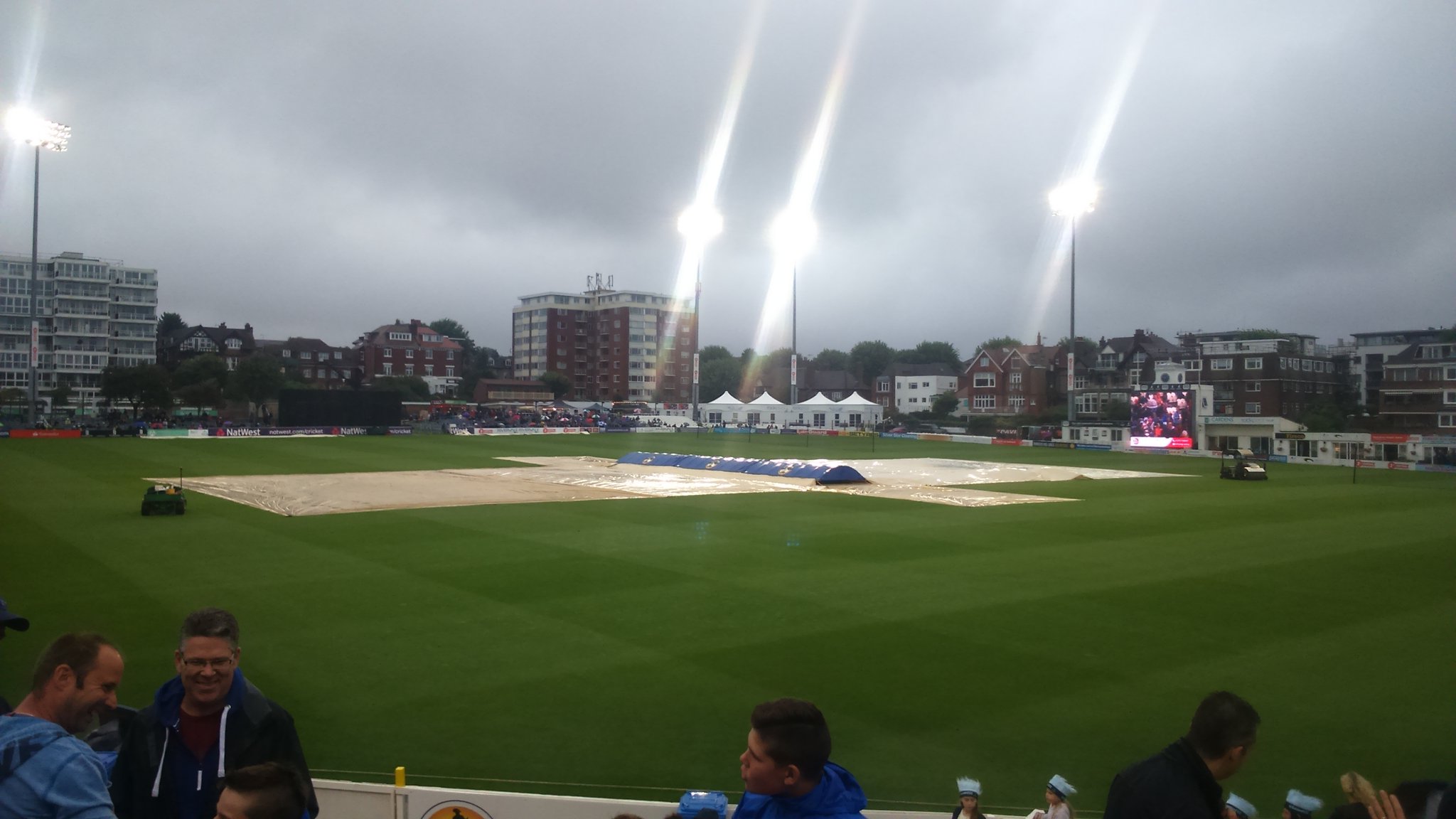
It had rained much of the day, but stopped around 6pm. When I got to the ground the covers were still on:

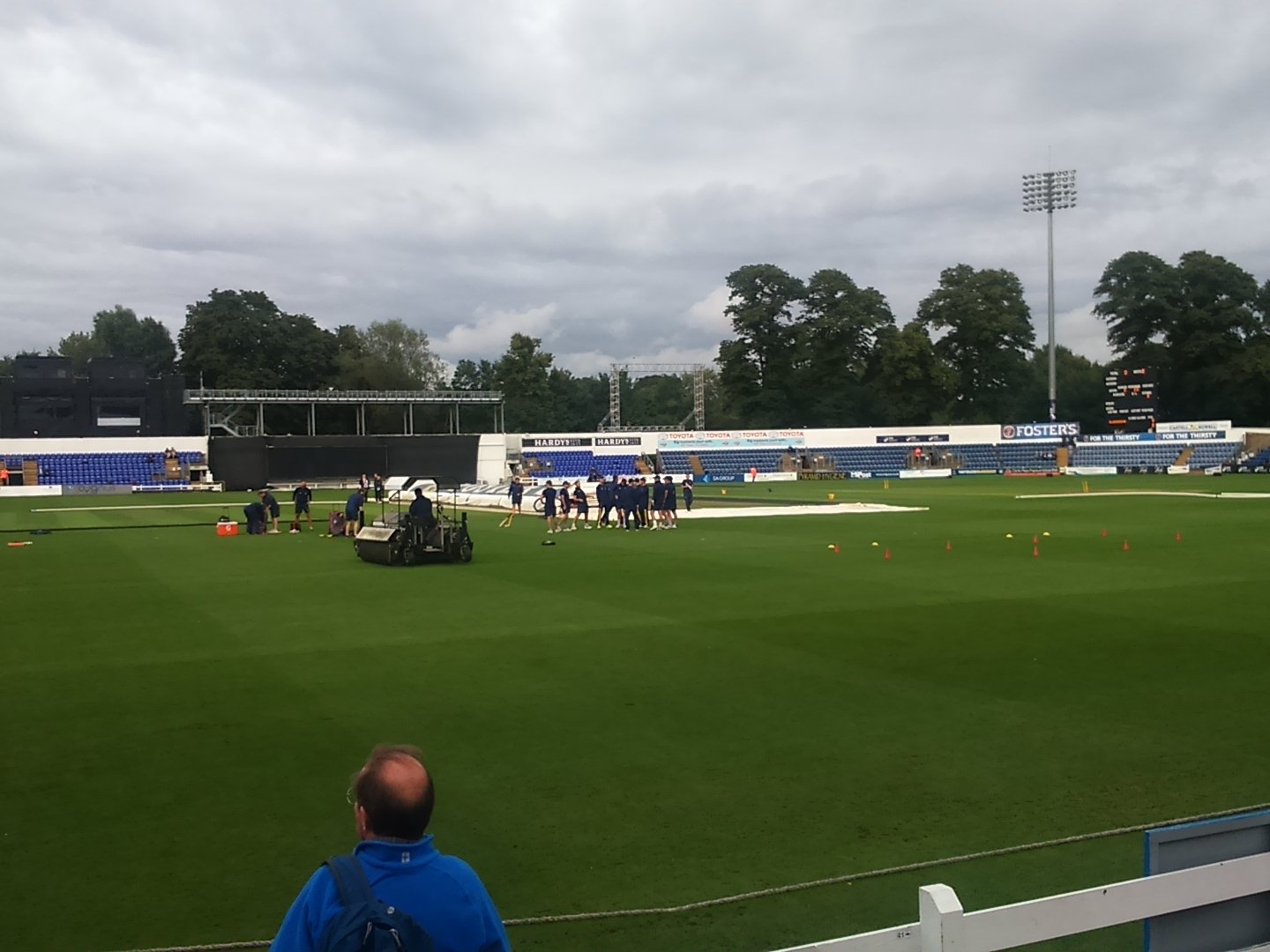
The umpires inspected the pitch at 7pm, and during their deliberations it started drizzling. They decided to have another look at 7.30.

I stayed inches ground, updating the rest of the staff group who happily stayed in the pub while I sat in the gloom of a sparsely populated SWALEC.

Eventually the ground staff started to remove the covers

The toss was finally thrown at 8pm. Glamorgan won and decided to field. Play would start at 8.30, with 9 overs per side.

Play did get under way at 8.30..

It was predictably knockabout stuff, with Sussex slogging from the word go. They reached 87 for 2 off 8 overs, but then the rain returned. A little after 9pm the game was abandoned. Fewer than 10 overs having been bowled, tickets were refunded.

It was a shame that we didn’t get a full game, not only because the social event was a damp squib, but also because Glamorgan really wanted a win. Their previous match at the SWALEC (against Somerset last Saturday) was also rained off but their match  the following day against Essex in Chelmsford led to a victory with a six off the last ball as Glamorgan chased 220 to win off 20 overs.

Anyway, it’s the return match against Essex in Cardiff on Sunday so let’s hope for a full game then.

Glamorgan versus Sussex

Posted in Cricket with tags , , , on August 23, 2016 by telescoper

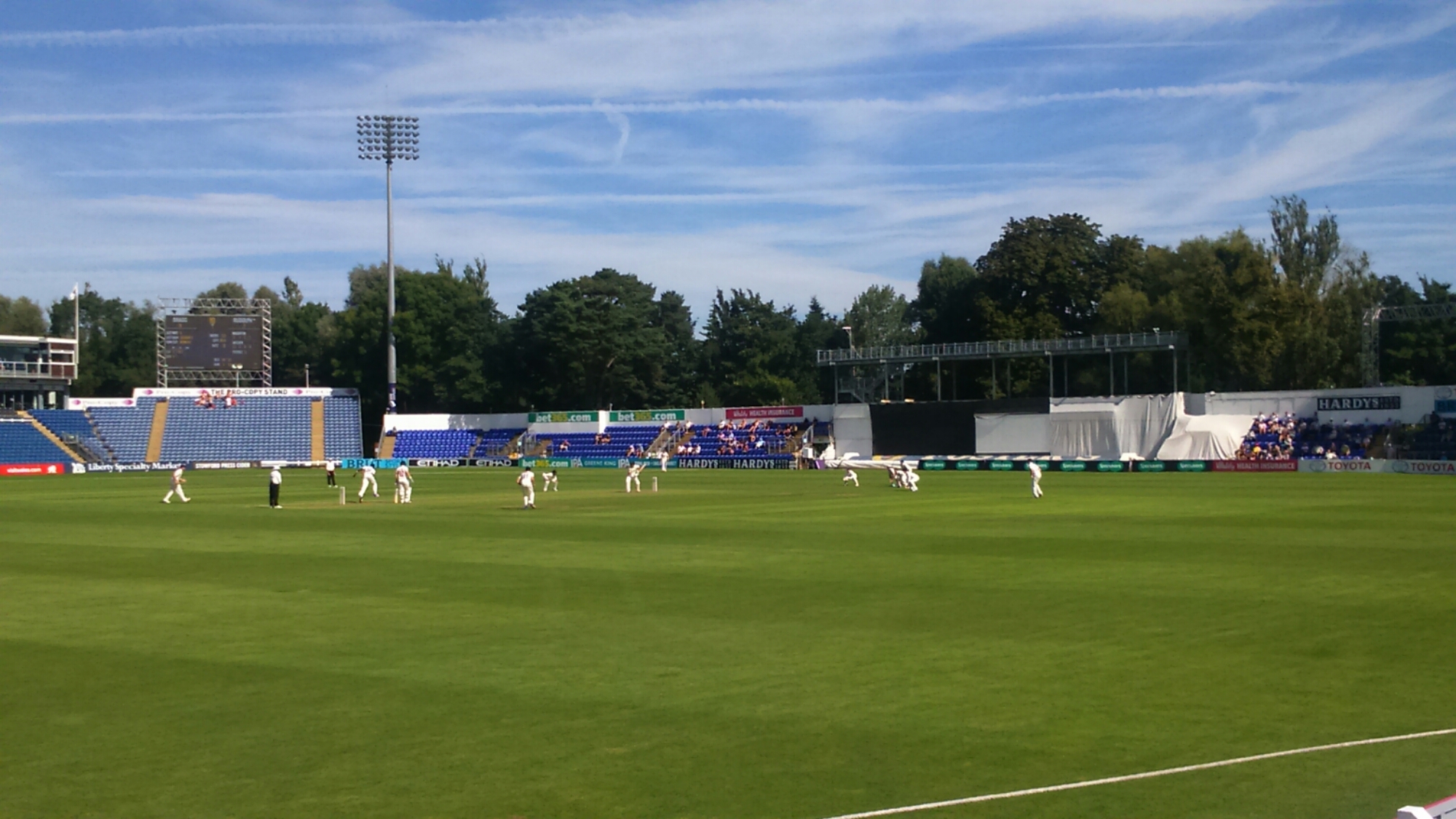
Another of life’s little coincidences came my way today in the form of a County Championship match between Glamorgan and Sussex in Cardiff. Naturally, being on holiday, and the SWALEC Stadium being very close to my house, I took the opportunity to see the first day’s play.

image

Sussex used the uncontested toss to put Glamorgan in to bat. It was a warm sunny day with light cloud and no wind. One would have imagined conditions would have been good for batting, but the Sussex skipper may have seen something in the pitch or, perhaps more likely, knew about Glamorgan’s batting frailties…

As it turned out, there didn’t seem to be much pace in the pitch, but there was definitely some swing and movement for the Sussex bowlers from the start. Glamorgan’s batsman struggled early on, losing a wicket in the very first over, and slumped to 54 for 5 at one stage, recovering only slightly to 87 for 5 at lunch.

After the interval the recovery continued, largely because of Wagg (who eventually fell for an excellent 57) and Morgan who was unbeaten at the close. Glamorgan finished on 252 all out on the stroke of the tea interval. Not a great score, but a lot better than looked likely at 54 for 5.

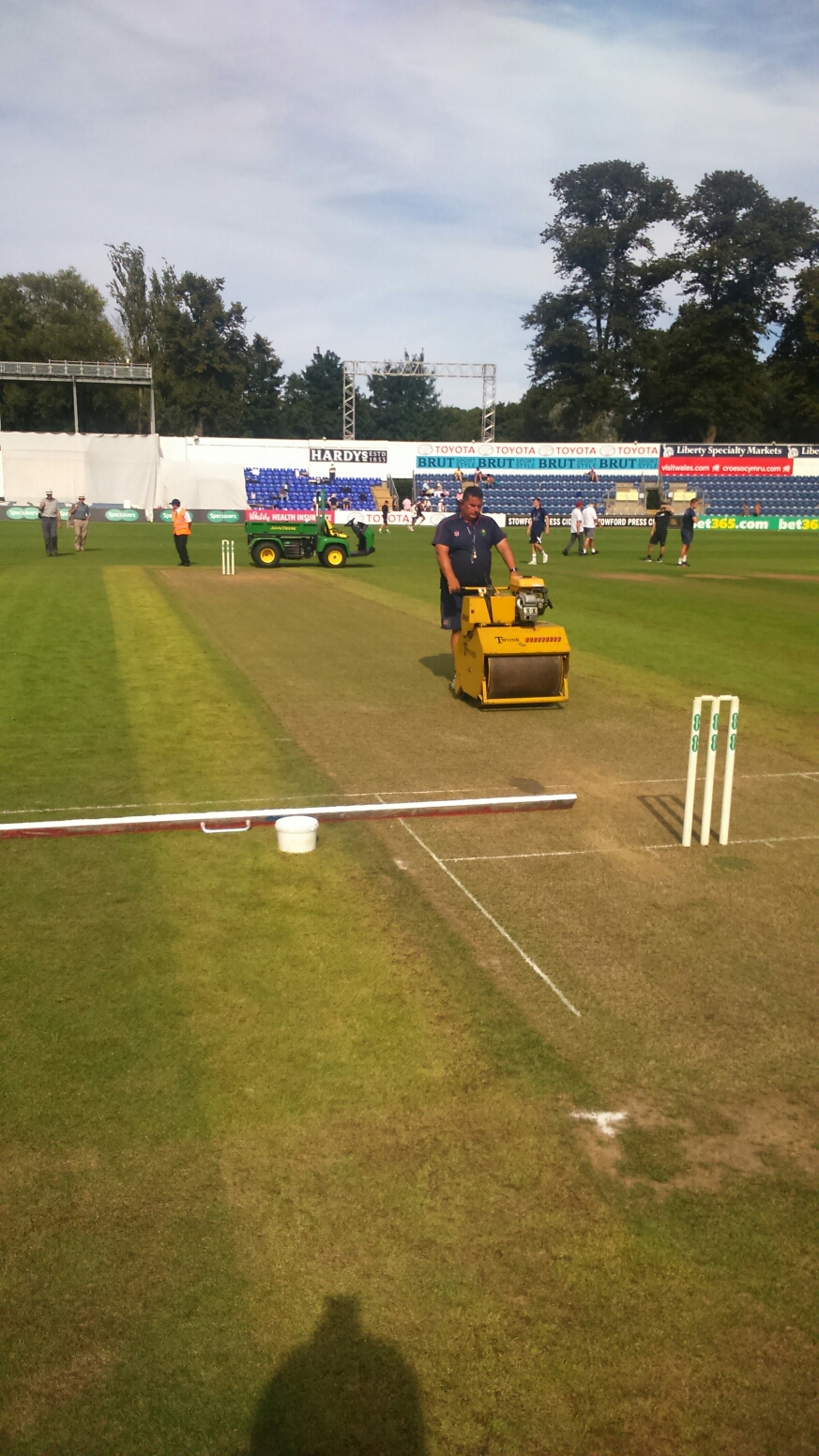
During the tea interval I wandered onto the field and looked at the pitch, which had quite a bit of green in it:

image

Perhaps that’s why Sussex put Glamorgan in?

Anyway, when Sussex came out to bat it was a different story. Openers Joyce and Nash put on 111 for the first wicket, but Nelson did the trick for Glamorgan and Joyce was out just before stumps bringing in a nightwatchman (Briggs) to face the last couple of overs.

A full day’s cricket of 95 overs in the sunshine yielded 363 runs for the loss of 12 wickets. Not bad at all! It’s just a pity there were only a few hundred people in the crowd!

Sussex are obviously in a strong position but the weather forecast for the later part of this week is not good so they should push on tomorrow and try to force a result!

Sussex versus Glamorgan

Posted in Biographical, Cricket with tags , , , on July 29, 2016 by telescoper

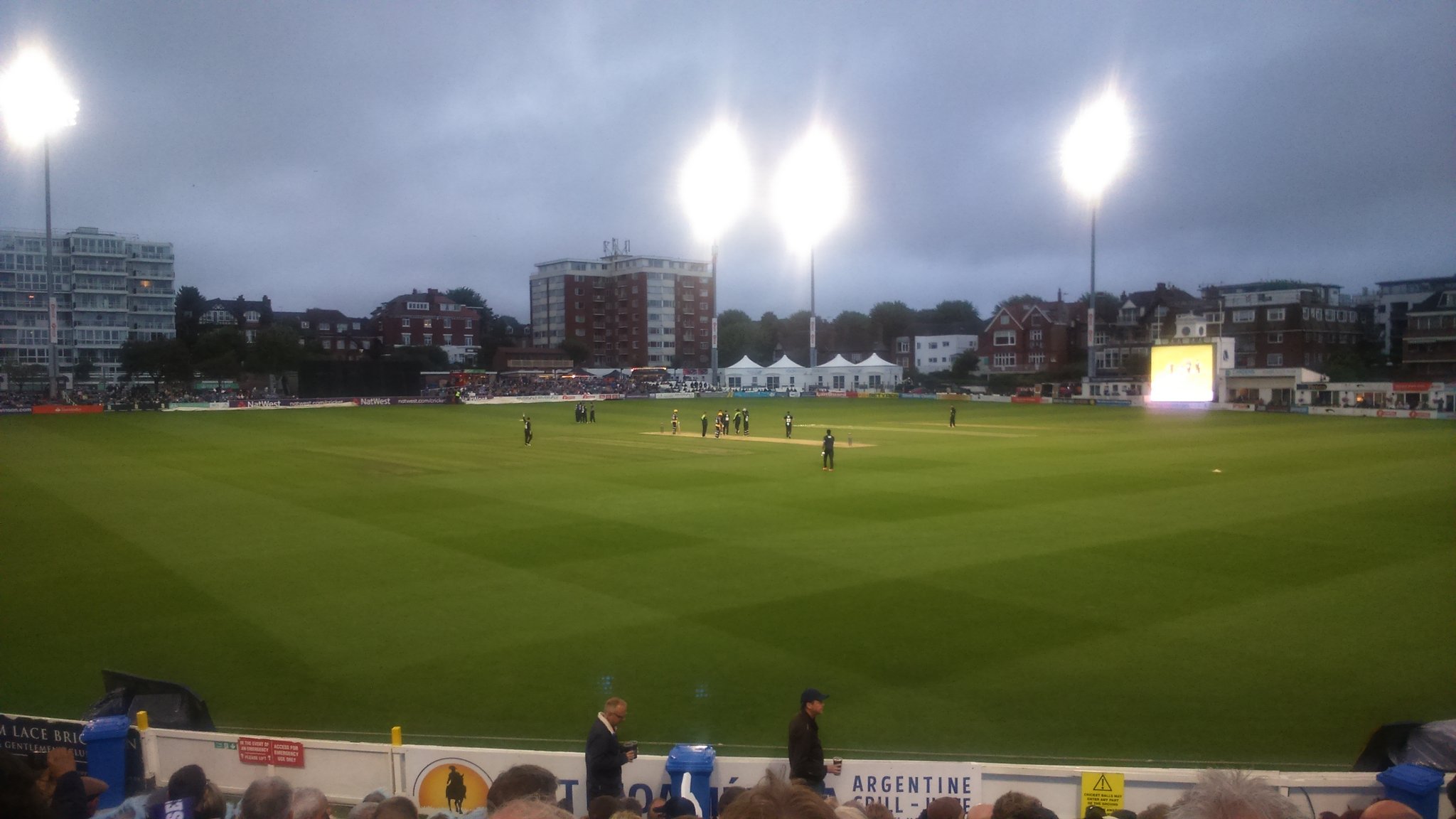
It was an interesting coincidence that, last night, on the eve of my last day working at the University of Sussex before moving to Cardiff University, there was a game of cricket between Sussex and Glamorgan at the County Ground in Hove. Naturally I decided to go along and was fortunate to have Dorothy Lamb along for company. To be precise this wasn’t “proper cricket”, but a Natwest T20 “Blast”. Unfortunately the weather dampened the squib considerably. Yesterday’s weather forecast predicted rain in the afternoon clearing by the time the game started (at 18.30), but when we got to the ground it was still drizzling:

Cricket_1

After a lot of faffing about play did actually get under way at about 19.50, the match to be reduced to 14 overs a side because of the late start.

Cricket_2You can see the full scorecard here. Glamorgan batted first, struggling right from the start despite some wayward bowling from Sussex.  Having been 62 for 8 at one point they were probably relieved to get into three figures, though they only just managed this: they were all out for 101 in the last over. Sussex batted and got off to a much better start, but then the rain came back so they went off. They then came back again but only one ball was beowled before the rain (which was really just drizzle) started again so they went off again. And so on. In the end only four overs and one ball were possible before the rain came back for good and the match was abandoned with no result. The upshot of this was that Glamorgan qualified for the Quarter Finals and Sussex didn’t. Glamorgan were lucky. Sussex were 30-1 when play was halted but a minimum of five overs have to be bowled for a result to be declared. A few minutes more play and Sussex would almost certainly have won. Such is life.


Sussex – The Aerial Perspective

Posted in Brighton with tags , , on October 9, 2015 by telescoper

This very nice short video by Scott Wright was made using a camera on a drone, giving some unusual perspectives on familiar Sussex landmarks!


The Last Match

Posted in Cricket, History with tags , , , , , on August 23, 2015 by telescoper

Yesterday (Saturday 22nd August) I took the day off to go to Sussex County Cricket Club‘s ground at Hove watch some cricket and also to watch a play called The Last Match. Here’s a snap I took in the direction of the scoreboard as play commenced, at 11am.
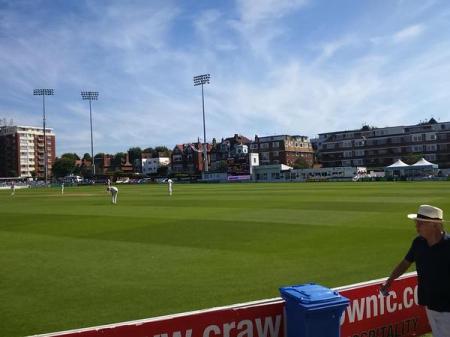
Hove_cricket

As you can see from the picture, it was very sunny yesterday – the high cloud had vanished by the afternoon to leave a perfectly cloudless blue sky. I arrived at the ground already rather hot, having walked from Kemptown (which lies well to the East of Hove) along the seafront and through Brighton city centre to get there. Fortunately, cricket grounds are not short of options for liquid refreshment!

The match going on was between Sussex and Yorkshire in the County Championship. I haven’t seen much County cricket in recent years, but it was good to see a reasonably big crowd there. Many of them were Yorkshire supporters who had presumably made the short trip South from the Midlands to watch the game. Saturday was the second day of a four-day game. Yorkshire had batted first on day 1 and reached 346-6 by close of play, with Gary Ballance not out on 98 and Tim Bresnan not out on 44 (both former England players). No sooner had I settled into my seat than Ballance got his century, but Bresnan took about 35 minutes to get to his fifty. Thereafter the Yorkshire batsman progressed steadily, adding a hundred to their overnight score without losing a wicket but soon after that Ballance was out for 165, clean bowled by Liddle. A few runs later Bresnan was run out in controversial fashion: the batsmen went for a quick single, fielder Chris Nash threw at the bowler’s end whereupon the bowler caught it and fell on the stumps, knocking them all over with Bresnan short of his ground. The umpire’s finger went up, but it should have been not out, because the ball is supposed to hit the stumps at some point. Anyway, the umpire’s decision is final – no reviews in County cricket – so Bresnan was out for 78 with the score on 458-8. Had I been Yorkshire captain I would probably have declared then to let my bowlers have a go at Sussex before lunch. But that didn’t happen.

Six overs later the ninth wicket fell, at about 12.59 (with lunch scheduled for 1pm). Then a rule was invoked with which I was unfamiliar. Apparently in County cricket if a wicket falls just before lunch, so that the batting side is nine down, play continues for up to 30 minutes (or 8 overs) or until the final wicket falls. Thus it came to pass that, possibly for the first time ever in the history of cricket, play stopped Play…

The Play concerned was due to start at 1.15 in one of the function rooms at the boundary of the ground, but the organizers decided to hold back the start until the session of play (in the cricketing sense) had actually finished. As it happened, the last wicket pair for Yorkshire batted about 7 overs and added 35 runs until Plunkett was run out. Yorkshire’s innings closed at 494 all out. Now the Play could start.

The subject of The Last Match was legendary Yorkshire spin bowler Hedley Verity. I posted about him not long ago so I won’t repeat his life story here, but the point was that the last match he ever played in for Yorkshire (and indeed the last competitive match he ever played in) was the County Championship fixture against Sussex at Hove which took place from August 30th to September 1st 1939. Hence the poem I posted yesterday, which is actually quoted during the play.

The significance of the date September 1st 1939 is that was when German forces began the invasion of Poland, which commenced at 5am UK time. Although Britain did not formally declare war on Germany until 3rd September, the invasion of Poland did lead to various emergency measures being immediately adopted in Britain. One of these was that a plan to evacuate all children of school age from major cities was implemented on that day. On the morning of 1st September the Yorkshire players were told that they should abandon the final day and return home. Verity must have been especially keen to rejoin his family, as he had two young children to think about. Yorkshire had by then already won the County Championship so there wasn’t really that much to play for. However, the players on both sides discussed what to do and decided to play out the match, the main reason being that it was a benefit match for Jim Parks. I’d also suggest that the players probably knew they wouldn’t be playing cricket again for a long time, and wanted to savour the last monents of peaceful normality, much as a condemned man might savour his last cigarette.

It’s probable that the cricketers’ minds were not entirely on the match that day, but what happened was remarkable nevertheless. Sussex had batted first and score 387 all out; Yorkshire managed 392 all out in their first innings. Verity had taken only 2 for 108 off 18 overs in the first innings, which makes the second innings all the more remarkable. Sussex were bowled out for a paltry 33, with Verity the destroyer (6-1-9-7). Yorkshire then knocked off the 30 required to win for the loss of one wicket, and won the match. The Yorkshire players bundled onto their coach and travelled home.

Verity subsequently enlisted in the British Army and, as a Captain in the Green Howards, took part in the invasion of Sicily in 1943. During the Battle for Catania, Verity was ordered to lead his unit in a night attack on a farmhouse occupied by German soldiers. He did so, but he had walked into a trap and they were quickly surrounded. Half his men were killed and he received a bullet in the chest. He died of his wounds in a prisoner of war camp at Caserta, near Naples on July 31st 1943, at the age of 38, but the official telegram informing his family that he had been killed was not sent until some time later; it was dated 1st September 1943..

Apart a brief preamble and some film footage projected at the rear of the stage, most of The Last Match is set in the hospital in which Verity spent his last days and revolves around a conversation between himself (played by Al Barclay) and a fictional character, Francis Watson (played by Daniel Abelson) whose role is to hold a mirror up to Verity. Francis is younger, more cynical and from a wealthier background than Verity who comes across as rather old-fashioned but with a strong sense of personal duty. It only lasts about 35 minutes, but in that short time it touches on a wide range of issues, especially the conflict between freedom and responsibility. It’s a poignant story, well written and acted, although its brevity means that there’s no time to develop the characters fully. It did occur to me watching it that it would work very well as a radio play, and I hear that there has been some discussion of that possibility.

Congratulations to writers Colin Philpott and Kit Monkman for such a thought-provoking piece. It certainly added an interestingly different dimension to a day’s cricket. The production now moves to Yorkshire – it will be at Yorkshire County Cricket Ground, Headingly on 1st September and again on 24th September, and a couple of other venues in between. Do go and see it if you get a chance.

So then it was back to the cricket, sunshine and (I must admit) some beers – Harvey’s mainly! On what seemed to be a good batting wicket, the Sussex batsmen struggled early on against an impressive Yorkshire pace attack (Sidebottom, Bresnan, Plunkett and Patterson; the first three of whom are former England bowlers). Despite numerous appeals, a lot of playing and missing, and more oohs and aahs than you will hear in a Frankie Howerd monologue, openers Ed Joyce and Luke Wells put on 110 for the first wicket before Wells fell to Adil Rashid for 43. A couple of balls later Rashid also dismissed the hapless Machan for a duck. Plunkett trapped Nash lbw for 18 to make it 139-3. Ed Joyce brought up his century with a six off Rashid, and almost immediately departed off the same bowler to make it 175-4, whereupon Sussex sent on a nightwatchman, Oliver Robinson, who was almost out first ball to Rashid but clung on until close of play.

Honours pretty even I’d say at the end of day 2, and this (Sunday) morning’s session having been lost to rain with more bad weather forecast for tomorrow, I suspect this one will be a draw.

So there you have it. War and peace. Life and death. Sussex and Yorkshire. Beer and lovely weather. What more could you want from a day off?

UPDATE: Monday 24th August. Sussex ended day 3 on 493-7 with centuries for Michael Yardy and Ben Brown. No play was possible this morning, the final day, because of heavy rain, so the match does indeed look set to be a draw.

UPDATE to the UPDATE: No play was possible on Monday at all due to rain, so the game did indeed end as a draw.

Why Cosmology Isn’t Boring

Posted in Brighton, The Universe and Stuff with tags , , , on October 23, 2014 by telescoper

As promised yesterday, here’s a copy of the slides I used for my talk to the ~150 participants of the collaboration meeting of the Dark Energy Survey that’s going on here this week at Sussex. The title is a reaction to a statement I heard that recent developments in cosmology, especially from Planck, have established that we live in a “Maximally Boring Universe”. I the talk I tried to explain why I don’t think the standard cosmology is at all boring. In fact, I think it’s only now that we can start to ask the really interesting questions.

At various points along the way I stopped to sample opinions…

IMG-20141022-00439

I did however notice that Josh Frieman (front left) seemed to vote in favour of all the possible options on all the questions.  I think that’s taking the multiverse idea a bit too far..