Archive for The Unanswered Question

Ives, Beethoven and Sibelius at the National Concert Hall

Posted in Biographical, Music with tags , , , , , , , on February 11, 2023 by telescoper

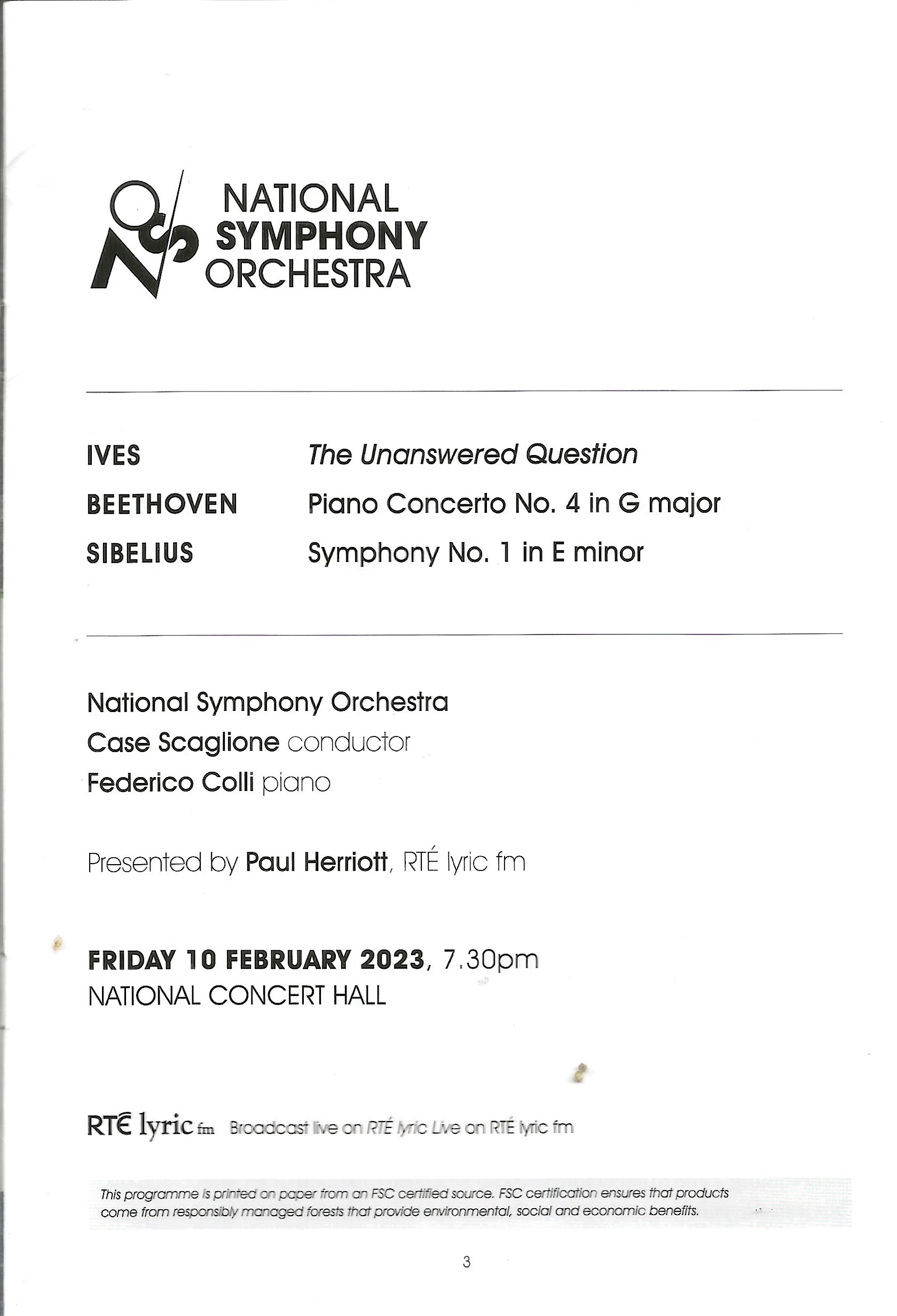
Last night’s concert by the National Symphony Orchestra at the National Concert Hall in Dublin was one that I’d been looking forward to for a long time. It didn’t disappoint! Congratulations to the National Symphony for yet another excellent concert, this time under the direction of guest conductor Case Scaglione.

The first half of the programme consisted of The Unanswered Question by Charles Ives and Beethoven’s Piano Concerto No. 4 with soloist Federico Colli. That’s an interesting juxtaposition, made even more interesting by the Beethoven piece was played directly after the Ives without a break for applause. I wondered what was up when Case Scaglione walked on stage with Federico Colli who took his seat at the piano at the start of the concert. There is no piano part in The Unanswered Question, so Colli sat quietly until the end of that piece and then went straight into the opening piano statement of the Beethoven. I wasn’t expecting this before the performance but it worked very well. The only problem is that I didn’t get the chance to applaud at the end of The Unanswered Question.

The Unanswered Question is one of my favourite works by Charles Ives (along with Three Places in New England), a composer whom I admire greatly. I wrote a piece about him some years ago, actually.  The Unanswered Question, was completed in 1908 (although it was revised later) and is subtitled “A Cosmic Landscape”. It’s a sort of meditation on the philosophical problem of existence. It comprises three different voices: muted strings playing notes from a G-Major triad (a rather “churchy” key, giving the flavour of a simple hymn). Then, played (in this performance) from the balcony behind the conductor, a solo trumpet poses the Question: a five note figure that is repeated with almost imperceptible variations several times during the work. The reply to the Question comes from the woodwinds, whose dissonant response is at first plaintive but then increasingly agitated and frustrated. Then the Question comes again without an answer, but the strings carry on quietly in G Major until everything goes quiet.

The Piano Concerto No. 4 by Ludwig van Beethoven is in G Major, so there is a continuity between the two pieces in terms of tonality, although of course the musical language is very different. It was composed in 1805/6, a hundred years before the Ives. It’s an audacious piece right from the start as it opens with unaccompanied piano. The second movement is a kind of dialogue between the orchestra and the piano, which at times sounds more like an argument as the orchestra makes a series of rather harsh statements with somewhat conciliatory responses from the piano. The last movement is a more conventional and jovial Rondo, by which time the solo trumpeter from the Ives piece had found her way back to the stage from the balcony. I’ve heard this movement several times played on its own on the radio.

Federico Colli cut a dashing figure in a grey suit and waistcoat with a high collar and a voluminous white cravat. He was well up to the demands of the piece, playing very expressively, tenderly at times and with virtuosic brilliance when called for.

After the wine break we returned for the majestic Symphony No. 1 by Jean Sibelius. This is one of the great symphonies and another favourite of mine – I have several different recordings of it and have heard it on the radio many times – but I had never heard it performed live in person before last night. The First Movement (initially Andante) opens with a theme played by solo clarinet. It then moves into allegro energico which was played very briskly in this performance (in contrast to some famous recordings which slow it down). The motif played by the clarinet at the start permeates the whole work, returning in different guises and endowing the composition with a strong sense of unity. It’s all shot through with great romantic tunes and has wonderful dynamics. In short, it’s a masterpiece. Not bad for a First Symphony!

Charles Ives & Albert Einstein: Parallel Lives

Posted in Music, The Universe and Stuff with tags , , , on October 20, 2015 by telescoper

I just noticed that today is the birthday of the great American modernist composer Charles Ives, who was born 141 years ago on this day. Some time ago I read The Life of Charles Ives by Stuart Feder, it’s a very interesting and informative biography of one of the strangest but most fascinating composers in the history of classical music so I thought I’d rehash an old piece I wrote about him to celebrate his birthday.

Charles Ives was by any standards a daring musical innovator. Some of his compositions involve atonal structures and some involve different parts of the orchestra playing in different time signatures. He also wrote strange and wonderful piano pieces, including some which involved re-tuning the piano to obtain scales involving quarter-tones. Among this maelstrom of modern ideas he also liked to add quotations from folk songs and old hymns which gives his work a paradoxically nostalgic tinge.

His pieces are often extremely diffficult to play (so I’m told) and sometimes not that easy to listen to, but while he’s often perplexing he can also be exhilarating and very moving. Other composers might play off two musical ideas against each other, but Ives would smash them together and to hell with the dissonance. I think the wholeheartedness of his eccentricity is wonderful, but I know that some people think he was just a nut.. You’ll have to make your own mind up on that.

My favourite quote of his can be found scrawled on a hand-written score which he sent to his copyist:

Please don’t try to make things nice! All the wrong notes are right. Just copy as I have – I want it that way.

But the point of adding this post to my blog was that in the course of reading the biography, it struck me that there is a strange parallel between the life of this controversial and not-too-well known composer and that of Albert Einstein who is certainly better known, especially to people reading what purports to be a physics blog.

For one thing their lifespans coincide pretty closely. Charles Ives was born in 1874 and died in 1954; Albert Einstein lived from 1879 to 1955. Of course the former was born in America and the latter in Germany. One inhabited the world of music and the other science; Ives, in fact, made his living in the insurance business and only composed in his spare time while Einstein spent most of his career in academia, after a brief period working in a patent office. Not everything Ives wrote was published professionally and he also rewrote things extensively, so it is difficult to establish exact dates for things, especially for a non-expert like me. In any case I don’t want to push things too far and try to argue that some spooky zeitgeist acted at a distance to summon the ideas from each of them in his own sphere. I just think it is curious to observe how similar their world lines were, at least in some respects.

We all know that Einstein’s “year of miracles” was 1905, during which he published classic papers on special relativity, Brownian motion and the photoelectric effect. What was arguably Ives’ greatest composition, The Unanswered Question, was completed in 1906 (although it was revised later). This piece is subtitled “A Cosmic Landscape” and it’s a sort of meditation on the philosophical problem of existence: the muted strings (which are often positioned offstage in concert performances) symbolize silence while the solo trumpet evokes the individual struggling to find meaning within the void. Here’s a fine recording of this work, featuring the New York Philharmonic conducted by Leonard Bernstein:

The Unanswered Question is probably Ives’ greatest masterpiece, but it wasn’t the only work he composed in 1906. A companion piece called Central Park in the Dark also dates from that year and they are sometimes performed together as a kind of diptych which offers interesting contrasts. While the former is static and rather abstract, the latter is dynamic and programmatic (in that it includes realistic evocations of night-time sounds).

Einstein’s next great triumph was his General Theory of Relativity in 1915, an extension of the special theory to include gravity and accelerated motion, which which came only after years of hard work learning the required difficult mathematics. Ives too was hard at work for the next decade which resulted in other high points, although they didn’t make him a household name like Einstein. The Fourth Symphony is an extraordinary work which even the best orchestras find extremely difficult to perform. Even better in my view is Three Places in New England (completed in 1914) , which contains my own favourite bit of Ives. The last movement, The Housatonic at Stockbridge is very typical of his unique approach, with a beautifully paraphrased hymn tune floating over the top of complex meandering string figures until the piece ends in a tumultuous crescendo.

After this period, both Einstein and Ives carried on working in their respective domains, and even with similar preoccupations. Einstein was in search of a unified field theory that could unite gravity with the other forces of nature, although the approach led him away from the mainstream of conventional physics research and his later years he became an increasingly marginal figure.

By about 1920 Ives had written five full symphonies (four numbered ones and one called the Holidays Symphony) but his ambition beyond these was perhaps just as grandiose as Einstein’s: to create a so-called “Universe Symphony” which he described (in typically bewildering fashion) as

A striving to present – to contemplate in tones rather than in music as such, that is – not exactly within the general term or meaning as it is so understood – to paint the creation, the mysterious beginnings of all things, known through God to man, to trace with tonal imprints the vastness, the spiritual eternities, from the great unknown to the great unknown.

I guess such an ambitious project – to create an entirely new language of “tones” that could give expression to timeless eternity, a kind of musical theory of everything – was doomed to failure. Although Ives was an experienced symphonic composer he couldn’t find a way to realise his vision. Only fragments of the Universe Symphony remain (although various attempts have been made by others to complete it).

In fact, the end of Ives’ creative career was much more sudden and final than Einstein who, although he never again reached the heights he had scaled in 1915 – who could? – remained a productive and respected scientist until his death. Ives had a somewhat melancholic disposition and from time to time suffered from depression. By 1918 he already felt that his creative flame was faltering, but by 1926 the spark was extinguished completely. His wife, appropriately named Harmony, remembered the precise day when this happened at their townhouse in New York:

He came downstairs one day with tears in his eyes, and said he couldn’t seem to compose anymore – nothing went well, nothing sounded right.

Although Charles Ives lived almost another thirty years he never composed another piece of music after that day in 1926. I find that unbearably sad, but at least a lot of his work is available and now fairly widely played. Alongside the pieces I have mentioned, there are literally hundreds of songs, some of which are exceptionally beautiful, and dozens of smaller works including piano and violin sonatas.

Although they both lived in the same part of America for many years, I don’t think Charles Ives and Albert Einstein ever met. I wonder what they would have made of each other if they had?

If you believe in the multiverse, of course, then there is a part of it in which they do meet. Einstein was an enthusiastic violinist so there will even be a parallel world in which Einstein is playing the Ives’ Violin Sonata on Youtube…