A week or so ago I posted an item about the Edgeworth family that included a reference to Kenneth Edgeworth, an amateur astronomer of some note who first posited the existence of what is now known as the Kuiper belt. Here’s another interesting connection. Kenneth Edgeworth was born in 1880 in Daramona House in Street in County Westmeath. The owner of this house was Edgeworth’s uncle, another astronomer called William Edward Wilson who built an observatory next to Daramona House.
Here are pictures of (left) house and (right) the observatory, neither of look in particularly good condition!


After independence, many of the large houses owned by the rich Anglo-Irish families who had run Ireland until then fell into disrepair or were destroyed.
Anyway, on top of the two-storey observatory building there used to be a dome that housed a 24″ Grubb reflecting telescope. Here’s an old picture showing what it looked like in better times, around 1900:

The dome is no longer there, and neither is the telescope. The latter was donated to the University of London in 1925 eventually housed in the Observatory at Mill Hill, now run by University College London. Here is an excerpt from the history of the University of London Observatory:
W.E. Wilson established an observatory at Daramona, Street, County Westmeath, in 1871 and equipped it with a 12-inch equatorial reflector by Grubb. Wilson (born in 1851, elected FRS in 1896, an original member of the BAA, awarded an honorary DSc by the University of Dublin in 1901, High Sheriff of Co. Westmeath in 1894), observed the transit of Venus in 1882 and solar eclipses at Oran in 1870 and Spain in 1900, published many papers in Proc. R. Soc, Proc. R. Dublin Soc., Proc. R. Irish Acad., etc., and died in 1908) enlarged his observatory in 1881 and installed a 24-inch reflector by Grubb on the mounting previously used for the 12-inch reflector. Ten years later a new mounting was constructed. It is this mounting which was moved to Mill Hill in 1928. Dr. Wilson used his telescope to make some of the best photographs of his time of star clusters and nebulae, and he worked extensively on problems of solar physics and the solar constant. The telescope may be used in Newtonian and Cassegrain forms; the focal length of the mirror is 10 feet and the equivalent focal length at the Cassegrain focus is approximately 42 feet. The telescope was moved in 1928 from Ireland to University College, where minor modifications were made to the focussing arrangements and plate-holder, and an electric motor was added to rewind the driving clock automatically.
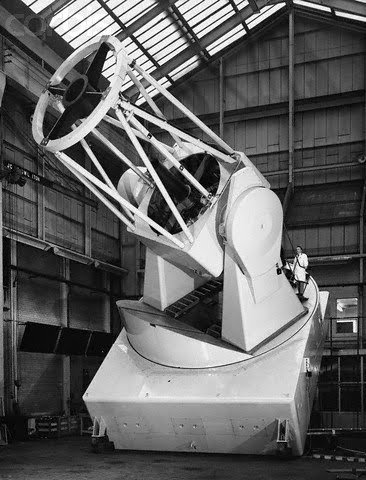
The Wilson telescope was retired from active service in 1974 and moved to the World Museum in Liverpool where, as far as I know, it remains on display to this day.


 In the Dark