Archive for Times Higher

Rubbishing the Viva

Posted in Education with tags , , , , , on October 25, 2012 by telescoper

There’s a strange article today in the Times Higher that claims that the UK’s system of examining PhD students is “a scandal” and that it is “way behind the rest of the world”. These comments are from a chap called Ron Barnett (an emeritus professor at the Institute for Education, who explains

“Students can spend five years doing their PhD, present their thesis and come up against the maverick view of an independent examiner and in effect be rubbished,” he commented.

“I’ve seen it happen far too many times,” he told a Westminster Higher Education Forum seminar on the future of postgraduate education, held in London on 17 October.

I have to say I find it hard to reconcile such remarks with the business of examining PhDs as I’ve observed it, in Physics and Astronomy. And I’ve done quite a few over the years; see, e.g., here. For a start, it’s extremely rare for a student to spend five years doing a PhD in my field – the Research Councils put extremely strong pressure on departments to ensure that students submit within four years, and most research students take less time than this to produce their thesis.

But it’s the idea that a maverick external examiner can sabotage a PhD that I find hardest to recognize. If that looks like happening the internal examiner should stand up for the candidate. In fact, here in Cardiff we have an additional safeguard against this sort of eventuality: each viva has a Chair as well as the two examiners. The Chair is just there to ensure fair play and that proper procedure is followed, but is rarely (if ever) called upon to intervene in practice.

I can’t speak for other fields, of course, and it may indeed be more of a problem in other disciplines. Curiously, Prof. Barnett says that he has seen it happen “far too many times”. I wonder how? As internal examiner? In which case he should have stepped in to stop it? If not as internal then in what capacity was he privy to the conduct of a PhD viva? I’m confused.

Anyway, in a couple of weeks I’ll be participating in a PhD examination in another country (Denmark). There the defence is public, and it involves two external “opponents”, but I don’t know whether it is easier or harder for the candidate than the British system so I won’t comment on whether it’s fairer or more rigorous than what we have in the UK. I’m very much looking forward to seeing how it works, actually.

In my opinion, if there is a “scandal” in the system of UK PhD examinations, at least in science disciplines, it’s not the one Prof. Barnett describes. It’s that we produce far too many low-quality PhDs based on dull, incremental research and that, if anything, externals are not tough enough.

There, I’ve said it. No doubt you’ll have a go at me through the comments box!

Death by Management

Posted in Education with tags , , , on March 4, 2012 by telescoper

I thought I’d do a quick post before I go out to pass on a story from the latest Times Higher. The news won’t come as a shock to anyone who actually works in a University, but it appears that the number of  “managers” working in Higher Education is growing rapidly:

Data released by the Higher Education Statistics Agency reveal there were 15,795 managers in higher education in December 2010 – up by almost 40 per cent on the 11,305 employed in the 2003-04 academic year.

That was compared to the 19.2 per cent increase in academics since 2003-04. It means there is now a manager for every 9.2 academics compared with a ratio of one to 10.8 seven years earlier.

It’s tempting to take the usual easy shot at “managers”, but I’m not going to do that, at least not immediately, because I’m not at all sure precisely how they define a “manager” in the context of this survey. In my School we have a School Manager, who looks after budgets and runs the School Office which carries out a large number of complex administrative tasks related to research grants, undergraduate and postgraduate admissions, student records, and so on. People like this are indispensible because if we didn’t have them these tasks would have to be done by academics, which would be a distraction from their proper business of teaching and research, and which they would almost certainly do extremely badly. Managers who work alongside academic staff and understand the realities of University life are therefore a good thing to have. They actually help.

The problem I have is that, as it seems to me, much of the growth in numbers of “managers” does not involve people in this sort of job at all. The greater part of the increase is in centralised administrative divisions or, as they’re called in Cardiff, “Directorates”. In fact Cardiff is nowhere near as bad in this respect as some other universities I’ve either worked in or heard about from colleagues, but it is an issue even here.

The problem we find with such folk is that they are so remote that they seem to have no idea what people working in  academic Schools and Departments actually do. For one thing they seem to think we just loaf around all day waiting for the chance to fill in some new forms or attend a some allegedly vitally important meeting at short notice (usually in teaching term, and usually mid-morning when lectures are in progress). In fact, there isn’t a day of the week when I don’t have teaching of some sort going on in teaching term. That’s not unusual for an academic in my Schoo, so it’s extremely difficult to attend such events at the drop of a hat without jeopardising teaching. The frequent requests to do so mean that I’d be surprised, in fact, if most of these managers actually knew when teaching term was.  Meetings scheduled outside term of course eat into research time, but given that managers think “doing research” means “having a holiday”, you might be surprised we don’t have more meetings during the student vacations. Of course the real reason for this is that they don’t want us to attend (see below).

Another result of the increase in administrative staff is a plethora of badly thought out “initiatives”, similar initiatives even arising from several directorates simulaneously as managers compete with each other to weigh down academics with forms to fill in. The worst of these involve idiotic schemes in which Schools have to prepare lengthy documents to bid for minuscule amount of money from the central University coffers, the cost in staff time  of administering such procedures far exceeding the financial or other benefits they can possibly deliver.

Worse, these central units are sometimes so badly run that they mess up the basic administrative tasks that they should be carrying out.  Schools are thus forced to duplicate the work that should be done by someone else to make sure that it’s done properly. The idea that centralised administration leads to greater efficiency rarely works in practice. In contrast to the staff in individual Schools, most of whom actually care deeply about what they do because they work directly with the people involved, to the administrators are sometimes – not always, by any means, but definitely sometimes – too remote to care.

So in the end I am going to take a cheap shot at creeping managerialism, but only insofar as it relates to the invasion of universities by people who have no understanding of the core activities of a higher education institution, but who think they have the right to dictate to people who do. Instead of meaningful cooperation with academics, we have phoney “consultations”: meetings usually scheduled in such a way that academics can’t attend (see above) or documents requiring a response with absurdly short deadlines. This kind of management does not lead to a more “professional” institution, it just leads to alienation. In short, these people don’t help at all, they’re a positive hindrance.

Over the last decade, the burden of red tape has steadily increased for all kinds of institutions, but only the NHS vies with Universities in taking the fetish of managerialism to absurd levels. Academics will soon have to take courses in management-speak before they can be employed at a University as the influx of business types continues to accelerate.

The greatest irony of all this is that in the UK universities (with some notable exceptions) are generally regarded by the wider world as examples of international excellence, whereas British businesses (again with some notable exceptions) are seen by those abroad to epitomize incompetence and failure….

The Unprofessional Professors

Posted in Education with tags , , , on November 26, 2011 by telescoper

I’ve been so preoccupied with other things over the past week or so that I haven’t had time until now to comment on an article I saw in last week’s  Times Higher about the role of a Professor in a modern university; there’s also an accompanying editorial in the same issue although, as is usual for editorials in the Times Higher, it doesn’t actually say anything that adds to the original piece.

People outside academia probably wonder what makes a Professor different from a Lecturer or Reader, apart from being older and getting paid a bit more. Undergraduate students probably wonder even more because they don’t see any obvious evidence that Prof. X is any better at teaching than plain Dr. Y. Quite possibly the reverse, in fact.

If you look at the contract of a Professor you won’t find that helps much either. Mine just says words to the effect that I should do whatever the Head of School asks me to do. In my case I have no complaints. I do teaching (lecturing, project supervision, tutorials, exercise classes), administration (various committees, and Director of Postgraduate Studies) and research (including supervising PhD students and a PDRA, publishing papers, etc) and I also do a few things outside the University such as STFC panels. I’m not complaining at all about this workload, for which  consider myself to be quite well paid. What I find difficult is swapping between so many different tasks even during the course of a single day, and I am all too aware that things  do sometimes fall through the cracks.

The criteria for promotion to the rank of Professor (i.e. to a “Chair”)  operated by most universities generally state that a professor must excel at teaching, administration and research. This provides for even greater mystification when you look around the average department because you’ll find many – probably even a majority – who couldn’t administer the skin on a rice pudding, and who make only derisory attempts to teach. These are the ones who have done it all on research, which in reality easily trumps the other two. To paraphrase Paul’s letter to the Corinthians: there are teaching, administration and research but the greatest of these is research. In fact the others don’t matter much at all.

The point is, at least in physics, that current levels of funding for undergraduate teaching mean that departments are financially unviable if they rely on undergraduate teaching as their primary source of income. It’s therefore inevitable that the primary criterion for appointing and retaining staff is their ability to win research grants and be a star performer in the REF. Indeed, many promotions to Chair happen when a member of staff threatens to leave, and take  their research grants and publication statistics with them. Furious negotiations then take place, a promotion to Chair ensues, and more likely than not a reduced teaching and administration load for the newly minted Prof.  Of course this means the load for someone  else has to go up. And if they are given management tasks to do, the Prof will manage the workload by simply not doing it, letting everything fall to bits until the job is allocated to someone else. Likewise with teaching: if you do it so badly that the students fail their exams or complain that you’re useless, you’ll just find your courses are given to someone else and you have more time to indulge your research interests. Studied incompetence is the ally of selfishness. It actually pays to be bad.

This is such a successful strategy that many departments now have as many professors as other teaching staff, if not more, a significant fraction of whom shirk their adminstrative duties and make little effort to teach well. Why should they? They know that as long as they hold onto their research grants they are indispensible, no matter how much strain they put on their colleagues. You might argue that this is unprofessional conduct, but there’s no question that it works.

Given this state of affairs, it’s hardly surprising that junior staff complain that their professors don’t show sufficient leadership and don’t take an active role in mentoring younger staff.  Selfishness pays. How many leaders can a department sustain anyway? If 2/3 of the staff are professors can they all be leaders? Who will follow?

I’ll get into trouble if I name individuals in my department – they know who they are – but I’m sure people in other universities recognize the same thing in their own departments. The situation won’t change until a funding regime is put in place that requires departments to prove commitment to excellence in teaching in the same way that they do for research. Then promotions panels might actually start to follow  their own published criteria instead of doing what they do now, which is nothing short of systematic hypocrisy.

Hard Decisions, Easy Targets

Posted in Science Politics, The Universe and Stuff with tags , , , , , , on January 25, 2011 by telescoper

Just back from a day trip to London – at the Institute of Physics to be precise – to wrap up the proceedings of this years protracted STFC Astronomy Grants Panel (AGP) business. The grant letters have already gone out, so no real decisions were made relating to the current round, but we did get the chance to look at a fairly detailed breakdown of the winners and losers. Perhaps more significantly we also discussed issues relating to the implementation of the brand new system which will be in place for 2011/12.

I’m not exactly sure at the moment how much of what we discussed is in the public domain, so I won’t write anything about the meeting here. Tomorrow there is a meeting of the RAS Astronomy Forum at which department representatives will also be briefed about these issues. I will, however, in due course, on as much information as I can through this blog in case there is anyone out there who doesn’t hear it via the Forum.

Not being able to blog about AGP business, I thought I’d comment briefly on a couple of recent things that sprang to mind on the train journey into London. Last night there was a programme in the BBC series Horizon called Science under Attack, presented by Nobel laureate Sir Paul Nurse. I didn’t watch all of it, but I was fortunate (?) enough to catch a segment featuring a chap called James Delingpole, whom I’d never heard of before, but who apparently writes for the Daily Torygraph.

My immediate reaction to his appearance on the small screen was to take an instant dislike to him. This is apparently not an uncommon response, judging by the review of the programme in today’s Guardian. I wouldn’t have bothered blogging about this at all had I wanted to indulge in an ad hominem attack on this person, but he backed up his “unfortunate manner” by saying some amazing things, such as

It’s not my job to sit down and read peer-reviewed papers, because I don’t have the time; I don’t have the expertise

Yet he feels qualified to spout off on the subject nevertheless. The subject, by the way, was climate change. I’m sure not even the most hardened climate skeptic would want Mr Delingpole on their side judging by his performance last night or, apparently, his track-record.

Anyway, this episode reminded me of another egregious example of uninformed drivel that appeared in last week’s Times Higher. This was a piece purporting to be about the limits of mathematical reasoning by another person who is quite new to me, Chris Ormell, who appears to have some academic credentials, if only in the field of philosophy.

Ormell’s piece includes a rant about cosmology which is on a par with Delingpole’s scribblings about climate change, in that he has absolutely no idea what he is talking about. Jon Butterworth and Sean Carroll have already had a go at pointing out the basic misunderstandings, so I won’t repeat the hatchet job here. If I had blogged about this at the weekend – which I might have done had my rodent visitor not intervened – I would have been considerably less polite than either of them. Ormell clearly hasn’t even read a wikipedia article on cosmology, never mind studied it to a level sufficiently deep to justify him commenting on it in a serious magazine.

I’m still amazed that such a pisspoor article could have made it through the Times Higher’s editorial procedures but more worrying still is the ract that Ormell is himself the editor of a journal, called Prospero, which is “a journal of new thinking of philosophy for education”. The last thing education needs is a journal edited by someone so sloppy that he can’t even be bothered to acquire a basic understanding of his subject matter.

What’s in common between these stories is, however, in my opinion, much more important than the inadequate scientific understanding of the personalities involved. Rubbishing the obviously idiotic, which is quite easy to do, may blind us to the fact that, behind all the errors, however badly expressed it may be, people like this may just have a point. Too often the scientific consensus is portrayed as fact when there are clearly big gaps missing in our understanding. Of course falsehoods should be corrected, but what science really needs to go forward is for bona fide scientists to be prepared to look at the technical arguments openly and responsibly and be candid about the unknowns and uncertainties. Big-name scientists should themselves be questioning the established paradigms and be actively exploring alternative hypotheses. That’s their job. Closing ranks and stamping on outsiders is what makes the public suspicious, not reasoned argument.

In both climatology and cosmology there are consensus views. Based on what knowledge I have, which is less in the former case than in the latter, both these views are reasonable inferences but not absolute truths. In neither case am I a denier, but in both cases I am a skeptic. Call me old-fashioned, but I think that’s what a scientist should be.


Share/Bookmark

Political Correlation

Posted in Bad Statistics, Politics with tags , , , , on August 28, 2010 by telescoper

I was just thinking that it’s been a while since I posted anything in my bad statistics category when a particularly egregious example jumped up out of this week’s Times Higher and slapped me in the face. This one goes wrong before it even gets to the statistical analysis, so I’ll only give it short shrift here, but it serves to remind us all how feeble is many academic’s grasp of the scientific method, and particularly the role of statistics within it. The perpetrator in this case is Paul Whiteley, who is Professor of Politics at the University of Essex. I’m tempted to suggest he should go and stand in the corner wearing a dunce’s cap.

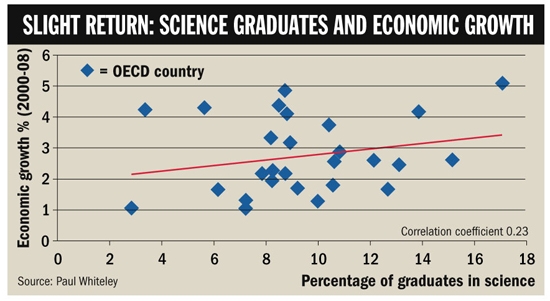
Professor Whiteley argues that he has found evidence that refutes the case that increased provision of science, technology, engineering and maths (STEM) graduates are -in the words of Lord Mandelson – “crucial to in securing future prosperity”. His evidence is based on data relating to 30 OECD countries: on the one hand, their average economic growth for the period 2000-8 and, on the other, the percentage of graduates in STEM subjects for each country over the same period. He finds no statistically significant correlation between these variates. The data are plotted here:

This lack of correlation is asserted to be evidence that STEM graduates are not necessary for economic growth, but in an additional comment (for which no supporting numbers are given), it is stated that growth correlates with the total number of graduates in all subjects in each country. Hence the conclusion that higher education is good, whether or not it’s in STEM areas.

So what’s wrong with this analysis? A number of things, in fact, but I’ll start with what seems to me the most important conceptual one. In order to test a hypothesis, you have to look for a measurable effect that would be expected if the hypothesis were true, measure the effect, and then decide whether the effect is there or not. If it isn’t, you have falsified the hypothesis.

Now, would anyone really expect the % of students graduating in STEM subjects  to correlate with the growth rate in the economy over the same period? Does anyone really think that newly qualified STEM graduates have an immediate impact on economic growth? I’m sure even the most dedicated pro-science lobbyist would answer “no” to that question. Even the quote from Lord Mandelson included the crucial word “future”! Investment in these areas is expected to have a long-term benefit that would probably only show after many years. I would have been amazed had there been a correlation between measures relating to such a short period, so  absence of one says nothing whatsoever about the economic benefits of education in STEM areas.

And another thing. Why is the “percentage of graduates” chosen as a variate for this study? Surely a large % of STEM graduates is irrelevant if the total number is very small? I would have thought the fraction of the population with a STEM degree might be a better choice. Better still, since it is claimed that the overall number of graduates correlates with economic growth, why not show how this correlation with the total number of graduates breaks down by subject area?

I’m a bit suspicious about the reliability of the data too. Which country is it that produces less than 3% of its graduates in science subjects (the point at the bottom left of the plot). Surely different countries also have different types of economy wherein the role of science and technology varies considerably. It’s tempting, in fact, to see two parallel lines in the above graph – I’m not the only one to have noticed this – which may either be an artefact of small numbers chosen or might indicate that some other parameter is playing a role.

This poorly framed hypothesis test, dubious choice of variables, and highly questionable conclusions strongly suggest that Professor Whiteley had made his mind up what result he wanted and simply dressed it up in a bit of flimsy statistics. Unfortunately, such pseudoscientific flummery is all that’s needed to convince a great many out there in the big wide world, especially journalists. It’s a pity that this shoddy piece of statistical gibberish was given such prominence in the Times Higher, supported by a predictably vacuous editorial, especially when the same issue features an article about the declining standards of science journalism. Perhaps we need more STEM graduates to teach the others how to do statistical tests properly.

However, before everyone accuses me of being blind to the benefits of anything other than STEM subjects, I’ll just make it clear that, while I do think that science is very important for a large number of reasons, I do accept that higher education generally is a good thing in itself , regardless of whether it’s in physics or mediaeval latin, though I’m not sure about certain other subjects.  Universities should not be judged solely by the effect they may or may not have on short-term economic growth.

Which brings me to a final point about the difference between correlation and causation. People with more disposal income probably spend more money on, e.g., books than people with less money. Buying books doesn’t make you rich, at least not in the short-term, but it’s a good thing to do for its own sake. We shouldn’t think of higher education exclusively on the cost side of the economic equation, as politicians and bureaucrats seem increasingly to be doing,  it’s also one of the benefits.


Share/Bookmark

Stephen Fry was right…

Posted in Biographical with tags , , on February 2, 2010 by telescoper

I’ve recently been reminded of a comment made by Britain’s only remaining National Treasure, Stephen Fry, in the Guardian a while ago.

“I don’t know about you but whenever I read a blog I do not let my eye drop below half the screen in case I accidentally hit the bit where the comments reside. Of all the stinking, sliding, scuttling, weird, entomological creatures that inhabit the floor of the internet those comments on blogs are the most unbearable, almost beyond imagining,”

There’s also a similar piece by David Mitchell that expresses the same sort of view.

Let me say straight away that I’m not referring to the comments posted on this blog recently. I always enjoy reading the threads on here, even if – or perhaps actually because – they fly off at unpredictable tangents from the main point of the original item. I would never have imagined that Bob Kirshner’s guest post would have led to an in-depth discussion of lavatory seats, for example. I disagree with quite a lot of the opinions expressed, but it’s actually quite nice to give people the opportunity to get something off their chest, as long as they remain civilised – which they usually do.

So please keep commenting on here, and please don’t be scared to look at the comments either. Some of them may indeed be weird, but they’re not going to disturb your piece of mind. Stephen Fry and David Mitchell were referring   to the sort of stuff you often see on higher-profile sites, especially newspapers, where the online comments are filled with  drivel so moronic that it’s actually depressing to think that there are people lurking out there capable of writing it. These guys (Mitchell and Fry) are in the public eye and so they attract a great deal of comment themselves, much of it staggering in its inanity and abusiveness.

One might have expected a bit better from the readership of the Times Higher, an organ which I thought was read by academics and university-based professionals who presumably must have received some sort of education themselves before gaining employment that involves attempting to educate others. However, the comments following the piece I blogged about recently contains, as well as  some sensible reactions (both for and against my actions),  a few that are just puerile and others that barely conceal the writer’s bigotry. Clearly not everyone who works in a university is either articulate or rational. But then I knew that already.

One particular commenter, the presumably pseudonymous John Fitzpatrick, states

As for Coles, what an effete and bitchy little man he has exposed himself as. How he can face his students and colleagues after that is simply amazing.

Amazing it may be, but I certainly can and do face my students and colleagues, although I usually refrain from exposing myself. I’m sure they don’t all agree with what I did, but my conscience is clear. I don’t have the luxury of anonymity anyway.

The Times Higher asked me to contact them if I felt any of the comments were defamatory or abusive so they could remove them, but I replied to say I thought it was better to leave them all there whatever they said. In their own way, they speak  eloquently  for the very point of view they are trying to oppose…

The F-word

Posted in Biographical with tags , , , , , , , on January 31, 2010 by telescoper

Once upon a time, a young man was walking home, alone, from a nightclub on Brighton’s seafront towards the house he shared with some friends. It was a warm summer night or, rather, morning, as it was about 3am. As he crossed King’s Road and began to walk up Preston Street, a group of four youths appeared from the direction of the West Pier, ran across the road and attacked him. He fought back, hitting one of them on the nose and drawing blood, but was soon overpowered and fell to the ground under a rain of fists. He was repeatedly kicked while he lay on the road, and soon lapsed into unconsciousness while the onslaught continued.

To this day he can’t remember how long this went on for, nor can he remember anything at all about the people who eventually came to his assistance. But he can remember the word that was being shouted continually as he was systematically beaten. The word was FAGGOT.

This happened in the 1980s, and the young man was me. At the time I was a postgraduate student at the University of Sussex, and I had just spent the evening at the Zap Club (now sadly defunct). On Wednesdays, this establishment played host to  Club Shame, a gay one-nighter that was extremely popular and well-known around the town. Unfortunately, this made people leaving it in the early hours of the morning easy targets for the many queerbashers who got their kicks beating up gay men for no other reason than that they were gay.

I was actually one of the lucky ones. Apparently, shortly after I fell to the ground and passed out, a group of passers-by chased off the youths who had attacked me, helped me to my feet, and helped me get home.  The commotion when I arrived woke up a couple of my friends who cleaned me up, and gave me a glass of whisky. I was rattled, angry at the gratuitous violence visited on me by complete strangers, and frustrated by the clear demonstration of my own inability to defend myself.   I had a black eye, a fat lip and a lot of bruises but there turned out to be no lasting physical damage. Although I don’t like to admit it, I  have quite a few psychological scars that have stayed with me ever since. I don’t even tell many  people about this episode because my weakness embarrasses me. Still, at least I didn’t end up dead, like poor Jody Dobrowski.

Neither I nor any of the friends (also gay) who helped me ever even thought about reporting the incident to the Police. The Brighton police at that time were notorious for dismissing complaints of gay-bashing despite the fact it was an endemic problem. People I knew who had reported such incidents usually found themselves being investigated rather than their assailants. In those days the law did not recognize homophobic offences as hate crimes. Far from it, in fact. Attacking a gay person was, if anything, considered to be a mitigating circumstance. This attitude was fuelled by a number of high-profile cases (including a number of murders) where gay-bashers had been acquitted or charged with lesser offences after claiming their victim had provoked them.

Now fast-forward about 20 years. Attitudes have definitely changed, and so has the law. Certain types of criminal offence are now officially recognized as hate crimes: the list treats sexual orientation as equivalent to race, gender, religious belief and disability in such matters. The Police are now obliged to treat these with due seriousness, and penalties for those found guilty of crimes exacerbated by homophobia are consequently more severe. All Police forces now have special units for dealing with them; here is an example.

These changes are mirrored in other aspects of life too. For example, employment law relating to discrimination or harassment in the workplace now puts sexual orientation on the same footing as race, gender, disability and religious belief. In many universities in the UK, staff have been required to attend training in Equality and Diversity matters not only to raise awareness of the legal framework under which we all have to work, but also to promote a sensitivity to these issues in order to improve the working environment for both staff and students.

This training isn’t about over-zealous busybodies. Under the law, employers have a vicarious liability for the conduct of their staff with regard to harassment and discrimination. This means that a University can be sued if, for example, one of its employees commits harassment, and it can be shown that it did not make appropriate efforts to ensure its staff did not engage in such activities.

Of course not everyone approves of these changes. Some staff  have refused point-blank to attend Equality and Diversity training, even though it’s compulsory. Others attend grudgingly, muttering about “political correctness gone mad”. You may think all this is a bit heavy handed, but I can tell you it makes a real difference to the lives of people who, without this legal protection, would be victimised, harassed or discriminated against.  It is, also, the law.

I think the efforts that have been made to improve the legal situation have been (at least partly) responsible for the changes in society’s attitudes over the last twenty years, which have been extremely positive. I’m old enough to remember very different times. That’s not to say that there’s no bigotry any more. Even in this day and age, violent crimes against gay men are still disturbingly common and Police attitudes not always helpful.

Somewhat closer to home, a recent story in the Times Higher pointed out that relatively few universities have made it onto the list of gay-friendly employers compiled by the campaigning organisation Stonewall. My experience generally, having worked in a number of UK universities (Sussex, Queen Mary, Nottingham and Cardiff), is that they are  friendly and comfortable places for an openly gay person to work. So much so, in fact, that there’s no real need to make a big deal of one’s sexual identity. It doesn’t really have much to do with the way you do your work – certainly not if it’s astrophysics – and work-related social events are, as a rule, very inclusive.

However, even in the supposedly enlightened environment of a University there do remain islands of bigotry, and not just about gay and lesbian staff.  Sexism is a major problem, at least in science subjects, and will probably remain so until the gender balance improves, which it slowly doing, despite the actions of certain professors who actively block attempts to encourage more female applicants to permanent positions.

I also agree with the main point made by the Times Higher article which is that, despite what the law says, universities still do not seem to me to treat sexual orientation with the same seriousness as, say, race or gender discrimination. Fairly predictably, the online version of the article attracted some nasty comments of a homophobic nature which were subsequently removed according to the terms and conditions of the website.

Recent experiences of my own (relating to this blog) seemed relevant so I passed them onto the Times Higher after reading this story. I didn’t think they would consider it important enough to publish, as in the grand scheme of things it involved a relatively minor offence, so I was a bit surprised to find a full story in this week’s edition. It caught me on the hop a bit because I wasn’t even told they were going to run it at all, let alone straight away and I didn’t get the chance to see the final copy. Thankfully, it’s quite accurate, matter-of-fact, and avoids sensationalism.

I’m not going to put all the details here, because as far as I’m concerned it’s all over and there’s nothing to be gained by going over it again. The relevance to the earlier Times Higher story is clear, however. In a nutshell, I made a complaint about a comment on this blog, involving offensively homophobic language, to the University of Nottingham, the employer of the person who made it. I was not asked to give evidence to the subsequent “investigation”, was not told how it was conducted or how it arrived at its decision, and was not even informed of its outcome for months after it had been completed, and only then after I made repeated requests. My subsequent requests for information about the conduct of the investigation were refused. The University of Nottingham also refused to confirm whether the culprit had ever attended Equality and Diversity training.

What was it I had objected to? It was the F-word – FAGGOT, universally recognized as grossly offensive and, as I’ve explained, one about which my I also have my own particular reasons for objecting to. I was appalled that a former colleague could use that word in a manner that seemed (and still seems) to me to have been calculated to be offensive, subsequent “apologies” notwithstanding. The “investigation”, however, disagreed and accepted the defence that it was meant as a joke. I wonder what they would have decided if I’d been black and had been called a “n****r”?

At the time, I asked for advice on what to do about this. Stonewall encouraged me to report it to the Police, on grounds of criminal harassment. This seemed to me to be excessive, since it had resulted in no physical harm or loss by me and would use up a lot of police time to little effect and a lot of embarassment to others at Nottingham that this had (and has) nothing to do with. A gay-friendly solicitor in Cardiff explained how I could pursue a civil case against the individual and/or employer but that it would be very expensive and damages, if awarded at all, would probably be very small. In the end, therefore, I decided to take the advice of our Equality and Diversity Officer in Cardiff  and reported it instead to the University of Nottingham to deal with internally. What a waste of time that was.

I’m sure there will be some readers of this post who think I over-reacted to the comment in question, and that I’ve blown this matter out of all proportion; this indeed seems to be the prevailing view among the comments on the Times Higher thread. You’re all entitled to your opinion, of course. I fully admit that, for reasons that should now be obvious, I am unable to respond particularly rationally to being called a faggot. But then I don’t see why, in this day and age,  I should be expected to. Things are supposed to have moved on, in case you didn’t know. Anyway, I  don’t think I over-reacted and, in this case, I happen to think it’s my opinion that counts. That’s what the law says too, as a matter of fact.

I’m not claiming to be whiter than white. I am fully aware that I’ve made comments on this blog that have offended some people of whom I am very fond. I’m very sorry that I’ve caused offence in this way. I also admit some of my jokes are a bit off-colour. I tend to be direct in my criticism of those I think deserve it. I think I know how to take a joke too; growing up as  gay teenager in 1970s Newcastle gave me quite a thick skin. I can take forthright criticism too – I should; I’ve had plenty of practice! But I will not accept being called a faggot. Everyone has their limits, and that is mine.

If you don’t like it then, frankly, you can F-off.

The League of Small Samples

Posted in Bad Statistics with tags , , , on January 14, 2010 by telescoper

This morning I was just thinking that it’s been a while since I’ve filed anything in the category marked bad statistics when I glanced at today’s copy of the Times Higher and found something that’s given me an excuse to rectify my lapse. Today saw the publication of said organ’s new Student Experience Survey which ranks  British Universities in order of the responses given by students to questions about various aspects of the teaching, social life and so  on. Here are the main results, sorted in decreasing order:

1 Loughborough University 84.9 128
2 University of Cambridge, The 82.6 259
3 University of Oxford, The 82.6 197
4 University of Sheffield, The 82.3 196
5 University of East Anglia, The 82.1 122
6 University of Wales, Aberystwyth 82.1 97
7 University of Leeds, The 81.9 185
8 University of Dundee, The 80.8 75
9 University of Southampton, The 80.6 164
10 University of Glasgow, The 80.6 136
11 University of Exeter, The 80.3 160
12 University of Durham 80.3 189
13 University of Leicester, The 79.9 151
14 University of St Andrews, The 79.9 104
15 University of Essex, The 79.5 65
16 University of Warwick, The 79.5 190
17 Cardiff University 79.4 180
18 University of Central Lancashire, The 79.3 88
19 University of Nottingham, The 79.2 233
20 University of Newcastle-upon-Tyne, The 78.9 145
21 University of Bath, The 78.7 142
22 University of Wales, Bangor 78.7 43
23 University of Edinburgh, The 78.1 190
24 University of Birmingham, The 78.0 179
25 University of Surrey, The 77.8 100
26 University of Sussex, The 77.6 49
27 University of Lancaster, The 77.6 123
28 University of Stirling, The 77.6 44
29 University of Wales, Swansea 77.5 61
30 University of Kent at Canterbury, The 77.3 116
30 University of Teesside, The 77.3 127
32 University of Hull, The 77.2 87
33 Robert Gordon University, The 77.2 57
34 University of Lincoln, The 77.0 121
35 Nottingham Trent University, The 76.9 192
36 University College Falmouth 76.8 40
37 University of Gloucestershire 76.8 74
38 University of Liverpool, The 76.7 89
39 University of Keele, The 76.5 57
40 University of Northumbria at Newcastle, The 76.4 149
41 University of Plymouth, The 76.3 190
41 University of Reading, The 76.3 117
43 Queen’s University of Belfast, The 76.0 149
44 University of Aberdeen, The 75.9 84
45 University of Strathclyde, The 75.7 72
46 Staffordshire University 75.6 85
47 University of York, The 75.6 121
48 St George’s Medical School 75.4 33
49 Southampton Solent University 75.2 34
50 University of Portsmouth, The 75.2 141
51 Queen Mary, University of London 75.2 104
52 University of Manchester 75.1 221
53 Aston University 75.0 66
54 University of Derby 75.0 33
55 University College London 74.8 114
56 Sheffield Hallam University 74.8 159
57 Glasgow Caledonian University 74.6 72
58 King’s College London 74.6 101
59 Brunel University 74.4 64
60 Heriot-Watt University 74.1 35
61 Imperial College of Science, Technology & Medicine 73.9 111
62 De Montfort University 73.6 83
63 Bath Spa University 73.4 64
64 Bournemouth University 73.3 128
65 University of the West of England, Bristol 73.3 207
66 Leeds Metropolitan University 73.1 143
67 University of Chester 72.5 61
68 University of Bristol, The 72.3 145
69 Royal Holloway, University of London 72.1 59
70 Canterbury Christ Church University 71.8 78
71 University of Huddersfield, The 71.8 97
72 York St John University College 71.8 31
72 University of Wales Institute, Cardiff 71.8 41
74 University of Glamorgan 71.6 84
75 University of Salford, The 71.2 58
76 Roehampton University 71.1 47
77 Manchester Metropolitan University, The 71.1 131
78 University of Northampton 70.8 42
79 University of Sunderland, The 70.8 61
80 Kingston University 70.7 121
81 University of Bradford, The 70.6 33
82 Oxford Brookes University 70.5 99
83 University of Ulster 70.3 61
84 Coventry University 69.9 82
85 University of Brighton, The 69.4 106
86 University of Hertfordshire 68.9 138
87 University of Bedfordshire 68.6 44
88 Queen Margaret University, Edinburgh 68.5 35
89 London School of Economics and Political Science 68.4 73
90 Royal Veterinary College, The 68.2 43
91 Anglia Ruskin University 68.1 71
92 Birmingham City University 67.7 109
93 University of Wolverhampton, The 67.5 72
94 Liverpool John Moores University 67.2 103
95 Goldsmiths College 66.9 42
96 Napier University 65.5 63
97 London South Bank University 64.9 44
98 City University 64.6 44
99 University of Greenwich, The 63.9 67
100 University of the Arts London 62.8 40
101 Middlesex University 61.4 51
102 University of Westminster, The 60.4 76
103 London Metropolitan University 55.2 37
104 University of East London, The 54.2 41
10465

The maximum overall score is 100 and the figure in the rightmost column is the number of students from that particular University that contributed to the survey. The total number of students involved is shown at the bottom, i.e. 10465.

My current employer, Cardiff University, comes out pretty well (17th) in this league table, but some do surprisingly poorly such as Imperial which is 61st. No doubt University spin doctors around the country will be working themselves into a frenzy trying how best to present their showing in the list, but before they get too carried away I want to dampen their enthusiasm.

Let’s take Cardiff as an example. The number of students whose responses produced the score of 79.4 was just 180. That’s by no means the smallest sample in the survey, either. Cardiff University has approximately 20,000 undergraduates. The score in this table is therefore obtained from less than 1% of the relevant student population. How representative can the results be, given that the sample is so incredibly small?

What is conspicuous by its absence from this table is any measure of the “margin-of-error” of the estimated score. What I mean by this is how much the sample score would change for Cardiff if a different set of 180 students were involved. Unless every Cardiff student gives Cardiff exactly 79.4 then the score will vary from sample to sample. The smaller the sample, the larger the resulting uncertainty.

Given a survey of this type it should be quite straightforward to calculate the spread of scores from student to student within a sample from a given University in terms of the standard deviation, σ, as well as the mean score. Unfortunately, this survey does not include this information. However, lets suppose for the sake of argument that the standard deviation for Cardiff is quite small, say 10% of the mean value, i.e. 7.94. I imagine that it’s much larger than that, in fact, but this is just meant to be by way of an illustration.

If you have a sample size of  N then the standard error of the mean is going to be roughly (σ⁄√N) which, for Cardiff, is about 0.6. Assuming everything has a normal distribution, this would mean that the “true” score for the full population of Cardiff students has a 95% chance of being within two standard errors of the mean, i.e. between 78.2 and 80.6. This means Cardiff could really be as high as 9th place or as low as 23rd, and that’s making very conservative assumptions about how much one student differs from another within each institution.

That example is just for illustration, and the figures may well be wrong, but my main gripe is that I don’t understand how these guys can get away with publishing results like this without listing the margin of error at all. Perhaps its because that would make it obvious how unreliable the rankings are? Whatever the reason we’d never get away with publishing results without errors in a serious scientific journal.

Still, at least there’s been one improvement since last year: the 2009 results gave every score to two decimal places! My A-level physics teacher would have torn strips off me if I’d done that!

Precision, you see, is not the same as accuracy….

A Letter to Lord Drayson

Posted in Finance, Science Politics with tags , , on January 12, 2010 by telescoper

As reported in the Times Higher, the five chairs of the advisory panels that took part in STFC‘s recent prioritisation exercise have circulated an open letter to Lord Drayson. I’ve taken the liberty of posting the entire letter here.

-0-


UK fundamental science at a crossroads

An open letter to Lord Drayson, Minister for Science

On 16 December the Science and Technology Facilities Council announced the outcome of its “programmatic review”. The results present a dismal future for researchers in fundamental science: particle physics, nuclear physics, astronomy and space physics. In order to balance its books STFC announced cuts to these frontier science discovery areas amounting to about £28m per annum starting in 2012. Although STFC’s total annual budget is more than £450m, the cuts have been targeted at the roughly £175m annual spend on UK projects in these fundamental science areas. The cuts include:

  • an across-the-board reduction of 25 per cent for training of our brightest young scientists;
  • termination of involvement in more than 20 cutting-edge science projects in which the UK plays leading roles;
  • cancellation of support for an additional 20 projects, currently at the early R&D stage, which were planned to form the foundations of the future science programme 10-20 years from now, and in which the UK has international leadership.


Even those projects lucky enough to be continued will face cuts advertised at between 10 and 25 per cent, and this on top of cuts to STFC’s university physics grants, announced in the past 12 months, of 25 per cent across the board.

As chairs of STFC’s science advisory panels we represent the several thousand members of the UK’s particle physics, nuclear physics, astronomy and space physics communities. On 21 December we wrote to Professor Michael Sterling, chair of STFC Council, to express, on behalf of our communities, dismay at this terrible outcome. We pointed out the obvious consequences:

  • the waste of much of the significant prior investment made by the UK in forefront science;
  • the loss of hard-won UK leadership in many significant areas;
  • the lack of opportunity for developing future UK strategic opportunities for advancing the scientific frontier, with relevant knowledge exchange impact, on the 10-20 year horizon;
  • the extremely negative message to bright young people about the importance the UK places in cutting-edge, fundamental science, and the career opportunities that follow from training in these areas.


The Prime Minister has publicly stated his commitment, which we strongly agree with, to preserve funding for science, seeing it as a key part of the solution to the current economic difficulties. Given that, how could more than 40 internationally leading science projects, and hundreds of studentships, be identified for the chop?

The problem stems from the setting up of STFC in April 2007 as an agency for funding both fundamental science and large (mainly accelerator- and laser-based) facilities used by scientists in other disciplines: for example, biologists and chemists, whose research is funded by the other UK research councils. By December 2007 STFC was already in financial difficulty and announced the need to save £80m over the following three years. The House of Commons Science and Technology Select Committee investigated and concluded that STFC had been set up with a shortfall of funds needed to support both the science programme and development and operation of the facilities, and that it had managed the situation very poorly. These problems, inherent at STFC’s inception, have led inexorably to its pre-Christmas announcement to cut the science funding in order to support the operation of its facilities.

The situation has been exacerbated by the collapse of the pound against major currencies: STFC pays about £200m annually in subscriptions (in Euros and Swiss francs) for UK scientists to access major European research centres: CERN, the European Space Agency, the European Southern Observatory and others.

Unless the Government takes action, STFC’s science cuts will almost inevitably lead to:

  • irreparable damage to the high international reputation of the UK in these areas: we will be perceived as an untrustworthy partner in global projects;
  • a “brain drain” of the best UK scientists, university lecturers and professors to positions overseas;
  • a weakening of our capability to attract the best of overseas scientific talent to the UK;
  • a consequent reduction in the provision and quality of UK university physics teaching and training that are essential for the UK’s economic future.


It is obvious that STFC cannot continue to stagger between financial crises on an almost annual basis. It is structurally incapable of managing both an internationally leading fundamental science programme and domestic facilities that are used primarily by scientists funded by other research councils. Both the science programme and the facilities operations need to be properly supported by dedicated agencies, and the UK’s globally leading research in particle physics, nuclear physics, astronomy and space physics needs to be protected against exchange rate fluctuations.

Philip Burrows (University of Oxford) – Particle Physics Advisory Panel

Michele Dougherty (Imperial College London) – Near Universe Advisory Panel

Martin Freer (University of Birmingham) – Nuclear Physics Advisory Panel

Philip Mauskopf (Cardiff University) – Particle Astrophysics Advisory Panel

Bob Nichol (University of Portsmouth) – Far Universe Advisory Panel

Commented out

Posted in Uncategorized with tags , , , on December 3, 2009 by telescoper

Interesting. Very interesting.

You may recall that a few days ago, the Times Higher closed the comments section on their story about Mark Brake, the University of Glamorgan Professor who falsely represented his credentials on a grant application in 2006 by claiming to have a PhD. This is an ongoing story on this blog – see previous posts here, here and here – and I had been logging the comments for future reference. I was worried that the comments might be lost when the Times Higher closed them so I posted them on this blog. I took them offline a bit later because I was worried about possible copyright infringement, but also made several copies which I have lodged in various places for safekeeping.

When I got back home yesterday I spent a bit of time catching up on blog administration and found that the page of Times Higher comments (which was still on my wordpress space, but not available to the public) had been marked “DO NOT REPOST – CONTACT SUPPORT”. I did so, and it was explained to me that they had received a complaint containing the following

.. this post is actually a repost of an entire conversation held on the Times Higher Education Supplement website, which was removed earlier today after the editor there decided that the contents had become too abusive, and was in breach of not only their own sites rules against defamation and liable, but also in breach of several telecommunications acts here in the UK as well as consituting an invasion of privacy into the lives of several people.

Since the Times Higher hadn’t given a reason for deleting the comments thread on its own site, I asked them whether these indeed were the reasons they had removed them and whether they had made this complaint. I suspected not, as for one thing I was sure that employees of  said organ would be able to spell “libel” correctly. Had they – or anyone else – approached me directly with a  good reason I would have been happy to remove them. As it happens nobody contacted me personally about this, and I was a bit annoyed at the underhand way that it was done. Not the only underhand thing that has happened recently in connection with this story.

I received a reply from Phil Baty, one of the editors of the THES, who confirmed that they had decided to close the thread after “complaints” but had not made any approach about my use of the THES comments on this site. He also  stated that

the decision to close the thread should not be taken as any judgement on our part on the behaviour of any individual who posted.

The anonymous complainant thus seems to have deliberately misrepresented the situation to WordPress in order to suppress the contents of my blog page. Sneaky.

Neither WordPress nor the Times Higher would reveal the identity of the complainant, but I can guess. I surmise this was done by an individual anxious to hush up this story and to conceal his identity. I wonder who that might be?

Anyway, the main point of this post is to reassure those at the University of Glamorgan responsible for disciplinary matters that the abusive comments posted on the THES  have not been lost so there’s no reason to give up their investigation into the ongoing serious misconduct of its employees. I’d be delighted to hand over the information if they request it as part of their no doubt strenuous efforts to root out those responsible for bringing their name into disrepute.

I’m sure the University of Glamorgan would have been very upset if  such important evidence of ongoing wrongdoing had been lost so I am happy to be able to allay their fears.

Perhaps the University of Glamorgan might also like to establish whether any of its employees used a deliberate falsehood to persuade WordPress to suppress this evidence? Shouldn’t be too difficult.

PS. I note the recent news that the University of Glamorgan is to get a new Vice-chancellor.