Archive for Times Literary Supplement

“Who was Mr. W.H.”? – and Other Questions

Posted in LGBTQ+, Poetry with tags , , , , , , , on October 2, 2025 by telescoper

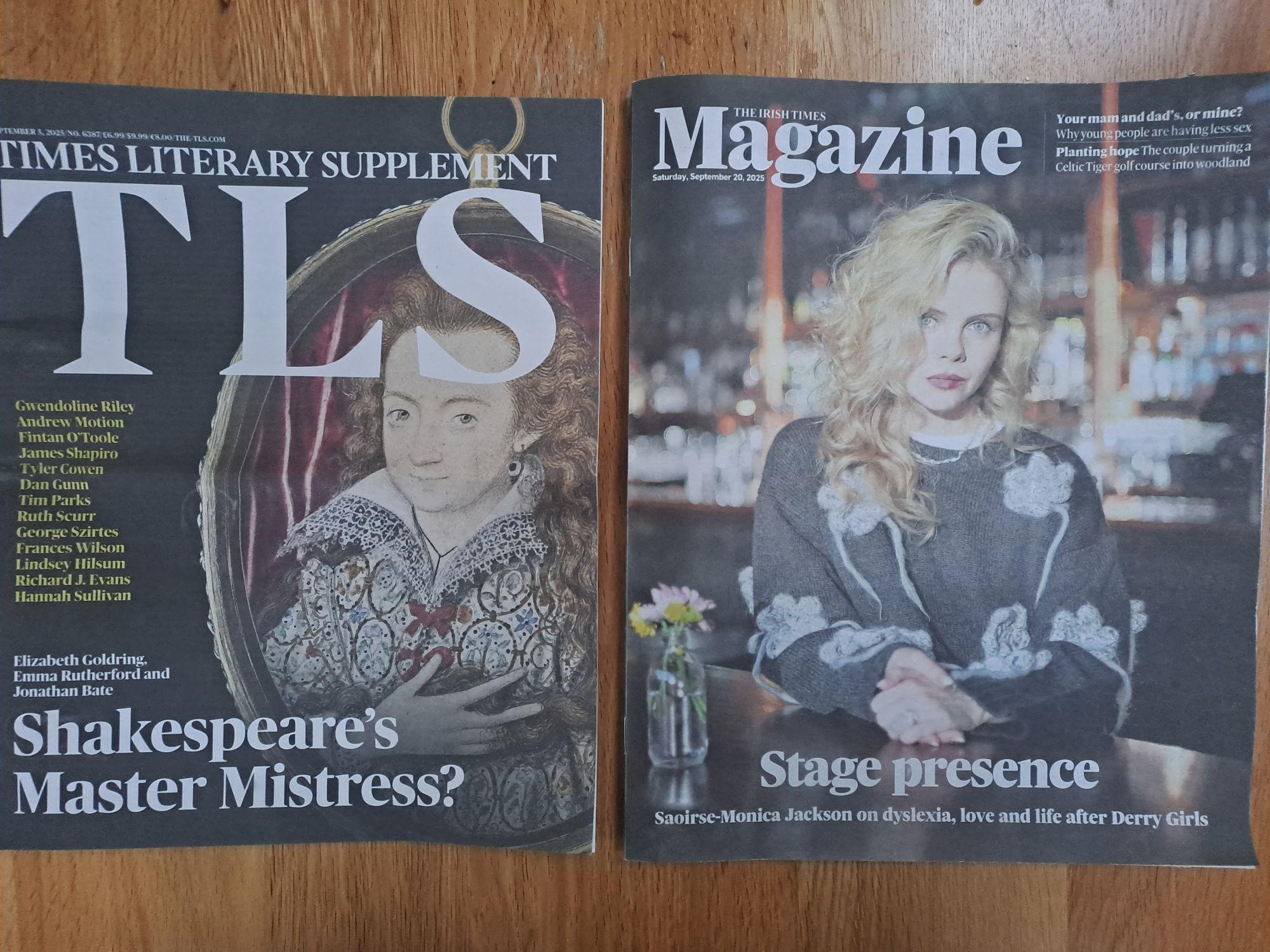
Today is National Poetry Day in the UK and Ireland but, instead of posting a poem like I usually do on this occasion, I thought I’d do a bit of reflecting on Shakespeare’s Sonnets. What prompted this is an article in the Times Literary Supplement I mentioned in a post on Monday. The cover picture shows a newly-discovered miniature by Nicholas Hilliard that is claimed to be of Henry Wriothesley, 3rd Earl of Southampton, and patron of William Shakespeare:
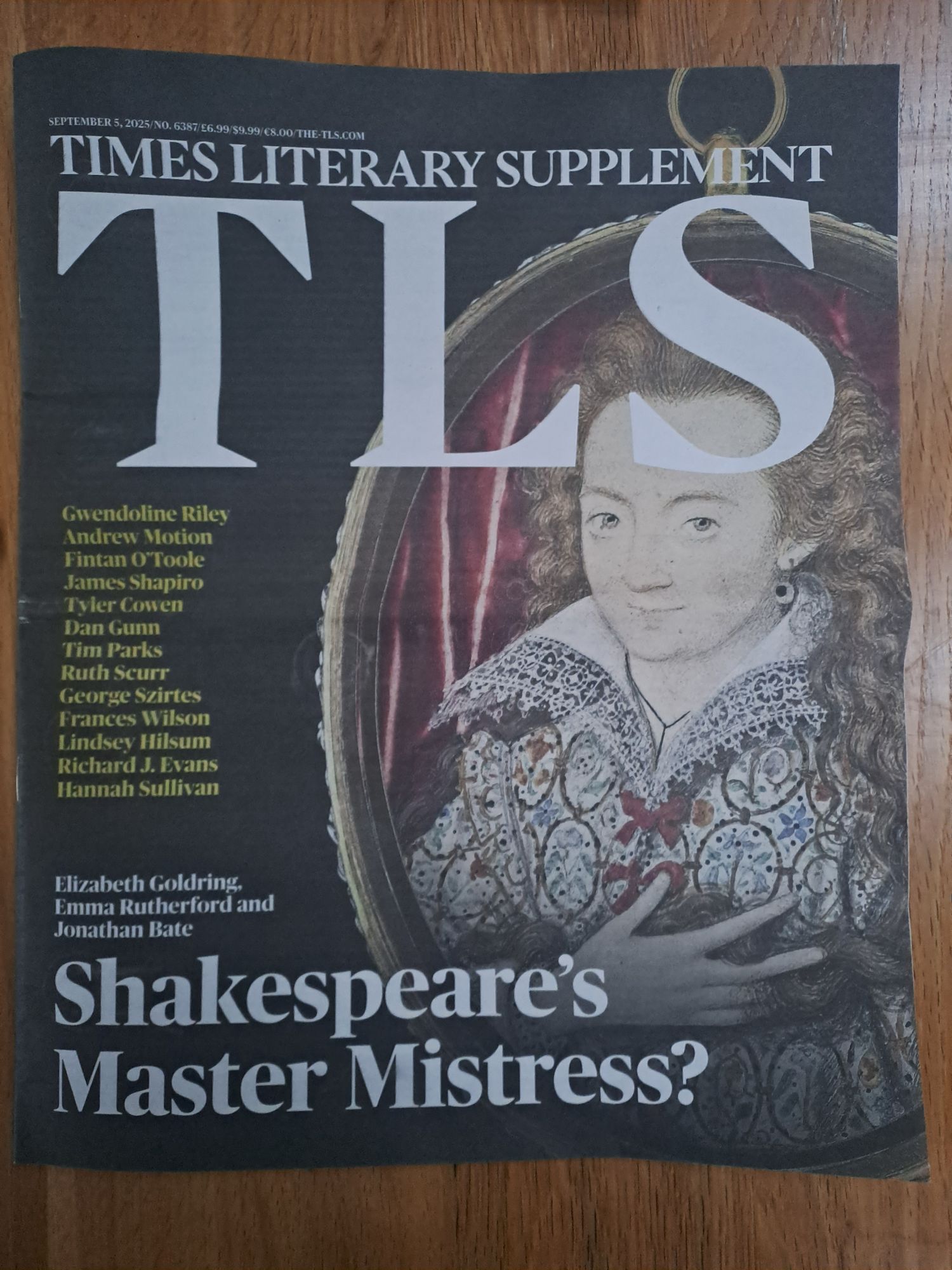
On the 20th May 1609, a collection of 154 Sonnets by William Shakespeare was published, which arguably represents at least as high a  level of literary achievement as his plays. The “Master Mistress” in the title of the TLS article is a reference to Sonnet No. 20 in the collection, published on 20th May 1609, of 154 Sonnets by William Shakespeare, which arguably represents at least as high a  level of literary achievement as his plays. Here is Sonnet No. 20 in the form usually printed nowadays:

A woman’s face with nature’s own hand painted,
Hast thou the master mistress of my passion,
A woman’s gentle heart but not acquainted
With shifting change as is false women’s fashion,
An eye more bright than theirs, less false in rolling:
Gilding the object whereupon it gazeth,
A man in hue all hues in his controlling,
Which steals men’s eyes and women’s souls amazeth.
And for a woman wert thou first created,
Till nature as she wrought thee fell a-doting,
And by addition me of thee defeated,
By adding one thing to my purpose nothing.
But since she pricked thee out for women’s pleasure,
Mine be thy love and thy love’s use their treasure.

The somewhat androgynous facial appearance of Henry Wriothesley – seen in other portraits – has led some to suggest that the above Sonnet was addressed to him. Others think that the poem was addressed to a young male actor (a “boy player“) who played female roles on the stage, as was usual in Shakespeare’s time. It was illegal for women to perform on stage until 1660.
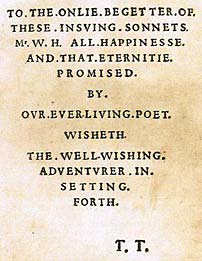
The dedication in the First Folio edition of the Sonnets, published in 1609, is shown on the left. The initials “T.T.” are accepted to stand for the name of the publisher Thomas Thorpe but the identity of “Mr. W.H.” is unknown. Of course “W.H.” is a reversal of the “H.W. ” that could be Henry Wriothesley, but would the publisher really use “Mr” to refer to a member of the nobility? Another curiosity is the prevalence of full stops, which is more characteristic of inscriptions carved in stone than on printed pages.

The First Folio edition was the only edition of the Sonnets published in Shakespeare’s lifetime and the circumstances of its publication remain uncertain to this day and not only because of identity of “Mr W.H.” For example, if it was authorised by Shakespeare, why did Shakespeare himself not write the dedication? Some have argued that it must have been published posthumously, so Shakespeare must have been dead in 1609, whereas most sources say he died in 1616.

Most of the poems (126 out of 154) contain poetic statements of love for a young man,  often called the “Fair Youth”. However, there is also a group of sonnets addressed to the poet’s mistress, an anonymous “dark lady”, which are far much more sexual in content than those addressed to the “Fair Youth”. The usual interpretation of this is that the poet’s love for the boy was purely Platonic rather than sexual in nature.  If Mr W.H. was a boy player then he would have been very young indeed, i.e. 13-17 years old…

Anyway, it was certainly a physical attraction: verse after verse speaks of the young man’s beauty. The first group of sonnets even encourage him to get married and have children so his beauty can continue and not die with his death. Sonnet 20 laments that the youth is not a woman, suggesting that this ruled out any sexual contact.  These early poems seem to suggest a slightly distant relationship between the two as if they didn’t really know each other well. However, as the collection goes on the poems become more and more intimate and it’s hard for me to accept that there wasn’t some sort of involvement between the two.  Although homosexual relationships were not officially tolerated in 17th Century England, they were not all that rare especially in the theatrical circles in which Shakespeare worked.

Oscar Wilde wrote a story called “A Portrait of Mr. W.H.” which suggests he is a young actor by the name of “Will Hughes”. The main evidence for this is Sonnet 20.

Look at the First Folio version:
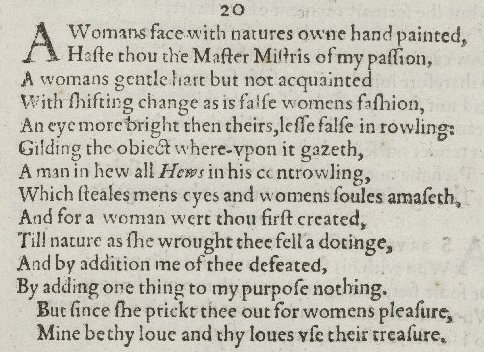
The initial capital and emphasis of “Hews” seen in line 7 is very unusual and suggests that it is a joke (one of many in this poem), in the form of a pun on the preceding “hew”. It is suggested that “Hews” is actually “Hughes”. Ingenious, but I’m not convinced. There were many other meanings of “hew” in use in Shakespeare’s time; it was a variant spelling of “ewe” for example.

We’ll probably never know who Mr W.H. was – presumably not Smith – or indeed what was the real nature of his relationship to Shakespeare but we do not need to know that to read and enjoy the poems.

I do have a fundamental misgiving, though, about the assumption that the “Onlie begetter” of these sonnets means the person to whom they are addressed, or who inspired them. That assumption entirely disregards the “Dark Lady” sequence. There are at least two addressees so neither can be the only begetter, if that is what begetter is supposed to mean.

I think it more likely Mr W.H., whoever he was, is the person who caused the collection to be created and/or published, perhaps by sponsoring the First Folio. It’s also possible that these poems may have been commissioned over the years by Mr. W.H. and/or others – experts think they were written over a period of at least 16 years – and only published together at much later date. It is indeed said that some of verses were circulated in private well before they were published, though they may perhaps have been edited or otherwise tidied up for the 1609 edition. Perhaps Shakespeare supplemented his income by writing sonnets to order?

This line of thought also took me to another question: why does everyone assume that all 126 of the “Fair Youth” sonnets are about the same person? That person is never named and only occasionally described. Some of the 126 are thematically linked, but overall it is a collection rather than a sequence. Some are humorous and some are very serious indeed. Some are downright cryptic. I think it quite possible, especially if the poems really were written over a period of 16 years, that they not all addressed to the same individual. Once you accept the evident truth that there is more than one recipient, then why not more than two?

Some have taken this even further and asked: do we really know that all 154 sonnets were written by the same person? The same question is asked about Shakespeare’s work generally. Was there really one person behind his plays, or were they collaborative efforts.

Finally, I wonder for what purpose these sonnets were written. Were they actually sent to the addressee(s) as expressions of love, like letters, or were they private meditations, like one might write in a journal?

I don’t suppose we’ll ever really know the answers to these questions, but I find it fascinating that the origin of such a famous collection is enshrouded in so many mysteries! I promise to post more of them here in due course.
Supplementary Information

Posted in Biographical, Crosswords, Literature with tags , , on September 29, 2025 by telescoper

Regular readers of this blog know that I have a habit of reading the Times Literary Supplement which I buy not only for the book reviews, but also for its excellent crossword. I’ve even won the crossword competition prize a few times. You can find an assortment of posts related to the TLS here.

Recently the Times Literary Supplement underwent something of a makeover, changing the design and switching from a weekly to fortnightly publication. The first new-style issue was published on September 5th. Here is the cover:

The cover article is about the possible identity of the “Mr W.H.” to whom William Shakespeare dedicated his collection of Sonnets; see here. I may write something about that in the not too distant future, as I’ve been reading these again recently.

Anyway, my subscription definitely specifies a “weekly print edition delivered to my door”, so that has gone out the window. I wasn’t best pleased to have the terms of my subscription changed unilaterally like that. Of course I could just read the online edition, but I don’t like reading too much on a screen. I’ve never adapted to reading books on a Kindle either. And crosswords are impossible that way. The old format TLS was rather like a tabloid newspaper, which I found easy to read and handle, and of 28 pages per edition. The new format has 48 pages (which is not 2 times 28) and is rather cramped and crowded and with heavier paper to make it look there’s more to it than there is.

The look and feel they seem to have gone for is “Generic Weekend Supplement”, as you can see if you compare it with last week’s Irish Times Weekend Magazine:

The latter supplement has 52 pages instead of 48 and has more advertisements inside but is otherwise similar.

So why mention this? Well one thing is that the number of crosswords provided by the TLS per year has now reduced by half, which to me reduces the value of the subscription significantly. Moreover, the first issue of the new style supplement was published on September 5th, but didn’t arrive through my letterbox until 24th September. That’s 19 days. The deadline for entries to the crossword competition was September 15th.

Now the old-style issues used to take about 10 days to cross the Irish Sea, which I thought was bad, but 19 days is just awful. One theory of this is that the TLS launches issues with the same momentum, so that the new edition, having about twice the mass, has half the speed and therefore takes roughly twice as long to reach the subscriber. Checking the envelope, incidentally, I see that it was postmarked Bratislava. There must be a very cheap – but slow – way of sending post from the UK to Ireland via Slovakia.

Anyway, I’ve decided not to renew my subscription to the TLS, as I did with Private Eye recently. I cancelled my subscription to the Eye not because I was offended by anything in it, but because it was taking a ridiculously long time to arrive. I can still pick up copies of both publications in the local newsagent. I’m sure Paddy will keep copies of both to one side if I ask him.

Alternatively, I might switch from the TLS to the London Review of Books or some similar. Does anyone have recommendations?

Crossword Solution and Problem

Posted in Crosswords, mathematics with tags , , , , on March 22, 2025 by telescoper

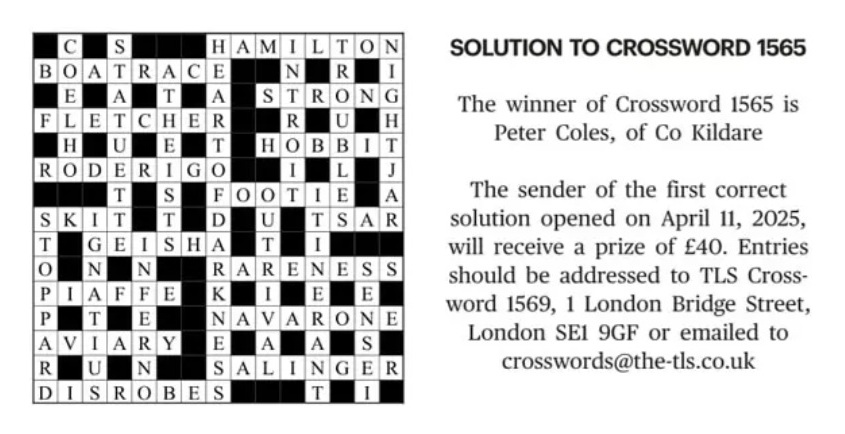
I got an email last week pointing out that I had won another prize in the Times Literary Supplement crossword competition 1565. They have modernised at the TLS, so instead of sending a cheque for the winnings, they pay by bank transfer and wanted to check whether my details had changed since last time. You can submit by email nowadays too, which saves a bit in postage.

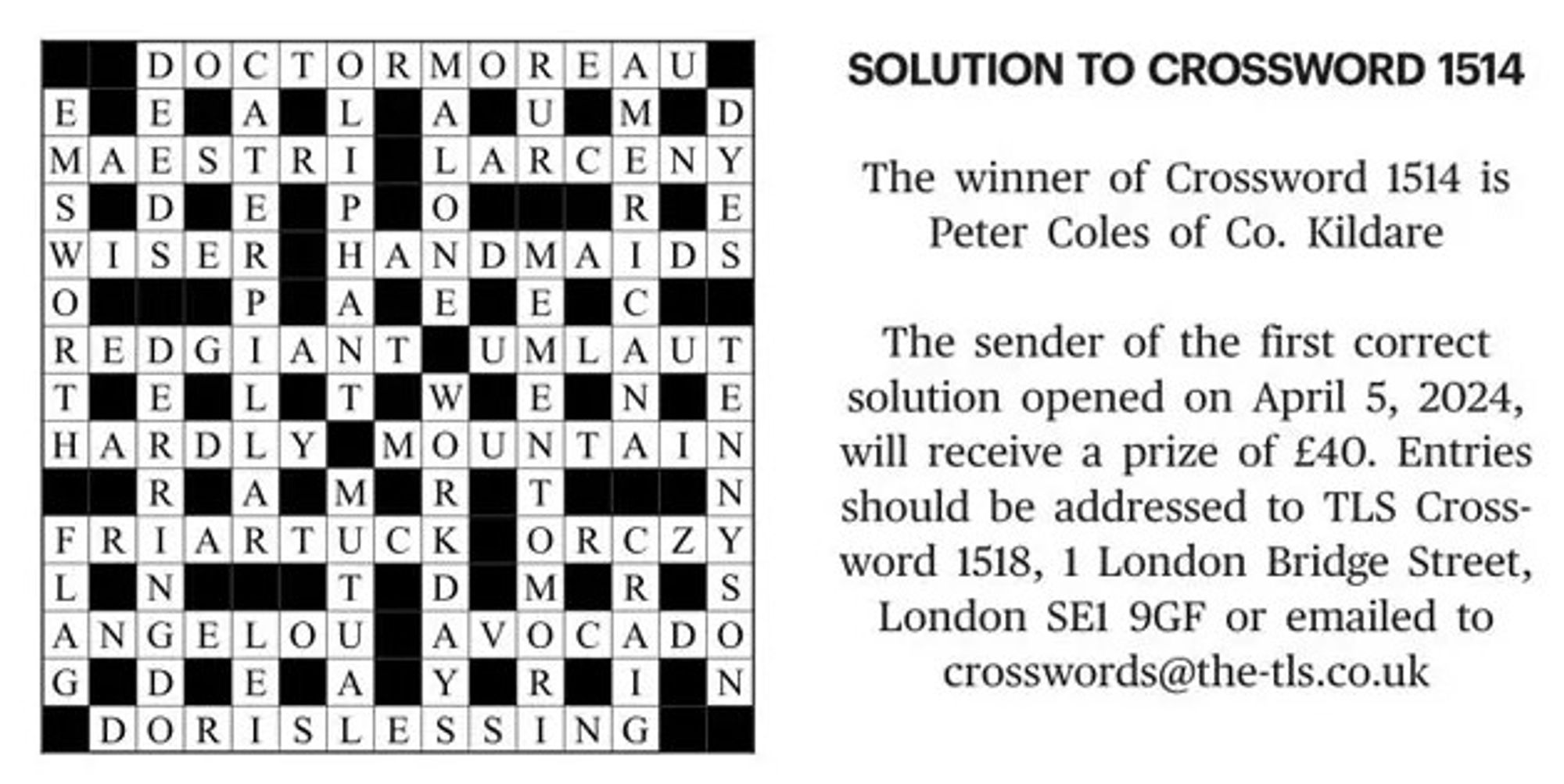
Anyway, I checked this week’s online edition and found this for proof:

I checked when I last won this competition, which I enter just about every week, and found that it was number 1514, almost exactly a year ago. There are 50 competitions per year rather than 52, because there are double issues at Christmas and in August, so it’s actually just over a year (51 puzzles) since I last won. I’ve won the crossword prize quite a few times but haven’t been very careful at keeping track of the dates. I think it’s been about once a year since I started entering.

All this suggested to me a little problem I devised when I was teaching probability and statistics many years ago:

Let’s assume that  the same number of correct entries, N, is submitted for each competition. The winner each time is drawn randomly from among these N. If there are 50 competitions in a year and I submit a correct answer each time, winning once in these 50 submissions, then what can I infer about N?

Answers on a postcard, via email, or, preferably, via the Comments!

Roger Penrose: Discoverer of Black Holes?

Posted in History, The Universe and Stuff with tags , , , , , , , , , on February 27, 2025 by telescoper

I got home from a busy day on campus to find the 21st February issue of the Times Literary Supplement had landed on my doormat having arrived today, 27th February. It used to take a couple of weeks for my subscription copy to reach Ireland but recently the service has improved. Intriguingly, the envelope it comes in is postmarked Bratislava…

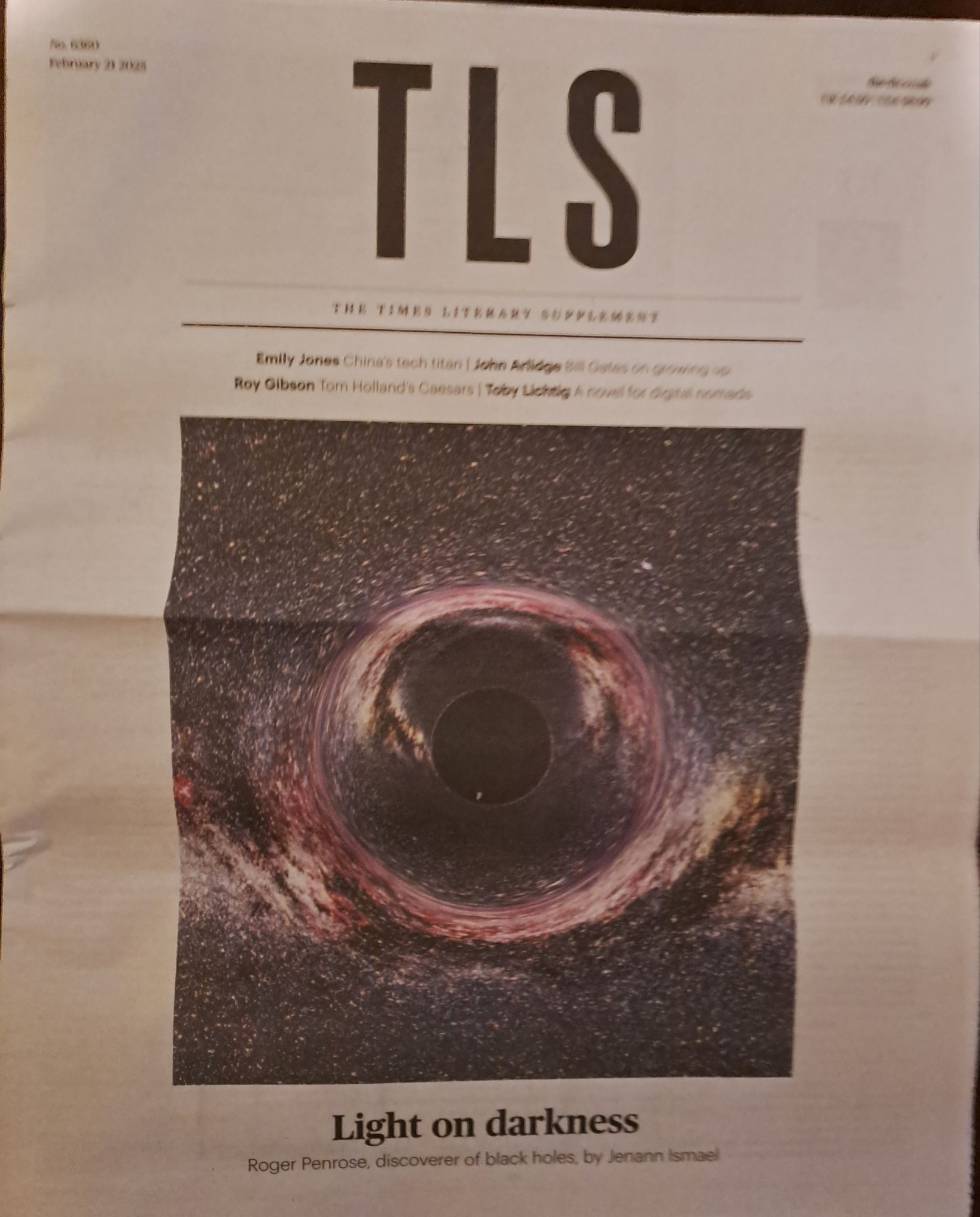
But I digress. This is the cover:

The text below the title “Light on darkness” under the graphic reads “Roger Penrose, discoverer of black holes, by Jennan Ismael”. Nice though it is to see science featured in the Times Literary Supplement for a change and much as I admire Roger Penrose, it is unreasonable to describe him as “the discoverer of black holes”.

A black hole represents a region of space-time where the action of gravity is sufficiently strong that light cannot escape. The idea that such a phenomenon might exist dates back to John Michell, an English clergyman, in 1783, and later by Pierre-Simon Laplace but black holes are most commonly associated with Einstein’s theory of general relativity.  Indeed, one of the first exact solutions of Einstein’s equations to be found describes such an object. The famous Schwarzschild solution was obtained in 1915 by Karl Schwarzschild, who died soon after on the Eastern front in the First World War. The solution corresponds to a spherically-symmetric distribution of matter, and it was originally intended that it could form the basis of a mathematical model for a star. It was soon realised, however that for an object of any mass M there is a critical radius (Rs, the Schwarzschild radius) such that if all the mass is squashed inside Rs then no light can escape.  In terms of the mass M, velocity of light c, and Newton’s constant G, the critical radius is given by Rs = 2GM/c2 . For the mass of the Earth, the critical radius is only 1cm, whereas for the Sun it is about 3km.

Since the pioneering work of Schwarzschild, research on black holes has been intense and other kinds of mathematical solutions have been obtained. For example, the Kerr solution describes a rotating black hole and  the Reissner -Nordstrom solution corresponds to  a black hole with an electric charge.  Various theorems have also been demonstrated relating to the so-called `no-hair’ conjecture: that black holes give very little outward sign of what is inside.

Some people felt that the Schwarzschild solution was physically unrealistic as it required a completely spherical object, but Roger Penrose showed mathematically that the existence of a trapped surface was a generic consequence of gravitational collapse, the result that won him the Nobel Prize in 2020. His work did much to convince scientists of the physical reality of black holes, and he deserved his Nobel Prize, but I don’t think it is fair to say he “discovered” them.

I would say that, as is the case for discoveries in many branches of science, there isn’t just one “discoverer” of black holes: there were important contributions by many people along the way.

P.S. If you want to limit the application of the word “discovery” to observations then I think that the discovery of black holes is down to Paul Murdin and Louise Webster who identified the first really plausible candidate for a black hole in Cygnus X-1, way back in 1971…

P.P.S. The term “Black Hole” was, as far as I know, coined by John Wheeler in 1967.

Roger Penrose is 93.

The IOAP Diamond Open Access Awards

Posted in Crosswords, Open Access with tags , , , on March 21, 2024 by telescoper

Before Christmas on this blog I mentioned the Irish Open Access Publishers inaugural Diamond Open Access awards. I nominated the Open Journal of Astrophysics in the 1st Category – Best Peer Reviewed Open Access Journal. I was also nominated in the 4th Category – Outstanding Contribution to the Open Access Publishing Field in Ireland. Neither nomination was successful.

In fact I was on my way back to Ireland from Arizona when the awards were announced at webinar on March 12th which I couldn’t attend because I was on my way back from Arizona then. The rules for the competition stated that “Nominees including winners notified by email on the 1st March, 2024”. Since I heard nothing at all by then (or indeed until the weekend before the official announcement) I made the (correct) inference that I was not in contention* and my presence was not required. I subsequently forgot about the awards until I was coincidentally reminded yesterday.

*Update: although I wasn’t informed by the organizers, and only found out indirectly on Saturday 23rd March, it seems I was given an honourable mention.

Anyway, here are the lucky winners:

The winner in Category 1 was Alphaville, a journal “about all aspects of film and screen media history, theory and criticism through multiple research methodologies and perspectives” which is based at University College Cork. This journal was founded in 2011, so has been going for far longer than the Open Journal of Astrophysics! Congratulations to them!

There was no winner in Category 2, Best Peer Reviewed Open Access Monograph.

The winner in Category 3, Best Open Educational Resource was the MTU Assignment Toolkit.

There were joint winners in Category 4: Yvonne Desmond of TU Dublin, and the team behind the journal SCENARIO, based at University College Cork. The latter journal is a trilingual journal “in the area of performative teaching, learning and research” which was founded in 2007, so has been going for even longer than the Category 1 Winner!

Congratulations to all the winners!

P.S. At least I had some consolation when I got back from the USA, in the form the Times Literary Supplement Crossword prize!

Desktop – John J. Ronan

Posted in Poetry with tags , , on March 14, 2024 by telescoper

I’m a bit jetlagged and have a busy day ahead, but fortunately I found this interesting and vaguely relevant poem in an old copy of the TLS last night, so will share it in lieu of a proper post.

On Bumfodder

Posted in Books, History with tags , , on June 21, 2019 by telescoper

It’s not quite the end of the week for me, as I am on duty all day tomorrow for the Summer Open Day at Maynooth University, but I thought I’d end the penultimate working day of this week with a post about a piece I read in the Times Literary Supplement a few weeks ago. I subscribe to this mainly for the crossword, but also because some of the reviews are extremely interesting.

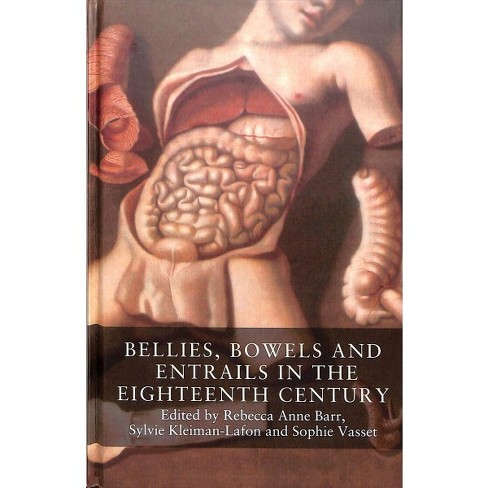
In the May 31st issue of said organ, I came across a review of a book charmingly entitled Bellies, bowels and entrails in the eighteenth century, which is published by Manchester University Press. I’m not planning to buy a copy as it costs £96, but it I was intrigued by the review, which includes such vivid insights as

Stomachs and bellies, hiccups and flatulence dominate the last third of the book…

The thing that really caught my attention however was the issue of toilet paper. As far as I am aware, paper in a form specifically designed for the use of wiping one’s bits clean after defecation wasn’t introduced until the middle of the 19th century, but waste paper was commonly used for that purpose much earlier. In the 18th century it was apparently commonplace to tear pages out of cheap books to use as lavatory tissue, and it appears some people would buy books both to read when on the job and for cleaning up afterwards.

This practice gave rise to the word bumfodder, which the Oxford English Dictionary defines as:

  1. Toilet paper. Also occasionally: a piece of this.

  2. attributive and allusively. Worthless or inferior literature; any written or printed material that is perceived as useless, tedious, or unnecessary.

In case you didn’t know, this is also the origin of the word bumf, which the OED gives as

  1. slang (originally in British public schools). Paper (of any kind). Now rare.

  2. Toilet paper. Now somewhat archaic.

  3. orig. Military slang. Written or printed material that is perceived as useless, tedious, or unnecessary, as bureaucratic paperwork, advertising, etc. Also occasionally: worthless or inferior literature.

I have to admit I’ve used the word `bumf’ in the third sense on a number of occasions without realizing quite how indelicate is its origin.

The first instances of `bumfodder’ quoted in the OED date from the mid-17th Century, which surprises me a little because I was under the impression that paper was an expensive commodity then. By the 18th century, however, it was obviously much cheaper, presumably because of mass production, and so consequently books and newspapers were much less expensive. Waste paper was then used quite frequently not only as toilet paper but also for wrapping groceries and other goods. I should mention, however, that paper was used at toilet tissue in China as far back as the 6th Century AD, so Europe was obviously a bit behind on the matter.

Anyone who has read any 18th Century literature – the humour in which is often rather coarse – will not be surprised by the number of scatalogical jokes about bumfodder going around. Obviously I couldn’t repeat any here.

P.S. Now wash your hands please.

‘Stephen Hawking RIP’ by Ella Baron

Posted in Art, The Universe and Stuff with tags , , on April 5, 2018 by telescoper

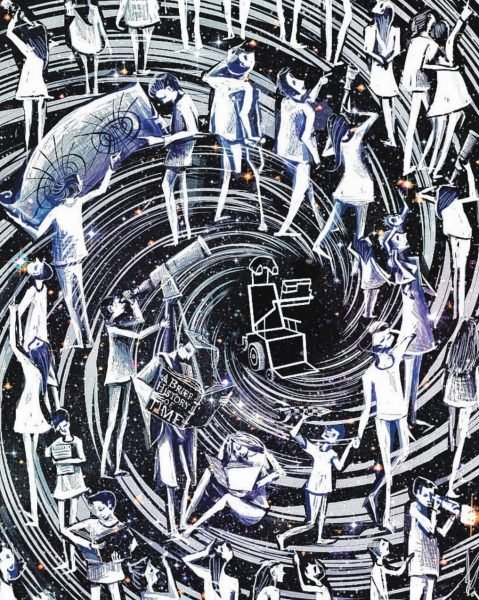
I just saw this lovely illustration (by Ella Baron) and thought I would share it here.

It appears in the March 23 of the Times Literary Supplement which arrived in Maynooth while I was away and I’ve just found time to read it. I subscribe to the TLS primarily because I like the crossword..

The ‘cartoon’ is accompanied by an excerpt from A Brief History of Time:

If a pulse of light is emitted… then as time goes on it will spread out… like ripples on the surface of a pond when a stone is thrown in…

Crossword Update

Posted in Crosswords with tags , , , , , on December 1, 2016 by telescoper

I haven’t posted anything for a while in the folder marked `Crosswords’ so here’s a quick update on the situation with respect to my adventures in the land of cruciverbalism.

This morning I received the latest issue of the Times Literary Supplement, and found this on the back page:

tls_winner

I like doing this crossword, as it involves an interesting mixture of literary references and more usual cryptic clues. Also, the prize is not a dictionary but a cheque for £40. I’ve actually won this weekly competition three times this year, which means I’ve netted £120 – more than enough to pay for the subscription. Since the TLS is also very interesting to read (once the crossword has been finished), this seems to be working out rather nicely!

I’ve had a couple of other wins recently. This set of dictionaries courtesy of the Everyman puzzle in the Observer:

dictionaries

And this pair of non-dictionaries courtesy of the Financial Times:

not_dictionaries

This good news aside however I must pass on some very distressing information. It is with great dismay at the accelerating decline of Western civilisation that I have to point out that I think there was a mistake in the latest Azed crossword (No. 2321). The clue at 21 down reads:

Remains of pyre – death of Cleo – packed with African timber? (7)

The checked lights give A-HHE-P, which strongly suggests ASH-HEAP (hyphens are not clued in Azed puzzles). The first part of the clue – `Remains of pyre’ – then parses as the definition. The cryptic part then comprises two parts: ‘death of Cleo’ (suggesting ASP) fits with ASHHEAP if ASP is `packed with African timber’, i.e. if a four-letter word meaning `African timber’ is included within ASP. I can’t find any such word HH-A, but SHEA is a kind of African tree. That, however, would give ASSHEAP which (as well as sounding a bit rude) does not fit with the definition or the checked light at 26 down (HEARTH, i.e. HEART+H).

I’m pretty sure, therefore, that this is a slip by the setter.

Academic Cruciverbalism

Posted in Biographical, Crosswords, Literature with tags , , , , , , , , , on May 10, 2016 by telescoper

The other day I came across something I’ve never seen before: an academic paper about cryptic crosswords. It’s in an open access journal so feel free to clock – it’s not behind a paywall. Anyway, the abstract reads:

This paper presents a relatively unexplored area of expertise research which focuses on the solving of British-style cryptic crossword puzzles. Unlike its American “straight-definition” counterparts, which are primarily semantically-cued retrieval tasks, the British cryptic crossword is an exercise in code-cracking detection work. Solvers learn to ignore the superficial “surface reading” of the clue, which is phrased to be deliberately misleading, and look instead for a grammatical set of coded instructions which, if executed precisely, will lead to the correct (and only) answer. Sample clues are set out to illustrate the task requirements and demands. Hypothesized aptitudes for the field might include high fluid intelligence, skill at quasi-algebraic puzzles, pattern matching, visuospatial manipulation, divergent thinking and breaking frame abilities. These skills are additional to the crystallized knowledge and word-retrieval demands which are also a feature of American crossword puzzles. The authors present results from an exploratory survey intended to identify the characteristics of the cryptic crossword solving population, and outline the impact of these results on the direction of their subsequent research. Survey results were strongly supportive of a number of hypothesized skill-sets and guided the selection of appropriate test content and research paradigms which formed the basis of an extensive research program to be reported elsewhere. The paper concludes by arguing the case for a more grounded approach to expertise studies, termed the Grounded Expertise Components Approach. In this, the design and scope of the empirical program flows from a detailed and objectively-based characterization of the research population at the very onset of the program.

I still spend quite a lot of my spare time solving these “British-style” cryptic crossword puzzles. In fact I simply can’t put a crossword down until I’ve solved all the clues, behaviour which I admit is bordering on the pathological. Still, I think of it as a kind of mental jogging, forcing your brain to work in unaccustomed ways is probably good to develop mental fitness for other more useful things. I won’t claim to have a “high fluid intelligence” or any other of the attributes described in the abstract, however. As a matter of fact I think in many ways cryptic crosswords are easier than the straight “American-style” definition puzzle. I’ll explain why shortly. I can’t remember when I first started doing cyptic crossword puzzles, or even how I learned to do them. But then people can learn languages simply by picking them up as they go along so that’s probably how I learned to do crosswords. Most people I know who don’t do cryptic crosswords tend to think of them like some sort of occult practice, although I’ve never actually been thrown off a plane for doing one!

If you’ve never done one of these puzzles before, you probably won’t understand the clues at all even if you know the answer and I can’t possibly explain them in a single post. In a nutshell, however, they involve clues that usually give two routes to the word to be entered in the crossword grid. One is a definition of the solution word and the other is a subsidiary cryptic allusion to it. Usually the main problem to be solved involves the identification of the primary definition and secondary cryptic part, which are usually heavily disguised. The reason why I think cryptic puzzles are in some ways easier than the “straight-definition” variety is that they provide two different routes to the solution rather than one definition. The difficulty is just learning to parse the clue and decide what each component means.

The secondary clue can be of many different types. The most straightforward just exploits multiple meanings. For example, take

Fleeces, things often ordered by men of rank [6]

The answer to this is RIFLES which is defined by “fleeces” in one sense, but “men of rank” (soldiers) also order their arms hence giving a different meaning. Other types include puns, riddles, anagrams, hidden words, and so on. Many of these involve an operative word or phrase instructing the solver to do something with the letters in the clue, e.g.

Port’s apt to make you steer it erratically [7]

has the solution TRIESTE, which is an anagram of STEER+IT, port being the definition.

Most compilers agree however that the very best type of clue is of the style known as “&lit” (short for “and literally what it says”). Such clues are very difficult to construct and are really beautiful when they work because both the definition and cryptic parts comprise the same words read in different ways. Here’s a simple example

The ultimate of turpitide in Lent [5]

which is FEAST. Here we have “e” as the last letter of turpitude in “fast” (lent) giving “feast” but a feast is exactly what the clue says too. Nice.

Some clues involve more than one element of this type and some defy further explanation altogether, but I hope this at least gives you a clue as to what is involved.

Cryptic crosswords like the ones you find in British newspapers were definitely invented in the United Kingdom, although the crossword itself was probably born in the USA. The first great compiler of the cryptic type used the pseudonym Torquemada in the Observer. During the 1930s such puzzles became increasingly popular with many newspapers, including famously The Times, developing their own distinctive style. People tend to assume that The Times crossword is the most difficult, but I’m not sure. I don’t actually buy that paper but whenever I’ve found one lying around I’ve never found the crossword particularly hard or, more importantly, particularly interesting.

With the demise of the Independent, source of many prize dictionaries, I have now returned to the Guardian and Observer puzzles at the weekend as well as the interesting mixture of cryptic and literary clues of the puzzle in the weekly Times Literary Supplement and the “Genius” puzzle in The Oldie. I’ve won both of these a few times, actually, including the TLS prize just last week (£40 cash).

I also like to do the bi-weekly crossword set by Cyclops in Private Eye which has clues which are not only clever but also laced with a liberal helping of lavatorial humour and topical commentary which is right up my street. Many of the answers (“lights” in crossword parlance) are quite rude, such as

Local energy source of stress for Bush [5]

which is PUBES (“pub” from “local”+ E for energy +S for “source of stress”; Bush is the definition).

I send off the answers to the Eye crossword every time but have never won it yet. That one has a cash prize of £100.

Anyway, Torquemada, who I mentioned above, was eventually followed as the Observer’s crossword compiler by the great Ximenes (real name D.S. Macnutt) who wrote a brilliant book called the Art of the Crossword which I heartily recommend if you want to learn more about the subject. One of the nice stories in his book concerns the fact that crossword puzzles of the cryptic type were actually used to select recruits for British Intelligence during the Second World War, but this had a flip side. In late May 1944 the chief crossword setter for the Daily Telegraph was paid a visit by some heavies from MI5. It turned out that in a recent puzzle he had used the words MULBERRY, PLUTO, NEPTUNE and OVERLORD all of which were highly confidential code words to be used for the forthcoming D-Day invasion. The full background to this curious story is given here.