This is a big weekend for fans of hurling, as we have reached the semi-final stage of the All Ireland Senior Hurling Championship. Yesterday Cork trounced Dublin by 7-26 to 2-21. I’ve never seen such a high scoring game at the top level, nor a margin as large as 20 points (a goal is worth 3 points)! Though not expected by many to progress, Dublin had deservedly beaten Limerick in the quarter-finals but they were never in the game yesterday.
The other semi-final takes place this afternoon at 4pm, and is between Kilkenny and Tipperary. Which of these will meet Cork in the Final? We’ll soon find out!
Update: it was another high scoring match, finishing Kilkenny 0-30 to Tipperary’s 4-20, so Tipperary won by 2 points (with a goal in the last minute). The All Ireland Final will therefore be between Cork and Tipperary.
Both semi-finals are held at Croke Park, as is the final. Many supporters come through Maynooth on their way to these matches, as we’re on the train line that goes into Dublin Connolly via Drumcondra (the nearest station to Croke Park). There is an arrangement by which supporters can park their cars at the GAA ground in Maynooth and take the train, as there is no chance of parking near Croke Park.
Yesterday evening I needed to do a quick trip to the shops and ran into a crowd of returning Cork supporters who had just arrived by train. Most fans were in very good humour (unsurprisingly) but a few were very much the worse for drink: one young lad had passed out on the footpath and concerned pedestrians called an ambulance; over the road at the bus terminus Gardaí were dealing with a drunk and aggressive person; and in Supervalu a hopelessly inebriated bloke staggered into the off-licence part to get more booze but ended up falling over and dropping the cans he had picked up, with one bursting and making a mess all over the floor.
Anyway, none of this is to do with the intended subject of this post. Cork’s victory yesterday reminded me of a little bit of hurling information that I found interesting, concerning the way to hold the hurley. Having been brought up on a different bat-and-ball game (cricket), I was surprised to learn that in hurling you are supposed to hold the bat the wrong way round! What I mean by that is that in cricket the batter holds the bat with the dominant hand at the bottom of the handle near the blade and the other hand at the top. For illustration, here’s a forward defensive shot played by a right-hander:
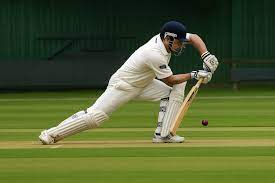
For illustration, on the left, there’s a forward defensive shot played by a right-hander. You can see the left hand at the top of the handle and the right hand near the bottom. Shots like this are played predominatly with the bat moving in a vertical plane, guided by the left hand with the right hand guiding the direction. A hook or pull shot is played with the same grip but swinging the bat across the body from right to left with more bottom hand.
When I was at school I tried batting left-handed in the nets. It was quite interesting. I found I could play defensive shots equally well that way as with my usual right-handed stance, but I couldn’t play attacking shots very well at all.
It’s the same arrangement in baseball (or rounders, as we call it on this side of the Atlantic). The batter will hold the bat with their weaker hand nearer the end of the handle, i.e. towards the thin end.
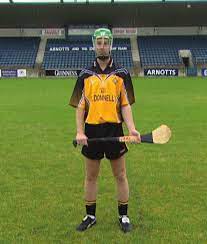
On the other hand (!), a hurler holds the hurley the other way round. On the right you can see a hurler at the ready position, with his right hand at the top of the handle and the left hand near the blade. When striking the sliotar (ball), the hands are moved closer together. Holding the end of the hurley in the dominant hand means that more strength can be applied when reaching away from the body with one hand, something that isn’t really done in cricket. The typical long-range strike of the sliotar is rather like a hook shot in cricket, except it’s played the opposite way across the body.
Here’s a video:
This seems very unnatural if you have been brought up to use the opposite basic grip, which explains why so many struggled even to hit the sliotar at the practice at the EAS Social Dinner in Cork a couple of weeks ago. In Ireland, however, kids learn to play hurling when they’re still in kindergarten so this is instilled at a very early age.


 In the Dark